Introduction
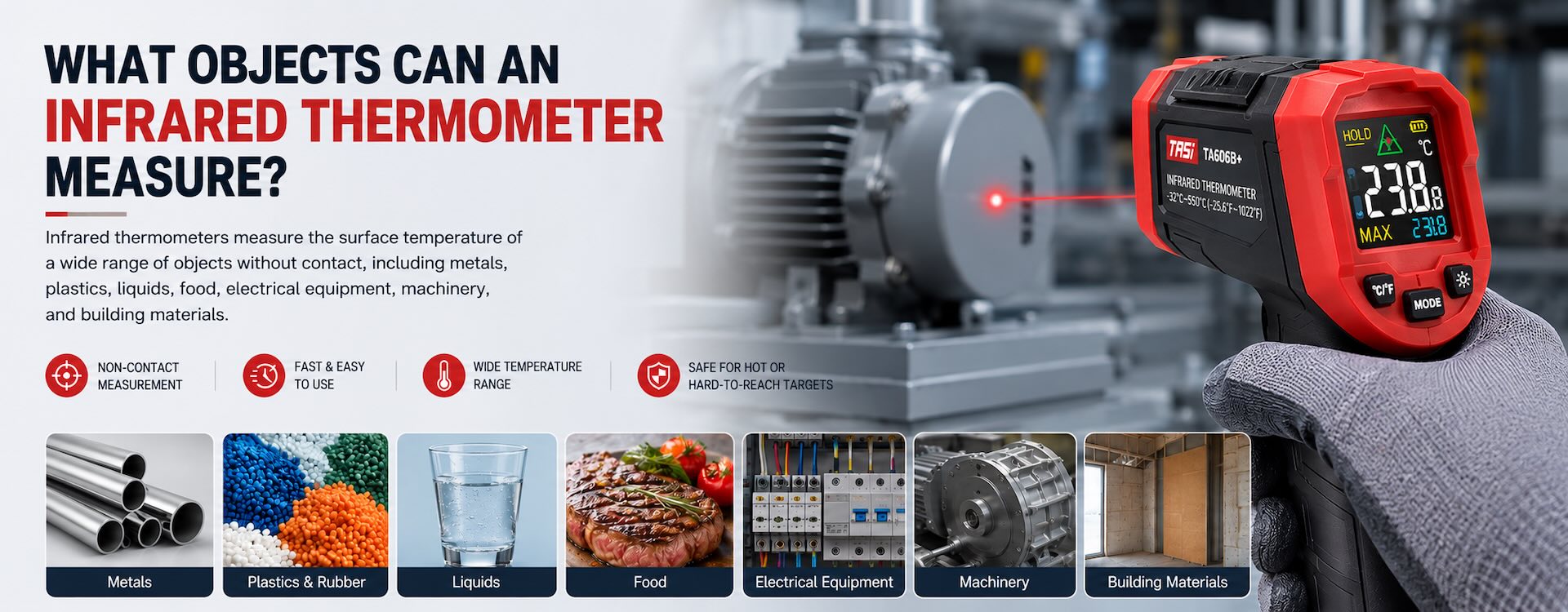
An infrared thermometer determines temperature by detecting infrared radiation emitted from an object's surface. As a result, most objects can be measured as long as they emit sufficient infrared radiation and their surface characteristics are suitable for infrared measurement.
From wood, plastics, and rubber to machinery, electrical components, food, and liquids, infrared thermometers can be used across a broad range of applications. However, being technically measurable does not mean that every material can be measured with the same level of accuracy.
Factors such as emissivity, surface finish, target size, measuring distance, viewing angle, and ambient conditions can all influence the reading.
Understanding how different materials behave during infrared measurement is therefore essential for obtaining reliable results.
Key Takeaways
● Infrared thermometers primarily measure surface temperature, not internal temperature.
● Wood, plastics, rubber, paper, textiles, painted surfaces, and other high-emissivity materials are generally easy to measure.
● Oxidized, painted, or rough metal surfaces are usually easier to measure than polished metal.
● Shiny stainless steel, aluminium, copper, and other low-emissivity metals can strongly reflect surrounding infrared radiation and require special attention to emissivity.
● Liquids can be measured at the surface, but infrared measurement does not directly indicate temperature at different depths.
● When measuring glass, the reading normally represents the glass surface rather than an object behind it.
● The target must adequately fill the instrument's measurement spot; otherwise, surrounding surfaces may affect the reading.
What Does an Infrared Thermometer Actually Measure?
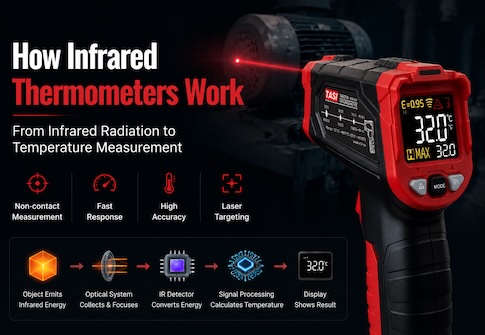
An infrared thermometer does not detect temperature inside an object. Its optical system collects infrared radiation from a defined area of the target surface. A detector then converts this radiation into an electrical signal, which is processed to calculate temperature.
For most handheld infrared thermometers, the displayed value should therefore be understood as:
The surface temperature of the measured area.
For example, when measuring a hot-water pipe, the instrument detects the temperature of the pipe's outer surface. When aimed at a cup of hot water, it measures the surface of the liquid. When measuring food, it detects the food's surface temperature rather than its internal or core temperature.
This makes infrared thermometers particularly suitable for fast screening, comparative measurements, moving objects, hot surfaces, and locations where contact measurement is inconvenient or unsafe.
Where internal temperature is required, a thermocouple, probe thermometer, or another suitable contact temperature sensor is generally necessary.
Which Common Materials Are Well Suited to Infrared Measurement?
Most non-metallic materials with relatively high emissivity are well suited to direct measurement with an infrared thermometer.
Typical examples include:
● Wood and wood products;
● Paper, cardboard, and packaging materials;
● Rubber and rubber products;
● Most plastics;
● Leather and textiles;
● Painted and coated surfaces;
● Concrete, cement, and brick;
● Stone, ceramics, and tiles;
● Soil and many building materials;
● Food surfaces;
● Ice and frozen surfaces.
These materials generally emit infrared radiation efficiently, allowing the thermometer to receive a relatively stable signal.
Nevertheless, the emissivity setting should always be selected according to the material, surface condition, and recommendations provided for the instrument.
Can an Infrared Thermometer Measure Metal?
Yes, but metals require more attention than many other materials.
The infrared characteristics of a metal surface can change significantly depending on its finish. The same metal may have very different emissivity values when oxidized, painted, roughened, or polished.
In general:
● Painted metal surfaces are relatively easy to measure;
● Oxidized or rough metal surfaces are usually easier to measure;
● Rusted metal is often easier to measure than highly polished metal;
● Shiny stainless steel, aluminium, and copper require particular caution;
● Mirror-like or highly polished metals are among the most challenging surfaces for infrared measurement.
Shiny metals usually have low emissivity and high infrared reflectivity. As a result, the thermometer may detect infrared energy reflected from nearby machinery, walls, people, or other hot and cold sources.
Where the thermometer allows emissivity adjustment, the setting should be matched to the material and surface condition.
If the test procedure permits the surface to be modified, a suitable high-emissivity reference area may also be used, provided that this is compatible with the application and relevant safety requirements.
Can Plastics and Rubber Be Measured?
Most plastics and rubber materials can be measured effectively with an infrared thermometer. Infrared measurement is therefore widely used in plastics processing, injection moulding, rubber manufacturing, and production inspection.
Typical targets include:
● Plastic housings;
● Plastic pipes;
● Injection-moulded parts;
● Rubber conveyor belts;
● Rubber rollers;
● Tyre surfaces;
● Seals and gaskets;
● Plastic films and materials used in production lines.
However, different polymers can have different infrared characteristics. Colour, thickness, transparency, and surface finish may also influence the measurement.
Transparent or semi-transparent plastics may require additional care because the result can be affected by material thickness, spectral properties, and radiation from objects behind the material.
Can Wood, Paper, and Textiles Be Measured?
Yes. These materials generally have relatively high emissivity and are therefore among the easier targets for infrared measurement.
Applications include checking the surface temperature of:
● Timber and wooden products;
● Paper and paper rolls;
● Cardboard and packaging;
● Fabrics and textiles;
● Leather products;
● Materials near wood-drying or processing equipment.
If a material is wet, laminated, coated, or covered with another surface layer, its effective emissivity may change and should be considered when interpreting the reading.
Can an Infrared Thermometer Measure Liquid Temperature?
Yes, but it measures the surface temperature of the liquid.
Typical examples include:
● Water;
● Cooking oil;
● Coolant;
● Cleaning fluids;
● Industrial process liquids;
● Certain chemical liquids.
An infrared thermometer detects radiation from the upper surface of the liquid. The displayed value therefore should not automatically be considered representative of the temperature throughout the container.
If significant thermal stratification exists, the surface may be cooler or warmer than the liquid at greater depth.
Where process conditions allow, mixing the liquid before measurement can provide a more representative surface reading.
Steam, heavy vapour, condensation, or other material between the thermometer and the liquid surface should also be avoided because it can interfere with the infrared measurement path.
Can Food Temperature Be Measured?
Yes. Infrared thermometers are frequently used for rapid temperature screening in food storage, cold-chain operations, kitchens, and food processing.
Typical applications include checking:
● Chilled or frozen food surfaces;
● Meat surfaces;
● Bread and baked products;
● Cooking oil;
● Beverages and liquid food surfaces;
● Food packaging;
● Refrigeration and heating equipment surfaces.
However, infrared measurement still provides only the surface temperature.
For example, the outer surface of food removed from an oven may be considerably hotter than its centre. When a food-safety procedure or process specification requires core temperature, an appropriate penetration or probe thermometer should be used.
Can Glass Be Measured?
Yes, the surface temperature of glass can be measured, but one common misunderstanding should be avoided:
A standard handheld infrared thermometer generally cannot measure an object through ordinary glass in the same way that visible light passes through it.
Many infrared thermometers operate within wavelength ranges in which ordinary glass is not transparent.
Therefore, when the instrument is pointed at a window, the reading will normally correspond mainly to the glass surface rather than the temperature of an object behind the glass.
Whenever possible, the infrared thermometer should have a direct, unobstructed line of sight to the target surface.
Can Electrical Equipment Be Measured?
Yes. Electrical inspection is one of the most common applications for infrared thermometers.
Subject to appropriate electrical safety procedures, typical targets include:
● Electrical cabinet components;
● Circuit-breaker housings;
● Terminals and connections;
● Cables and cable joints;
● Switches;
● Relays;
● Transformer housings;
● Power supplies;
● Electrical connection points.
Infrared measurement is useful for comparing similar components and identifying abnormal hot spots.
However, bare copper busbars, polished terminals, and other shiny conductive surfaces often have low emissivity. Their apparent infrared temperature may therefore differ substantially from the actual surface temperature if emissivity and reflected radiation are not properly considered.
For reliable condition monitoring, measurements should also take account of electrical load, ambient temperature, equipment configuration, and temperature differences between comparable components.
Can Machinery Be Measured?
Yes. Infrared thermometers are particularly useful for maintenance because they can check hot, moving, or difficult-to-access surfaces without physical contact.
Typical targets include:
● Motor housings;
● Bearing housings;
● Gearboxes;
● Compressors;
● Pump bodies;
● Hydraulic equipment;
● Pipes;
● Heating equipment;
● Conveyor systems;
● Engine and machinery surfaces.
Recording temperatures at the same locations over time can help identify abnormal trends.
For example, a persistent temperature increase around a bearing housing may indicate a lubrication problem, excessive loading, misalignment, or mechanical wear and may warrant further inspection.
Can HVAC and Building Surfaces Be Measured?
Yes. Infrared thermometers are widely used in HVAC servicing, building maintenance, and facility management.
Typical targets include:
● Air-conditioning supply and return grilles;
● Heating pipes;
● Hot- and cold-water pipes;
● Radiators;
● Boiler housings;
● Refrigeration equipment surfaces;
● Walls;
● Floors;
● Ceilings;
● Doors and windows;
● Insulation materials.
Comparing surface temperatures across different locations can help identify temperature imbalance, insulation problems, or abnormal equipment operation.
An infrared thermometer measures surface radiation and is not designed to directly measure ambient air temperature. Air temperature should be measured using an appropriate air-temperature probe, thermometer, or temperature/humidity instrument.
Which Objects Are More Difficult to Measure Accurately?
Although infrared thermometers can be used on a wide range of objects, the following targets require additional care:
● Shiny metals: Polished stainless steel, aluminium, copper, and similar surfaces have low emissivity and high reflectivity.
● Mirror-like surfaces: Reflected infrared radiation may dominate the signal received by the instrument.
● Transparent or semi-transparent materials: Results can be influenced by material transmission properties and background radiation.
● Very small targets: If the target does not completely fill the measurement spot, surrounding surfaces can influence the reading.
● Targets obscured by steam, smoke, or dust: Material in the optical path can attenuate or distort infrared radiation.
● Rapidly changing targets: Instrument response time and target temperature changes must both be considered.
● Targets outside the instrument's specified range: A temperature reading cannot be considered valid if the target exceeds the measurement range.
Whether a target is suitable for infrared measurement therefore depends not only on its material, but also on surface condition, target size, distance, environment, and instrument specification.
Why Can Measurements of the Same Object Sometimes Differ Significantly?
Infrared measurements are influenced by more than the object's actual temperature.
Important factors include:
● Correct emissivity setting;
● Whether the surface is painted, oxidized, polished, wet, or coated;
● Distance between the thermometer and the target;
● Whether the target fully covers the measurement spot;
● Measurement angle;
● Reflections from nearby hot or cold objects;
● Dust, oil, moisture, or condensation on the optical lens;
● Smoke, steam, or heavy airborne particles in the measurement path;
● Operation within the thermometer's specified ambient and measurement-temperature ranges.
For repeatable industrial measurements and condition trending, measurement position, distance, viewing angle, and emissivity settings should be kept as consistent as possible.
What Should Be Considered When Measuring Different Objects?
First confirm that the target temperature is within the instrument's specified measurement range. Then determine whether the target material and surface condition are compatible with the selected emissivity setting.
During measurement:
● Aim as perpendicular to the surface as practical and avoid excessive viewing angles;
● Use the instrument's D:S ratio to select a suitable measuring distance;
● Ensure the target is large enough to fully cover the measurement spot;
● Pay particular attention to emissivity and reflection when measuring low-emissivity metals;
● Do not attempt to measure an object through ordinary glass;
● Distinguish between surface temperature and internal temperature when measuring food or liquids;
● Avoid heavy steam, smoke, or dust in the optical path;
● Do not assume that the size of the laser dot represents the actual measurement area.
The laser is primarily an aiming aid. The actual infrared measurement spot has a defined diameter that normally increases as the measuring distance increases.
FAQ
Can an infrared thermometer measure every type of object?
Most objects emit infrared radiation, but not every surface can be measured with the same accuracy. Shiny metals, mirror-like materials, and some transparent materials require particular attention to emissivity and reflected radiation.
Can an infrared thermometer measure water temperature?
It can measure the temperature of the water surface. It does not directly measure water temperature at different depths. A contact temperature probe should be used when internal liquid temperature is required.
Can a standard infrared thermometer measure human body temperature?
A device specifically designed and validated for body-temperature measurement should be used. General-purpose industrial infrared thermometers are intended primarily for surface temperature measurement and should not be treated as substitutes for medical or dedicated body-temperature instruments.
Can an infrared thermometer measure through glass?
A standard handheld infrared thermometer normally measures the surface of the glass rather than an object behind it. Direct measurement without the glass barrier is therefore recommended.
Why are readings unstable on shiny stainless steel?
Shiny stainless steel has low emissivity and strongly reflects infrared radiation from its surroundings. Incorrect emissivity settings or nearby hot and cold objects can therefore cause significant measurement errors.
Can an infrared thermometer measure air temperature?
Not directly. Standard infrared thermometers measure infrared radiation from surfaces. Ambient air temperature should be measured with an appropriate air-temperature sensor.
Does the thermometer measure only where the laser dot is pointing?
No. The laser is usually only an aiming reference. The actual infrared measurement area is larger and depends on the instrument's D:S ratio and measuring distance.
Can moving objects be measured?
Yes, provided that the target is large enough and that its speed is compatible with the thermometer's response time. Non-contact measurement is particularly useful for moving surfaces that are difficult to measure with contact sensors.
Summary
Infrared thermometers can measure the surface temperature of a wide range of materials and objects, including wood, plastics, rubber, paper, textiles, building materials, metals, liquids, food, electrical components, machinery, and HVAC equipment.
The key question is not simply whether a particular object can be measured, but whether its surface radiation characteristics are suitable for the measurement conditions.
High-emissivity surfaces of sufficient size are generally straightforward to measure. Shiny metals, mirror-like surfaces, glass, transparent materials, and small targets require greater attention to emissivity, reflected radiation, measurement distance, and spot size.
Understanding that an infrared thermometer measures surface temperature and adapting the measurement method to the target material and environment are essential for obtaining reliable non-contact temperature readings.