Introduction
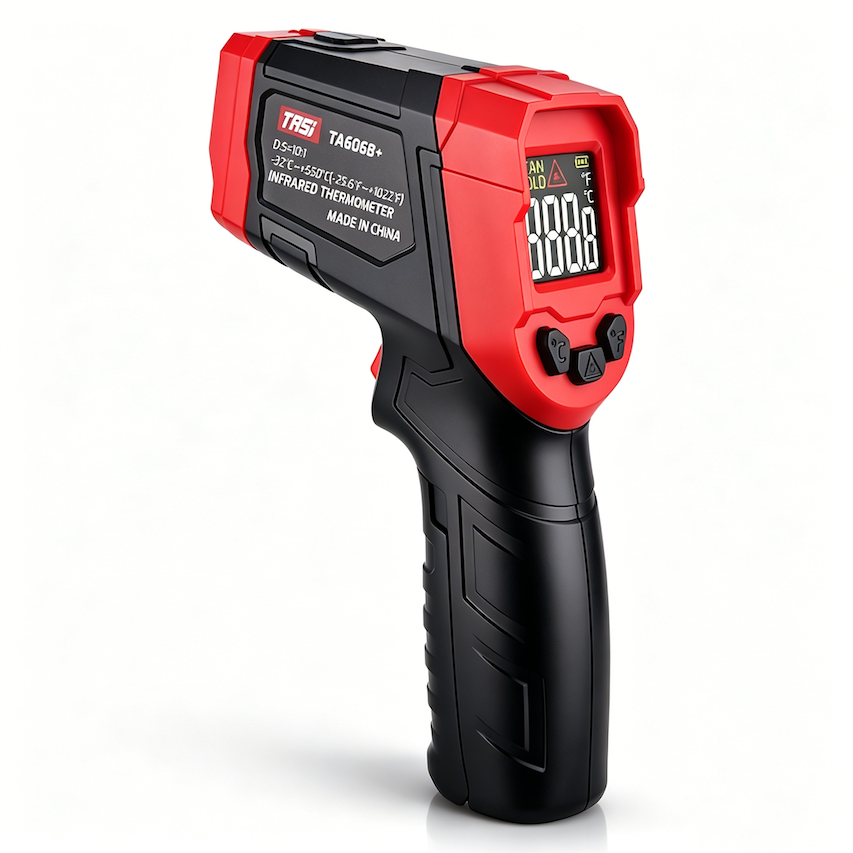
Infrared thermometer specifications often include values such as D:S 12:1, 30:1, or 50:1. D:S stands for Distance-to-Spot Ratio and describes the relationship between the distance to the target and the diameter of the measurement spot.
D:S is not a temperature range specification and does not directly indicate measurement accuracy. Instead, it describes the optical resolution of an infrared thermometer. Understanding this specification is particularly important when measuring small components, distant equipment, or high-temperature targets.
If the measurement distance is too great, the measurement spot may become larger than the target. In this case, the thermometer may receive infrared radiation from both the intended target and surrounding surfaces, causing the displayed temperature to differ from the actual surface temperature of the target.
Key Points
● D:S represents the ratio between measurement distance (D) and measurement spot diameter (S).
● A higher D:S ratio generally allows smaller targets to be measured from the same distance.
● As measurement distance increases, the measurement spot also becomes larger.
● The target should fully cover the measurement spot, preferably with additional margin.
● The laser pointer is primarily an aiming aid and does not represent the actual infrared measurement area.
● D:S describes optical performance and should not be interpreted as a direct indication of temperature measurement accuracy.
What Is the D:S Ratio of an Infrared Thermometer?
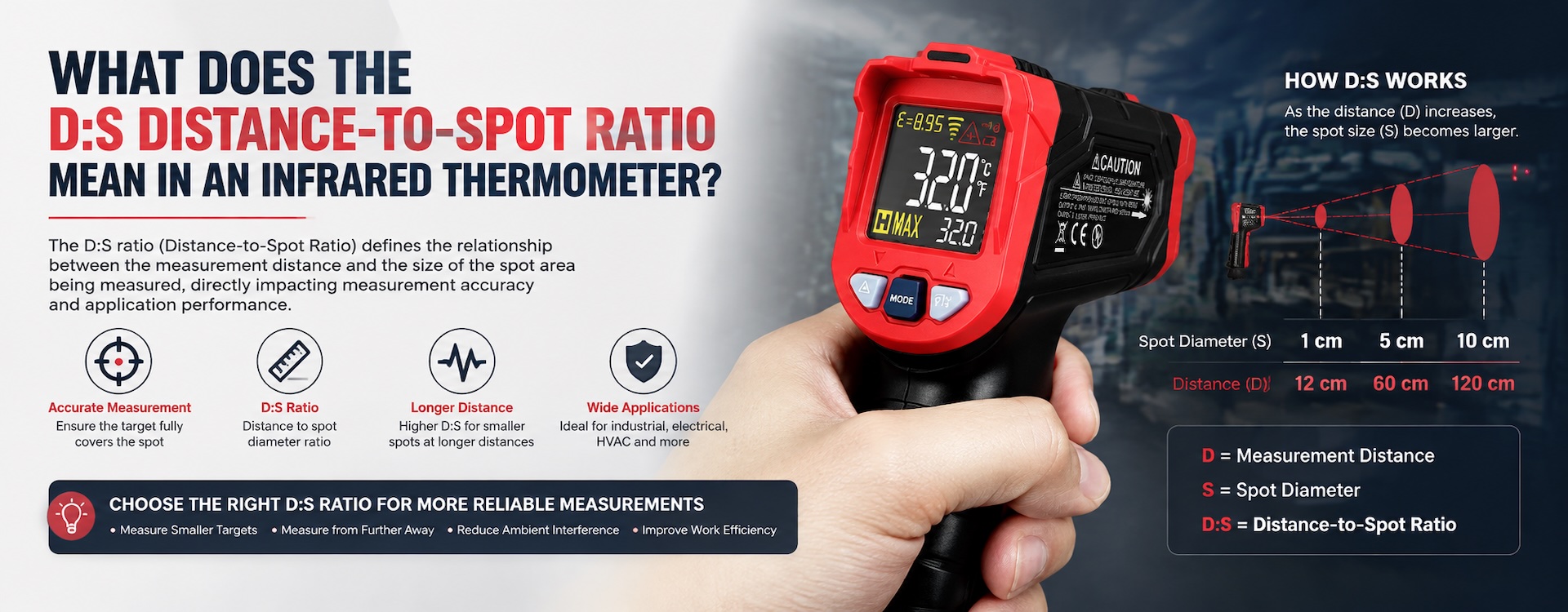
D:S stands for Distance-to-Spot Ratio, where D represents the measurement distance and S represents the measurement spot diameter.
In simple terms, D:S tells the user approximately how large an area the infrared thermometer detects when it is positioned at a given distance from the target.
For example, an infrared thermometer rated at D:S 12:1 can be understood approximately as follows:
● At a distance of 12 cm, the theoretical spot diameter is approximately 1 cm.
● At a distance of 60 cm, the theoretical spot diameter is approximately 5 cm.
● At a distance of 120 cm, the theoretical spot diameter is approximately 10 cm.
This means that as the distance from the target increases, the area covered by the thermometer also increases.
The exact optical characteristics may vary between products. Always refer to the manufacturer's D:S specification and optical diagram for the actual spot size.
Why Is Measurement Spot Size Important?
An infrared thermometer does not measure only the tiny location indicated by the laser dot. Instead, it receives infrared radiation emitted from a defined area of the target surface and calculates the temperature from the detected radiant energy.
This area is known as the measurement spot.
Target Larger Than the Measurement Spot
When the target fully covers the measurement spot, most of the infrared radiation detected by the sensor originates from the intended target. The resulting temperature reading is therefore more representative of that surface.
Target Smaller Than the Measurement Spot
If the target is smaller than the measurement spot, the thermometer may also detect radiation from surrounding walls, equipment, air outlets, or other surfaces.
For example, if an electronic component is 2 cm in diameter but the measurement spot at the selected distance is already 5 cm, the reading may include temperature information from the area surrounding the component.
This is why users should either move closer to small targets or select an infrared thermometer with a higher D:S ratio.
How Is the D:S Ratio Calculated?
For infrared thermometers whose optical characteristics can be approximated using a linear D:S relationship, the following calculations can be used as a practical reference.
Calculating Spot Diameter
S ≈ D ÷ D:S ratio
For example, with a D:S ratio of 12:1 at a measurement distance of 120 cm:
120 cm ÷ 12 ≈ 10 cm
The theoretical measurement spot diameter is therefore approximately 10 cm.
Calculating Measurement Distance
D ≈ S × D:S ratio
For example, if the target is approximately 5 cm in diameter and the infrared thermometer has a D:S ratio of 20:1:
5 cm × 20 ≈ 100 cm
The corresponding theoretical measurement distance is approximately 100 cm.
In practical applications, however, the target should not merely match the theoretical spot diameter. To minimize the influence of surrounding surfaces, the target should be noticeably larger than the measurement spot.
What Is the Difference Between 12:1, 30:1, and 50:1?
Different D:S ratios primarily indicate different spot sizes at the same measurement distance.
At a Measurement Distance of 120 cm
● D:S 12:1: theoretical spot diameter approximately 10 cm.
● D:S 30:1: theoretical spot diameter approximately 4 cm.
● D:S 50:1: theoretical spot diameter approximately 2.4 cm.
At the same distance, a higher D:S ratio generally produces a smaller measurement spot, making it more suitable for smaller or more distant targets.
Conversely, when measuring targets of the same size, an infrared thermometer with a higher D:S ratio can generally be used from farther away.
This can be particularly useful when inspecting hot equipment, rotating machinery, energized electrical equipment, or other targets that are difficult or unsafe to approach closely.
Does a Higher D:S Ratio Mean Greater Accuracy?
Not necessarily.
D:S primarily describes the optical resolution of an infrared thermometer. Temperature measurement accuracy depends on factors such as the infrared sensor, optical system, calibration, signal processing, and measurement conditions.
For example, if one infrared thermometer has a D:S ratio of 12:1 and another has a ratio of 50:1, the 50:1 model cannot automatically be considered more accurate based on D:S alone.
Other factors affecting measurement results include:
● Instrument accuracy specifications.
● Emissivity of the target material.
● Correct emissivity setting.
● Target size and surface condition.
● Measurement distance and spot size.
● Ambient temperature and reflected radiation.
● Steam, smoke, dust, or transparent media in the measurement path.
● Significant temperature differences between the instrument and its environment.
D:S should therefore be considered together with accuracy, emissivity, temperature range, and other specifications rather than used as a standalone measure of accuracy.
What Is the Difference Between D:S and Laser Targeting?
This is a common source of misunderstanding when using infrared thermometers.
Most handheld infrared thermometers include a laser aiming function, but the laser is primarily intended to help the user identify where the instrument is pointing.
● The laser dot is an aiming reference.
● D:S determines the approximate area from which the infrared sensor receives radiation.
● The diameter of the laser dot normally does not represent the actual measurement spot diameter.
● A single laser generally indicates the approximate center of the measurement area.
● Dual-laser systems may assist in identifying the measurement area, depending on the instrument design.
Therefore, a laser dot falling on the target does not mean that the thermometer measures only that point.
When measuring small targets, users must still consider both D:S and measurement distance to ensure that the target fully covers the measurement spot.
How to Select the Right D:S Ratio for the Target Size
The two most important factors when selecting a D:S ratio are target size and actual working distance.
Large Targets at Short Distances
For air-conditioning outlets, large machine housings, walls, or general equipment surfaces, the measurement distance is usually short and the target area is relatively large. A very high D:S ratio is generally unnecessary.
Routine Industrial Equipment Inspection
For motors, bearing housings, electrical distribution equipment, and HVAC components, a medium D:S ratio can provide a practical balance between working distance and spot size.
Small Targets at Longer Distances
For small electrical components, pipes, connection points, or machinery located farther away, a higher D:S ratio helps maintain a smaller measurement spot at greater distances.
High-Temperature or Difficult-to-Reach Targets
For hot equipment, moving machinery, or applications that require a safe working distance, a higher D:S ratio can reduce the need to approach the target closely. The target must still be large enough to cover the measurement spot.
A higher D:S ratio is therefore not automatically the best choice for every application. Selection should be based on actual working distance and target dimensions.
Common Mistakes When Using D:S
Treating the Laser Dot as the Measurement Spot
The laser is only an aiming aid and does not mean that the infrared sensor measures only the laser dot.
Measuring from Too Far Away
As distance increases, the measurement spot becomes larger. If the target does not fully cover the spot, surrounding temperatures may influence the reading.
Considering D:S but Ignoring Target Size
Even with a high D:S ratio, an extremely small target or excessive measurement distance can still result in unreliable readings.
Assuming a Higher D:S Ratio Means Higher Accuracy
D:S describes optical resolution, not the temperature accuracy specification of the instrument.
Using the Theoretical Spot Size as an Exact Target Boundary
Theoretical calculations are useful for estimating spot size, but the target should ideally be noticeably larger than the calculated measurement spot.
How to Use D:S Correctly in Infrared Temperature Measurement
For practical measurements, follow these principles:
● Estimate the size of the target first.
● Check the infrared thermometer's D:S specification or optical diagram.
● Determine an appropriate measurement distance based on target size.
● Ensure the target is clearly larger than the measurement spot.
● Reduce the measurement distance when measuring small targets.
● Do not estimate the measurement area solely from the laser dot.
● When measuring reflective or low-emissivity materials, set the emissivity correctly.
● For critical measurements, follow the manufacturer's optical specifications and operating instructions.
Correct use of D:S can reduce errors caused by improper target coverage, but it does not replace correct emissivity settings, suitable environmental conditions, or proper measurement technique.
FAQ
What does D:S 12:1 mean?
● D:S 12:1 means that the ratio between measurement distance and theoretical spot diameter is approximately 12:1. At a distance of about 120 cm, for example, the theoretical spot diameter is approximately 10 cm. Always refer to the product's optical specifications for exact values.
Is a higher D:S ratio always better?
● No. A higher D:S ratio is more suitable for small targets or longer measurement distances, while close-range measurement of large surfaces may not require a high D:S ratio.
Does D:S affect infrared thermometer accuracy?
● D:S itself is not an accuracy specification. However, if the measurement spot is larger than the target, surrounding surfaces may influence the temperature reading.
Is the laser dot the actual measurement point?
● No. The laser is primarily an aiming aid. The infrared sensor measures radiation from an area rather than only the laser dot.
Does measuring closer always improve accuracy?
● A shorter distance reduces spot size and can be beneficial when measuring small targets, but overall accuracy also depends on emissivity, instrument specifications, environmental conditions, and target surface characteristics.
How can I determine the spot size at a given distance?
● The D:S ratio can be used for an approximate calculation, but the manufacturer's optical resolution specifications or distance-to-spot diagram should be used as the primary reference.
Summary
The D:S ratio of an infrared thermometer describes the relationship between measurement distance and measurement spot diameter and is an important optical parameter for determining whether a target can be measured effectively from a given distance.
A higher D:S ratio generally produces a smaller spot at the same distance, making it more suitable for small or distant targets. However, D:S is not the same as temperature accuracy, and a higher value is not necessarily better for every application.
For reliable non-contact temperature measurement, users should consider target size, working distance, and D:S together and ensure that the target fully covers the measurement area. Proper emissivity settings, suitable environmental conditions, and the instrument's specified accuracy must also be taken into account.