Introduction
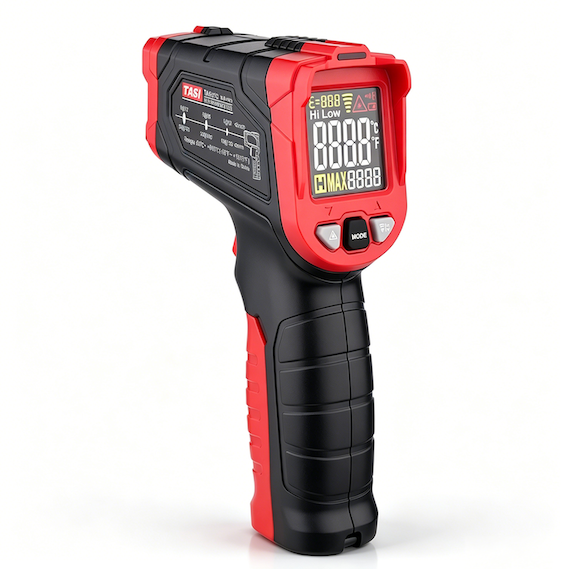
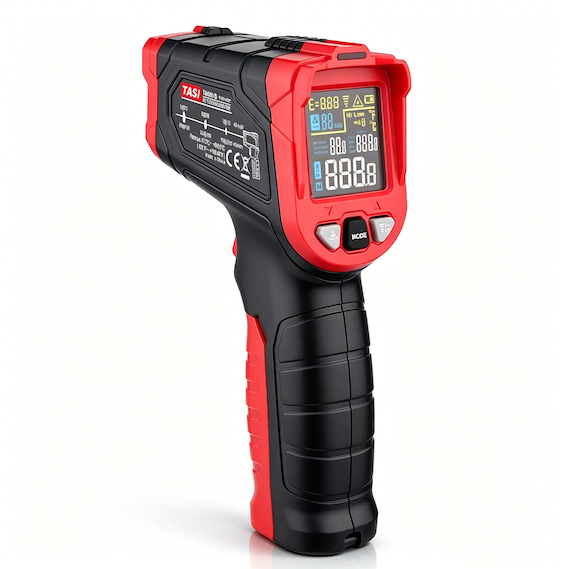
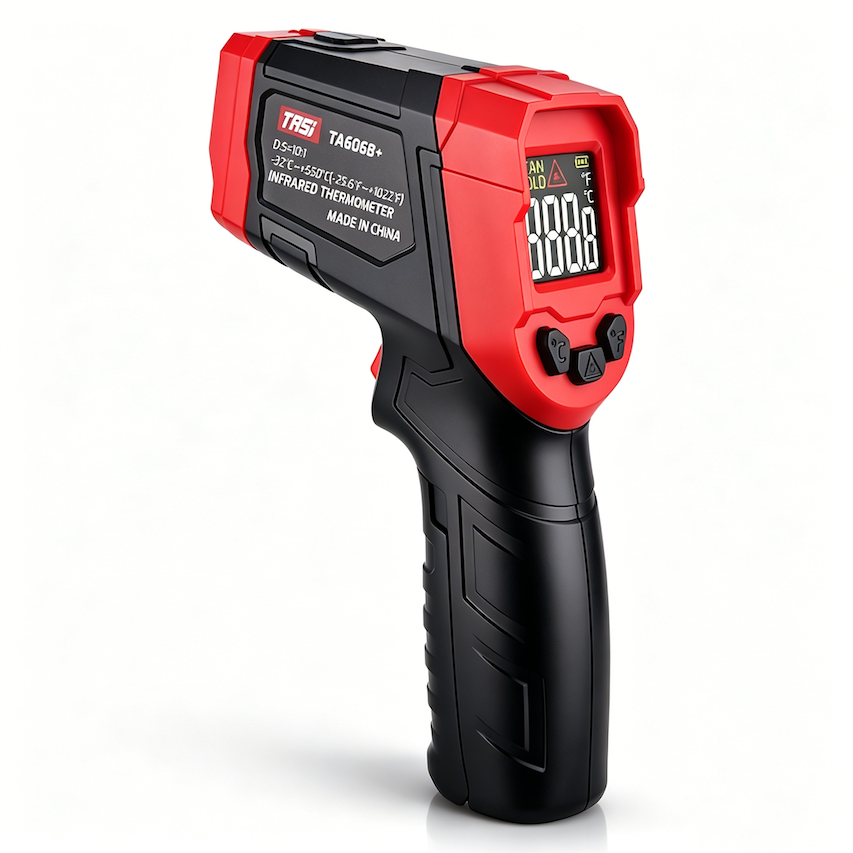
Infrared thermometers are widely used in industrial inspection, electrical maintenance, HVAC systems, automotive repair, food processing, laboratory testing, and other applications due to their fast response, non-contact measurement capability, and convenient operation.
However, some users may find that the measured temperature differs significantly from the actual temperature during use. In most cases, this does not indicate a device failure. Measurement errors are often caused by incorrect parameter settings, unsuitable measurement conditions, target surface characteristics, or improper operation.
Understanding the factors that affect infrared temperature measurement accuracy and using the instrument correctly are essential for obtaining reliable measurement results.
Key Points
● Inaccurate infrared thermometer readings are usually related to emissivity settings, measuring distance, target surface characteristics, and environmental conditions;
● Different materials emit infrared energy differently, so the correct emissivity value must be selected;
● Excessive measuring distance, incorrect target size, or unsuitable field of view can cause measurement deviations;
● Proper operation and regular calibration can significantly improve infrared temperature measurement reliability.
Common Causes of Inaccurate Infrared Thermometer Readings
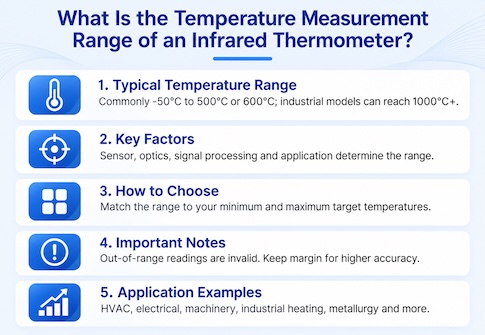
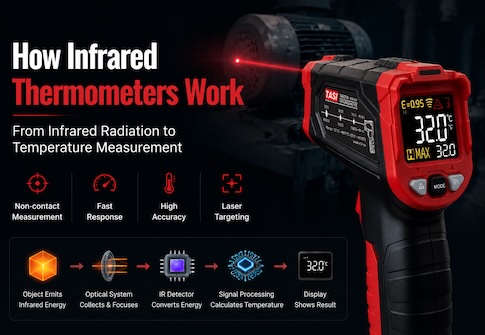
Infrared thermometers measure temperature by detecting infrared radiation emitted from an object’s surface and converting the received energy into a temperature value. Any factor affecting infrared radiation emission, transmission, or detection may introduce measurement errors.
Common causes include:
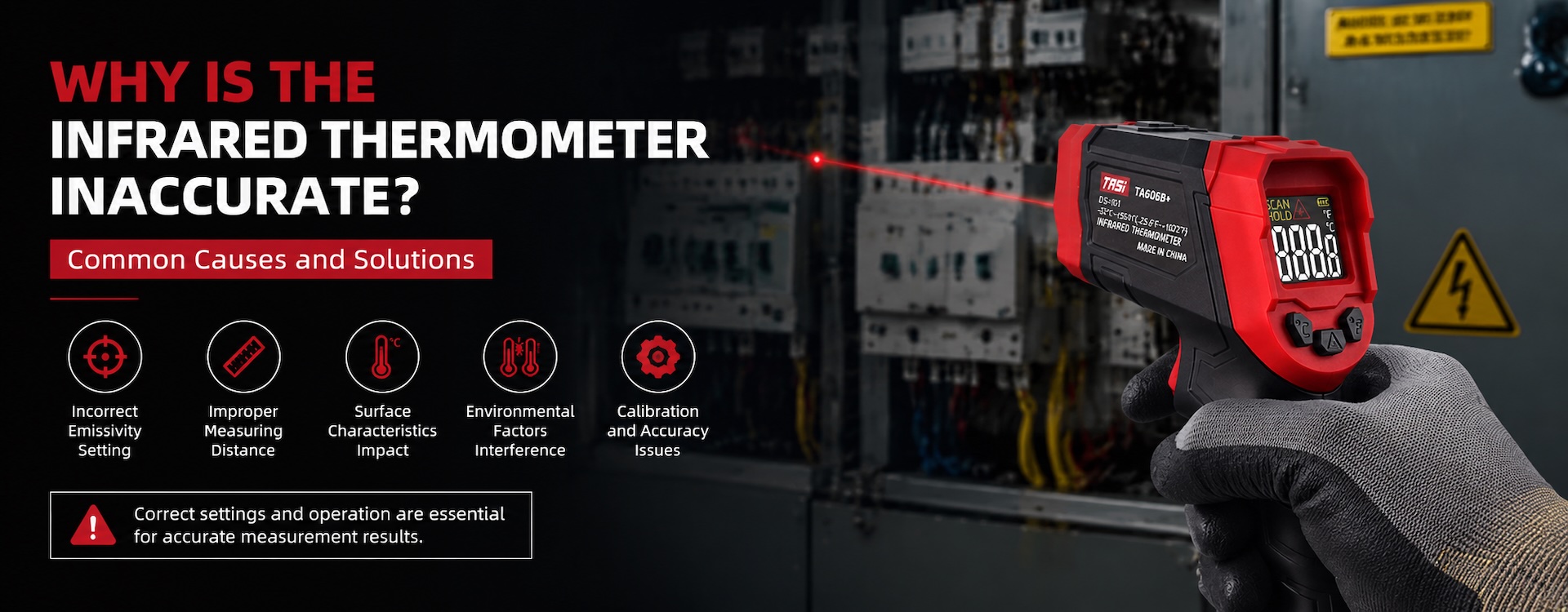
● Incorrect emissivity settings;
● Improper measuring distance or target size;
● Surface characteristics of the measured object;
● Environmental temperature, humidity, and airflow;
● Incorrect measuring angle or operation method;
● Instrument accuracy and calibration condition.
Incorrect Emissivity Settings Cause Measurement Errors
Emissivity is one of the most important factors affecting infrared temperature measurement accuracy.
Different materials have different abilities to emit infrared radiation. Materials such as metals, plastics, glass, and ceramics have different emissivity values. If the emissivity setting of the infrared thermometer does not match the actual material surface, the instrument will calculate temperature based on incorrect parameters, resulting in inaccurate readings.
For example:
● Black matte surfaces usually have high emissivity and can be measured with better accuracy;
● Polished metals and reflective stainless steel surfaces may produce significant errors if emissivity is not adjusted correctly;
● For unknown materials, users can refer to emissivity tables or compare measurements with a contact thermometer.
Correct emissivity adjustment is essential when measuring different materials.
Measuring Distance Affects Accuracy
Infrared thermometers usually have a distance-to-spot ratio (D:S), which defines the relationship between measuring distance and the size of the measurement area.
For example, a thermometer with a 12:1 D:S ratio can measure an approximately 1 m diameter area at a distance of 12 m.
If the measuring distance is too far while the target area is too small, the infrared thermometer may detect surrounding background temperatures, causing inaccurate readings.
During measurement:
● Keep the instrument as close as practical to the target;
● Ensure the measurement area fully covers the object;
● Avoid including surrounding objects within the measurement field.
Selecting the appropriate measuring distance is critical for accurate temperature measurement.
Target Surface Conditions Affect Measurement Results
Infrared thermometers measure infrared radiation emitted from the surface of an object, so surface conditions directly affect measurement accuracy.
The following conditions may introduce errors:
● Smooth or reflective metal surfaces can reflect infrared radiation from surrounding objects;
● Dust, oil, moisture, or contamination on the surface may change radiation characteristics;
● Transparent materials such as glass may not provide accurate internal temperature measurements;
● Different colors and materials may have different emissivity values.
For highly reflective surfaces, applying a matte coating or using a reference surface such as black tape can help improve measurement reliability.
Environmental Factors Affect Temperature Measurement
Infrared thermometers are optical measurement instruments, and environmental conditions can affect infrared signal detection.
Common influencing factors include:
● Large changes in ambient temperature;
● Direct sunlight or strong infrared heat sources;
● Smoke, steam, or dust in the air;
● Strong airflow around the measurement area.
For example, measuring a metal surface exposed to direct sunlight may result in a higher reading because solar radiation increases the surface temperature.
In industrial environments, avoid strong light sources, hot airflow, and other thermal interference whenever possible.
Incorrect Measuring Angle and Operation Method
Infrared thermometers require proper operating methods to achieve stable and accurate results.
Common mistakes include:
● Measuring at an excessive angle, reducing the received infrared energy;
● Reading the value before the measurement stabilizes;
● Dirty or contaminated lenses affecting infrared signal detection;
● Changing measurement positions frequently and causing inconsistent results.
For best performance, keep the thermometer perpendicular to the target surface and wait until the reading becomes stable before recording the temperature.
Instrument Accuracy and Calibration Influence Results
Although infrared thermometers provide convenient non-contact measurement, long-term use, environmental exposure, or mechanical impact may affect sensor performance and measurement accuracy.
Pay attention to the following:
● Check accuracy after the instrument experiences drops or strong vibration;
● Perform functional checks before using instruments that have been stored for a long time;
● Carry out regular calibration verification for applications requiring high accuracy;
● Low battery levels may affect measurement stability.
For industrial inspection and quality control applications, regular calibration and maintenance are recommended.
How to Improve Infrared Temperature Measurement Accuracy
To obtain more reliable measurement results, users should follow these practices:
● Set the correct emissivity according to the target material;
● Select an appropriate measuring distance and ensure the target fills the measurement area;
● Keep the infrared lens clean;
● Avoid interference from strong light, heat sources, and airflow;
● Allow the instrument to adapt to the ambient temperature before measurement;
● Repeat important measurements or compare results with a reference instrument.
Correct measurement practices are often more important than simply selecting a higher specification instrument.
FAQ
Why does my infrared thermometer show a higher temperature than expected?
Possible causes include incorrect emissivity settings, reflected heat from surrounding objects, direct sunlight exposure, or unsuitable measuring distance. Check the emissivity setting and measurement environment first.
Why are infrared thermometers inaccurate on metal surfaces?
Many metal surfaces have low emissivity and strong reflective properties, especially polished metals. Incorrect emissivity settings can cause significant measurement errors.
Does an infrared thermometer need calibration?
Yes. For daily inspection, regular accuracy checks may be sufficient. For industrial quality control or laboratory applications, periodic calibration verification is recommended.
Is a shorter measuring distance always more accurate?
Generally, measuring closer to the target can improve accuracy, but the target area must still match the instrument’s measurement range and specifications.
Why does the temperature reading change when measuring the same location?
Possible causes include surface temperature changes, different measuring angles, environmental interference, distance variation, or insufficient stabilization time. Keep measurement conditions consistent for better repeatability.
Summary
Inaccurate infrared thermometer readings do not always indicate instrument failure. In many cases, measurement errors are caused by incorrect settings, unsuitable operating methods, or environmental influences.
Emissivity, distance-to-spot ratio, target surface characteristics, and environmental conditions are the main factors affecting infrared temperature measurement accuracy. Users should select appropriate parameters and follow correct measurement procedures according to the application.
With proper setup, operation, and maintenance, infrared thermometers can provide fast, convenient, and reliable non-contact temperature measurement for industrial inspection and everyday applications.