Introduction
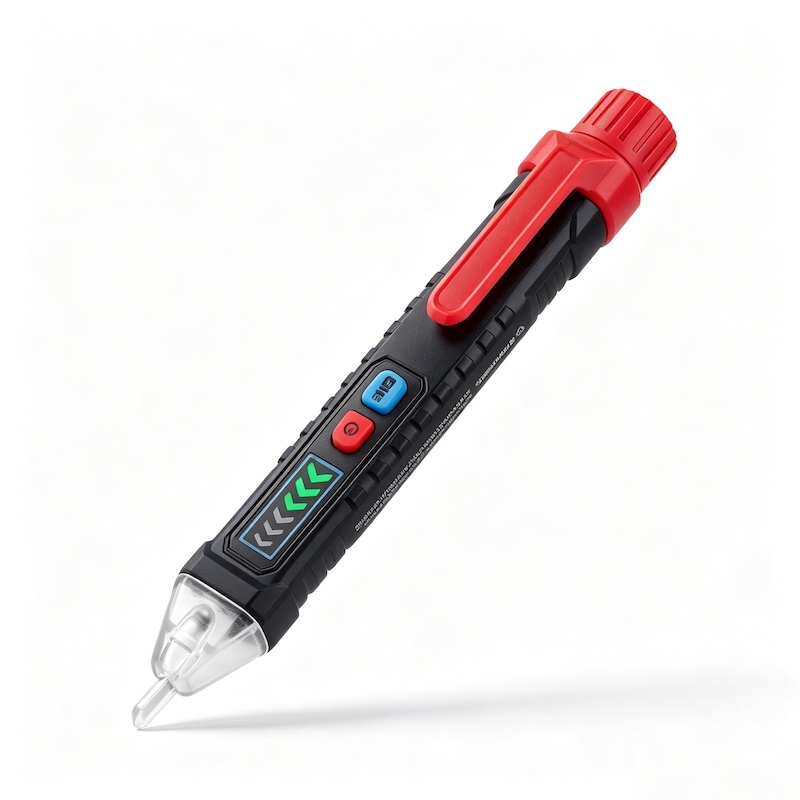
A non-contact voltage tester (NCVT) is commonly used for preliminary detection of energized AC circuits. The sensing tip normally does not need to touch an exposed metal conductor. When brought near a wire, outlet, switch, or other electrical component, the tester detects the surrounding alternating electric field and indicates whether voltage may be present.
This method is convenient and reduces the need for direct contact with energized conductors, making NCVTs widely used in residential electrical checks, installation work, equipment maintenance, and troubleshooting.
However, “non-contact” does not eliminate the need for safe operating practices. Detection distance, tester sensitivity, cable construction, shielding, grounding conditions, and surrounding electric fields can all affect the result. Correct use therefore involves not only detecting an alarm, but also understanding what the indication means and when a non-contact result should not be used as the sole basis for a safety decision.
Key Points
● Inspect the tester, battery condition, and operating functions before use.
● A recommended procedure is: test on a known live source, test the target, then re-test the known live source.
● Move the sensing tip gradually toward the target rather than rapidly inserting it into a group of wires or complex electrical assembly.
● Audible, visual, or vibration alarms normally indicate that an AC electric field strong enough to trigger the tester has been detected; they do not represent a precise voltage measurement.
● No alarm does not always mean that a circuit is completely de-energized.
● When safe isolation must be confirmed, follow the applicable electrical safety procedure and use an appropriate contact-type test instrument.
What Should Be Checked Before Using a Non-Contact Voltage Tester?
Before testing, inspect the instrument. Many incorrect results are caused not by the detection principle itself, but by weak batteries, instrument damage, or improper operation.
● Check the housing, sensing tip, and battery cover for visible damage.
● Make sure the batteries have sufficient charge and that no low-battery warning is displayed.
● Switch on the tester and verify that its LEDs, buzzer, display, or vibration function operate normally.
● If the tester offers high/low sensitivity or multiple voltage ranges, verify the selected mode.
● Refer to the product manual for the specified voltage range and environmental limitations.
A tester that powers on is not necessarily proof that its voltage-sensing circuitry is functioning correctly.
Whenever possible, first place the tester near a known energized source whose voltage is within the specified detection range. Confirm that the tester responds correctly before testing an unknown circuit.
How Should a Non-Contact Voltage Tester Be Used?
A reliable procedure can be summarized as:
Verify on a known live source → Test the target → Re-verify on the known live source.
A typical procedure is:
● Switch on the tester and allow it to complete any startup or self-test sequence.
● Select the appropriate sensitivity or detection range for the application.
● Check the tester on a known energized source to confirm proper operation.
● Hold the tester only in the designated gripping area and do not cover the sensing tip.
● Gradually move the sensing tip toward the wire, outlet, switch, or other point to be checked.
● Observe changes in the LED, buzzer, vibration, or display indication.
● If the tester produces the specified alarm, an AC electric field has been detected near the target.
● After testing, check the instrument again on the known live source to ensure that it remained operational throughout the test.
The final step is particularly important. If the tester no longer responds to the known energized source after the test, any previous “no voltage detected” result should not be considered reliable.
Why Test the Instrument on a Known Live Source First?
A non-contact voltage tester relies on an electronic sensing circuit. A depleted battery, internal electronic fault, damaged sensing tip, or improper startup can prevent the tester from detecting voltage correctly.
If such a tester is used directly on an unknown circuit, a lack of alarm may be incorrectly interpreted as proof that the circuit is de-energized.
Testing on a known live source confirms that the instrument is currently capable of detecting an electric field.
A good working practice is therefore:
Verify before testing and verify again after testing.
This reduces the risk of relying on a false negative caused by instrument failure during the test.
How Should Electrical Wires Be Tested?
When testing an insulated conductor, place the sensing tip close to the insulation and move it slowly along the wire.
If the conductor is an energized AC line and the surrounding electric field exceeds the tester's detection threshold, the instrument will normally provide an audible, visual, vibration, or display indication.
The alarm distance is not fixed. It can be affected by:
● Actual conductor voltage;
● Tester sensitivity;
● Insulation thickness;
● Distance between the sensing tip and conductor;
● Conductor arrangement inside the cable;
● Nearby energized conductors;
● Shielding and grounding conditions;
● Capacitive coupling between the operator, instrument, and surrounding environment.
For this reason, the distance at which the tester begins to alarm should not be used as a direct indication of the actual voltage level.
How Do You Test an Electrical Outlet?
When checking an outlet, position the sensing tip near each opening according to the local outlet design and wiring arrangement.
Under normal conditions, the tester usually responds clearly near the opening connected to the live conductor, while the neutral side generally produces a weaker response or no alarm.
However, an NCVT detects an AC electric field; it does not directly measure the potential difference between live and neutral. Outlet construction, conductor depth, adjacent wiring, and tester sensitivity can therefore influence the result.
If it is necessary to verify correct outlet wiring, an open neutral, protective earth continuity, or similar wiring conditions, a non-contact voltage tester alone is generally insufficient. Appropriate electrical test equipment should be used.
How Can a Non-Contact Voltage Tester Help Identify a Live Wire?
In a typical AC system, the live conductor has a significant alternating potential relative to earth and therefore produces an electric field that is usually easier for an NCVT to detect.
The tester can be moved near each conductor for comparison.
● A conductor producing a strong and stable alarm may be the live conductor.
● A conductor producing little or no response may be the neutral conductor.
This method is suitable for rapid preliminary identification, but it cannot provide absolute live/neutral identification in every wiring environment.
Parallel conductors can develop capacitive coupling, which may cause induced signals on a neutral or disconnected wire. The effect can be more noticeable when the tester is set to high sensitivity.
In complex wiring systems, industrial equipment, or situations requiring reliable conductor identification, use an appropriate contact-type test instrument for confirmation.
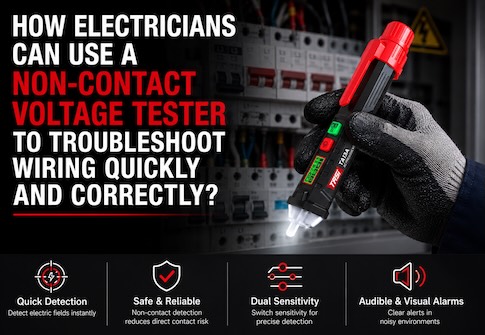
When Should High or Low Sensitivity Be Used?
Some non-contact voltage testers offer dual or multiple sensitivity settings.
High sensitivity is generally useful for:
● Detecting lower AC voltages;
● Sensing through relatively thick insulation;
● Locating potentially energized areas in walls, cable bundles, or equipment;
● Preliminary detection of weak AC electric fields.
Low sensitivity is generally more suitable for:
● Routine mains-voltage checks;
● Locations where several conductors are close together;
● Identifying which individual conductor is likely energized;
● Reducing false or unwanted alarms caused by surrounding electric fields.
If several nearby conductors all trigger an alarm in high-sensitivity mode, switch to a lower sensitivity setting and bring the sensing tip closer to each conductor individually.
What Does an Alarm Actually Mean?
An alarm from a non-contact voltage tester generally means:
The tester has detected an AC electric field strong enough to exceed its trigger threshold.
This is not the same as a multimeter displaying an actual voltage such as 120 V or 230 V.
Most standard NCVTs cannot determine the exact conductor voltage from alarm intensity alone. Even models that use different LED colors, buzzer rates, or indication levels usually provide a relative electric-field or detection-level indication rather than a precision voltage measurement.
Therefore, it is incorrect to assume that:
“Faster alarm = definitely higher voltage”
or
“Louder alarm = definitely higher voltage.”
If the actual voltage value is required, use a suitable digital multimeter or other contact-type voltage measuring instrument.
Does No Alarm Mean the Circuit Is Definitely De-Energized?
No.
A lack of alarm only means that under the current test conditions, the instrument has not detected an electric field strong enough to trigger its indication.
Possible reasons include:
● The voltage is below the tester's detection range;
● The sensing tip is too far from the conductor;
● The insulation is relatively thick;
● The cable is shielded;
● The conductor is inside metal conduit or an enclosure;
● The battery is weak;
● The tester is faulty;
● The selected sensitivity or mode is unsuitable;
● Grounding or capacitive coupling conditions have changed.
An NCVT is highly useful for rapid energized-circuit screening, but when a circuit must be proven safe before repair, disconnection, or direct conductor contact, follow the applicable safety procedure and confirm with a suitable contact-type test instrument.
Why Can the Neutral Wire Sometimes Trigger an Alarm?
This does not necessarily indicate a faulty tester.
When live and neutral conductors run parallel over a significant distance, capacitive coupling can develop between them. A sufficiently sensitive NCVT may therefore detect an induced electric field around the neutral conductor or even around a disconnected wire.
This can also occur in:
● Multi-core cables;
● Distribution panels;
● Areas with densely arranged wiring;
● Parallel wiring inside walls;
● Long disconnected conductors.
In such cases, reduce the sensitivity if possible, bring the sensing tip closer to each conductor, and compare the responses.
If identification remains uncertain, confirm the condition with an appropriate contact measurement.
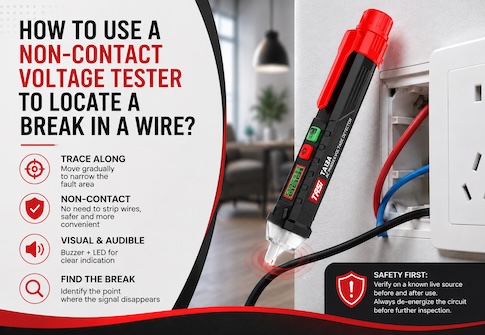
Can an NCVT Be Used to Locate a Break in a Wire?
In some situations, it can assist with preliminary fault tracing.
For example, the tester can be moved slowly along an AC-powered cable. If a stable indication is present along one section and disappears beyond a certain point, a break, poor connection, or loss of supply may exist near that location.
However, this method is only an aid to troubleshooting.
Wall construction, cable depth, shielding materials, parallel conductors, and changes in probe distance may all cause the detected signal to increase or disappear. The position where the alarm stops should therefore not be treated as definitive proof of the exact conductor break location.
What Safety Precautions Should Be Followed?
Although a non-contact voltage tester reduces the need to touch exposed conductors, electrical testing still requires appropriate safety awareness.
● Do not exceed the tester's specified voltage rating or operating conditions.
● Do not use a tester with a damaged housing, sensing tip, or insulation.
● Never touch an exposed conductor simply because the tester does not alarm.
● Do not use a standard NCVT as a precision voltage measuring instrument.
● Do not estimate actual voltage solely from alarm strength or detection distance.
● Exercise additional caution in wet environments, complex electromagnetic environments, and unusual electrical systems.
● Before electrical repair or disassembly, follow the applicable procedure for isolating and verifying the power supply.
● Energized work beyond the user's level of training and competence should be performed by appropriately qualified personnel.
What Are Common Mistakes When Using a Non-Contact Voltage Tester?
Testing the circuit without first checking the tester
If the instrument has failed, even an energized circuit may produce no alarm. Always verify the tester on a known live source first.
Treating “no alarm” as proof of complete safety
Non-contact detection has defined detection limits and operating conditions. It should not always be used as the final method of proving absence of voltage.
Using maximum sensitivity for every test
High sensitivity is useful for detecting weak fields, but it is also more susceptible to nearby energized conductors. Lower sensitivity is often more effective when identifying a specific wire.
Estimating voltage from alarm intensity
Alarm strength depends on probe distance, insulation, electric-field distribution, and tester sensitivity as well as voltage. It is not a substitute for voltage measurement.
Moving the probe too quickly
Rapid scanning can make subtle changes in indication easy to miss. For conductor identification or fault tracing, move the sensing tip slowly and steadily.
FAQ
Q1: Does a non-contact voltage tester need to touch the wire?
No. Under normal conditions, the sensing tip only needs to be brought near an insulated conductor carrying AC voltage.
Q2: Can an NCVT directly measure 120 V, 220 V, or 230 V?
A standard NCVT is primarily designed to detect the presence of an AC electric field. It does not measure exact voltage in the same way as a digital multimeter. Refer to the specifications of the individual model.
Q3: Why does the tester alarm near several wires at the same time?
High sensitivity, surrounding electric fields, and capacitive coupling from adjacent energized conductors can all cause this. Reduce sensitivity and test closer to each conductor individually.
Q4: If the tester does not alarm, can electrical repair work begin immediately?
It is not recommended to rely on that result alone. Where safe isolation must be confirmed, follow the applicable electrical safety procedure and use an appropriate contact-type test instrument.
Q5: Why does the tester sometimes need to be very close to the live wire before alarming?
Detection distance depends on voltage, insulation thickness, sensitivity, cable construction, and environmental conditions. It is therefore not a fixed distance.
Q6: Can an NCVT distinguish live and neutral conductors?
It can often provide a quick preliminary indication in a typical AC installation, because the live conductor normally produces a stronger response. Induced voltages and conductor arrangement can affect the result, so another suitable test method should be used when reliable identification is required.
Q7: Why should the tester be checked on a known live source before use?
This confirms that the sensing circuit, battery, and alarm functions are operating correctly and reduces the risk of incorrectly identifying an energized circuit as de-energized.
Q8: Why should the known live source be tested again afterward?
The final check confirms that the tester remained operational during the entire test. If it no longer responds afterward, previous negative indications cannot be considered reliable.
Conclusion
Correct use of a non-contact voltage tester involves more than simply placing it near a wire and waiting for an alarm. A reliable operating sequence is:
Verify instrument operation → Select the appropriate sensitivity → Approach the target slowly → Interpret the indication correctly → Re-verify instrument operation.
NCVTs are highly useful for quickly checking wires, outlets, switches, and electrical equipment for the presence of an AC electric field. They can also assist with live-wire identification and preliminary troubleshooting.
However, non-contact voltage detection should always be understood as a rapid screening and supplementary diagnostic method. An alarm means that a detectable AC electric field is present nearby, while the absence of an alarm does not prove that a conductor is completely de-energized under all conditions.
Where electrical equipment must be confirmed safe before repair, conductor disconnection, or direct contact, follow the applicable electrical safety procedure and use appropriate test equipment for final verification.