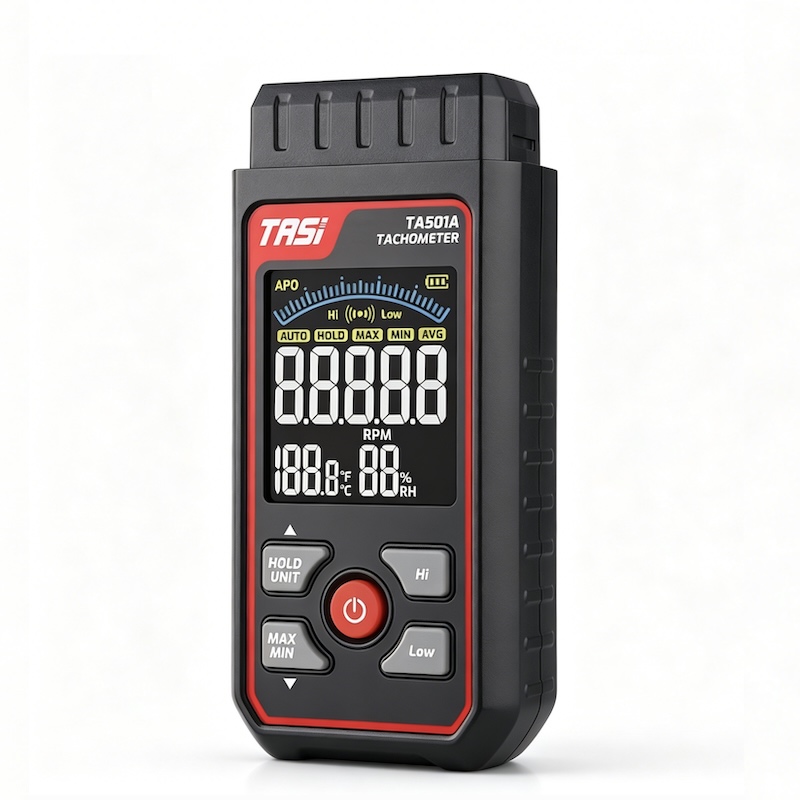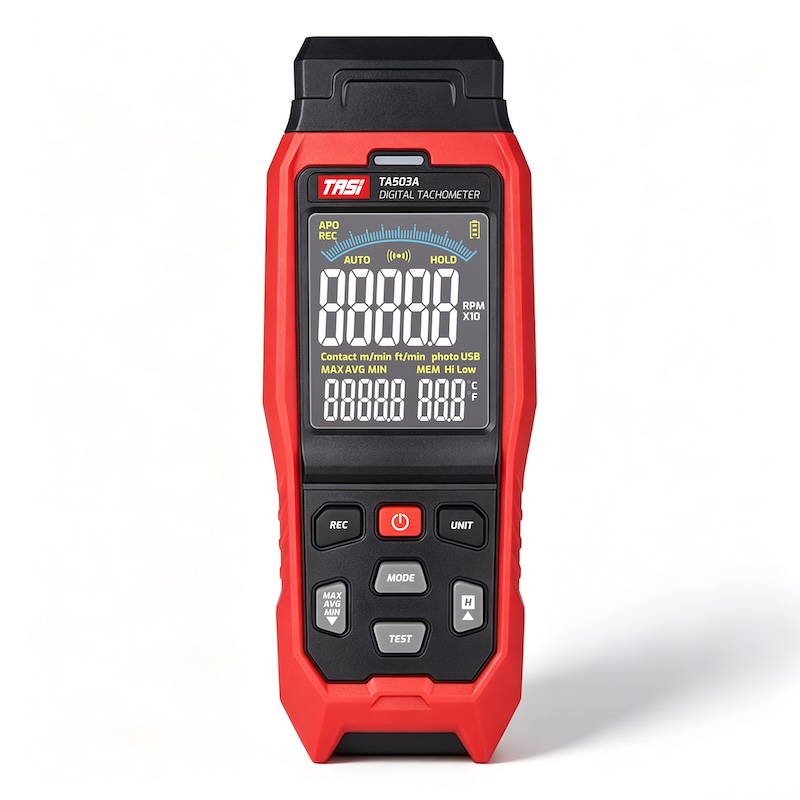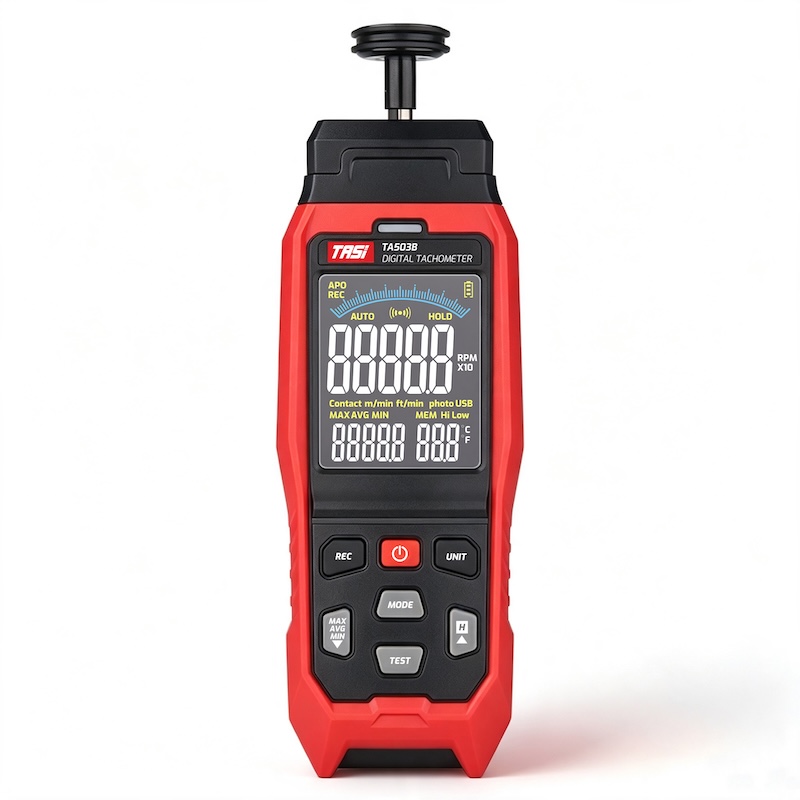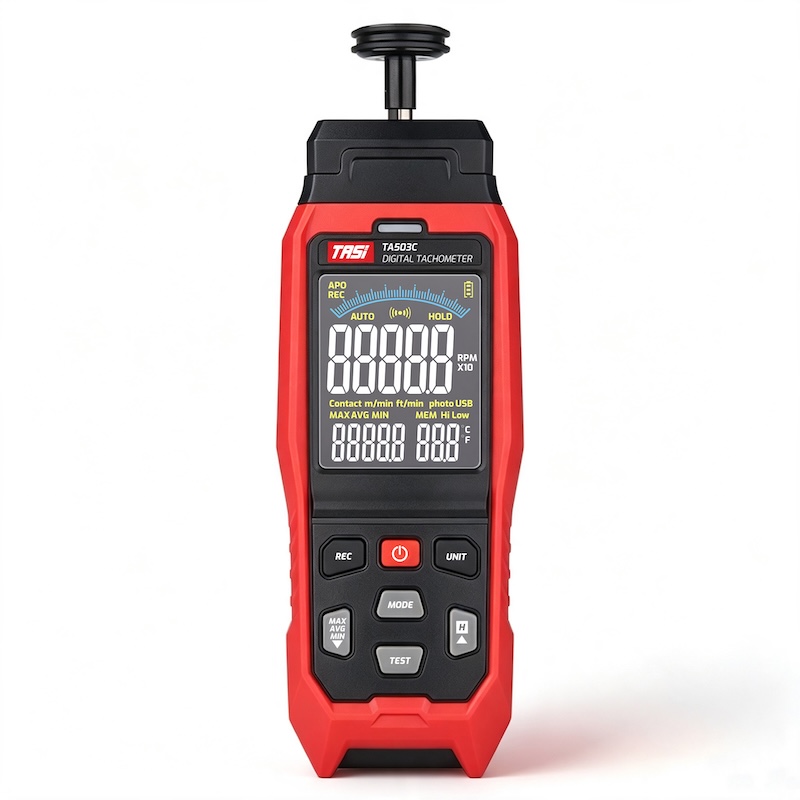
Introduction
Rotational speed is an important parameter for evaluating the operating condition of motors, fans, pumps, shafts, pulleys, and other rotating machinery. On high-speed equipment or components that are difficult or unsafe to access directly, bringing a measuring probe into physical contact with the rotating part may not be practical.
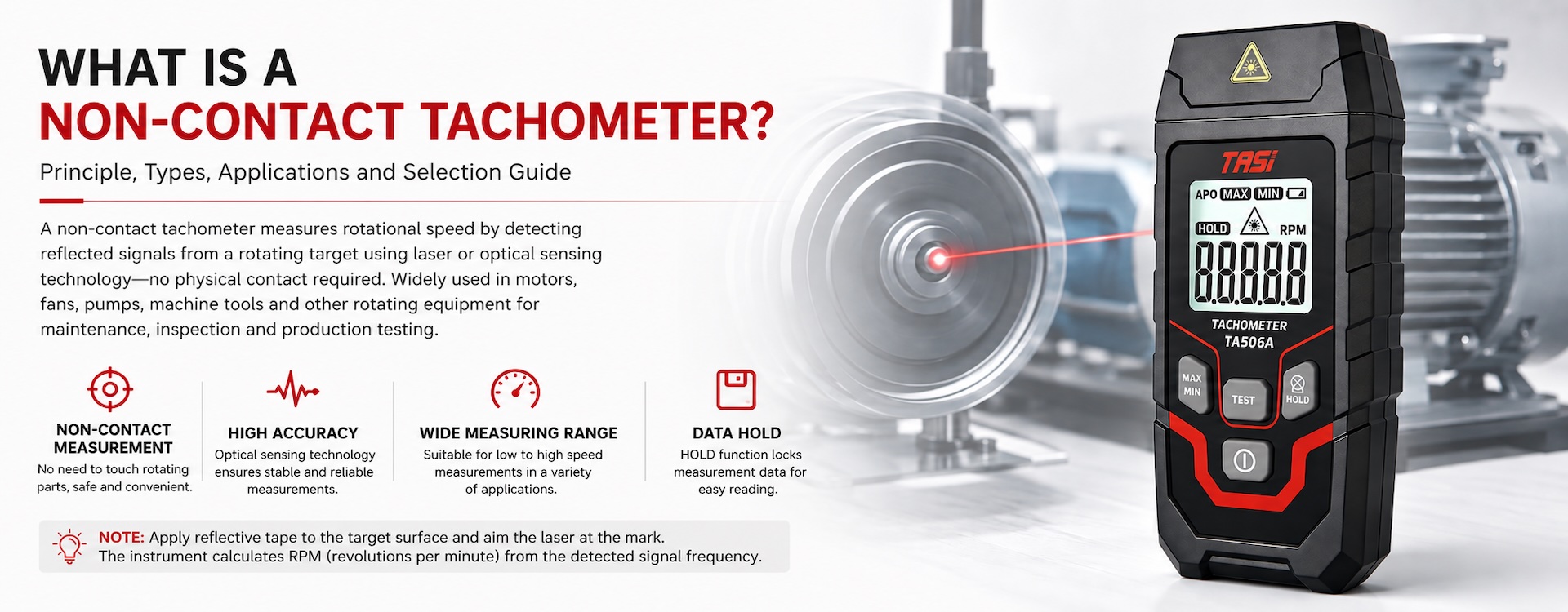
A non-contact tachometer is designed for these applications. Instead of touching the rotating shaft, it uses optical or photoelectric sensing to detect periodic changes generated by the rotating target and converts these signals into a rotational speed reading, typically expressed in RPM.
Because the measurement does not mechanically load the rotating component, non-contact tachometers are widely used in industrial maintenance, equipment inspection, production testing, and laboratory measurements.
Key Takeaways
● A non-contact tachometer measures rotational speed without physically contacting the rotating component.
● Most handheld models use laser or optical reflection sensing.
● The instrument calculates speed from the frequency of detected pulses and normally displays the result in RPM.
● Reflective tape is commonly applied to the rotating component so that each revolution can be detected reliably.
● Non-contact measurement is particularly suitable for high-speed, difficult-to-reach, or mechanically sensitive rotating equipment.
● Measurement reliability can be affected by the reflective target, measurement distance, surface condition, ambient light, and measurement angle.
What Is a Non-Contact Tachometer?
A non-contact tachometer is an instrument that determines rotational speed by detecting periodic motion without requiring the measuring probe to touch the rotating component.
In a typical handheld digital tachometer, a laser or visible light beam is directed at the rotating target. A piece of reflective tape or another optical marker on the target produces a stronger reflected signal whenever it passes through the measurement area.
The optical sensor detects these recurring reflections, and the instrument calculates rotational speed from the number and frequency of detected pulses.
Rotational speed is normally expressed in RPM, or revolutions per minute.
● 600 RPM means that the component completes 600 revolutions per minute.
● 1,500 RPM means 1,500 revolutions per minute.
● 3,000 RPM means 3,000 revolutions per minute.
In practical terms, a non-contact tachometer converts periodic rotational movement into detectable electrical pulses and processes those pulses into a numerical speed value.
How Does a Non-Contact Tachometer Work?
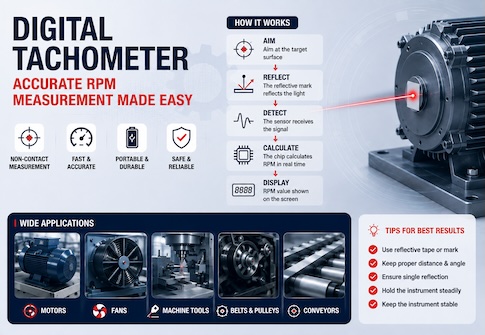
The basic measurement process can be described as “emit light, receive reflection, generate pulses, and calculate speed.”
● Emit the measuring beam: A laser or other light source is directed at the rotating target.
● Apply a reflective target: Reflective tape or another clearly distinguishable optical marker is placed on the rotating component.
● Detect changes in reflection: Each time the reflective target passes through the sensing area, the amount of light returned to the sensor changes significantly.
● Generate electrical pulses: The photoelectric sensor converts each detected change into an electrical pulse.
● Calculate rotational speed: The processor determines the pulse frequency and converts it into rotational speed according to the number of pulses generated per revolution.
● Display the result: The calculated value is shown on the digital display, normally in RPM.
If the rotating component generates one valid pulse per revolution, pulse frequency can be directly converted into rotational speed.
Why Is Reflective Tape Commonly Used?
Most portable optical or laser tachometers need a clear difference in reflectivity to identify each complete revolution reliably.
If the entire rotating surface has a similar color and reflectance, the sensor may not be able to distinguish one revolution from another. A small piece of reflective tape is therefore commonly attached to the rotating part.
The reflective marker creates a strong optical contrast with the surrounding surface. Each time it passes the sensing point, the instrument detects one event that can represent one complete revolution.
When using reflective tape:
● Normally, use one primary reflective marker per revolution.
● The marker should be large enough for reliable detection within the instrument's specified conditions.
● Keep the reflective surface clean and securely attached.
● Avoid additional highly reflective areas that may generate extra pulses.
● If multiple detectable markers are present, the pulse-to-revolution relationship must be considered.
For example, if a shaft is rotating at 1,000 RPM but produces two detectable reflection pulses per revolution, an instrument configured to interpret each pulse as one revolution could display approximately 2,000 RPM.
What Types of Non-Contact Tachometers Are Available?
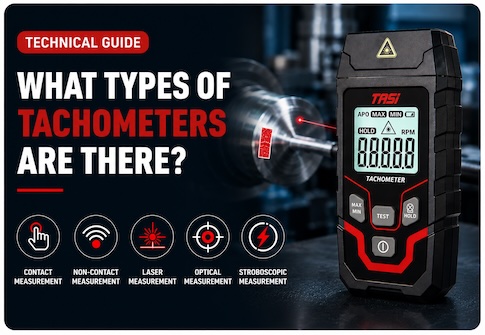
Portable non-contact tachometers can generally be classified according to their sensing method.
● Optical tachometers: Use a light source and photoelectric sensor to detect periodic changes in brightness or reflected light.
● Laser tachometers: Use a directional laser beam as the measuring light source, making the target area easier to identify during handheld measurements.
● Contact/non-contact tachometers: Some digital tachometers combine optical non-contact measurement with mechanical contact measurement, allowing users to select the appropriate method for the application.
Although their optical arrangements may differ, these instruments all determine speed by detecting a periodic event associated with rotation.
What Are the Main Components of a Non-Contact Tachometer?
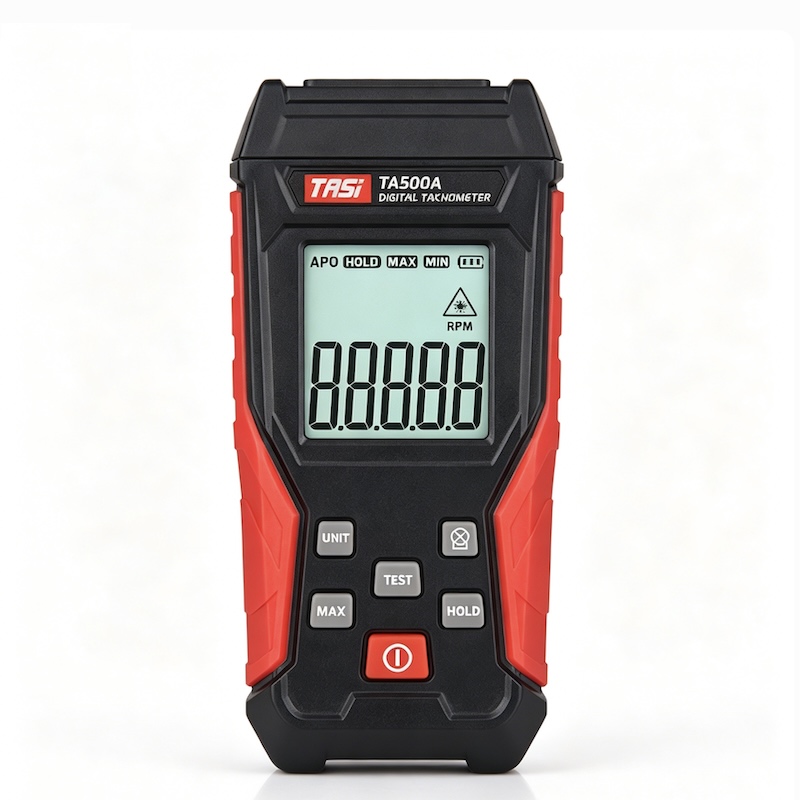
A typical handheld non-contact tachometer normally includes:
● Light source or laser emitter: Directs the measurement beam toward the rotating target.
● Photoelectric sensor: Receives reflected light and detects changes in light intensity.
● Signal conditioning circuit: Amplifies and processes the sensor signal.
● Microprocessor: Calculates rotational speed from the detected pulse frequency.
● Digital display: Shows RPM and, depending on the model, other measurement data.
● Operating controls: Used for measurement, mode selection, data recall, or other functions.
● Power supply: Provides power to the optical system, electronics, and display.
Specifications such as measuring range, resolution, measuring distance, display count, and memory functions vary by model.
What Equipment Can Be Measured with a Non-Contact Tachometer?
A non-contact tachometer can be considered whenever a rotating component is visible and a reliable optical target can be established.
Common applications include:
● Electric motor shaft speed measurement.
● Industrial fan and ventilation equipment inspection.
● Pump rotational speed measurement.
● Pulley and drive-wheel measurements.
● Machine spindle speed checks.
● Machine tool inspection.
● Generator and rotating equipment testing.
● Laboratory rotating machinery measurements.
● Industrial equipment maintenance and troubleshooting.
● Production-line verification of rotating mechanisms.
Non-contact measurement is particularly useful where physical contact is difficult, where the shaft is rotating at high speed, or where additional mechanical loading should be avoided.
What Are the Advantages of a Non-Contact Tachometer?
Compared with contact-based speed measurement, non-contact tachometers offer several practical advantages.
● No mechanical contact: The instrument can remain at a suitable distance from the rotating target.
● Minimal influence on the rotating system: No contact force or friction is applied to the measured component.
● Suitable for many high-speed applications: Measurements can be made without placing a contact adapter on a rapidly rotating shaft.
● Useful for difficult-to-reach components: Measurements may be possible from a distance within the specified optical measuring range.
● No contact-tip wear: There is no contact wheel or mechanical measuring tip subject to the same friction-related wear.
● Straightforward operation: Once a suitable reflective target has been established, the user can aim the measuring beam and obtain an RPM reading.
However, non-contact measurement is not automatically the best choice for every application. The target geometry and measurement environment should always be considered.
What Is the Difference Between Non-Contact and Contact Tachometers?
The main difference lies in how rotational information is obtained.
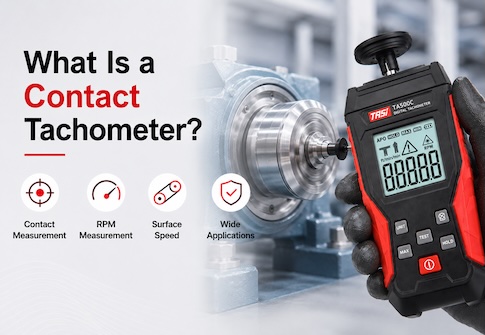
A non-contact tachometer detects rotation optically without touching the rotating component. A contact tachometer uses a contact tip, wheel, or other mechanical accessory that is placed directly against the shaft or moving surface.
Non-contact measurement is generally well suited to:
● High-speed rotating targets.
● Components that are difficult to access directly.
● Systems where additional mechanical load should be minimized.
● Applications where a reliable reflective target can be established.
Contact measurement can be useful when the rotating shaft can be accessed safely and where direct shaft speed, surface speed, or length measurement is required.
Neither method is universally superior. The correct choice depends on the application.
What Factors Affect Non-Contact Speed Measurement?
Although non-contact tachometers are relatively easy to operate, reliable measurements depend on suitable optical conditions.
● Reflective target: A target that is too small, dirty, loose, or duplicated can cause missed or additional pulses.
● Measurement distance: Operating outside the specified measuring distance may result in insufficient reflected signal.
● Measurement angle: An unsuitable angle can reduce the reflected light reaching the sensor.
● Surface condition: Highly polished metal, mirror-like surfaces, complex patterns, or additional reflective areas can create false triggering.
● Ambient light: Strong sunlight or intense artificial light may interfere with some optical sensing systems.
● Target stability: Excessive vibration may move the reflective target outside the sensing area and cause unstable readings.
● Speed range: The actual speed must remain within the instrument's specified measurement range.
An unexpected reading does not necessarily indicate an equipment problem. The measurement setup should also be checked.
How Should a Non-Contact Tachometer Be Used?
Before measurement, confirm that the rotating component is suitable for optical detection and follow the operating instructions for the specific instrument.
A typical procedure is:
● Clean the area where the reflective marker will be applied.
● Apply one clear and secure reflective marker to the rotating target.
● Run the equipment at the operating condition to be measured.
● Keep the tachometer within the specified measuring distance.
● Aim the laser or optical beam steadily at the path of the reflective marker.
● Wait until the displayed RPM value becomes stable.
● Repeat the measurement if necessary to verify consistency.
When working around rotating machinery, always maintain a safe distance and never place hands, instruments, or other objects inside hazardous moving areas simply to obtain a reading.
How Do You Select a Non-Contact Tachometer?
Selection should be based on the actual application rather than maximum speed alone.
● Measurement range: It should cover both the minimum and maximum expected operating speeds.
● Accuracy: Select an accuracy level appropriate for maintenance, production testing, or laboratory work.
● Measurement distance: Confirm the optical measuring distance if the target cannot be approached closely.
● Resolution: This is particularly important for low-speed measurements or applications where small speed changes must be observed.
● Response performance: Consider update rate and reading stability when measuring rapidly changing speeds.
● Data functions: Depending on the application, data hold, minimum/maximum capture, or memory functions may be useful.
● Measurement modes: If both non-contact RPM and contact shaft or surface-speed measurements are required, a combined contact/non-contact model may be more practical.
The best instrument is the one that matches the actual rotating equipment, operating range, and measurement environment.
FAQ
Does a non-contact tachometer always require reflective tape?
Not necessarily. It depends on the instrument and the optical characteristics of the target. However, reflective tape is recommended for many portable laser and optical tachometers because it produces a clear and repeatable signal.
Is a laser tachometer a non-contact tachometer?
Yes. A laser tachometer is one of the most common types of non-contact tachometer and uses a laser beam to detect periodic reflections from the rotating target.
Can a non-contact tachometer measure motor speed?
Yes. If a suitable rotating part such as the shaft or coupling is visible and a reliable optical target can be established, motor speed can be measured without physical contact.
Why does the tachometer sometimes show twice the actual speed?
A common cause is two detectable reflection points per revolution. If both generate valid pulses and the instrument interprets each pulse as one revolution, the displayed value may be approximately twice the actual speed.
Can a non-contact tachometer measure very low rotational speeds?
This depends on the specified minimum measurement range. At very low speeds, fewer pulses are generated within a given time, so the instrument may require a longer sampling period to obtain a stable reading.
Should the tachometer be positioned as close as possible to the rotating target?
No. It should be used within the manufacturer's specified measuring distance. Moving unnecessarily close to rotating machinery can also increase operational risk.
Conclusion
A non-contact tachometer measures rotational speed using optical or laser sensing without physically touching the rotating component. It detects periodic reflections or optical changes, calculates the corresponding number of revolutions, and normally displays the result in RPM.
Compared with contact measurement, the non-contact method avoids mechanical loading and is particularly useful for high-speed, difficult-to-reach, or contact-sensitive rotating equipment. It is widely used for motors, fans, pumps, machine tools, shafts, and other industrial machinery.
For reliable results, users should pay attention to the reflective target, measurement distance, angle, surface characteristics, and ambient lighting. A stable, distinct, and correctly interpreted periodic signal is essential for accurate non-contact rotational speed measurement.