Introduction
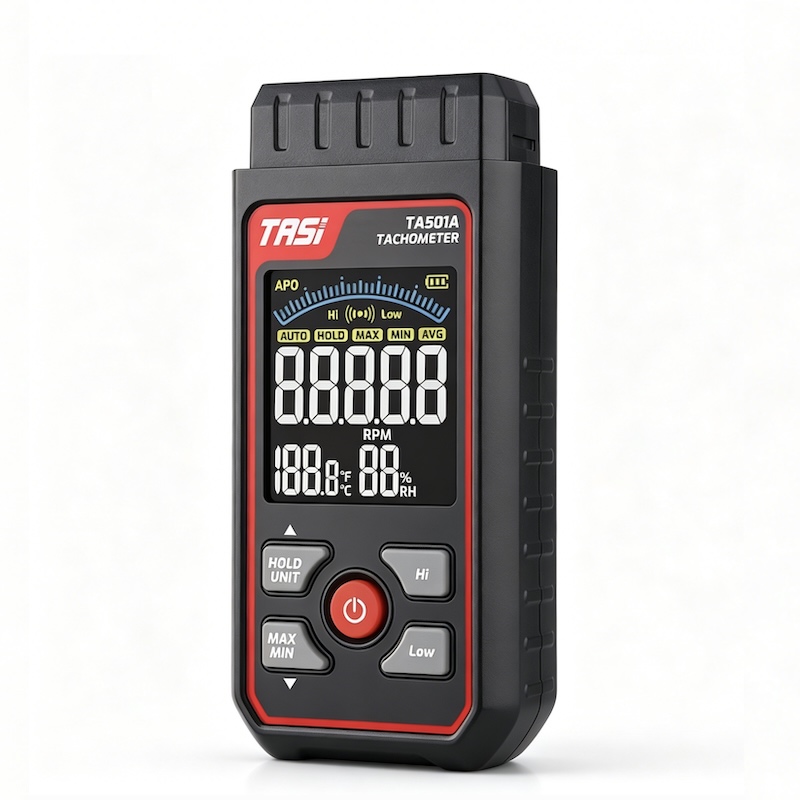
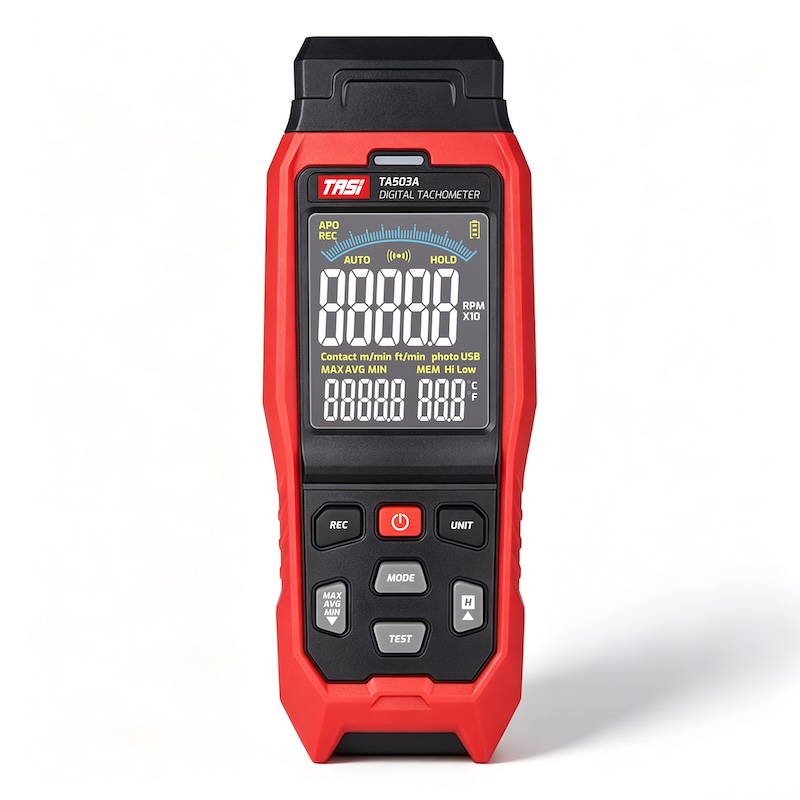
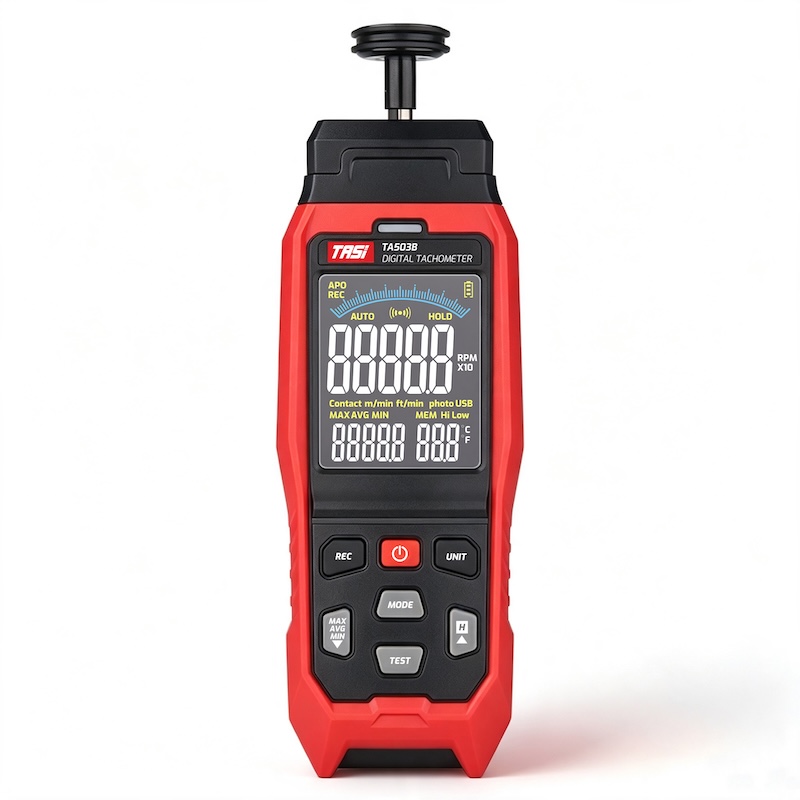
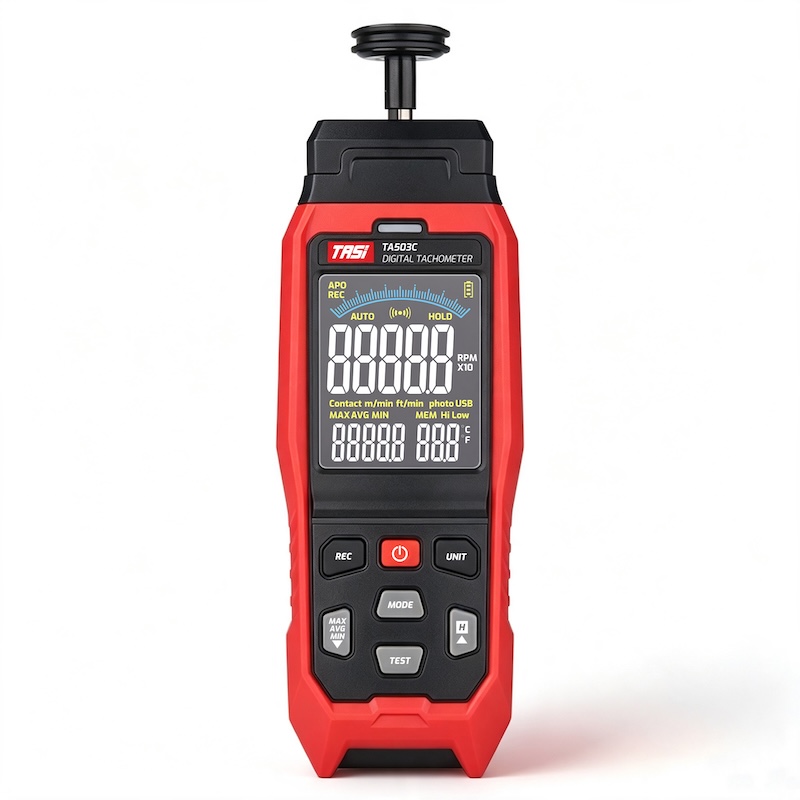
When measuring a motor shaft, fan, pulley, roller, or other rotating component, a tachometer may occasionally remain at “0,” fail to display an RPM value, or show unstable readings. This does not necessarily mean that the tachometer is defective.
A non-contact tachometer requires a stable, periodic reflected-light signal in order to calculate rotational speed. A contact tachometer, by contrast, requires stable mechanical contact between the measuring tip or wheel and the rotating part. If these measurement conditions are not met, the instrument may be unable to detect rotational speed.
For this reason, the measurement setup should always be checked before assuming that the instrument itself has failed.
Key Points
● For non-contact tachometers, the most common causes are incorrect reflective tape, measuring distance, or measuring angle.
● Reflective tape that is too small, dirty, damaged, loose, or insufficiently reflective may prevent reliable signal detection.
● Strong ambient light, highly reflective surroundings, and excessive target vibration may interfere with optical sensing.
● Contact tachometers require stable contact with the rotating shaft or surface; slipping may cause no reading or inaccurate readings.
● Incorrect measurement mode, RPM outside the specified measuring range, or low battery power should also be checked.
● If measurement conditions are correct but no speed can be detected, inspect the optical window, sensor, accessories, and general instrument condition.
Why Can a Tachometer Fail to Detect RPM?
A tachometer must first obtain a signal representing the rotational cycle. It then calculates RPM from the number of detected cycles over a given period of time.
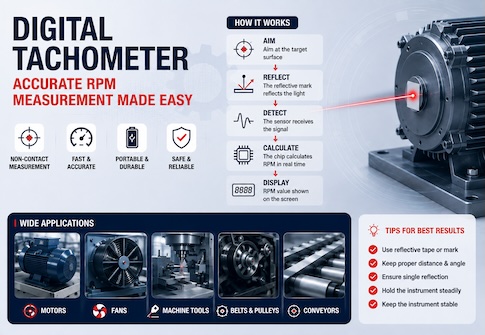
Non-contact tachometers typically use optical or laser-reflective sensing. As reflective tape rotates through the measurement area, the instrument detects repeated changes in reflected light and converts them into electrical pulses. If the reflected signal is too weak, irregular, or affected by interference, the tachometer may be unable to calculate rotational speed.
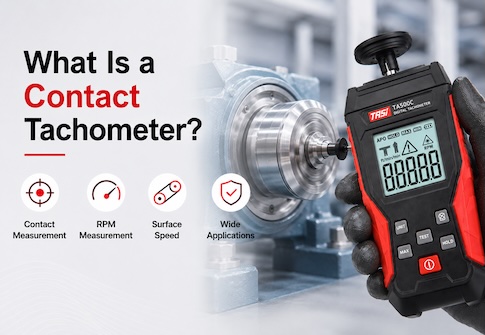
A contact tachometer obtains rotational information mechanically through a contact tip, cone adapter, or measuring wheel. If contact is unstable, the accessory slips, or the measuring position is incorrect, the instrument may also fail to obtain a valid speed signal.
In practical terms, a tachometer that cannot detect RPM is usually not receiving a sufficiently stable and valid rotational signal.
Reflective Tape Is Installed Incorrectly
For non-contact tachometers that rely on reflective tape, the tape should be one of the first items checked.
● Reflective tape that is too small may not produce a sufficiently strong signal.
● Oil, dust, dirt, or surface damage can reduce reflectivity.
● Loose or partially detached tape may move during rotation and create an unstable signal.
● If the surrounding surface is already highly reflective, the contrast between the tape and background may be insufficient.
● Multiple reflective points on the same rotational path may generate multiple pulses per revolution, causing unstable or multiplied readings.
The reflective tape should be applied to a clean, flat surface and positioned so that it passes consistently through the measuring area. A clear optical contrast between the reflective marker and the surrounding surface improves measurement reliability.
The Measuring Distance Is Incorrect
Non-contact tachometers normally have a specified operating distance. Measuring too close or too far away may reduce detection reliability.
At excessive distances, the reflected signal returning to the sensor may become too weak. At very short distances, the optical path, spot size, or sensor geometry may not operate under optimum conditions.
Always follow the measuring distance specified for the instrument. If no RPM reading appears, adjust the distance within the permitted range and check whether the reading becomes stable.
If moving the tachometer slightly restores a reliable reading, the original measurement position was probably unsuitable.
The Measuring Angle Is Incorrect
The optical beam must not only reach the reflective tape; enough reflected light must also return to the receiving sensor.
If the measuring angle is too large, the beam may visibly strike the reflective marker while the returning signal remains too weak for reliable detection.
Keep the tachometer steady, aim at the path of the reflective tape, and adjust the angle gradually until a stable RPM reading appears.
A visible laser spot on the rotating part does not necessarily mean that the optical sensor is receiving a sufficiently strong return signal.
The Target Surface Has Poor Reflective Characteristics
Target colour, material, texture, and surface condition can all influence optical RPM measurement.
Dark, rough, or light-absorbing materials generally produce weaker reflected signals. Highly polished metal or mirror-like surfaces may create unwanted reflections and optical interference.
For normal shafts and mechanical parts, applying suitable reflective tape usually provides a more stable reference than measuring directly from the original surface.
Oil, moisture, and heavy dust should also be removed from the measurement area when it is safe to do so.
Ambient Light Is Interfering with the Measurement
Direct sunlight, powerful lighting, flashing light sources, and nearby optical equipment may interfere with some photoelectric tachometers.
This is particularly relevant outdoors, near bright industrial lighting, or around polished metallic surfaces where background reflections may reduce the contrast of the reflective marker.
Try changing the measuring direction, shielding the sensor from strong light, or reducing the measuring distance within the allowed range.
The Rotational Speed Is Too Low or the Signal Is Unstable
At very low rotational speeds, fewer pulses are generated over a given time, so the tachometer may require a longer sampling period before a stable reading appears.
Strong shaft vibration, fluctuating speed, or excessive movement of the reflective marker can also interrupt the detection signal.
Hold the tachometer steady, keep the optical beam aligned with the reflective marker path, and allow sufficient time for the instrument to complete its measurement.
If the target speed is below the specified minimum measuring range, the tachometer may not display a valid RPM value.
The Wrong Measurement Mode Is Selected
Some digital tachometers support multiple functions, such as non-contact RPM, contact RPM, surface speed, or linear speed measurement.
If the wrong mode is selected, the displayed value may be incorrect or the expected RPM reading may not appear.
Before measuring, check:
● Whether the instrument is set to RPM mode.
● Whether contact or non-contact measurement is selected correctly.
● Whether the correct unit is displayed.
● Whether the target speed is within the specified measuring range.
Why Does a Contact Tachometer Show No Reading?
For contact tachometers, the mechanical connection between the instrument and the rotating component is critical.
● A measuring tip that is not aligned with the shaft centre may produce unstable contact.
● Insufficient pressure may cause the tip to slip.
● Excessive pressure may affect the operation of the rotating equipment and increase measurement risk.
● A worn, dirty, or loose contact accessory may reduce measurement stability.
● When using a measuring wheel for surface-speed measurement, slipping against a belt, roller, or other moving surface may produce low or unstable readings.
The measuring accessory should remain in smooth, continuous contact with the target without excessive lateral movement.
For exposed high-speed shafts or locations with entanglement hazards, contact measurement should not be forced merely to obtain a reading. A non-contact tachometer may be the safer option where appropriate.
Check the Battery and Instrument Condition
If the measurement setup appears correct but RPM still cannot be detected, inspect the tachometer itself.
● Low battery voltage may affect the optical emitter, sensor, display, or internal electronics.
● Dust, oil, or contamination on the optical transmitting or receiving window can weaken the signal.
● Severe impact, dropping, prolonged high temperature, or high humidity may affect instrument performance.
● If the tachometer cannot detect several known rotating targets under correct conditions, the sensor or internal circuitry may require further inspection.
Replace or recharge the battery as appropriate and clean optical windows carefully with suitable soft materials.
How to Quickly Troubleshoot a Tachometer with No RPM Reading
Use a simple step-by-step approach:
● Confirm that the target is rotating steadily.
● Check that the correct RPM and measurement mode are selected.
● For non-contact measurement, inspect the reflective tape for cleanliness, damage, and secure attachment.
● Aim the beam at the path of the reflective marker.
● Adjust the measuring distance within the specified operating range.
● Slightly change the measuring angle to obtain a stronger return signal.
● Reduce interference from sunlight, strong lighting, or highly reflective surfaces.
● For contact measurement, check for stable contact and eliminate slipping.
● Check battery condition and clean the optical windows if necessary.
● Test the tachometer on another rotating target with a known stable speed.
This process can identify most common causes of missing or unstable RPM readings.
FAQ
Why is there a visible laser spot but no RPM reading?
A visible laser spot only confirms that the beam reaches the target. It does not confirm that the receiving sensor is detecting a sufficiently strong and stable reflected signal. Check the reflective tape, distance, angle, and ambient lighting.
Can rotational speed be measured without reflective tape?
This depends on the tachometer design and the optical properties of the target. Some high-contrast surfaces may be measurable directly, but suitable reflective tape normally provides a more reliable signal for optical or laser tachometers.
Why does the tachometer sometimes work and sometimes display zero?
The reflected signal may be close to the detection threshold. Hand movement, distance, angle, reflective tape size, target vibration, or ambient lighting can all contribute to intermittent detection.
Why does the RPM reading fluctuate constantly?
Possible causes include an unstable reflective signal, multiple reflective points, changing target speed, target vibration, or movement of the tachometer during measurement.
Why does a contact tachometer show a lower-than-expected reading?
The contact tip or measuring wheel may be slipping. Check the contact position, pressure, accessory condition, and stability of the measurement.
What should I do if replacing the reflective tape does not solve the problem?
Check the measuring distance, angle, ambient light, measurement mode, battery, and optical windows. If the tachometer fails on several correctly prepared rotating targets, further instrument inspection may be required.
Conclusion
When a tachometer cannot detect RPM, the problem is often not the calculation function itself but the absence of a stable and valid rotational signal.
For non-contact tachometers, first check the reflective tape, measuring distance, angle, target surface, and ambient light. For contact tachometers, focus on contact position, applied pressure, and slipping. Measurement mode, measuring range, battery condition, and optical cleanliness should also be verified.
A systematic troubleshooting process usually makes it possible to identify the cause quickly and improve the reliability of subsequent rotational-speed measurements.