Introduction
When using a non-contact tachometer to measure motors, fans, pulleys, shafts, or other rotating equipment, users may notice that the reading can become more or less stable when the measuring distance changes.
This raises a common question: Does measuring distance affect tachometer accuracy?
Strictly speaking, as long as the measurement is performed within the specified operating range and the reflected signal remains stable, distance does not normally change the tachometer’s stated accuracy. However, distance affects spot size, reflected signal strength, target recognition, and resistance to optical interference, so it can indirectly affect reading stability and measurement reliability.
Key Points
● Within the specified measuring range, distance normally does not directly change the tachometer’s stated accuracy;
● Excessive distance can reduce the strength of the reflected signal reaching the sensor;
● As distance increases, the optical spot or detection area may become larger and may cover both the reflective tape and surrounding surfaces;
● Measuring too close does not necessarily improve accuracy and may fall outside the optimum optical range;
● Reflective tape size and condition, measurement angle, ambient light, and rotational speed can all affect measurement quality;
● In practice, the objective is to obtain a clear and stable reflected signal rather than simply measuring from the shortest or longest possible distance.
Does Measuring Distance Directly Change Tachometer Accuracy?
Usually, no.
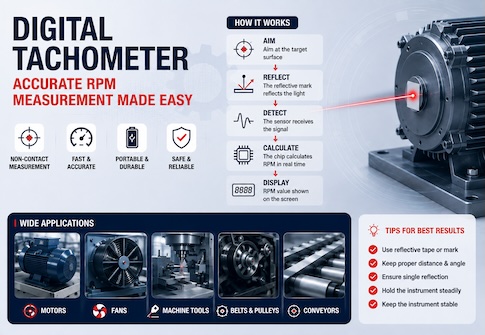
A non-contact laser or optical tachometer emits light toward a rotating target and uses a photosensor to detect periodic reflections from reflective tape or another high-reflectivity area. The instrument calculates rotational speed from the number of detected pulses over time and displays the result, usually in RPM.
If the instrument can consistently identify each reflection and the measurement remains within the specified operating conditions, moving slightly closer to or farther from the target should not change the actual rotational speed or automatically alter the instrument’s inherent accuracy specification.
However, practical measurement accuracy also depends on whether the sensor can detect every reflected pulse correctly and consistently. For this reason, measuring distance may affect the optical signal conditions even though it does not directly alter the tachometer’s internal accuracy specification.
Why Can Excessive Distance Cause Unstable Readings?
As the distance between the tachometer and the rotating target increases, the amount of useful reflected light returning to the sensor may decrease.
As long as the return signal remains sufficiently strong, the tachometer can continue to calculate RPM normally. If the distance increases to the point where the signal approaches the sensor’s detection threshold, several problems may occur:
● The RPM reading begins to fluctuate;
● The displayed value occasionally jumps higher or lower;
● The instrument intermittently loses the signal;
● Individual revolutions may not be detected consistently;
● The instrument may eventually fail to display a stable speed reading.
Therefore, when distance appears to “affect accuracy,” the underlying cause is often reduced optical signal quality rather than a change in the electronic measurement accuracy of the instrument.
Is a Shorter Measuring Distance Always More Accurate?
No.
Positioning the tachometer as close as possible to a rotating part does not automatically improve accuracy.
Different non-contact tachometers have different optical designs, beam geometries, receiving angles, and recommended operating distances. If the instrument is positioned too close, the emitted beam and receiving path may not operate under ideal optical conditions.
There is also an important safety consideration. Measuring too close to high-speed shafts, fans, belts, or transmission components unnecessarily increases the operator’s exposure to moving machinery.
The correct approach is therefore to remain within the manufacturer’s specified measuring range and choose a position that provides both stable readings and a safe working distance.
Why Does Measuring Distance Affect Spot Size?
The optical beam of a laser or photoelectric tachometer does not necessarily maintain the same effective size at every distance.
As distance changes, the illuminated or detected area on the rotating target may also change. At longer distances, the effective spot can become larger.
If the reflective tape is relatively small and the optical spot simultaneously covers the tape, metal shaft, oil residue, screws, labels, or other reflective surfaces, the signal received by the sensor can become less distinct.
Ideally, one revolution should produce one clearly identifiable reflected pulse. If multiple reflective areas are detected during a single revolution, the instrument may count additional pulses and display an incorrect RPM value.
For this reason, at longer distances it is not enough to confirm that the beam reaches the target. The spot must still identify the intended reflective area clearly.
Does Reflective Tape Affect the Usable Measuring Distance?
Yes, significantly.
Non-contact RPM measurement depends on sufficient optical contrast between the reflective tape and the surrounding surface.
Clean, high-quality reflective tape with good reflectivity allows the sensor to recognize the target more reliably, including at relatively longer distances.
By contrast, unstable readings may occur even at a short distance if:
● The reflective tape is too small;
● The tape is dirty, oily, worn, or damaged;
● The tape is lifting, wrinkled, or partially detached;
● The surrounding surface is also highly reflective;
● The emitted beam does not accurately hit the reflective area.
For this reason, the suitability of the measuring distance must be evaluated together with the condition of the reflective target.
How Are Measurement Angle and Distance Related?
Measurement angle is another important factor in optical signal detection.
The tachometer should normally be aimed so that the emitted light reaches the reflective tape as directly and consistently as possible, allowing sufficient reflected light to return to the receiving sensor.
If the measuring distance is already relatively long and the instrument is also positioned at a large angle to the reflective target, the useful return signal may be reduced even further.
This combined effect can become particularly noticeable when measuring high-speed shafts, small reflective targets, or equipment operating under strong ambient lighting.
For stable measurements, keep the tachometer steady and aim the optical beam accurately at the reflective tape rather than measuring from an unnecessarily oblique angle.
Can Ambient Light Increase the Effect of Measuring Distance?
Yes.
A non-contact tachometer must distinguish the intended reflected signal from surrounding optical interference. Strong sunlight, intense workplace lighting, flickering sources, mirror-like reflections, or other optical disturbances can make signal recognition more difficult.
When the measuring distance is relatively long and the useful reflected signal is already weaker, the relative influence of ambient light can become more significant.
If the reading becomes unstable under difficult lighting conditions, try the following:
● Reduce the measuring distance appropriately;
● Adjust the measurement angle;
● Prevent strong light from entering the sensor directly;
● Clean or replace the reflective tape;
● Minimize interference from other highly reflective surfaces.
Why Can the Reading Become More Stable at a Different Distance?
This is normal.
The best measuring position for a non-contact tachometer is not necessarily the closest possible position. It is the position that provides the most favorable optical conditions.
At a certain distance, the optical spot may align well with the reflective tape and provide a strong, distinct return signal. Moving closer or farther may change spot size, beam position, reflection geometry, or background interference.
For this reason, it is often useful to make small forward or backward adjustments within the specified measuring range while observing the RPM display.
If the reading becomes significantly more stable at one position, that location is likely providing better optical signal conditions.
How Can You Tell Whether the Measuring Distance Is Suitable?
The suitability of the distance can usually be judged from the behavior of the reading.
A suitable measuring position normally has the following characteristics:
● The laser spot or detection area is accurately positioned on the reflective tape;
● The tachometer obtains an RPM reading quickly;
● The value remains continuous and stable without frequent large fluctuations;
● Small movements of the instrument do not immediately cause signal loss;
● There is no obvious double counting or missed counting;
● A safe distance is maintained from moving machinery.
If a small change in distance significantly improves the reading, the original position may have been close to the limit of reliable optical detection.
How Should Measuring Distance Be Selected in Practice?
There is no single measuring distance that is suitable for every tachometer.
Different models use different optical systems, emitter output levels, photosensors, reflective target requirements, and maximum operating distances. The product specifications should therefore always be used as the primary reference.
As a general rule:
● Operate within the manufacturer’s specified measuring distance;
● Select a position that produces a stable, continuous reading;
● Make sure the beam is accurately aimed at the reflective tape;
● Do not approach hazardous rotating parts simply to reduce the distance;
● If long-distance measurement is unstable, reduce the distance and test again;
● If very close measurement is unstable, move back slightly within the specified range;
● For high-speed machinery, prioritize operator safety before optimizing optical conditions.
Which Factors Can Cause More Error Than Measuring Distance?
In practical RPM measurement, many problems that appear to be caused by distance may actually have another source.
Common causes include:
● Multiple reflective areas on the rotating target causing more than one pulse per revolution;
● Multiple pieces of reflective tape being used while the result is interpreted as one pulse per revolution;
● Reflective tape that is too small, dirty, or damaged;
● The beam not accurately hitting the reflective tape;
● Excessive hand movement during measurement;
● Mechanical vibration of the rotating shaft;
● Highly reflective surrounding surfaces;
● Ambient light interfering with the sensor;
● Measuring beyond the specified operating distance.
When RPM readings are abnormal, the measuring distance, reflective tape, measurement angle, target surface, and ambient conditions should therefore be checked together.
FAQ
Does a longer measuring distance always increase tachometer error?
No. Within the specified operating range, increasing distance does not necessarily increase error proportionally. The key issue is whether the sensor can continue to detect each reflected pulse correctly and consistently.
Why does the RPM reading fluctuate when the tachometer is too far away?
The reflected signal may become weaker, the effective spot may become larger, or background interference may increase, resulting in missed or false pulse detection.
Is measuring as close as possible always better?
No. Very short distances may not provide optimum optical conditions and may also create unnecessary safety risks near high-speed rotating components.
Is larger reflective tape better for long-distance measurement?
A sufficiently visible reflective area can improve signal recognition, but the tape size must still be appropriate for the target, spot size, and mechanical geometry. Larger is not automatically better.
Is it normal for RPM to change significantly when the distance changes?
If the actual machine speed is constant, a large change caused only by moving the tachometer usually indicates unstable optical detection at one of the positions. Check the reflective tape, measurement angle, ambient light, and possible multiple reflections.
Do all tachometers have the same maximum measuring distance?
No. Maximum and recommended measuring distances vary according to the optical design, emitter output, and sensor sensitivity of each model. Always refer to the specifications of the specific instrument.
Conclusion
Measuring distance can affect the practical performance of a non-contact tachometer, but it is important to distinguish between instrument accuracy and signal detection stability.
Within the manufacturer’s specified operating range, and with a clean reflective target, correct alignment, and limited optical interference, distance normally does not directly change the tachometer’s stated accuracy.
Problems are more likely to occur when excessive distance reduces the returned signal, enlarges the effective detection area, increases background interference, or combines with poor measurement angle or unsuitable reflective tape.
The correct approach is therefore not to assume that “closer is always more accurate,” but to work within the specified range and select a safe position that provides a clear reflected signal and a stable RPM reading.