Introduction
Rotational speed is an important parameter for evaluating the operating condition of motors, fans, shafts, pulleys, machine spindles, and other rotating equipment. For high-speed components, inaccessible locations, or applications where physical contact is undesirable, a non-contact laser tachometer provides a practical measurement method.
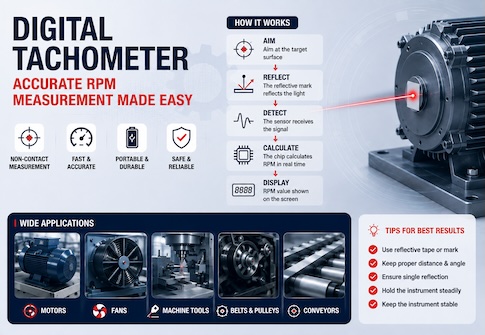
A laser tachometer does not measure the “speed of the laser.” Instead, it directs a laser beam toward a reflective marker attached to the rotating component. Each time the marker passes through the measurement point, the reflected light changes significantly. The instrument detects these periodic changes, converts them into electrical pulses, and calculates rotational speed.
The basic measurement process can be summarized as:
Laser emission → reflective marker passes the beam → reflected light is detected → pulse signal is generated → rotational frequency is calculated → RPM is displayed.
Key Points
● A laser tachometer is a non-contact instrument and normally does not need to touch the rotating component.
● A reflective tape or another optically distinct marker is generally placed on the rotating surface.
● Each time the reflective marker passes through the laser spot, the instrument detects a significant change in reflected light.
● The optical detection circuit converts the reflected-light variation into electrical pulses.
● The instrument calculates rotational frequency from the number or timing of pulses and converts the result into RPM.
● The laser primarily provides a directional and stable light source; it does not directly determine rotational speed.
● Reflective marker quantity, measuring distance, measuring angle, ambient light, and surface reflectivity can all affect measurement stability.
What Is a Laser Tachometer?
A laser tachometer is generally a digital, non-contact tachometer that uses a laser as its optical measurement source. It can also be regarded as a common type of photoelectric tachometer.
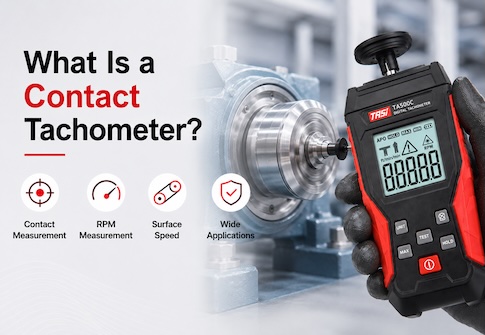
Unlike a contact tachometer, which requires a cone tip, contact adapter, or wheel to physically touch the rotating shaft or surface, a laser tachometer can measure rotational speed from a certain distance. This makes it particularly suitable for high-speed components, difficult-to-access equipment, and applications where mechanical contact is impractical.
The primary measurement unit is usually RPM (revolutions per minute). For example, a reading of 1500 RPM means that the measured component is rotating approximately 1500 revolutions per minute.
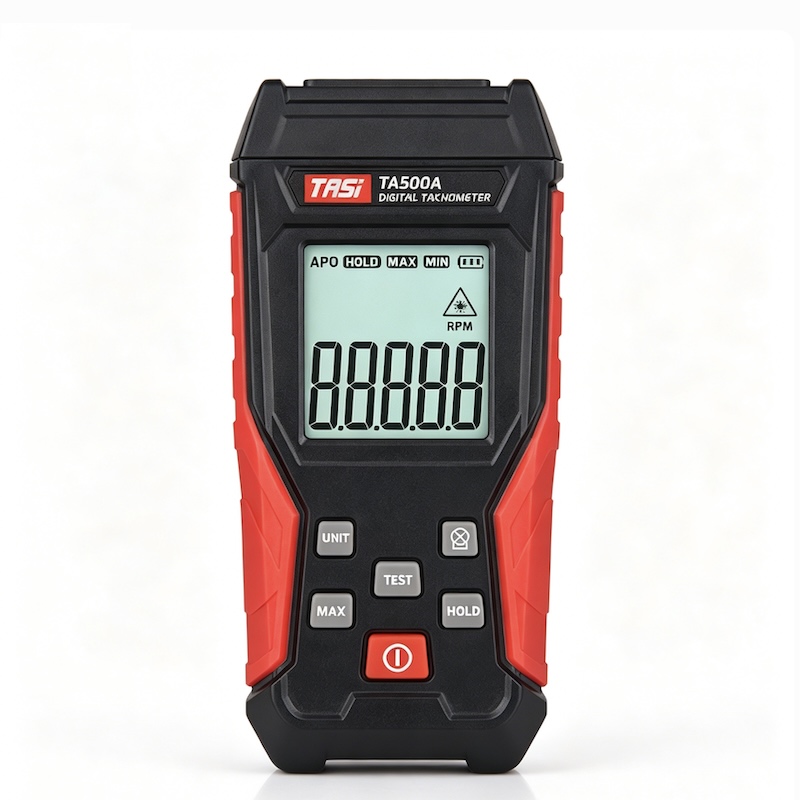
A typical laser tachometer consists of a laser emitter, optical receiver, signal-conditioning circuit, timing and processing unit, and digital display.
Core Operating Principle of a Laser Tachometer
The key principle is not to continuously track the physical position of the rotating component, but to detect a recurring optical event during each revolution.
Before measurement, a small piece of reflective tape is generally attached to a shaft, disc, pulley, or other rotating surface. The reflective marker has significantly different optical reflectivity from the surrounding surface.
During operation, the tachometer directs a laser beam toward the measurement area. When the ordinary surface passes through the beam, the returned light level is relatively low. When the reflective marker reaches the laser spot, considerably more light is reflected toward the instrument.
As the component continues rotating, the optical receiver therefore detects a periodic variation in reflected-light intensity.
If there is one reflective marker per revolution:
● The first detection of the marker generates one valid pulse.
● After one complete revolution, the marker returns to the measurement point and generates the next pulse.
● The time interval between two consecutive pulses approximately corresponds to one revolution.
By continuously detecting these pulses, the instrument can determine rotational frequency and calculate RPM.
What Does the Laser Emitter Do?
The laser emitter provides a stable, concentrated light beam directed toward the rotating target.
Compared with a widely dispersed light source, a laser offers good directionality and a relatively concentrated spot. This makes it easier to illuminate a specific reflective marker and helps the operator identify the measurement point.
The laser itself does not directly “measure” rotational speed. Its primary function is to act as the active illumination source.
The actual measurement chain is:
● The laser illuminates the target.
● The reflective marker creates a periodic increase in reflected light.
● The optical sensor detects the light variation.
● The electronic circuit identifies the periodic signal.
● The processor calculates RPM from pulse frequency or pulse interval.
For this reason, the laser spot must remain reliably aligned with the path of the reflective marker.
Why Is Reflective Tape Usually Required?
Many rotating shafts, discs, and pulleys have relatively uniform surfaces. Without a clearly distinguishable optical feature, the amount of reflected light may change very little during rotation, making it difficult for the instrument to identify individual revolutions.
Reflective tape creates a clearly defined optical reference point.
Because the tape and surrounding surface have different reflectivity, the receiver detects a distinct signal change whenever the tape passes through the laser beam.
A suitable reflective marker should provide:
● A clear reflectivity difference from the surrounding surface.
● Sufficient area for reliable laser illumination.
● Secure attachment, especially at high rotational speeds.
● A single, clearly identifiable reflective region to avoid multiple pulse detections.
For conventional RPM measurement, one reflective marker per revolution is generally the simplest configuration.
How Is Reflected Light Converted into a Speed Signal?
After the laser beam is reflected from the rotating surface, part of the reflected light returns to the instrument's optical receiver.
A photoelectric sensor converts variations in received light intensity into electrical signals. When the reflective marker enters the laser spot, the signal level increases; when it leaves, the signal level decreases.
The raw signal normally requires further processing because actual operating environments may introduce ambient light, stray reflections, electrical noise, or vibration-related disturbances.
The signal may therefore pass through amplification, filtering, threshold detection, and pulse shaping.
The resulting signal becomes a series of relatively clean electrical pulses:
One valid reflection → one valid pulse.
The processor can then measure pulse frequency or the time interval between adjacent pulses to determine rotational speed.
How Does a Laser Tachometer Calculate RPM?
Assume that one valid reflective pulse is generated during each revolution. In this case, the detected pulse frequency corresponds directly to rotational frequency.
For example, if the instrument detects 25 valid pulses per second, the component is rotating approximately 25 revolutions per second.
Since one minute contains 60 seconds:
25 × 60 = 1500 RPM
The rotational speed is therefore approximately 1500 RPM.
Some tachometers count pulses over a defined measurement interval, while others calculate speed from the time between consecutive pulses. Digital filtering and averaging may also be used to stabilize the displayed value.
Why Does the Number of Reflective Markers Matter?
For ordinary RPM measurement, it is generally advisable to use one effective reflective marker per revolution.
This is because the instrument fundamentally measures the frequency of valid reflection events.
For example, if a rotating component is actually running at 1000 RPM and has one reflective marker, one pulse is produced per revolution and the displayed value can correspond directly to the actual speed.
If two equally detectable reflective markers are positioned around the same circumference, the instrument may detect two pulses per revolution.
If it interprets each pulse as one revolution, the displayed value may be approximately 2000 RPM.
Multiple reflective areas should therefore be avoided unless the instrument or measurement method is specifically configured to compensate for them.
Why Can a Laser Tachometer Measure Without Contact?
The measurement relies on optical signals rather than mechanical contact.
The required optical path is essentially:
Laser tachometer → laser beam → reflective marker → reflected light → optical receiver.
As long as the laser can illuminate the target and sufficient reflected light returns to the receiver, rotational speed can be measured without touching the rotating component.
This method offers several advantages:
● No additional mechanical load is applied to the shaft.
● It is suitable for relatively high rotational speeds.
● A safer distance can be maintained from moving parts.
● Measurement is not affected by variations in contact pressure.
● Difficult-to-access rotating components can often be measured more conveniently.
However, non-contact measurement does not mean unlimited measuring distance. The usable range depends on the optical system, target reflectivity, ambient conditions, and the specifications of the instrument.
What Factors Affect Laser Tachometer Accuracy?
Although laser tachometers are relatively straightforward to operate, optical measurement can be affected by setup and environmental conditions.
● Condition of the reflective marker: A marker that is too small, dirty, damaged, wrinkled, or poorly attached may produce an unstable signal.
● Laser spot position: The laser should consistently intersect the path of the marker. Edge illumination may cause intermittent detection.
● Measuring distance: Beyond the specified effective range, the returned signal may become too weak for stable measurement.
● Measurement angle: An unsuitable angle may reduce the amount of reflected light reaching the receiver.
● Ambient light: Strong sunlight, flickering light sources, or other intense illumination may interfere with optical detection.
● Surface reflectivity: Polished metal or other highly reflective areas may be mistaken for the intended marker.
● Mechanical vibration: Excessive movement of the instrument or target can cause the laser spot to move away from the required position.
● Multiple reflective features: More than one strong reflection per revolution can generate extra pulses and produce an incorrectly high reading.
How to Use a Laser Tachometer Correctly
For more stable and reliable measurements:
● Confirm that the rotating component is suitable for non-contact RPM measurement.
● Clean the intended marker area if necessary and attach a suitable piece of reflective tape.
● Ensure that the marker is securely fixed, particularly on high-speed equipment.
● Run the equipment at the operating condition to be measured.
● Aim the laser tachometer at the path of the reflective marker.
● Adjust the instrument so that the laser spot reliably intersects the marker.
● Maintain an appropriate measurement distance and angle.
● Keep the instrument steady and wait until the display stabilizes before recording the RPM value.
● If the reading is obviously abnormal, check for additional reflective points, incorrect laser alignment, or optical interference.
When measuring high-speed rotating machinery, always maintain an appropriate safety distance and never position hands or the instrument unnecessarily close to moving parts.
What Is the Relationship Between a Laser Tachometer and a Photoelectric Tachometer?
From a measurement-principle perspective, a laser tachometer is essentially a type of photoelectric non-contact tachometer.
Both technologies determine speed by detecting periodic optical signals produced by a rotating component.
The term “laser tachometer” emphasizes the use of a laser as the active illumination source. Because the laser provides good directionality and a clearly visible measurement spot, it is widely used in handheld digital tachometers.
A laser tachometer can therefore be described as:
A non-contact tachometer that uses laser illumination and photoelectric reflection detection to determine rotational speed.
What Equipment Can Be Measured with a Laser Tachometer?
Typical applications include:
● Motor shafts.
● Fans and blowers.
● Pumps and drive shafts.
● Machine-tool spindles.
● Pulleys.
● Rotating discs.
● Centrifugal equipment.
● Laboratory rotating machinery.
● Rotating components in industrial drive systems.
Non-contact laser measurement is particularly useful for high-speed, difficult-to-access, or mechanically sensitive rotating equipment.
If the target is not visible, cannot accept a reflective marker, or is subject to severe optical interference, another rotational speed measurement method may be more appropriate.
FAQ
Does a laser tachometer always require reflective tape?
Not necessarily in every application, but for conventional handheld laser tachometers, reflective tape generally provides a clearer and more stable periodic optical signal and is therefore widely recommended.
Can a laser tachometer measure a motor shaft directly?
Yes, provided there is an accessible line of sight and a suitable reflective marker can be used. A safe distance must always be maintained when measuring high-speed shafts.
Why is there no reading even though the laser is aimed at the shaft?
Possible causes include insufficient reflected light, absence of a clear reflective marker, incorrect laser alignment, unsuitable measuring distance, or strong ambient-light interference.
Why is the displayed RPM twice the actual speed?
A common cause is the presence of two detectable reflective areas per revolution. The instrument may interpret both as separate revolutions.
Does the laser itself determine measurement accuracy?
No. The laser provides the measurement light source, while overall accuracy also depends on the optical receiver, signal processing, timing accuracy, marker quality, measurement geometry, and environmental conditions.
Can a laser tachometer measure very high rotational speeds?
Many laser tachometers support wide RPM ranges, but the maximum measurable speed depends on the specific instrument. Always refer to the product's specified measurement range.
Conclusion
The operating principle of a laser tachometer is based on converting mechanical rotation into measurable periodic optical pulses.
The instrument emits a laser beam toward a rotating component. Each time the reflective marker passes through the laser spot, the reflected-light intensity changes significantly. The photoelectric sensor converts this variation into electrical pulses, and the internal processor calculates rotational speed from the pulse frequency or interval before displaying the result in RPM.
The measurement chain can therefore be summarized as:
Rotational motion → periodic reflection → photoelectric signal → pulse detection → frequency calculation → RPM display.
Correct reflective-marker placement, appropriate measuring distance and angle, and avoidance of unwanted reflections and strong ambient-light interference are essential for stable and reliable results. Laser tachometers are therefore widely used for motors, fans, spindles, and other rotating machinery in industrial maintenance, commissioning, and equipment inspection.