Introduction
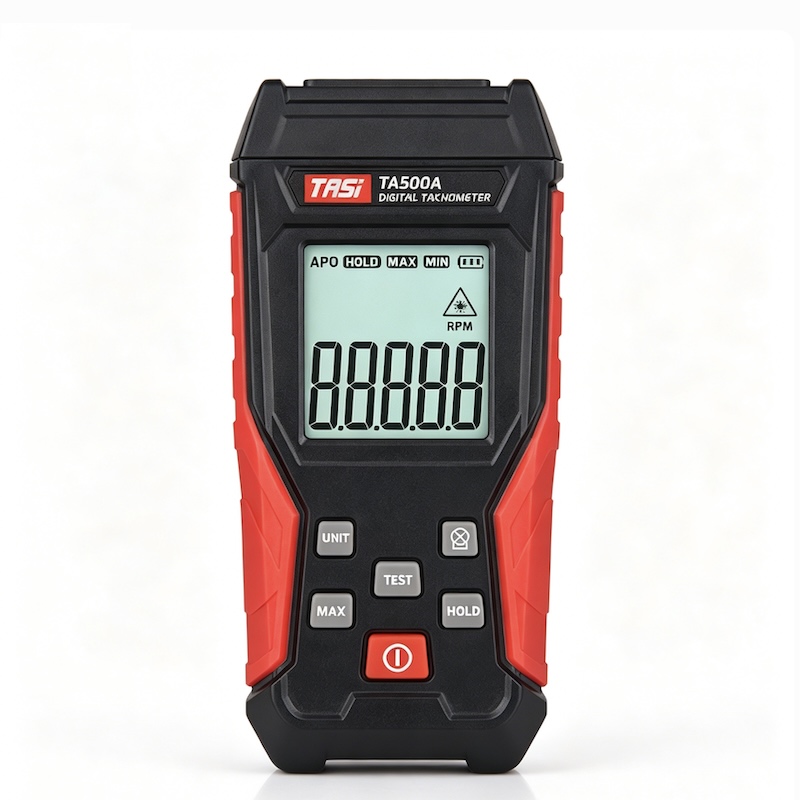
When measuring the speed of a motor shaft, fan, pulley, coupling, or other rotating component with a laser or photoelectric tachometer, a small piece of reflective tape is often applied to the rotating surface first. This raises a common question: if the tachometer already emits a laser or light beam, why is reflective tape necessary?
The reflective tape is not primarily an aiming target. Its main purpose is to create a clear, repeatable change in reflected light that the optical sensor can distinguish from the surrounding surface.
Each time the reflective mark passes through the measuring beam, the tachometer detects a strong optical change. These repeated signals are converted into pulses, which the instrument uses to calculate rotational speed.
For non-contact tachometers based on reflective optical sensing, the quality of this reflected signal has a direct effect on measurement stability.
Key Points
● Reflective tape creates a strong and repeatable reflected-light signal; it is not simply a laser aiming mark.
● With one reflective mark, one complete revolution normally produces one detectable optical pulse.
● The tachometer calculates RPM from the pulse frequency or the time interval between pulses.
● Dark, rough, low-reflectivity, or visually irregular surfaces benefit most from reflective tape.
● In conventional one-pulse-per-revolution measurement, only one reflective mark should normally be used.
● The tape should be firmly attached, flat, and positioned where the measuring beam can reliably detect it.
What Does Reflective Tape Do in RPM Measurement?
Photoelectric and laser non-contact tachometers typically contain a light source, optical receiver, photosensor, and signal-processing circuitry. During measurement, the instrument directs a beam toward the rotating surface and monitors the reflected light returning to the sensor.
The natural reflectivity of a rotating surface may be highly inconsistent. Black plastics can absorb much of the incident light, rough metals may scatter it, and curved shafts can continuously change the reflection angle as they rotate.
If the tachometer relies only on these natural reflections, it may be difficult to distinguish one complete revolution from random changes in reflected light.
Reflective tape creates a high-contrast optical reference.
● When the beam strikes the normal surface, the returned signal is relatively weak.
● When it strikes the reflective tape, the returned signal increases significantly.
● As the tape repeatedly passes through the measuring beam, the sensor detects periodic changes in reflected light.
● The electronics convert these changes into pulses and calculate rotational speed.
In practical terms, reflective tape provides an easily identifiable optical reference mark on the rotating component.
How Does a Tachometer Use Reflective Tape to Calculate RPM?
RPM stands for revolutions per minute.
If one reflective mark is applied to a rotating shaft, that mark normally passes the measuring beam once during every full revolution. Each detectable passage can therefore be registered as one pulse.
For a one-mark setup:
● 1 revolution = 1 valid pulse
● 100 revolutions = 100 valid pulses
● The instrument converts the detected pulse rate into RPM
Depending on the tachometer design, the internal electronics may calculate speed from the number of pulses detected over a defined time interval or from the time between consecutive pulses.
This is why the reflected signal needs to be clear and repeatable. Weak, unstable, or multiple reflections per revolution may cause fluctuating or incorrect readings.
Why Not Measure Directly from the Rotating Surface?
In some cases, a rotating component may already have a highly reflective feature that can be detected by the tachometer. However, real industrial surfaces are often unsuitable for reliable optical detection.
Common examples include:
● Black or dark surfaces that absorb a large portion of the incident light.
● Rough surfaces that scatter reflected light in multiple directions.
● Polished metal that produces strong specular reflections whose direction changes with angle.
● Surfaces containing labels, scratches, oil, markings, or multiple colours that may generate several optical transitions.
● Rotating components exposed to changing ambient light.
Using dedicated reflective tape creates a defined reference point with greater optical contrast and repeatability.
Its purpose is therefore not merely to make the target more visible, but to help the tachometer identify each complete revolution reliably.
Why Is Only One Reflective Mark Normally Used?
For conventional measurement based on one pulse per revolution, one effective reflective mark should normally be present on the measured circumference.
If two reflective marks are applied to the same rotating component, the sensor may detect two pulses during each revolution. Unless the instrument is configured to compensate for two pulses per revolution, the indicated speed may be approximately twice the actual rotational speed.
For example, if the actual speed is 1,000 RPM:
● One reflective mark may produce approximately 1,000 pulses per minute.
● Two effective reflective marks may produce approximately 2,000 pulses per minute.
● Without pulse-per-revolution compensation, the tachometer may display approximately 2,000 RPM.
For normal tachometer measurements, the rotating surface should therefore have one dominant reflective reference point unless the instrument specifically supports a different pulse configuration.
When Is Reflective Tape Particularly Important?
Reflective tape is generally recommended whenever a non-contact tachometer uses reflected light as its sensing principle.
It is especially useful in the following situations:
● Black rotating shafts: Dark surfaces often return insufficient light for reliable detection.
● Rough metal surfaces: Scattered reflections can reduce the amount of light reaching the receiver.
● High-speed rotating components: Reliable pulse detection becomes increasingly important as rotational speed increases.
● Visually irregular surfaces: Labels, markings, oil, or different surface finishes may create unwanted optical transitions.
● Longer measuring distances: The amount of reflected light reaching the sensor may decrease as distance increases.
● Unstable readings: If distance and alignment are correct but the reading still fluctuates, the reflective mark should be checked.
Reflective tape improves signal recognition, but it does not replace correct measurement distance, beam alignment, or proper instrument operation.
Where Should Reflective Tape Be Applied?
The reflective tape should be attached to a surface that rotates at exactly the speed being measured and can be clearly detected by the tachometer.
Possible locations include:
● An accessible section of a motor shaft.
● A coupling rotating at the same speed as the shaft.
● A pulley or rotating disc.
● A fan hub, impeller, or another component directly linked to the target rotation.
The selected point must represent the actual rotational speed of interest.
If the measured component is downstream of a gearbox, belt drive, or gear transmission, its speed may differ from the motor speed. The measurement location must therefore be selected according to the specific mechanical system.
How Should Reflective Tape Be Applied and Used?
Although reflective tape is small, correct application has a direct effect on signal quality.
● Stop the equipment before applying the tape. Never attempt to attach reflective tape to a rotating component.
● Clean dust, oil, moisture, and other contamination from the mounting surface.
● Apply the tape flat and securely, avoiding lifted edges, folds, or damage.
● Avoid using an excessively large reflective area that may create an unnecessarily long or irregular pulse.
● Normally use only one main reflective mark for one-pulse-per-revolution measurement.
● Maintain the measuring distance and angle recommended for the tachometer.
● Allow the reading to stabilise before recording the result.
For high-speed machinery, secure adhesion is particularly important because centrifugal force can cause poorly attached tape to detach.
Does a Larger Reflective Mark Improve Measurement?
Not necessarily.
The reflective area must be large enough for the instrument to detect it reliably, but increasing its size does not automatically improve performance.
If a reflective strip covers too much of the rotating circumference, the strong reflected signal may remain present for a larger portion of each revolution. Under some conditions, this can reduce the definition of the pulse transition.
A suitable reflective mark should:
● Be detected consistently.
● Provide a clear contrast with the surrounding surface.
● Produce one dominant signal per revolution.
● Meet the size and application recommendations of the tachometer manufacturer.
Dedicated reflective material is therefore preferable to simply using the largest available bright surface.
Can White Paper or Ordinary Tape Replace Reflective Tape?
Ordinary white paper, white adhesive tape, or glossy tape is not recommended as a standard replacement for dedicated reflective tape.
Some light-coloured materials may produce a detectable reflection at short distances and low speeds, but their optical performance, directional reflection, surface consistency, and adhesion are not controlled for tachometer measurement.
Dedicated reflective tape offers several advantages:
● More consistent and pronounced optical reflection.
● Greater contrast against typical machine surfaces.
● More reliable adhesion to rotating components.
● Better detection within the normal measuring range of the instrument.
For repeatable maintenance measurements or recorded speed data, using the recommended reflective material is preferable.
Does Reflective Tape Affect Measurement Accuracy?
Reflective tape does not normally determine the specified accuracy of the tachometer itself, but it can strongly affect the reliability of signal detection.
A clean, correctly positioned reflective mark helps the instrument receive stable pulses under normal operating conditions.
Measurement problems may occur when:
● The tape is loose or partially detached.
● Oil, dust, or dirt reduces its reflectivity.
● The reflective surface is damaged.
● More than one strong reflective point exists per revolution.
● The beam does not reliably intersect the reflective area.
● The measuring distance exceeds the instrument's effective range.
● The measurement angle results in insufficient returned light.
If the reading fluctuates, suddenly doubles, appears too low, or disappears intermittently, both the instrument setup and the reflective mark should be inspected.
What Safety Precautions Apply When Using Reflective Tape?
RPM measurement is often performed near motors, couplings, fans, pulleys, shafts, and other high-speed rotating machinery, so safe working practices are essential.
● Apply or replace reflective tape only when the machine is stopped and secured against unintended movement.
● Never touch a rotating shaft, coupling, fan, or pulley.
● Do not move the tachometer unnecessarily close to rotating machinery simply to obtain a stronger signal.
● Maintain a safe distance while remaining within the instrument's specified measuring range.
● Make sure the reflective tape is firmly attached before operation.
● When using a laser tachometer, never direct the laser beam toward a person's eyes.
One of the principal advantages of non-contact RPM measurement is the ability to obtain speed data from a safe distance. This advantage should not be compromised during setup or measurement.
FAQ
Q: Do all tachometers require reflective tape?
No. Reflective tape is mainly used with non-contact tachometers that operate by photoelectric or laser-reflection sensing. Contact tachometers use a contact tip or measuring wheel and normally do not require reflective tape.
Q: Does a laser tachometer always require reflective tape?
For most handheld laser tachometers that detect reflected optical pulses, using reflective tape in accordance with the manufacturer's instructions is recommended. Some naturally reflective surfaces may produce usable signals, but a dedicated reflective mark generally improves measurement stability.
Q: Why does the reading sometimes become twice the actual speed after applying reflective tape?
Check whether there are two detectable reflective areas within one revolution. Two pieces of reflective tape, or one tape mark plus another highly reflective surface feature, may generate two pulses per revolution.
Q: Can dirty reflective tape still be used?
If oil, dust, or contamination significantly reduces reflectivity, the tape should be cleaned or replaced. Weak reflections can cause unstable or missing readings.
Q: Should the reflective tape be placed at the centre or edge of the rotating part?
It does not have to be at the geometric centre. The important requirement is that it rotates synchronously with the component being measured and repeatedly passes through the sensing beam.
Q: Does higher rotational speed place greater demands on the reflective tape?
Yes. At higher speeds, the mark must remain securely attached and provide a clear optical contrast. Secure mounting is also essential to prevent the tape from detaching under centrifugal force.
Conclusion
Reflective tape is an important optical reference for photoelectric and laser-based non-contact RPM measurement. By creating a clearly defined high-reflectivity area on the rotating component, it enables the tachometer to convert each revolution into a stable, detectable optical pulse and calculate RPM from the resulting pulse frequency.
Its role is therefore more important than simply providing a laser target. It improves the reliability with which the instrument distinguishes individual revolutions, particularly on dark, rough, low-reflectivity, or visually irregular surfaces.
For reliable measurement, use a suitable reflective tape, maintain one dominant reflective reference per revolution, and observe the correct measuring distance, beam position, and angle. Reflective tape should always be applied or replaced while the equipment is stopped and in a safe condition.