Introduction
When using an infrared thermometer, it is easy to assume that the temperature displayed by the instrument comes directly from the exact point illuminated by the laser.
That is not the case.
The laser on an infrared thermometer is primarily an aiming aid. It indicates approximately where the instrument is pointing, while the actual temperature measurement is based on infrared radiation collected from an area within the optical field of view.
As a result, even when the laser dot is positioned precisely on the target, the reading may still be affected by surrounding surfaces if the target is too small or the measurement distance is too great.
Understanding the difference between the laser aiming point and the actual measurement area is essential for reliable non-contact temperature measurement.
Key Points
● The laser is primarily used for aiming and does not perform the temperature measurement.
● An infrared thermometer measures infrared radiation emitted from an area of the target surface rather than from a geometrically infinitesimal point.
● The measurement area generally becomes larger as the distance from the target increases.
● The D ratio defines the relationship between measurement distance and spot diameter.
● A laser dot located on the target does not guarantee that the entire infrared measurement area is within the target.
● For more reliable results, the target should be significantly larger than the measurement spot.
What Is the Actual Purpose of the Laser Dot?
Many handheld infrared thermometers include a laser aiming system. When the measurement trigger is pressed, a visible laser dot appears on the target surface.
Its main functions are to:
● Indicate where the thermometer is approximately aimed;
● Help the user locate the intended measurement area quickly;
● Improve positioning when measuring from a distance;
● Reduce obvious aiming errors.
However, the laser itself is not the temperature sensor.
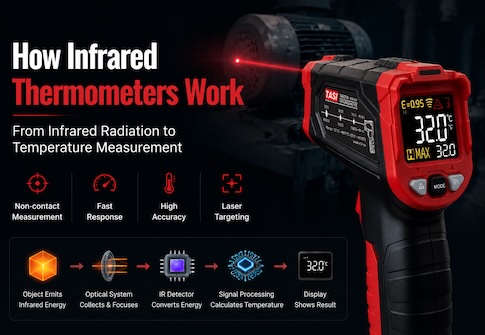
Infrared thermometers do not determine temperature by analysing reflected laser light. Instead, an infrared detector collects thermal radiation naturally emitted from the target surface. The instrument then calculates surface temperature based on the detected radiation, emissivity settings, and other measurement parameters.
For most infrared thermometers in which the laser is used only for aiming, temperature measurement can therefore continue even when the laser function is switched off.
An Infrared Thermometer Actually Measures an Area
The optical system of an infrared thermometer has a defined field of view.
This field of view can be visualised as an area that generally becomes wider as the distance from the instrument increases. The infrared detector therefore receives radiation from a surface area rather than from a single mathematical point.
For example, when an infrared thermometer is aimed at a large metal plate, the visible laser dot may be only a few millimetres across, while the actual area contributing to the temperature reading may be several centimetres in diameter.
The displayed temperature therefore represents the infrared radiation collected within the instrument's field of view rather than the temperature of an infinitely small point under the laser.
This is why infrared thermometer specifications commonly refer to terms such as spot size, target area, and field of view.
Why Does the Measurement Area Increase with Distance?
An infrared thermometer's optical system receives radiation within a defined viewing angle.
At a short distance, this field of view covers a relatively small surface area. As the distance increases, the same viewing angle covers a progressively larger area.
In practical terms:
● Shorter distance → smaller measurement area;
● Greater distance → larger measurement area;
● Excessive distance → greater risk of including surrounding background surfaces.
This is particularly important when measuring small parts, wires, pipes, electronic components, or mechanical components.
Even if the laser dot remains centred on the target, an excessively large measurement distance may cause the actual infrared spot to extend beyond the target edges.
The D** Ratio Determines the Measurement Spot Size**
One of the most important optical specifications of an infrared thermometer is the D** ratio — Distance-to-Spot Ratio**.
For example, if an infrared thermometer has a D ratio of 12:1, the relationship can be approximately understood as:
● At a distance of about 120 mm, the spot diameter is about 10 mm;
● At a distance of about 600 mm, the spot diameter is about 50 mm;
● At a distance of about 1200 mm, the spot diameter is about 100 mm.
These examples are intended to explain the basic relationship. Actual optical characteristics should always be confirmed using the manufacturer's D diagram and product specifications.
This also demonstrates why laser dot size and infrared measurement spot size are not the same thing.
Even at a distance of one metre, the laser dot may remain visually small while the infrared measurement area may already cover several centimetres.
Why Can the Reading Still Be Incorrect When the Laser Is on the Target?
A common situation is that the laser dot is clearly positioned in the centre of the target, yet the measured temperature differs significantly from the expected value.
One possible reason is that the target does not completely fill the thermometer's field of view.
Consider the measurement of a narrow hot pipe.
The laser dot may be correctly positioned on the pipe, but if the thermometer is too far away, the infrared measurement area may also include:
● The hot pipe;
● A wall behind the pipe;
● Nearby equipment;
● Other background surfaces.
The infrared detector then receives combined radiation from several surfaces rather than only from the intended target.
If the target is significantly hotter than the background, the measured value may be lower than the actual target temperature. If hotter surrounding surfaces enter the field of view, the opposite effect may occur.
For this reason, measurement reliability cannot be determined solely by checking whether the laser dot is on the target. The entire infrared measurement spot must also remain within the target area.
The Target Should Be Larger Than the Measurement Spot
To reduce background influence, the target should fully cover the thermometer's optical field of view.
In practice, it is preferable not to use a target that is only exactly the same size as the theoretical spot diameter.
A more reliable approach is to:
● Move as close to the target as practical;
● Ensure the target is clearly larger than the measurement spot;
● Aim toward the centre of the target;
● Avoid measuring directly at target edges;
● Pay particular attention to the D ratio when measuring small objects.
For example, a large heated plate may still completely fill the field of view at a moderate distance.
A small wire, narrow pipe, or electronic component, however, generally requires a much shorter measurement distance.
Why Can a Single Laser Not Indicate the Spot Boundary?
Many handheld infrared thermometers use a single-laser aiming system.
A single laser typically indicates the approximate centre or direction of the measurement area, but one point cannot show the full diameter of the infrared measurement spot.
For example, the visible laser dot may be only 2–3 mm in diameter while the actual infrared measurement area may already be 30 mm, 50 mm, or larger.
The visible size of the laser spot should therefore never be used to estimate the infrared measurement area.
Instead, refer to the product documentation for:
● D ratio;
● Spot-size diagram;
● Optical resolution;
● Recommended measurement distance.
These specifications provide a much more meaningful indication of the actual measurement area.
Does a Dual-Laser Infrared Thermometer Show the Exact Measurement Area?
Some infrared thermometers use dual-laser aiming systems.
Depending on the optical design, the two laser points may help indicate the approximate measurement area and may make target positioning easier than with a single-laser system.
However, dual-laser designs are not identical between manufacturers or models.
On some instruments, the laser points are intended to indicate approximate spot boundaries, while other instruments use different aiming geometries.
It should therefore not be assumed that the area between two laser points always corresponds exactly to the infrared measurement area.
The optical diagram and operating instructions for the specific model should always be consulted.
Laser Aiming Can Be Particularly Misleading on Small Targets
Small targets are among the applications in which laser aiming is most easily misunderstood.
Typical examples include:
● PCB components;
● Wires and cables;
● Small bearings;
● Copper tubing;
● Narrow pipes;
● Electrical terminals;
● Small heating elements.
When the laser dot is visibly positioned on such a target, it may appear that the thermometer is measuring only that component.
However, if the infrared spot is larger than the target, surrounding surfaces will still contribute to the reading.
The smaller the target, the more important the thermometer's D performance and measurement distance become.
Do the Laser Dot and Infrared Detection Area Always Coincide?
Not necessarily.
The laser emitter and infrared optical system are normally separate components inside the instrument. As a result, some infrared thermometers may show a certain amount of offset between the laser indication and the infrared field of view, particularly at very short measurement distances.
Their relative positions may also vary with distance.
When measuring very small targets at close range, the laser dot should therefore not be treated as an exact representation of the infrared detection position.
Laser alignment, recommended measurement distance, and optical geometry should be confirmed in the documentation for the specific instrument.
How Should the Laser Aiming Function Be Used Correctly?
Laser aiming remains a very useful feature when its purpose is correctly understood.
Recommended practice includes:
● Use the laser first to establish the general measurement direction;
● Estimate the measurement spot at the current distance using the D ratio;
● Confirm that the entire measurement spot lies within the target;
● Reduce the measurement distance for small targets;
● Avoid measuring directly at the edge of a target;
● Pay particular attention to field-of-view coverage when the target and background temperatures differ significantly;
● Never estimate the infrared spot size from the visible laser dot alone.
A useful principle to remember is:
The laser tells you approximately where the thermometer is aimed; the D** ratio helps determine how large an area the instrument is actually measuring.**
FAQ
● Is the laser dot the actual temperature measurement point?
No. The laser is primarily an aiming aid. Temperature is determined from infrared radiation collected over an area within the detector's field of view.
● Does a smaller laser dot mean a smaller measurement area?
Not necessarily. Laser spot size and infrared measurement spot size are separate characteristics. The actual measurement area should be determined from the D ratio and optical specifications.
● Why is the reading more easily affected when measuring from farther away?
Because the infrared measurement spot generally increases with distance. If the target does not completely fill the spot, radiation from surrounding surfaces may influence the reading.
● Can the thermometer still measure when the laser is switched off?
For most infrared thermometers in which the laser is used only as an aiming aid, yes. The laser system and infrared temperature measurement system operate independently.
● Do two laser dots define the exact measurement area?
This depends on the specific model. Some dual-laser systems are designed to indicate an approximate spot boundary, but optical designs vary between products. Refer to the manufacturer's optical diagram.
● How can I prevent surrounding surfaces from affecting the reading?
Reduce the measurement distance, ensure the target is substantially larger than the infrared spot, and aim toward the centre of the target.
Conclusion
The laser dot on an infrared thermometer does not represent the actual temperature measurement area. Its primary purpose is to assist with aiming and target positioning.
The actual measurement area is determined by the infrared optical system. As measurement distance increases, the measurement spot generally becomes larger. Therefore, simply placing the laser dot on the target does not mean the instrument is measuring only that point.
Reliable infrared temperature measurement requires consideration of the D** ratio, target size, and measurement distance**, while ensuring that the target sufficiently fills the instrument's field of view.
Understanding the difference between the laser aiming point and the infrared measurement spot helps reduce measurement errors caused by background interference and incorrect target positioning.