Introduction
Sound is not defined only by how loud it is. It also differs significantly in pitch. For example, the low rumble of an engine sounds very different from a high-pitched electronic tone, even when both have similar sound pressure levels. One of the main reasons is their different frequencies.
Sound frequency is measured in hertz (Hz) and describes how rapidly a sound wave oscillates. Understanding frequency helps explain pitch, wavelength, sound propagation, human hearing characteristics and the information provided by sound level meters and frequency-analysis instruments.
Key Takeaways
● Sound frequency is the number of complete oscillation cycles a sound wave makes per second, measured in Hz.
● 1 Hz means one complete cycle per second, while 1000 Hz means 1000 cycles per second.
● In general, lower frequencies are perceived as lower-pitched sounds, while higher frequencies are perceived as higher-pitched sounds.
● Frequency is directly related to wavelength. In the same medium, higher frequency means shorter wavelength.
● Human hearing sensitivity varies with frequency, so sounds with the same sound pressure level can be perceived differently.
● Standard sound level meters mainly measure sound pressure level. Identifying the frequency content of sound requires spectrum, octave-band or similar frequency analysis.
What Is Sound Frequency?
Sound is a mechanical wave. When an object vibrates, it produces periodic pressure variations in the surrounding medium, such as air. These variations propagate outward as sound waves.
Sound frequency is the number of times this periodic variation repeats each second. It is normally represented by the symbol f and measured in hertz (Hz).
● 1 Hz: 1 cycle per second;
● 50 Hz: 50 cycles per second;
● 1000 Hz: 1000 cycles per second;
● 10 kHz: 10000 cycles per second.
The basic relationship is:
f = 1 / T
where f is frequency in Hz and T is the duration of one complete cycle in seconds.
For example, if a sound wave completes one cycle every 0.001 seconds:
f = 1 / 0.001 = 1000 Hz
Frequency therefore describes how fast the sound wave oscillates, not how loud the sound is.
What Do Hz and kHz Mean?
Hz is the standard unit used to express sound frequency. Higher frequencies are commonly expressed in kilohertz (kHz).
● 1 kHz = 1000 Hz;
● 2 kHz = 2000 Hz;
● 10 kHz = 10000 Hz.
For example, a specification stating “1000 Hz calibration signal” refers to an acoustic signal completing 1000 oscillation cycles per second.
Hz and kHz are widely used in acoustics, noise analysis, audio engineering and hearing-related measurements.
What Frequencies Can Humans Hear?
A young person with normal hearing can typically detect frequencies from approximately 20 Hz to 20 kHz.
This is a general reference range rather than an absolute limit. Actual hearing range varies with age, individual hearing ability and other factors. Sensitivity to high frequencies in particular commonly decreases with age.
Typical frequency regions can be broadly understood as follows:
● 20–200 Hz: predominantly low-frequency sounds, such as deep rumbles, large machinery and low musical tones;
● 200 Hz–2 kHz: contains a significant proportion of speech and everyday environmental sounds;
● 2–5 kHz: a range to which human hearing is generally highly sensitive and which is important for speech intelligibility and warning signals;
● 5–20 kHz: high-frequency sounds, often perceived as sharp tones, friction noise or high-frequency electronic sounds.
Frequencies below approximately 20 Hz are generally referred to as infrasound, while frequencies above approximately 20 kHz are referred to as ultrasound.
How Does Frequency Affect Pitch?
Sound frequency is closely related to perceived pitch.
In general:
● Lower frequencies are perceived as lower-pitched sounds;
● Higher frequencies are perceived as higher-pitched sounds.
For example, a 100 Hz pure tone sounds considerably lower than a 1000 Hz tone, while a 5000 Hz tone sounds much higher and sharper.
Frequency and perceived pitch are closely related but are not identical concepts. For simple pure tones, the relationship is straightforward. Real-world sounds such as machinery noise, music and speech usually contain many frequencies simultaneously, making their perceived characteristics more complex.
What Is the Relationship Between Frequency and Wavelength?
Frequency also directly affects wavelength.
Frequency, wavelength and sound speed are related by:
λ = c / f
where λ is wavelength, c is the speed of sound in the medium and f is frequency.
Using a sound speed of approximately 343 m/s in air at room temperature:
● A 100 Hz sound has a wavelength of approximately 3.43 m;
● A 1000 Hz sound has a wavelength of approximately 0.343 m;
● A 10000 Hz sound has a wavelength of approximately 0.0343 m.
In the same medium, lower frequency means longer wavelength, while higher frequency means shorter wavelength.
This difference affects how sound interacts with walls, machinery, buildings and other obstacles.
Why Do Low-Frequency Sounds Diffract More Easily Around Obstacles?
Because low-frequency sound has a longer wavelength, it tends to exhibit stronger diffraction when it encounters obstacles whose dimensions are comparable to or smaller than that wavelength.
In practical environments, this can result in situations such as:
● Low-frequency music or machinery noise remaining audible through or around walls;
● Low-frequency equipment noise propagating over considerable distances;
● High-frequency sounds being more strongly blocked by obstacles and often attenuating more rapidly.
This is one reason low-frequency noise can be particularly challenging to control in buildings, industrial facilities and environmental noise applications.
Does Frequency Affect How Far Sound Travels?
Yes, although propagation distance is not determined by frequency alone. Source level, atmospheric conditions, obstacles, reflections, absorbing materials and the surrounding environment also influence sound propagation.
In many practical conditions, atmospheric absorption is greater at high frequencies than at low frequencies. As distance increases, high-frequency components therefore often decrease more rapidly.
This is why distant music or industrial noise may sometimes be perceived mainly as a low-frequency rumble.
However, it is not correct to assume that low-frequency sound will always travel farther. Actual propagation also depends on source directivity, surrounding structures and environmental conditions.
What Is the Difference Between Frequency and Decibels?
Frequency and decibels describe different characteristics of sound.
● Hz describes how rapidly a sound wave oscillates;
● dB expresses the relative magnitude of an acoustic quantity and, in noise measurement, is commonly used to express sound pressure level.
Therefore, “1000 Hz” and “80 dB” are not interchangeable measurements.
For example:
1000 Hz, 80 dB
This indicates a sound with a frequency characteristic around 1000 Hz and a measured sound pressure level of 80 dB.
Two sounds can both measure 80 dB yet sound very different if their frequency content differs.
Why Can Sounds at the Same Decibel Level Seem Different in Loudness?
Human hearing is not equally sensitive to all frequencies.
At the same physical sound pressure level, the ear is generally more sensitive to frequencies in the mid-frequency range and less sensitive to very low frequencies and frequencies near the upper hearing limit.
As a result, two sounds with the same sound pressure level but different frequencies may not be perceived as equally loud.
This is one reason frequency weighting is used in noise measurement. A-weighting adjusts different frequency components according to characteristics of human hearing and produces the commonly used dBA measurement.
Why Do Real-World Sounds Usually Contain More Than One Frequency?
An ideal pure tone may contain essentially one primary frequency, but most real-world sounds consist of multiple frequencies.
For example, an operating electric motor may include:
● A fundamental frequency associated with rotation;
● Periodic frequencies generated by fan blades;
● Mid- and high-frequency components from bearings and gears;
● Harmonics caused by structural vibration;
● Broadband noise from friction and impacts.
Therefore, knowing only the overall sound level in dB does not fully describe a sound.
To identify the frequencies responsible for a particular noise, frequency analysis is required.
What Is a Sound Spectrum?
A sound spectrum represents a complex sound by separating it into different frequency components and showing how acoustic energy or sound level is distributed across frequency.
For example, a machine may produce an overall noise level of 85 dBA, while spectrum analysis shows:
● A pronounced low-frequency peak around 125 Hz;
● Relatively low sound levels around 1000 Hz;
● A distinct friction-related component around 4000 Hz.
For machine diagnostics, noise-source identification and noise-control work, this information can be more useful than a single overall sound pressure level.
What Are Octave-Band and One-Third-Octave-Band Analysis?
In practical noise measurement, it is often unnecessary to analyse every individual frequency in hertz. Instead, frequencies are grouped into standardized bands.
Common methods include octave-band and one-third-octave-band analysis.
Typical octave-band centre frequencies include:
31.5 Hz, 63 Hz, 125 Hz, 250 Hz, 500 Hz, 1 kHz, 2 kHz, 4 kHz and 8 kHz.
Comparing sound pressure levels across these bands provides a clear indication of where the dominant noise energy is concentrated.
One-third-octave analysis divides the frequency range into narrower bands and therefore provides greater frequency detail.
Can a Standard Sound Level Meter Measure Sound Frequency?
It depends on the instrument.
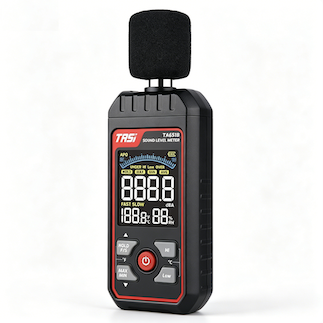
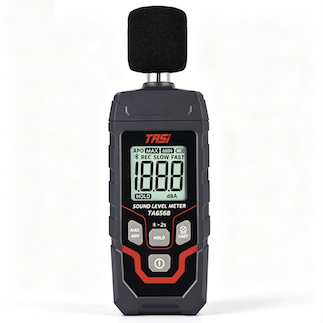
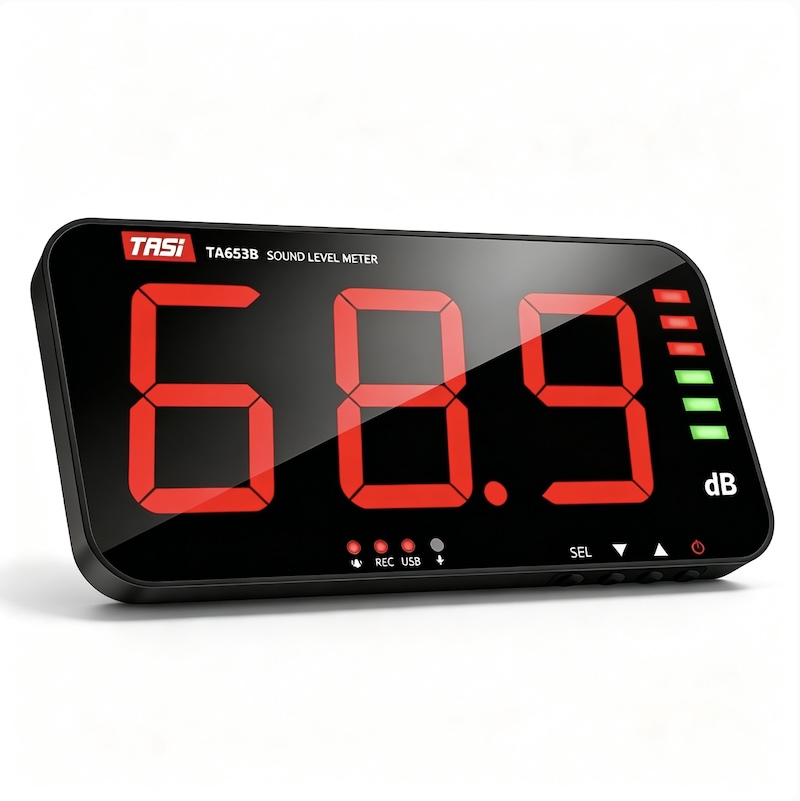
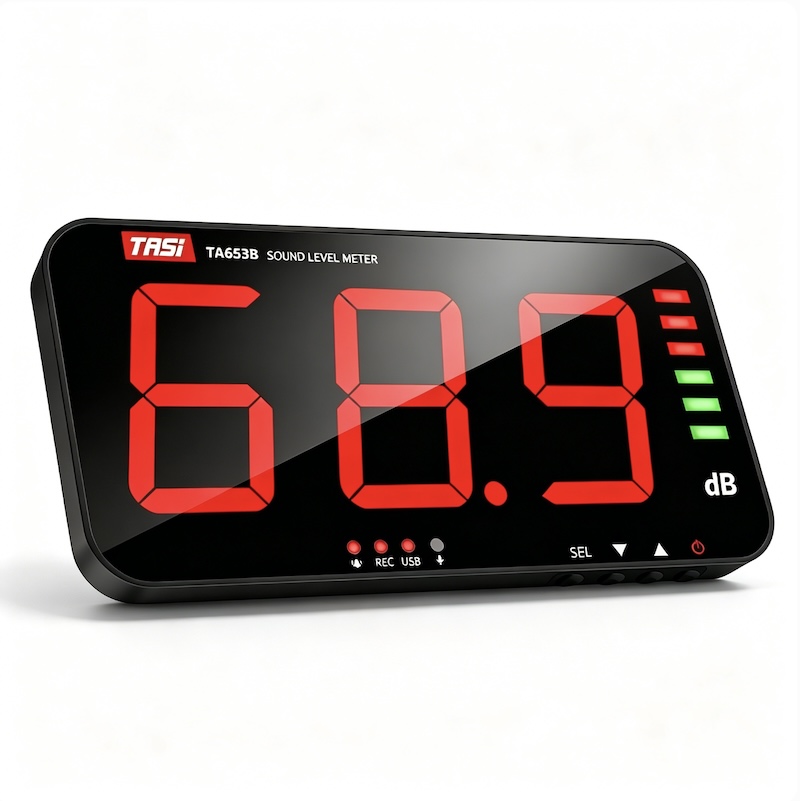
Basic digital sound level meters are mainly designed to measure overall sound pressure level, for example:
65.3 dBA
Such an instrument indicates how high the current sound level is but does not necessarily show which frequencies make up the sound.
Frequency analysis generally requires instruments equipped with functions such as:
● Spectrum analysis;
● Octave-band analysis;
● One-third-octave-band analysis;
● FFT frequency analysis;
● Data logging and analysis software.
Measuring sound level and analysing frequency content are therefore different acoustic measurement tasks.
What Is the Purpose of Frequency Analysis in Noise Measurement?
Overall sound pressure level indicates the general magnitude of noise. Frequency analysis provides additional information about where that noise is concentrated in the frequency domain.
For example, when machinery develops an unusual noise:
● Low-frequency abnormalities may be associated with large structural vibration, rotating components or imbalance;
● Distinct frequency peaks may be associated with rotational speed, blade-pass frequency or gear-mesh frequency;
● Increased high-frequency noise may be associated with friction, leakage or certain mechanical defects.
However, individual frequencies should not automatically be interpreted as specific faults. Proper diagnosis should also consider machine design, rotational speed, operating load and historical measurement data.
Why Is Frequency Important When Measuring Sound?
For many general environmental noise measurements, an overall dBA value provides useful information. Frequency information becomes particularly valuable when:
● Investigating abnormal machinery noise;
● Identifying low- or high-frequency noise sources;
● Comparing the acoustic characteristics of different equipment;
● Designing sound insulation, absorption or noise-control solutions;
● Evaluating building acoustics;
● Analysing fans, motors, compressors and other machinery;
● Performing more detailed occupational or environmental noise assessments.
In noise-control applications, knowing the dominant frequency range is often essential for selecting appropriate sound absorption, sound insulation or vibration-control measures.
FAQ
● Does a higher frequency mean a louder sound?
No. Frequency mainly describes how rapidly the sound oscillates and is closely related to pitch. Loudness-related measurements are generally expressed using sound pressure level. A high-frequency sound can be quiet, while a low-frequency sound can be very loud.
● What does 1000 Hz mean?
It means the sound completes approximately 1000 oscillation cycles per second. 1000 Hz can also be written as 1 kHz.
● What frequency range can humans hear?
Young people with normal hearing can typically perceive approximately 20 Hz to 20 kHz, although the actual range varies between individuals and generally changes with age and hearing condition.
● What is sound below 20 Hz called?
It is generally called infrasound. Although it is normally below the range perceived as conventional pitch, sufficiently high sound pressure levels may still produce other sensations.
● What is sound above 20 kHz called?
It is generally called ultrasound. Ultrasound lies above the typical upper limit of human hearing and is widely used in inspection, ranging, medical applications and ultrasonic cleaning.
● Why does a sound level meter display dBA instead of Hz?
A standard sound level meter is primarily designed to measure overall sound pressure level rather than display a complete frequency spectrum. Frequency analysis requires a meter or analyser with spectrum, octave-band or other frequency-analysis functions.
● Does lower frequency always mean sound travels farther?
No. Low-frequency sound generally has a longer wavelength and often experiences less atmospheric absorption, but actual propagation also depends on the source, environment, obstacles and atmospheric conditions.
Conclusion
Sound frequency is a fundamental physical parameter describing how rapidly a sound wave oscillates and is measured in hertz (Hz). It is closely related to pitch, wavelength, propagation behaviour and human hearing perception.
Frequency and decibels describe different acoustic properties: Hz indicates how fast the sound wave oscillates, while dB is used to express the magnitude of an acoustic quantity, commonly sound pressure level in noise measurement. Overall sound level measurements indicate the general noise magnitude, while frequency analysis reveals how that noise is distributed across frequency.
For environmental noise measurements, understanding frequency helps users interpret dBA values and frequency weighting correctly. In industrial diagnostics and noise control, spectrum, octave-band and one-third-octave-band analysis provide more detailed information about the acoustic characteristics of a sound.