Introduction
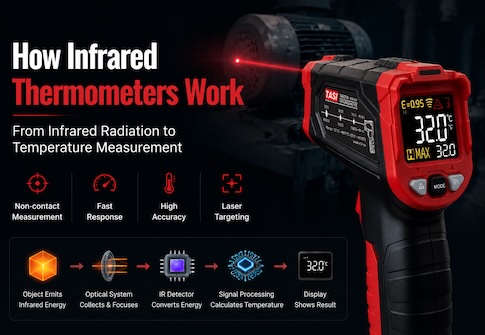
Infrared thermometers determine temperature by detecting infrared radiation from a target surface. However, the radiation received by the instrument does not necessarily originate entirely from the target itself.
For most opaque materials, the surface both emits its own infrared radiation and reflects infrared radiation from the surrounding environment. Walls, heating equipment, furnaces, lighting fixtures, hot pipes, and even people can become sources of background radiation.
The infrared thermometer must therefore account, as far as possible, for both the target's own emission and radiation reflected from the environment. The lower the target emissivity and the more reflective the surface, the greater the potential influence of background radiation.
Key Points
● The radiation received by an infrared thermometer may contain both radiation emitted by the target and radiation reflected from the surroundings.
● For opaque targets, lower emissivity generally corresponds to higher reflectivity.
● High-emissivity materials are usually less sensitive to background radiation, while low-emissivity metallic surfaces are much more susceptible.
● Some infrared temperature measurement instruments allow the reflected background temperature to be entered for compensation.
● Correct emissivity settings, avoiding strong reflected heat sources, and selecting an appropriate measurement angle are important for reducing background-related errors.
What Is Ambient Background Radiation?
Any object above absolute zero emits thermal radiation. In an infrared measurement environment, walls, machinery, pipes, furnaces, personnel, and other surrounding objects all contribute to the radiative environment.
Some of this infrared radiation can strike the target surface and then be reflected toward the infrared thermometer.
Because this reflected radiation does not originate from the target itself, it is commonly described as ambient background radiation or reflected background radiation.
For example, when measuring a shiny metal plate near a hot furnace, the infrared thermometer may receive:
● Infrared radiation emitted by the metal plate itself;
● Radiation from the furnace reflected by the metal surface;
● In longer-distance measurements, radiation affected by atmospheric absorption and emission along the optical path.
If all of this energy were interpreted as radiation emitted by the target, the displayed temperature could differ from the actual surface temperature.
Why Does Background Radiation Affect Infrared Temperature Measurement?
For many opaque materials under thermal equilibrium conditions, the relationship can be approximated as:
Emissivity ε + Reflectivity ρ ≈ 1
This means that when a material is a weak infrared emitter, it generally reflects a larger proportion of the infrared radiation incident on its surface.
A simplified representation of the radiation received from the target direction is:
Lmeasured ≈ εLtarget + (1 − ε)Lbackground
Where:
● ε is the emissivity of the target surface;
● Ltarget is the infrared radiance associated with the target temperature;
● Lbackground is the effective background radiance reflected from the surroundings into the instrument.
When ε is close to 1, most of the detected radiation originates from the target itself, and the contribution from reflected background radiation is relatively small.
When ε is low, reflected radiation becomes more significant. In this situation, a change in the temperature or position of nearby heat sources can alter the measured temperature even if the actual target temperature remains unchanged.
How Do Infrared Thermometers Account for Background Radiation?
An infrared thermometer detects radiation within a defined spectral range and converts the detector signal into a temperature value using its internal algorithms, emissivity setting, and internal temperature compensation.
The method used to account for background radiation depends on the design and functions of the instrument.
● Emissivity Compensation
Most infrared thermometers with adjustable emissivity allow the user to enter an emissivity value appropriate for the material being measured. The instrument uses this setting when calculating the relationship between radiation emitted by the target and reflected radiation.
However, setting emissivity correctly does not automatically eliminate the influence of background radiation. For low-emissivity targets in a strong radiative environment, significant errors may remain.
● Reflected Background Temperature Compensation
Some professional infrared thermometers and thermal imaging instruments allow the user to enter a reflected temperature, reflected apparent temperature, or similar parameter.
The instrument uses this value to estimate the environmental radiation reflected by the target surface and applies compensation during the temperature calculation.
The reflected background temperature is not necessarily the same as the surrounding air temperature. It represents the effective equivalent radiative temperature of the environment seen by the target surface.
● Internal Instrument Temperature Compensation
The infrared detector itself can also be affected by the internal temperature of the instrument and changes in ambient conditions. Infrared thermometers therefore normally include internal temperature compensation to correct signal drift.
This compensation addresses the thermal behavior of the instrument itself and is different from compensation for reflected background radiation from the target surface.
Which Targets Are Most Sensitive to Background Radiation?
The influence of background radiation varies significantly between materials.
High-emissivity materials, rough surfaces, and coated surfaces are generally less sensitive to reflected environmental radiation. Typical examples include:
● Matte painted surfaces;
● Rubber;
● Plastics;
● Wood;
● Paper;
● Many non-metallic materials.
Greater care is required when measuring:
● Polished aluminum;
● Stainless steel;
● Copper;
● Shiny metal components;
● Mirror-like or highly reflective surfaces.
These materials often have relatively low emissivity, which may also vary with wavelength, oxidation, roughness, and surface treatment. Their surfaces can therefore reflect a substantial proportion of surrounding infrared radiation.
For example, a polished metal surface that is not especially hot may reflect radiation from a nearby furnace, causing the infrared thermometer to indicate a temperature considerably higher than the actual surface temperature.
Conversely, a hot low-emissivity target reflecting a colder environment may produce a reading that is lower than its true temperature.
Are Ambient Temperature and Reflected Background Temperature the Same?
No.
Ambient temperature usually refers to the temperature of the air surrounding the infrared thermometer and the target. Reflected background temperature describes the overall infrared radiative environment surrounding the target.
For example, the air in a workshop may be approximately 25°C while a 300°C furnace is located close to the metal component being measured.
In this situation:
● The air temperature may still be approximately 25°C;
● The infrared radiation incident on the metal surface may be strongly influenced by the hot furnace;
● The effective reflected background temperature may therefore be much higher than the air temperature.
For demanding infrared measurements, ambient air temperature should not automatically be treated as equivalent to reflected background temperature.
How Can Measurement Errors Caused by Background Radiation Be Reduced?
Several practical measures can help reduce the influence of background radiation.
● Set Emissivity Correctly
Select an emissivity value that matches both the material and its actual surface condition. Oxidation, roughness, coatings, and surface treatments should also be considered rather than relying only on the material name.
● Avoid Reflections from Strong Heat Sources
Check whether furnaces, hot pipes, heaters, or other strong heat sources are positioned around the target. With reflective surfaces, determine whether these sources could be reflected toward the instrument.
● Optimize Measurement Position and Angle
If the displayed temperature changes significantly when the measurement angle is altered, reflected radiation may be influencing the result.
For general infrared temperature measurement, measuring as close to perpendicular to the target surface as practical is preferable, while avoiding geometries that place the instrument directly in the specular reflection path of a strong heat source.
● Reduce Reflections from the Operator
When measuring low-emissivity metals, the operator can also become a source of infrared radiation. At short distances, a shiny metal surface may reflect radiation from the operator's body or hands toward the instrument.
The operator and other warm objects should therefore be kept away from reflection paths that can enter the thermometer.
● Use a High-Emissivity Reference Surface
Where the process permits, a known high-emissivity coating, suitable high-emissivity tape, or another reference material can be applied to the target. Measurements should be made after the reference surface has reached thermal equilibrium with the target.
This method can significantly reduce uncertainty caused by reflected background radiation from low-emissivity metallic surfaces.
● Set Reflected Background Temperature Where Supported
For instruments that provide reflected temperature compensation, the parameter should be determined from the actual radiative environment rather than automatically assuming that reflected temperature equals room temperature.
How Can You Tell Whether Background Radiation Is Affecting the Measurement?
Several practical observations can help identify possible background radiation interference.
● The displayed temperature changes significantly when the measurement angle is slightly altered;
● The reading changes when the operator moves position;
● The measured temperature changes when nearby heating equipment is switched on or off;
● Different viewing directions produce noticeably different readings on the same metallic surface;
● A high-emissivity reference tape produces a significantly different result from the untreated metal surface.
When these effects occur, do not immediately assume that the infrared thermometer is faulty. First check emissivity settings, the reflected background, and the measurement geometry.
FAQ
Does a higher background temperature always cause a higher infrared temperature reading?
No. The direction of the error depends on the actual target temperature, target emissivity, and background radiative temperature. If the background is hotter than a low-emissivity target, the measured value may be too high. If the reflected environment is considerably colder, the measured value may be too low.
Are high-emissivity objects completely unaffected by background radiation?
No. They are generally less affected because a larger proportion of the detected radiation originates from the target itself.
If emissivity is set correctly, do I still need to consider background radiation?
Yes. This is particularly important for low-emissivity metals, highly reflective surfaces, and targets located near strong heat sources. Correct emissivity alone does not eliminate reflected background errors.
Can reflected background temperature simply be set equal to room temperature?
In a relatively uniform environment without significant hot or cold sources, room temperature may sometimes be a reasonable approximation. However, in the presence of furnaces, heaters, cold walls, or other surfaces at significantly different temperatures, air temperature may not represent the effective reflected background temperature.
Why do readings from shiny metals change so easily?
Shiny metals generally have low emissivity and high reflectivity. A significant proportion of the detected infrared radiation may therefore originate from the surrounding environment, making the reading sensitive to measurement angle, operator position, and nearby heat sources.
Conclusion
An infrared thermometer does not measure temperature directly. It determines surface temperature from detected infrared radiation, which means both radiation emitted by the target and reflected background radiation must be considered.
For high-emissivity materials, radiation from the target itself normally dominates and background effects are relatively small. For polished metals and other low-emissivity surfaces, reflected radiation can become a major source of measurement error.
Reliable infrared temperature measurement therefore requires correct emissivity settings, awareness of nearby hot and cold radiative sources, appropriate measurement geometry, and, where necessary, reflected temperature compensation or a high-emissivity reference surface.
Understanding the role of ambient background radiation is fundamental to interpreting infrared thermometer readings correctly and identifying the cause of unexpected measurement results.