Introduction
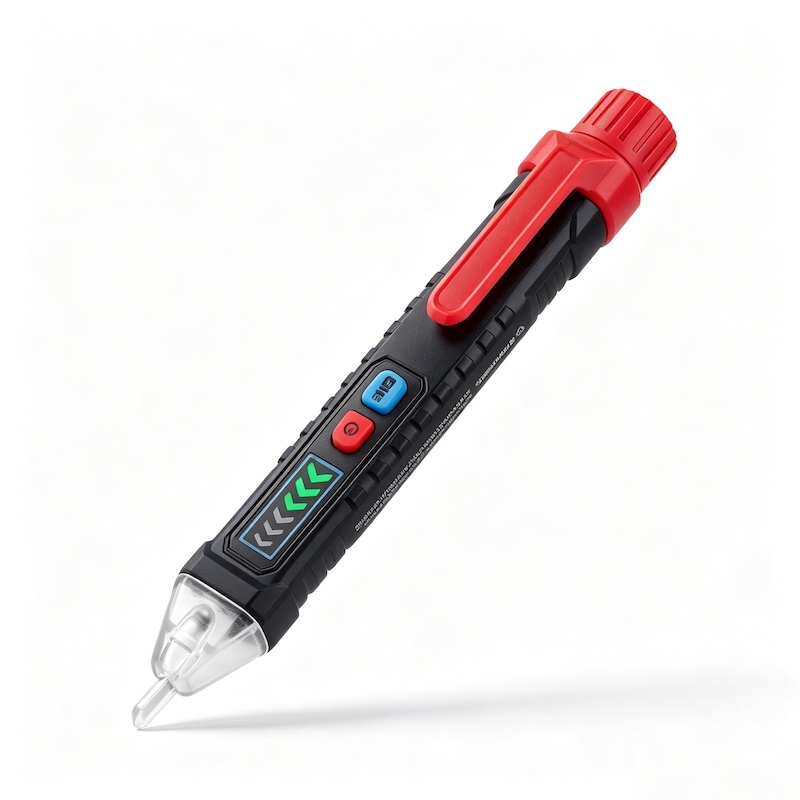
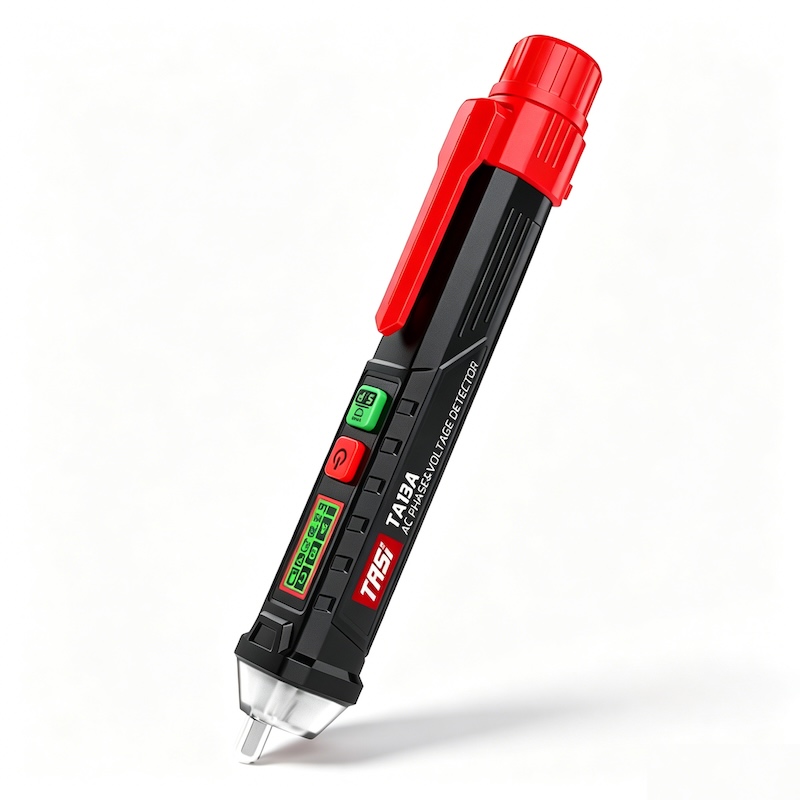
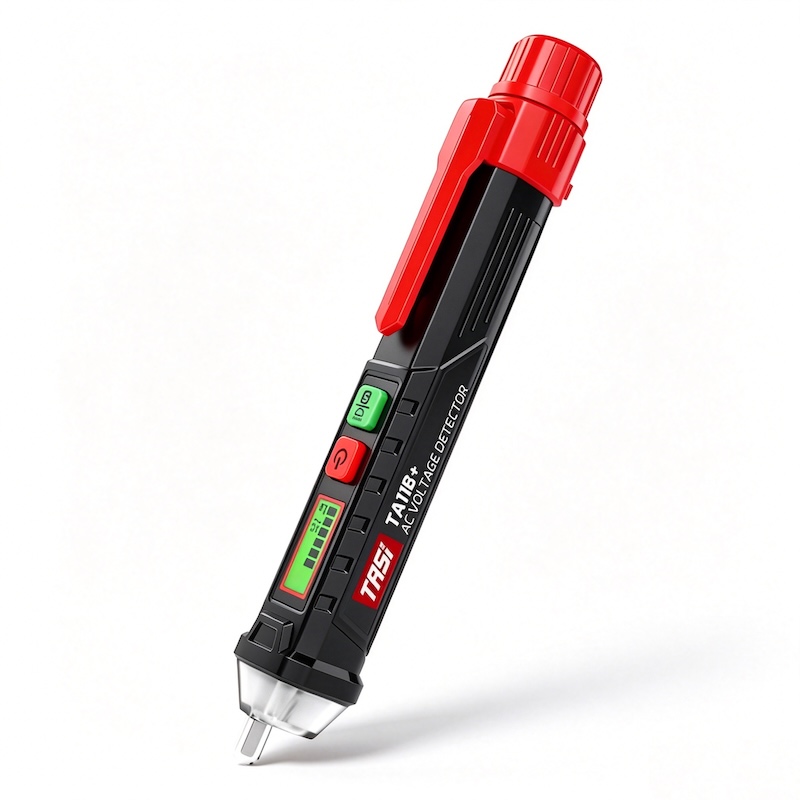
When a non-contact voltage tester is brought close to an outlet, wire, or electrical equipment, the tester typically illuminates an LED and emits an audible beep when an energized conductor is detected. This combination of light and sound provides the most direct indication of a non-contact voltage detection result.
However, the LED and buzzer do not detect voltage themselves. Detection is performed by the sensing and signal-processing circuitry inside the tester. Only after the instrument detects a sufficiently strong AC electric-field signal and determines that it meets the preset criteria will the audible and visual alerts be activated.
Understanding this process helps users interpret NCV indications correctly and avoid assuming that a stronger alert necessarily means a higher actual voltage.
Key Points
● Non-contact voltage testers primarily detect the alternating electric field surrounding energized AC conductors.
● The weak signal detected by the probe must be amplified, filtered, and evaluated before an alert is triggered.
● LEDs and buzzers are output devices used to indicate the detection result; they do not directly measure voltage.
● Some testers vary LED color, flashing rate, or beeping frequency according to the relative strength of the detected signal.
● Alert intensity depends not only on voltage but also on distance, insulation, sensitivity setting, and the surrounding electric-field environment.
● An NCV tester is useful for quickly identifying the presence of an AC electric field, but it does not replace a contact voltage tester for accurate voltage measurement or final verification of a de-energized circuit.
Before an Alert Can Be Triggered, the Tester Must Detect an AC Electric Field
An energized AC conductor produces an electric field that varies periodically with the alternating voltage. A non-contact voltage tester normally contains a sensing electrode in its probe tip. When the probe approaches an energized AC conductor, a small capacitive coupling is formed between the conductor, sensing electrode, user, and surrounding environment.
This coupling produces a very small AC signal inside the tester.
Because the tester does not need to establish direct electrical contact with the metal conductor, this method is known as non-contact voltage detection (NCV).
The basic operating sequence can be summarized as follows:
● An energized conductor produces an alternating electric field;
● The probe senses the electric field;
● The internal circuit receives a weak electrical signal;
● The signal is amplified and processed;
● The control circuit determines whether the alert threshold has been reached;
● The LED and buzzer are activated.
Why Can the Detected Electric Field Not Drive the Buzzer Directly?
The signal produced at the sensing electrode is normally extremely weak and cannot directly power an LED or buzzer. The tester therefore requires electronic circuitry to process the signal.
This usually involves several basic stages:
● Signal amplification: Increases the weak signal detected by the probe to a level that can be evaluated by the electronics.
● Filtering: Helps reduce the influence of high-frequency interference, random noise, and other unwanted signals.
● Signal evaluation: Determines whether the detected signal reaches the preset alert threshold.
● Output control: Activates the LED, buzzer, or other indication device when the detection criteria are met.
The specific circuit design, algorithms, and thresholds vary between manufacturers and models, but the fundamental operating principle is similar.
How Does the LED Provide a Visual Alert?
When the internal control circuit determines that a qualifying AC electric field is present, it sends a signal to the LED indicator circuit, causing the light to illuminate or flash.
Different non-contact voltage testers may use different visual indication methods, such as:
● A single-color LED illuminating when an AC electric field is detected;
● A flashing LED indicating the presence of an energized conductor;
● Faster flashing as the detected signal becomes stronger;
● Different LED colors for high- and low-sensitivity modes;
● Multiple LEDs to indicate different relative signal levels.
The exact meaning of each indication should therefore always be confirmed in the product manual, as alert logic is not standardized across all NCV testers.
Why Does the Buzzer Sound?
A small buzzer is typically installed inside the tester. Once the control circuit determines that the detected signal meets the alert conditions, it drives the buzzer to provide an audible indication.
Common audible alert patterns include:
● Beeping when an AC electric field is detected;
● Shorter intervals between beeps as the detected signal becomes stronger;
● Transitioning from intermittent to rapid beeping near a stronger electric field;
● Different beep patterns for different sensitivity modes on some models.
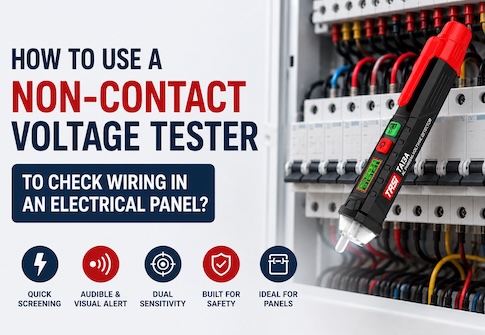
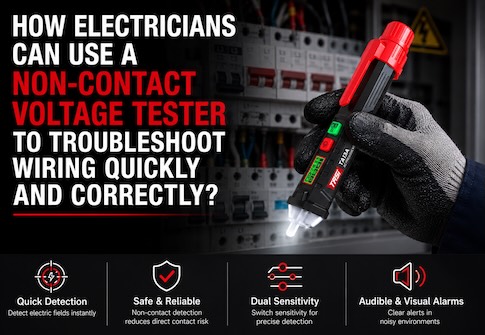
Combining sound and light allows the user to receive both visual and audible feedback, which can be particularly useful when checking distribution panels, troubleshooting electrical systems, or tracing wiring.
Why Do Some Testers Beep Faster as They Move Closer to a Live Conductor?
Some non-contact voltage testers do more than simply determine whether an electric field is present. They also use the relative strength of the detected signal to vary the alert pattern.
As the probe moves closer to an energized conductor, the electric field at the probe will generally become stronger, and the detected signal may increase accordingly.
Some testers are therefore designed to respond as follows:
● At a greater distance, the tester beeps intermittently or flashes slowly;
● As the distance decreases, the beep and flash rates increase;
● With a stronger detected signal, the tester may enter a rapid or near-continuous alert state.
This behavior can help locate areas where the electric field is relatively stronger. However, a faster alert does not necessarily mean that the actual conductor voltage is higher.
Does a Stronger Audible or Visual Alert Indicate the Actual Voltage Level?
Generally, no.
A non-contact voltage tester responds to the AC electric field present at the probe location rather than directly measuring the voltage across a conductor.
The alert response can be influenced by many factors, including:
● Conductor voltage;
● Distance between the probe and conductor;
● Thickness of the wire insulation;
● Position of the conductor inside a cable;
● Tester sensitivity setting;
● Capacitive coupling between the user and ground;
● Nearby energized wiring;
● Metal shielding;
● Electromagnetic interference.
For example, two conductors may have the same actual voltage, yet one can produce a stronger indication simply because it is closer to the probe or has thinner insulation.
Multi-level audible and visual alerts should therefore be interpreted as an indication of relative detected signal strength, not as an accurate voltage measurement.
How Do Alerts Differ Between Single-Sensitivity and Dual-Sensitivity Testers?
A single-sensitivity tester generally uses one fixed detection threshold. When the detected signal reaches that threshold, the tester activates its audible and visual alerts.
A dual-sensitivity or dual-range model allows the user to select between different detection modes. For example, some products provide a high-sensitivity low-voltage mode and a conventional voltage detection mode.
In high-sensitivity mode, weaker electric fields may be sufficient to trigger an alert, making the tester useful for tracing weaker signals or locating wiring. A lower-sensitivity mode can reduce unwanted responses caused by stray electric fields.
Higher sensitivity does not necessarily mean more accurate results in every situation. In densely wired or electrically complex environments, excessive sensitivity can make the tester more responsive to nearby energized conductors.
Why Can the Tester Alert Before It Touches the Wire?
This is a fundamental feature of non-contact detection.
An NCV tester senses the AC electric field surrounding an energized conductor rather than requiring direct contact with the conductor itself. Once the probe enters an area where the electric field is strong enough to exceed the detection threshold, the tester may begin alerting even though it is still some distance from the wire.
The alert distance depends on voltage, sensitivity, insulation construction, and environmental conditions. There is therefore no single fixed detection distance that applies to all situations.
In high-sensitivity mode, the tester may begin alerting farther away from the energized conductor.
Why Can the Tester Sometimes Alert Even When the Target Conductor Is Not Directly Energized?
Because an NCV tester responds to electric fields, it can sometimes detect fields originating from nearby energized conductors rather than from the target conductor itself.
Examples include:
● Several wires installed closely together;
● A disconnected conductor routed parallel to an energized wire;
● Multiple energized circuits located close together inside a distribution panel;
● Operation in a high-sensitivity mode;
● Strong surrounding AC electric fields.
Under these conditions, capacitive coupling or induced voltage may produce a detectable signal and trigger an audible and visual alert.
An NCV alert should therefore be interpreted as meaning that “an AC electric field above the tester's threshold has been detected at this location,” rather than proving that a particular conductor carries a specific voltage.
Why Might an Energized Conductor Fail to Trigger an Alert?
If the signal reaching the probe does not exceed the tester's internal detection threshold, the tester may not alert even when the circuit is energized.
Common causes include:
● Excessive distance between the probe and energized conductor;
● Thick insulation;
● Metal shielding around the conductor;
● Use of a lower-sensitivity mode;
● Voltage below the tester's specified detection range;
● Low battery condition;
● Tester malfunction;
● Weak capacitive coupling between the user and ground under the measurement conditions.
For this reason, an absence of an NCV alert should not by itself be considered proof that a circuit is fully de-energized during electrical safety work.
Why Do NCV Testers Commonly Use Both Sound and Light?
Using both audible and visual indications improves usability under different working conditions.
● In noisy environments, the LED can provide a clear visual indication;
● In low-light areas or situations where the tester cannot be continuously observed, the buzzer provides an audible indication;
● Simultaneous sound and light make detection status easier to recognize;
● Changes in beep rate or LED color can provide additional information about relative signal strength.
Some products also include vibration feedback or an LCD, but the purpose is the same: to convert an internal electric-field detection result into information that can be quickly understood by the user.
What Should Be Considered When Using Audible and Visual Alerts?
● Check the tester according to the manufacturer's instructions before use and make sure the battery condition is adequate.
● Where possible, verify operation on a known live circuit before testing an unknown circuit.
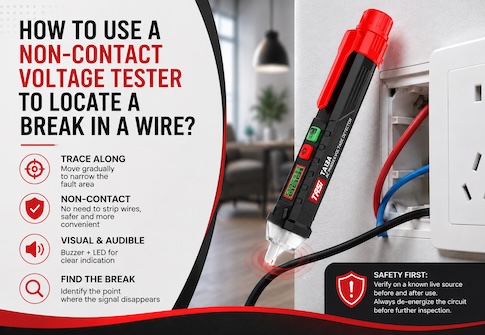
● Move the probe gradually toward the target rather than making only a quick pass at a single position.
● In densely wired areas, consider the possibility of alerts caused by nearby energized conductors.
● When using a dual-sensitivity tester, select the sensitivity mode appropriate for the application.
● Do not use beep rate or LED brightness to estimate the actual voltage.
● For accurate voltage measurement, use an appropriately rated multimeter, two-pole voltage tester, or other suitable contact measurement instrument.
● For verification of a de-energized condition and electrical safety procedures, use the appropriate test method and equipment required for the task.
FAQ
Why does a non-contact voltage tester both light up and beep?
When the internal circuitry detects an AC electric-field signal that meets the preset alert conditions, it drives both the LED and buzzer to provide visual and audible indications.
Does faster beeping mean a higher voltage?
Not necessarily. Beep rate usually relates to the relative strength of the detected signal, which is also influenced by distance, insulation, sensitivity, and surrounding electric fields. It cannot be directly converted into an actual voltage value.
Why does the tester alert before it reaches the wire?
Because an NCV tester detects the AC electric field surrounding an energized conductor. Direct contact with the metal conductor is not required. Once the electric field at the probe reaches the threshold, the tester may alert.
Does no alert mean the circuit is definitely de-energized?
No. Excessive distance, thick insulation, metal shielding, an unsuitable detection range, a weak battery, or environmental conditions may prevent an alert. Appropriate verification procedures and test equipment should be used for electrical safety confirmation.
What is the purpose of multi-level audible and visual alerts?
Multi-level alerts use different light patterns, colors, or beep rates to indicate relative changes in detected signal strength. They can help locate energized areas but do not replace accurate voltage measurement.
Can the tester still detect voltage if the buzzer is damaged?
If only the buzzer output has failed, the internal sensing circuit may still operate. However, because the alert system is no longer functioning as designed, continued use of the tester is not recommended.
Conclusion
The audible and visual alerts of a non-contact voltage tester are not powered directly by the measured voltage. They are the final stage of a process consisting of electric-field sensing, signal processing, threshold evaluation, and alert output.
When the probe approaches an energized AC conductor, the sensing electrode detects a weak AC electric-field signal. After amplification, filtering, and evaluation, the control circuitry activates the LED and buzzer if the signal meets the preset conditions. Some models also vary LED color, flash rate, or beep rate according to relative signal strength.
Audible and visual alerts provide a convenient way to locate energized wiring and identify the presence of an AC electric field, but the strength of the alert does not directly indicate the actual voltage. Accurate voltage measurement, electrical troubleshooting, and verification of a de-energized condition require suitable contact-type test instruments and appropriate testing procedures.