Introduction
RPM is commonly found in the specifications of motors, fans, pumps, machine-tool spindles, rollers, engines and many other types of rotating machinery. A motor, for example, may be rated at 3,000 RPM, while a fan may operate at 1,500 RPM and a high-speed spindle may reach tens of thousands of RPM.
Although RPM appears to be a simple numerical value, interpreting it correctly requires knowing which component is rotating, under what operating conditions the value applies, and how rotational speed relates to frequency, linear speed and load.
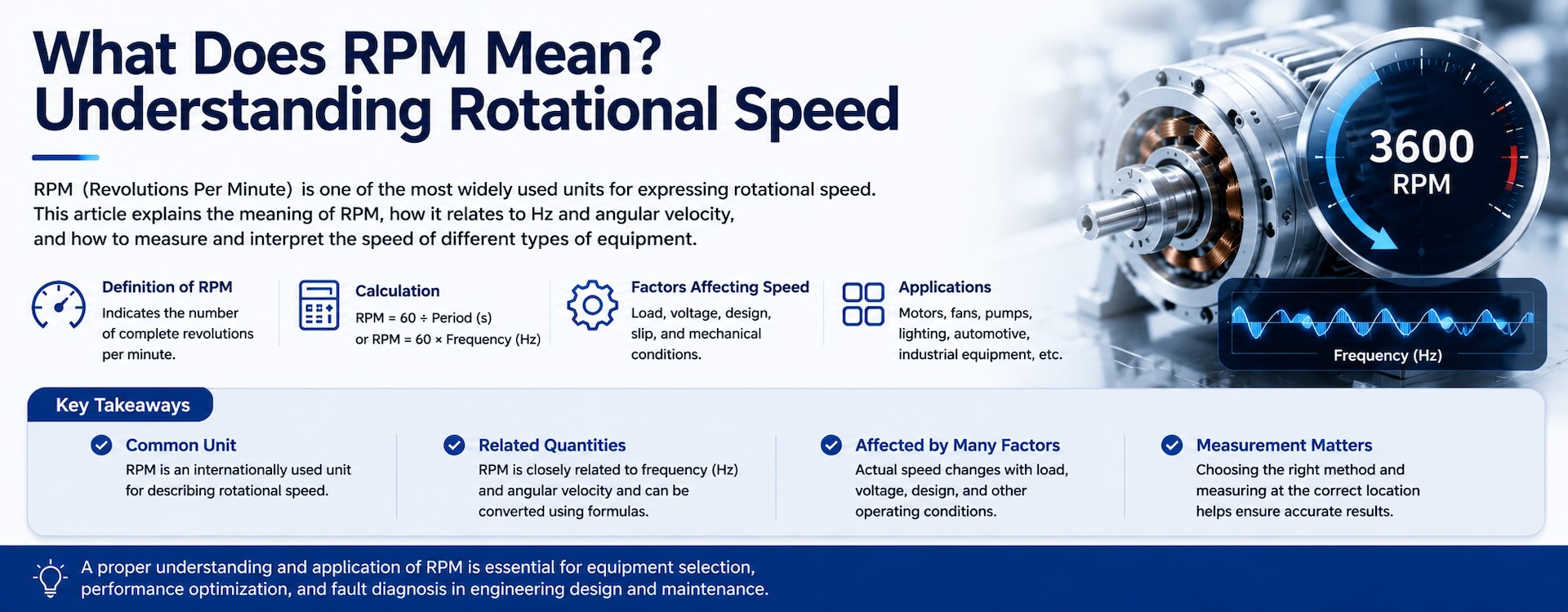
In simple terms, RPM indicates how many complete revolutions a rotating object makes in one minute and is one of the most common units used to describe rotational speed.
Key Points
● RPM stands for Revolutions Per Minute and indicates the number of complete revolutions made in one minute.
● 1 RPM means that a rotating component completes one full revolution in one minute.
● A higher RPM value means more revolutions are completed within the same period and therefore generally indicates a higher rotational speed.
● RPM can be converted into Hz, angular velocity and, when diameter is known, circumferential linear speed, but these quantities describe different characteristics of motion.
● The motor shaft, transmission shaft, gears and rollers within the same machine may rotate at different speeds, so the measurement location must always be identified.
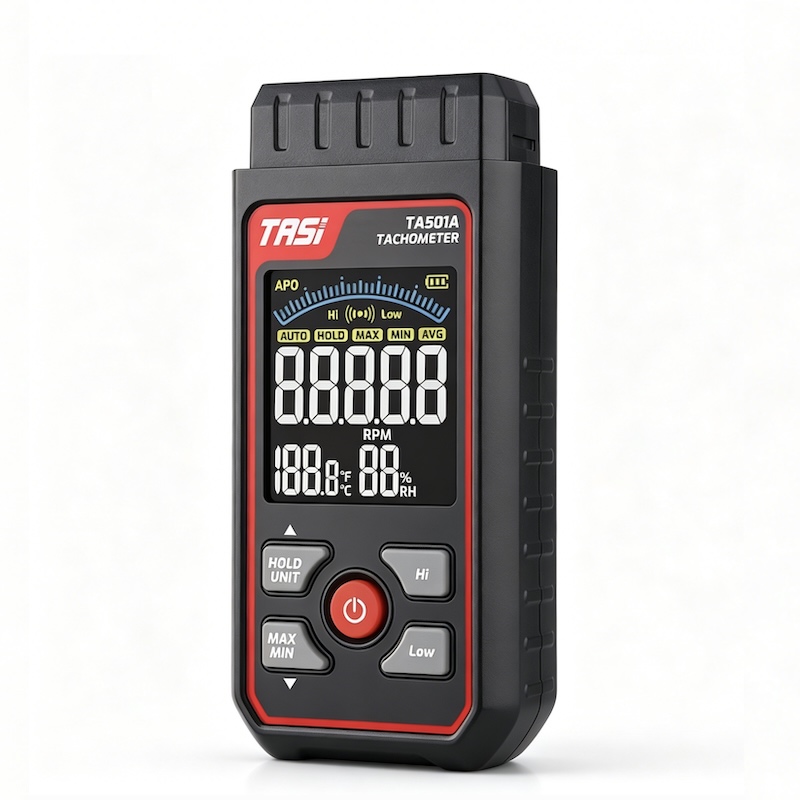
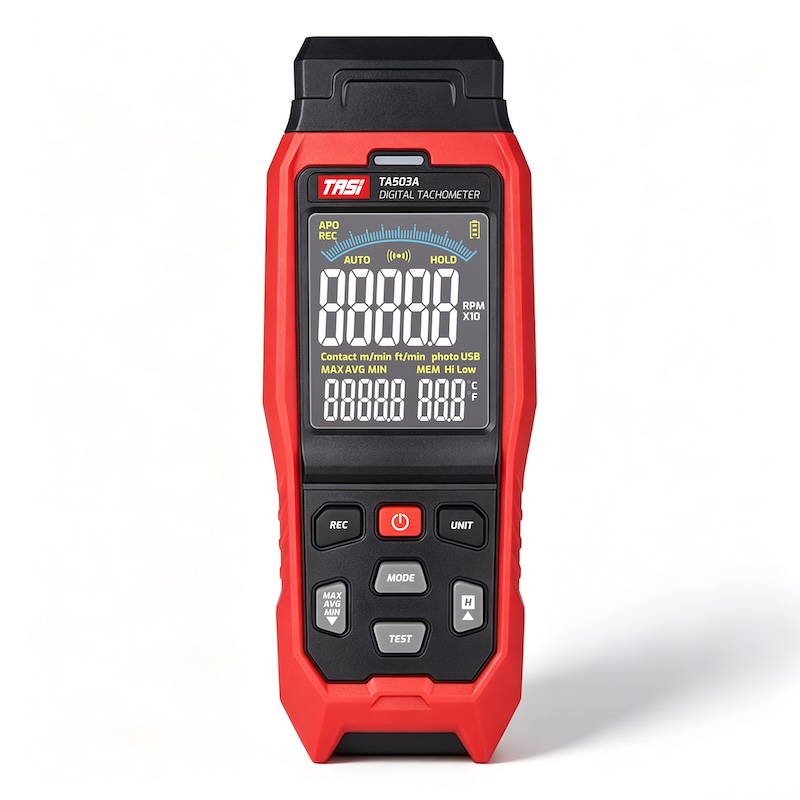
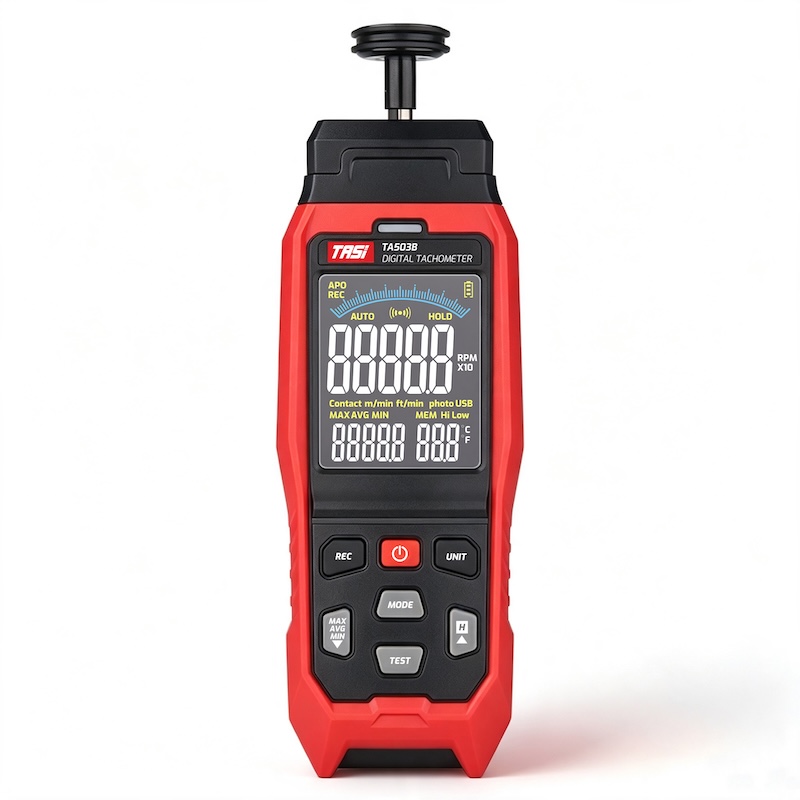
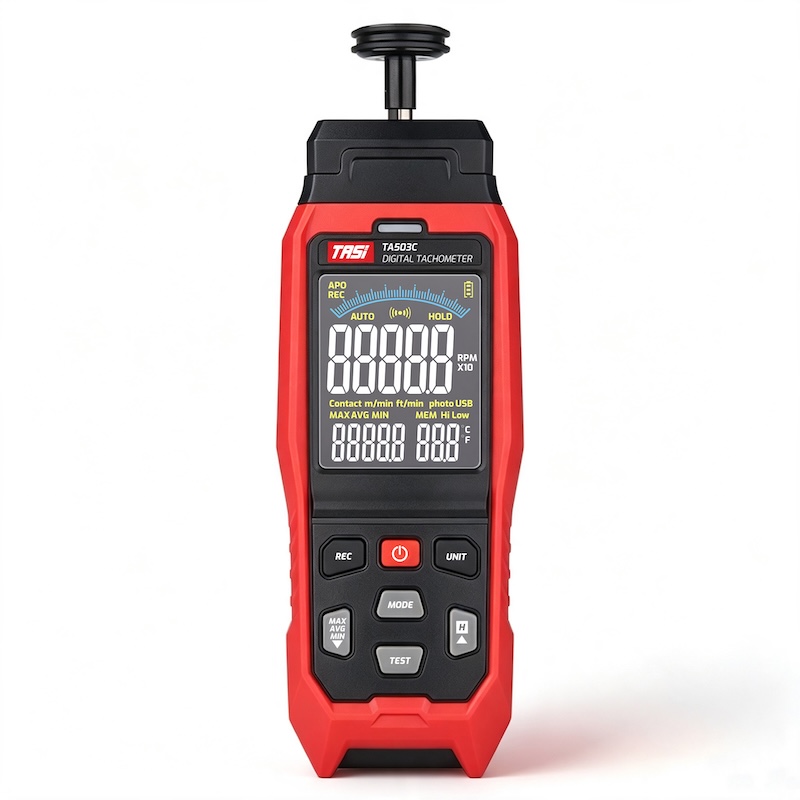
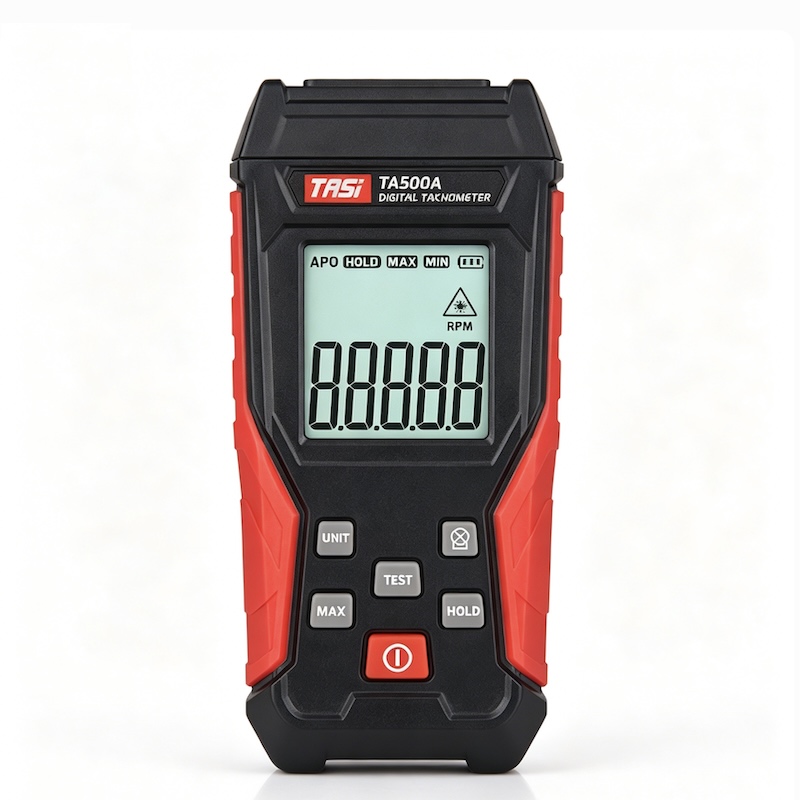
● Rotational speed can be measured using contact tachometers, non-contact optical tachometers or built-in speed sensors.
What Does RPM Mean?
RPM stands for Revolutions Per Minute and expresses how many complete revolutions a rotating component makes in one minute.
For example:
● 60 RPM: 60 revolutions per minute, equivalent to an average of 1 revolution per second.
● 600 RPM: 600 revolutions per minute, equivalent to an average of 10 revolutions per second.
● 3,000 RPM: 3,000 revolutions per minute, equivalent to an average of 50 revolutions per second.
● 12,000 RPM: 12,000 revolutions per minute, equivalent to an average of 200 revolutions per second.
For the same rotating object, a higher RPM value therefore means that it is rotating faster.
RPM is widely used for motors, engines, fans, pumps, machine tools, centrifuges, conveyors and mechanical transmission systems, making it a fundamental parameter in industrial equipment monitoring.
How Should Equipment Rotational Speed Be Understood?
Rotational speed describes how many revolutions a particular rotating component completes within a given period. In practice, the term “equipment speed” should always be associated with a specific rotating part.
A machine may contain several rotating components, such as:
● Motor output shaft;
● Gearbox input shaft;
● Gearbox output shaft;
● Gear or pulley;
● Roller;
● Fan impeller.
Even though these parts belong to the same machine, their RPM values may differ significantly because of gear ratios, pulley ratios or reduction gearboxes.
For example, if a motor operates at 1,500 RPM and drives a roller through an ideal 3:1 reduction system, the roller speed will be approximately 500 RPM.
For this reason, stating that “the machine runs at 1,500 RPM” may be incomplete. More precise descriptions include “motor shaft speed,” “spindle speed” or “roller speed.”
What Is the Relationship Between RPM and Hz?
Hertz (Hz) represents the number of cycles per second, while RPM represents the number of revolutions per minute.
If one complete revolution is treated as one cycle, the conversion is:
Hz = RPM ÷ 60
Examples:
● 60 RPM = 1 Hz;
● 600 RPM = 10 Hz;
● 1,500 RPM = 25 Hz;
● 3,000 RPM = 50 Hz.
This conversion describes the mechanical rotational frequency. It does not mean that a motor running at 3,000 RPM must necessarily be powered by a 50 Hz supply.
Actual motor speed also depends on motor type, number of poles, control method, load and slip. RPM alone therefore cannot be used to determine the electrical supply frequency.
What Is the Relationship Between RPM and Angular Velocity?
Engineering calculations often use angular velocity in addition to RPM. Angular velocity is commonly expressed in radians per second (rad/s).
Because one complete revolution corresponds to 2π radians, RPM can be converted to angular velocity using:
ω = 2π × RPM ÷ 60
For example, a shaft rotating at 600 RPM completes 10 revolutions per second and has an angular velocity of approximately:
62.83 rad/s
RPM is generally more convenient for equipment specifications, field measurements and maintenance work, while rad/s is more commonly used in mechanical design, dynamics and engineering calculations.
What Is the Difference Between RPM and Linear Speed?
RPM describes rotational speed, while linear speed describes the distance traveled by a point on a rotating surface per unit of time. They are not the same quantity.
For a circular rotating component with diameter D, circumferential linear speed depends on both its diameter and RPM.
At the same RPM:
● A larger diameter produces a higher circumferential speed.
● A smaller diameter produces a lower circumferential speed.
For example, consider two rollers both rotating at 600 RPM. If one has a diameter of 100 mm and the other 200 mm, the surface speed of the 200 mm roller is approximately twice that of the 100 mm roller.
For conveyors, grinding wheels, cutting tools and pulleys, RPM alone may therefore be insufficient. Component diameter must also be considered when evaluating actual surface speed.
How Should RPM Be Interpreted for Different Types of Equipment?
Different types of machinery are designed to operate at very different rotational speeds. A higher RPM does not automatically mean better performance.
● Motors: RPM indicates the rotational speed of the motor output shaft. Actual speed may vary with motor design, control method and load.
● Fans and Blowers: Speed influences airflow, pressure, noise and power consumption, but fans of different sizes and designs cannot be compared by RPM alone.
● Machine-Tool Spindles: Spindle RPM is selected according to tool diameter, workpiece material and machining process. Excessive or insufficient speed can affect machining quality.
● Engines: RPM generally refers to crankshaft speed and is commonly used to indicate engine operating conditions.
● Rollers and Conveyors: RPM should be considered together with roller diameter to determine surface speed.
● Pumps and Rotating Machinery: Speed may affect flow, pressure, vibration and mechanical loading and should remain within the equipment's specified operating range.
RPM should therefore always be interpreted in the context of equipment design and operating conditions rather than treated as an isolated performance figure.
Why Does Actual RPM Change During Operation?
The speed shown on an equipment nameplate or specification sheet is usually a rated or nominal value under defined operating conditions. Actual RPM may vary during operation.
Common causes include:
● Changes in mechanical load;
● Changes in power supply or drive conditions;
● Variable-frequency drive adjustments;
● Automatic speed control;
● Belt slip;
● Coupling or transmission problems;
● Increased bearing resistance;
● Mechanical wear;
● Acceleration or deceleration during operation.
For maintenance purposes, changes in rotational speed relative to normal reference values can provide useful diagnostic information.
If a rotating machine consistently operates below its normal speed under comparable conditions, the load, transmission system, motor and mechanical resistance may require further inspection.
Does Higher RPM Mean Better Equipment Performance?
No.
RPM only describes rotational speed and cannot independently determine equipment performance.
A high-speed motor may operate at a much higher RPM, while a lower-speed motor may provide significantly greater torque. Depending on their design and application, two machines may have operating speeds that differ by tens or even hundreds of times.
Equipment performance should normally be evaluated together with parameters such as:
● Torque;
● Power;
● Load capacity;
● Mechanical efficiency;
● Vibration;
● Temperature rise;
● Noise;
● Stability;
● Rated operating range.
The important question is therefore not whether RPM is high, but whether the equipment is operating stably within its intended speed range.
What Is the Difference Between Rated Speed and Actual Speed?
Rated speed is the reference rotational speed specified by the manufacturer under defined rated operating conditions. Actual speed is the RPM measured while the equipment is operating.
For example, a motor may have a rated speed of 1,450 RPM while an actual field measurement may show 1,435 RPM, 1,452 RPM or another nearby value.
A small difference does not necessarily indicate a fault. The result should be assessed together with:
● Permitted speed tolerance;
● Current load;
● Control method;
● Instrument accuracy;
● Measurement location;
● Operating environment.
For condition monitoring, long-term trends are often more informative than a single RPM reading. A gradual deviation from the established normal range under comparable operating conditions may warrant further investigation.
How Is Equipment RPM Measured?
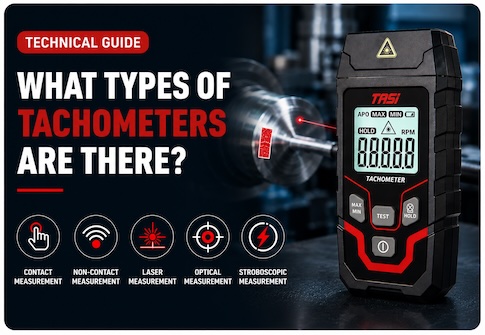
Rotational speed can be measured in several ways, with contact and non-contact measurement being the most common.
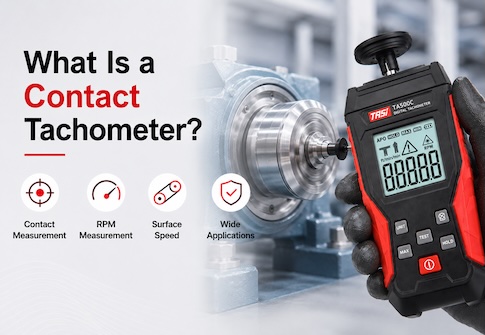
● Contact speed measurement: A tachometer contact tip or wheel is placed directly against a rotating shaft or surface. This method is suitable when the measurement point is accessible and safe to contact.
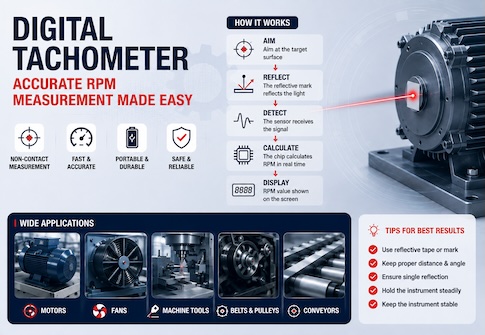
● Non-contact optical measurement: A reflective marker is applied to the rotating component, and an optical tachometer detects the recurring reflected signal to calculate RPM. This method is particularly useful for high-speed, hot or difficult-to-access rotating parts.
● Built-in sensors: Some machines use encoders, Hall-effect sensors, magnetic sensors or other sensing technologies to continuously measure rotational speed and display RPM through the control system.
When measuring exposed shafts, fan impellers or other high-speed components, measurement safety and adequate clearance should take priority over direct physical access.
What Should Be Considered When Measuring RPM with a Tachometer?
To obtain meaningful and repeatable speed measurements, measurement conditions should be kept as consistent as possible.
● Clearly identify the shaft or component being measured.
● Keep equipment operating conditions stable during measurement.
● When using a non-contact tachometer, position the reflective marker and maintain the measurement distance according to the instrument instructions.
● When using a contact tachometer, ensure stable contact and avoid slippage.
● Never approach high-speed rotating components without appropriate safety precautions.
● For trend monitoring, use the same measurement point and similar load conditions whenever possible.
● If a reading appears abnormal, repeat the measurement and check for reflective interference, contact slip or an incorrect measurement target.
RPM readings are most useful for comparison when measurement location and operating conditions remain consistent.
FAQ
Are RPM and rotational speed the same thing?
Rotational speed is the physical quantity being measured, while RPM is one of the most common units used to express it.
Does a higher RPM always mean faster rotation?
For the same rotating object, yes. A higher RPM means more revolutions are completed per minute. However, equipment of different sizes and designs should not be compared based on RPM alone.
What does 3,000 RPM mean?
It means that the rotating component completes approximately 3,000 revolutions per minute, or an average of about 50 revolutions per second.
Can RPM be converted directly to Hz?
Yes, when one full mechanical revolution is treated as one cycle. Divide RPM by 60. For example, 600 RPM corresponds to 10 Hz of rotational frequency.
Why is measured motor RPM different from the nameplate speed?
The difference may result from load, motor type, control method, slip, supply conditions or normal operating variation. Small differences are generally acceptable if the actual speed remains within the manufacturer's specified operating range.
Does one machine have only one RPM value?
Not necessarily. A machine may contain a motor, gearbox, pulleys, gears and rollers operating at different rotational speeds. The measurement point must therefore always be specified.
Do I need to touch the rotating shaft to measure RPM?
No. A non-contact optical tachometer can measure rotational speed using a reflective marker without direct physical contact with the rotating component.
Conclusion
RPM stands for Revolutions Per Minute and indicates how many complete revolutions a rotating component makes in one minute. It is one of the most widely used rotational speed units for motors, fans, pumps, spindles, rollers and other rotating machinery.
Correct interpretation of RPM requires more than simply looking at the numerical value. The rotating component, transmission ratio, equipment design and operating conditions must also be considered. RPM can be converted into rotational frequency and angular velocity and, when component diameter is known, can be used to determine circumferential speed.
In industrial maintenance and equipment condition monitoring, measuring RPM with a tachometer and comparing it with rated values or established historical data can help identify changes in operating condition. For long-term monitoring, consistent measurement points and comparable operating conditions are generally more valuable than a single isolated reading.