Introduction
The statement that humans can hear frequencies from 20 Hz to 20 kHz is widely used as a general description of human hearing. However, it does not mean that every person can hear every frequency within this range with the same sensitivity.
Whether a sound can be perceived depends not only on frequency but also on sound pressure level, age, hearing condition and individual differences.
For this reason, sound and noise assessment involves more than determining how loud a sound is. Its frequency content and the sensitivity of human hearing at those frequencies are also important.
Key Points
● The typical audible frequency range of a healthy young person is approximately 20 Hz to 20 kHz;
● Frequencies below approximately 20 Hz are generally classified as infrasound, while frequencies above approximately 20 kHz are classified as ultrasound;
● Human hearing sensitivity varies with frequency and is generally greatest in the region of approximately 2 to 5 kHz;
● Sensitivity to high-frequency sound typically decreases with age;
● Whether a particular frequency can be heard also depends on its sound pressure level;
● A-weighting in sound level meters is designed to approximate, to a certain extent, the frequency-dependent sensitivity of human hearing.
What Is the Typical Human Hearing Range?
Sound is a mechanical vibration that propagates through a medium. When sound waves reach the ear, variations in sound pressure are converted into neural signals that are interpreted by the brain.
The number of vibration cycles per second is called frequency and is expressed in hertz (Hz).
For a healthy young person, the commonly referenced audible frequency range is approximately:
● Lowest audible frequency: about 20 Hz;
● Highest audible frequency: about 20,000 Hz, or 20 kHz.
Sound within approximately 20 Hz to 20 kHz is therefore generally referred to as audible sound for humans.
For example, 50 Hz is considered relatively low frequency, 1,000 Hz is in the mid-frequency range, and 10,000 Hz is a high-frequency sound.
However, 20 Hz and 20 kHz should not be regarded as absolute hearing limits for every individual. They are typical reference values.
What Is Sound Below 20 Hz?
Sound with a frequency below approximately 20 Hz is generally referred to as infrasound.
Infrasound has a very low frequency and a relatively long vibration period. In many cases, the human ear cannot perceive it in the same way as ordinary audible sound. At sufficiently high sound pressure levels, however, people may sense vibration, pressure or other physical effects.
Possible sources of infrasound include:
● Large industrial machinery;
● Wind energy equipment;
● Explosions or strong impacts;
● Volcanic activity and earthquakes;
● Large engines and compression equipment.
Therefore, saying that a frequency below 20 Hz is normally inaudible does not mean that the acoustic energy is absent or that measurement equipment cannot detect it.
What Is Sound Above 20 kHz?
Sound with a frequency above approximately 20 kHz is generally referred to as ultrasound.
Most adults cannot hear frequencies above 20 kHz, although many animals are capable of detecting frequencies well beyond the upper limit of human hearing.
Ultrasound is widely used in applications such as:
● Ultrasonic testing;
● Medical imaging;
● Distance and position detection;
● Industrial non-destructive testing;
● Ultrasonic cleaning;
● Certain sensing and positioning systems.
The existence of a sound wave and the ability of humans to hear it are therefore two different matters.
Some measuring instruments may also have frequency response ranges that extend beyond the normal audible range.
Is the Human Ear Equally Sensitive to All Frequencies?
No.
Even when two sounds have the same physical sound pressure level, they may not be perceived as equally loud if their frequencies are different.
Human hearing is generally more sensitive in the mid-frequency region, particularly around approximately 2 to 5 kHz. This range also contains many important components of human speech.
By comparison, the ear is generally less sensitive to very low and very high frequencies.
For example, at relatively low sound pressure levels:
● A 1,000 Hz tone may be comparatively easy to hear;
● A 30 Hz low-frequency tone may require a higher sound pressure level to become clearly audible;
● A tone near the upper hearing limit may also require a higher sound pressure level to be perceived.
The audible range is therefore not simply a fixed rectangular frequency band. Hearing depends on the interaction between frequency and sound pressure level.
How Is Frequency Related to the Threshold of Hearing?
The threshold of hearing can be understood as the minimum sound pressure level required for a person to just perceive a sound at a given frequency.
This threshold varies with frequency.
In some mid-frequency regions, the human ear can detect sound at relatively low sound pressure levels. Near the lower and upper limits of the audible range, higher sound pressure levels are generally required.
A more accurate description of human hearing therefore needs to consider:
● Frequency;
● Sound pressure level;
● Individual hearing condition.
This is why human hearing characteristics are usually represented using curves rather than simply stating a frequency range of 20 Hz to 20 kHz.
Why Does Hearing Range Change with Age?
Age is an important factor affecting high-frequency hearing.
Children and young adults generally have a wider high-frequency hearing range. As people age, sensitivity to high frequencies commonly decreases.
Consequently, a theoretical upper hearing limit of 20 kHz does not mean that every adult can hear a 20 kHz tone.
Some adults may only clearly perceive frequencies up to 15 kHz, 12 kHz or even lower.
Other factors that can affect hearing include:
● Long-term noise exposure;
● Individual hearing differences;
● Ear health;
● Occupational environment;
● Prolonged exposure to high-volume headphones;
● Certain medications or other factors.
The 20 Hz to 20 kHz range should therefore be treated as a typical reference rather than as the sole criterion for determining an individual's hearing capability.
What Frequency Ranges Are Common in Everyday Sound?
Although the theoretical human hearing range is broad, many important everyday sounds occupy only part of this spectrum.
For example:
● Large machinery, engines and ventilation systems may contain significant low-frequency components;
● Human speech contains substantial low- and mid-frequency information, with some consonant information extending into higher frequencies;
● Metal friction, warning signals and electronic buzzers may contain pronounced mid- and high-frequency components;
● Impacts, knocking and mechanical collisions can generate broadband sound across many frequencies.
Real-world environmental noise is usually not composed of a single frequency. Instead, it contains multiple frequencies simultaneously.
For industrial noise, environmental noise and machinery diagnostics, frequency spectrum analysis may therefore be necessary in addition to measuring an overall sound level.
Why Do Sound Level Meters Commonly Use A-Weighting?
Because human hearing sensitivity changes with frequency, an instrument that treats every frequency equally may produce a value that does not closely reflect human auditory perception.
Sound level meters therefore use frequency-weighting networks, with A-weighting being the most commonly used.
Measurements obtained using A-weighting are normally expressed in dBA.
A-weighting reduces the contribution of certain low and very high frequencies so that the overall result approximates, to a certain extent, the frequency-dependent sensitivity of human hearing.
This is why dBA is widely used for environmental noise, occupational noise and many general sound level measurements.
However, A-weighting does not fully represent subjective loudness under all conditions. Low-frequency noise, impulsive noise and specialised acoustic analysis may require other weighting methods or frequency spectrum analysis.
Can a Sound Level Meter Measure Sounds Humans Cannot Hear?
Potentially, yes, depending on the instrument's specified frequency response.
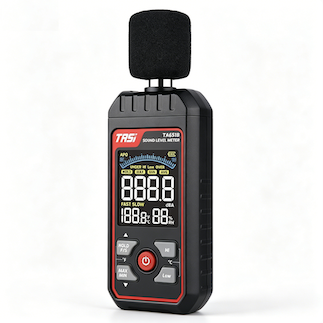
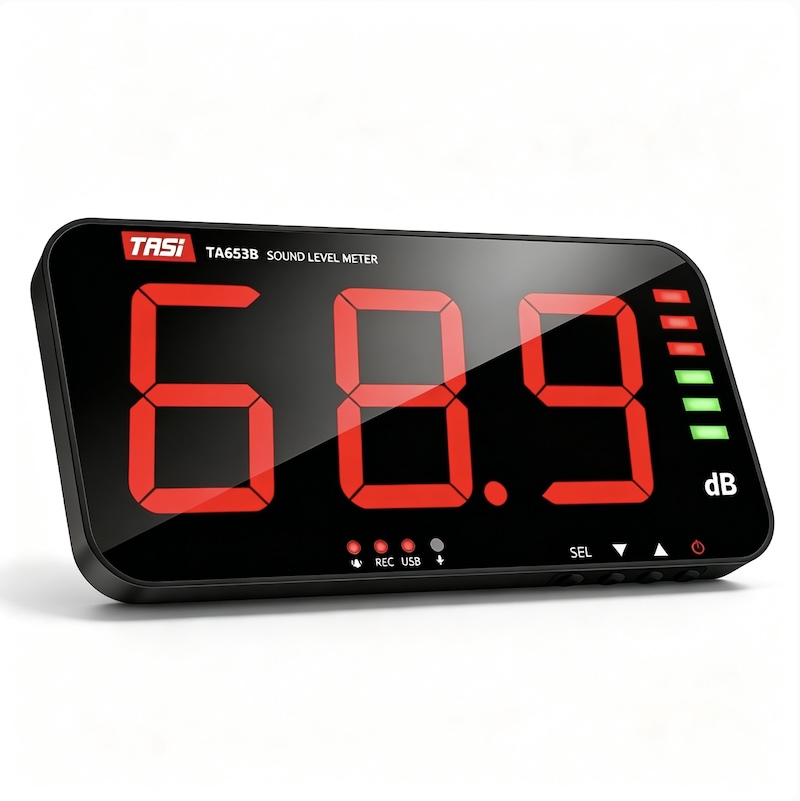
A sound level meter uses a microphone and electronic circuitry to detect variations in air pressure. Its measurement capability is determined by the microphone, sensor design, electronics and specified frequency response.
Therefore:
● A frequency that humans cannot hear may still be detectable by an instrument;
● A frequency detected by an instrument is not necessarily within the human audible range;
● The specified frequency response of the instrument should always be checked when determining whether it is suitable for a particular type of sound.
General-purpose sound level meters are typically designed primarily for measurements within the audible frequency region. Dedicated sensors and measurement systems are normally required for specialised infrasound or ultrasound measurements.
What Is the Difference Between Frequency and Decibels?
Frequency and decibels describe different characteristics of sound.
● Frequency (Hz) indicates how rapidly a sound vibrates and is closely related to perceived pitch;
● Sound pressure level (dB) represents the magnitude of acoustic pressure variations and is used to quantify sound level.
For example, a sound could be:
● 100 Hz at 70 dB;
● 1,000 Hz at 70 dB;
● 10,000 Hz at 70 dB.
Although all three have the same sound pressure level, their perceived loudness and auditory characteristics can differ considerably because their frequencies are different.
Both frequency and sound pressure level are therefore important when evaluating sound.
FAQ
Can humans really hear from 20 Hz to 20 kHz?
The 20 Hz to 20 kHz range is a typical reference for healthy young listeners. It is not a fixed range for every individual. Age, hearing condition and sound pressure level all affect the frequencies a person can actually perceive.
Why can many adults no longer hear 20 kHz?
Sensitivity to high-frequency sound generally declines with age, so the actual upper hearing limit of many adults is lower than 20 kHz.
Is sound below 20 Hz completely inaudible?
It is generally difficult to perceive through normal hearing, but sufficiently strong low-frequency sound may produce sensations of vibration, pressure or other physical effects.
Is sound above 20 kHz dangerous?
Risk cannot be determined from frequency alone. Sound pressure level, exposure duration, propagation conditions and the specific application must also be considered. Ultrasonic equipment should be assessed according to its actual operating conditions.
Why is a 1 kHz sound easier to hear than a sound at only a few tens of hertz?
The human ear is generally more sensitive to mid-frequency sound than to very low frequencies. Low-frequency sound therefore usually requires a higher sound pressure level to produce a similar auditory sensation.
Can a sound level meter measure the entire 20 Hz to 20 kHz range?
Not necessarily. Frequency response varies between instruments and should be verified from the product specifications. Specialised equipment may be required for infrasound, ultrasound or detailed spectrum measurements.
Conclusion
The typical human hearing range extends from approximately 20 Hz to 20 kHz, but this should be regarded as a general reference rather than an absolute limit. Actual hearing depends on frequency, sound pressure level, age and individual hearing condition.
Human hearing sensitivity is not uniform across the audible spectrum. The ear is generally most sensitive around approximately 2 to 5 kHz, while sounds near the lower and upper frequency limits usually require higher sound pressure levels to be clearly perceived.
Frequencies below approximately 20 Hz are generally classified as infrasound, while frequencies above approximately 20 kHz are classified as ultrasound. Even when these frequencies fall outside the typical human hearing range, they still physically exist and may be detected by appropriate measurement equipment.
Understanding the human hearing range provides an important foundation for interpreting sound frequency, sound pressure level, dBA, frequency weighting and sound level measurements.