Introduction
When reviewing the specifications of a digital tachometer, values such as “Resolution: 0.1 RPM” or “Resolution: 1 RPM” are commonly listed. Resolution determines how finely the instrument can display changes in rotational speed, but it does not indicate that the measurement itself is accurate to the same value.
For example, if a tachometer has a resolution of 0.1 RPM, its display can change in increments of 0.1 RPM, such as 1500.0 RPM, 1500.1 RPM, and 1500.2 RPM. This describes the instrument’s ability to display or distinguish small changes in speed. It does not mean that the measurement error is only ±0.1 RPM.
Tachometer resolution should therefore be evaluated together with measuring range, accuracy, measurement method, and the requirements of the application.
Key Points
● Tachometer resolution indicates the smallest change in rotational speed that the instrument can display or distinguish.
● Typical resolution values include 0.1 RPM and 1 RPM, and resolution may vary across different measuring ranges.
● A smaller resolution value allows finer changes in rotational speed to be displayed.
● Resolution is not the same as accuracy. A display resolution of 0.1 RPM does not mean the measurement error is ±0.1 RPM.
● Tachometer selection should consider resolution together with accuracy, measuring range, and actual speed variation.
● Higher resolution is particularly useful for low-speed measurement, speed stability analysis, and applications requiring observation of small RPM changes.
What Is Tachometer Resolution?
Tachometer resolution describes the smallest increment of rotational speed that the instrument can display or distinguish. It is normally expressed in RPM, or revolutions per minute.
For example:
● 0.1 RPM resolution: the display may change in steps of 0.1 RPM, such as 850.1, 850.2, and 850.3 RPM.
● 1 RPM resolution: the display normally changes in steps of 1 RPM, such as 850, 851, and 852 RPM.
Under otherwise comparable conditions, a tachometer with 0.1 RPM resolution can indicate smaller changes in speed than one with 1 RPM resolution.
Resolution mainly describes the level of detail in the displayed result. By itself, it does not indicate how accurate the instrument is, nor does it determine whether very low or very high rotational speeds can be measured reliably.
How Should 0.1 RPM and 1 RPM Resolution Be Understood?
Suppose the actual speed of a motor gradually increases from 1500.0 RPM to 1500.8 RPM.
With a tachometer offering 0.1 RPM resolution, the display may indicate values such as:
● 1500.0 RPM;
● 1500.2 RPM;
● 1500.5 RPM;
● 1500.8 RPM.
With a tachometer offering 1 RPM resolution, the displayed values may mainly appear as:
● 1500 RPM;
● 1501 RPM.
The first instrument provides a more detailed view of small speed changes and is therefore more useful when fine variations need to be observed. The second may be entirely sufficient for routine equipment inspection and general speed verification.
In this context, “higher resolution” generally means a smaller minimum display increment. It does not mean that an instrument with more digits automatically has better overall measurement performance.
What Is the Difference Between Tachometer Resolution and Accuracy?
Resolution and accuracy are two of the most frequently confused tachometer specifications.
Resolution answers the question: “How finely can the instrument display the speed?”
Accuracy answers the question: “How close is the measured value to the actual speed?”
For example, a tachometer may specify:
● Resolution: 0.1 RPM;
● Accuracy: ±0.05% of reading + a specified number of digits.
If the display shows 1500.1 RPM, the 0.1 RPM value refers only to display resolution. It does not mean that the actual speed must be within 1500.0 to 1500.2 RPM. The actual measurement uncertainty must still be evaluated according to the manufacturer’s stated accuracy specification.
A tachometer displaying one decimal place should therefore not automatically be considered accurate to 0.1 RPM.
For professional measurements, resolution and accuracy should always be evaluated separately.
How Is Tachometer Resolution Related to Measuring Range?
Many digital tachometers do not maintain the same resolution over their entire measuring range.
For example, an instrument may provide 0.1 RPM resolution at lower speeds but change to 1 RPM resolution at higher speeds. The exact ranges and associated resolutions depend on the specifications of the individual model.
This design can be influenced by the sensing system, signal-processing method, display capability, and total measuring range.
When comparing tachometers, it is therefore not sufficient to look only at a specification such as “maximum resolution: 0.1 RPM.” It is also necessary to check:
● Which measuring range provides 0.1 RPM resolution;
● What resolution applies at higher speeds;
● Whether the required operating speed falls within that range;
● Whether the specified accuracy within that range meets the application requirements.
This is particularly important when one instrument is expected to measure both low-speed and high-speed equipment.
Why Can Tachometer Resolution Not Be Increased Indefinitely?
Displaying additional decimal places can make a measurement appear more detailed, but useful resolution must be supported by the quality of the actual measurement signal.
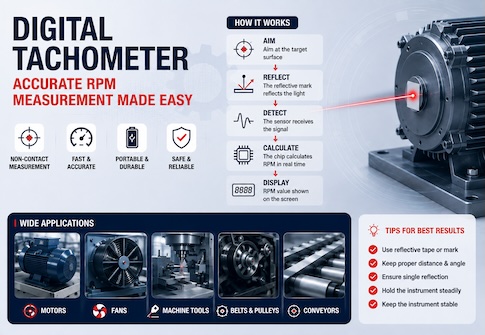
Non-contact optical or laser tachometers generally calculate speed by detecting periodic reflected signals from a rotating target. Signal quality, sampling interval, rotational speed, and signal-processing algorithms all influence the resulting measurement.
For contact tachometers, the stability of the contact tip or measuring wheel against the rotating component also affects the consistency of the reading.
If the instrument’s measurement uncertainty is significantly greater than the value represented by its last display digit, adding more decimal places does not automatically improve the quality of the measurement.
A meaningful resolution should therefore be matched to sensor performance, accuracy, measuring range, and the intended application rather than simply maximizing the number of displayed digits.
What Factors Affect Effective Speed Resolution?
The specified resolution is a design characteristic of the tachometer, but the ability to observe small speed changes consistently can also be affected by actual measurement conditions.
● Speed stability: If the rotating equipment itself fluctuates significantly, the displayed reading may continuously change.
● Quality of the reflective signal: With non-contact measurements, the position, size, surface condition, and contrast of reflective tape can affect signal detection.
● Measuring distance: Operating outside the recommended distance can reduce the strength of the reflected signal.
● Measurement angle: An unsuitable angle between the optical beam and reflective target can reduce signal quality.
● Sampling and display update rate: Different tachometers use different sampling and display-refresh strategies.
● Low-speed measurement: At lower speeds, fewer rotational pulses are available within a given period, so a longer sampling interval may be required to obtain a stable high-resolution result.
● Mechanical contact: With contact tachometers, slippage, insufficient pressure, or incorrect alignment can cause unstable readings.
Effective resolution in practical use therefore depends not only on the specification sheet but also on appropriate measurement conditions.
Is Higher Resolution Always Better?
Not every application requires very high RPM resolution.
For routine inspection of fans, motors, shafts, and other industrial equipment, the main objective may simply be to verify whether a machine is operating within its normal speed range. If the requirement is to distinguish between approximately 1450 RPM and 1700 RPM, a resolution of 1 RPM may already be more than sufficient.
Higher resolution becomes more useful when small variations of only a few RPM—or less—need to be observed.
Typical applications that can benefit from finer resolution include:
● Low-speed rotating equipment;
● Rotational speed stability testing;
● Motor performance analysis;
● Laboratory measurements;
● Equipment commissioning and adjustment;
● Applications requiring comparison of small speed changes.
The objective is therefore not to select the smallest possible resolution value, but to match the resolution to the smallest speed change that is relevant to the application.
How Should a Tachometer Be Selected Based on Resolution?
When selecting a tachometer, first determine the smallest RPM change that needs to be observed.
For general industrial maintenance, where the main purpose is to verify that equipment is operating within an acceptable speed range, measuring range, accuracy, reliability, and ease of operation may be more important than extremely fine resolution.
For applications requiring observation of small speed variations, check:
● Actual resolution within the required RPM range;
● Accuracy within the corresponding range;
● Minimum and maximum measurable speed;
● Whether non-contact or contact measurement is more appropriate;
● Whether functions such as Data Hold, MAX, MIN, or AVG are required;
● Measuring distance and reflective-tape requirements for non-contact measurement.
The number of decimal places on the display should not be used as the only basis for judging instrument performance. A suitable tachometer should provide an appropriate balance of measuring range, resolution, accuracy, and measurement stability.
Is There a Difference Between the Resolution of Non-Contact and Contact Tachometers?
Both non-contact and contact tachometers can provide fine digital resolution, but they acquire rotational speed information in different ways.
A non-contact tachometer typically uses optical or laser reflection to detect revolutions. Reflective tape is applied to the rotating component, and the instrument detects periodic reflected signals to calculate RPM. Because no direct physical contact with the rotating component is required, this method is suitable for motors, fans, shafts, and drive systems.
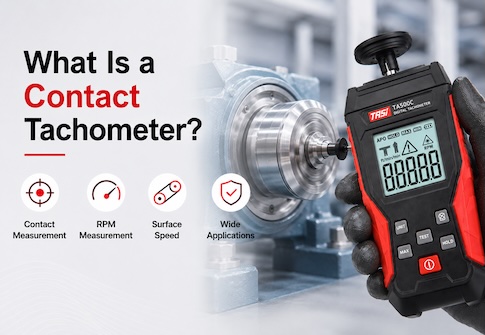
A contact tachometer uses a contact tip or measuring wheel placed directly against a rotating shaft or moving surface to determine rotational speed or linear speed.
Consequently, even if two instruments specify the same numerical resolution, their measurement stability can be affected by different factors. Non-contact measurements depend more heavily on optical signal quality, while contact measurements depend more heavily on stable mechanical contact.
Is It Normal for a High-Resolution Tachometer Reading to Fluctuate?
Yes, it can be normal.
A high-resolution tachometer can display smaller changes in rotational speed, so minor variations in the equipment itself are more visible. For example, if the actual speed varies between 1499.8 and 1500.4 RPM, a tachometer with 0.1 RPM resolution may display continuously changing values.
This does not necessarily indicate a fault.
If the reading fluctuates excessively, check:
● Whether the actual equipment speed is stable;
● Whether the reflective tape is firmly attached and flat;
● Whether the optical or laser beam remains correctly aligned with the reflective target;
● Whether the measuring distance is appropriate;
● Whether highly reflective objects are present nearby;
● Whether slippage is occurring during contact measurement.
When assessing tachometer performance, it is important to distinguish between the instrument displaying genuine small speed variations and unstable readings caused by improper measurement conditions.
FAQ
What does 0.1 RPM resolution mean on a tachometer?
It means the instrument can display or distinguish speed in increments of 0.1 RPM. For example, after 1250.1 RPM, the next display increment may be 1250.2 RPM.
Is 0.1 RPM resolution more accurate than 1 RPM resolution?
Not necessarily. A 0.1 RPM resolution provides finer indication, while measurement accuracy is determined by the separate accuracy specification.
Does one decimal place on the display mean the resolution is 0.1 RPM?
It may, but the display format alone should not be used to determine resolution. Refer to the instrument’s technical specifications.
Why can the same tachometer have different resolutions in different ranges?
Different speed ranges may require different signal acquisition, processing, and display strategies. Some instruments therefore provide finer resolution at lower speeds and larger increments at higher speeds.
Is higher resolution useful for low-speed measurements?
Yes, especially when small variations in low-speed equipment need to be observed. However, minimum measurable speed and accuracy must also be considered.
Is a smaller resolution value always better?
A smaller value provides finer indication, but it does not necessarily mean better overall performance. Accuracy, measuring range, measurement stability, and application conditions are equally important.
Should I consider accuracy or resolution first when choosing a tachometer?
Both are important. Accuracy indicates how close the reading is to the actual value, while resolution determines how small a change can be displayed. They should be evaluated together.
Conclusion
Tachometer resolution describes the smallest change in rotational speed that an instrument can display or distinguish, normally expressed in RPM. A resolution of 0.1 RPM provides finer speed information than 1 RPM, but it does not mean the measurement accuracy is also 0.1 RPM.
When selecting and using a tachometer, resolution, accuracy, measuring range, measurement method, and operating conditions should be considered together. Routine equipment inspection does not normally require the finest possible resolution, while low-speed measurements, speed stability analysis, and precision equipment adjustment may benefit significantly from finer resolution.
Understanding the difference between resolution and accuracy helps prevent misinterpretation of display digits and supports the selection of a tachometer that is better suited to the actual measurement task.