Introduction
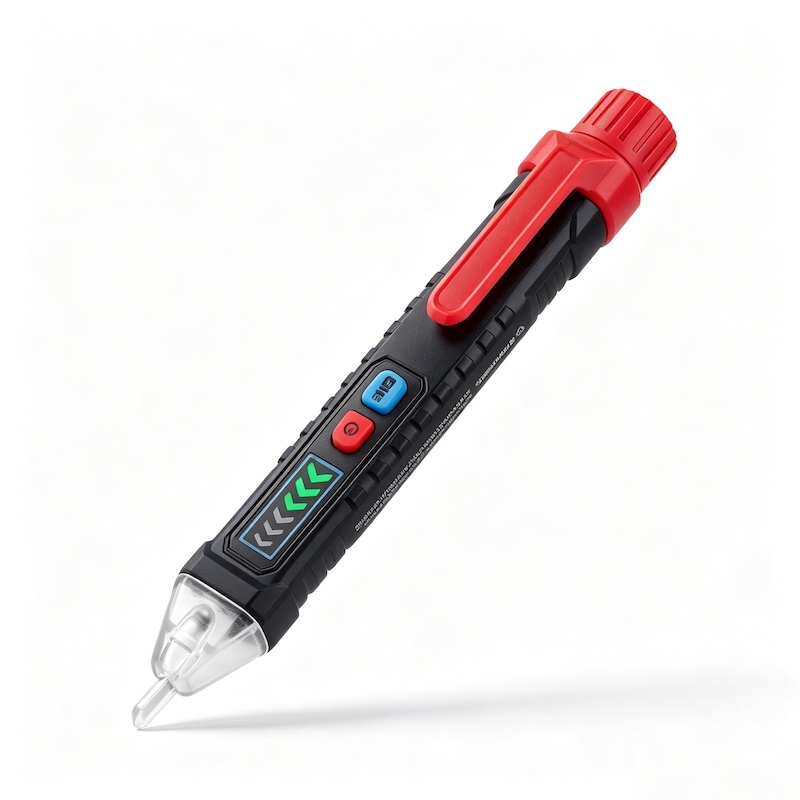
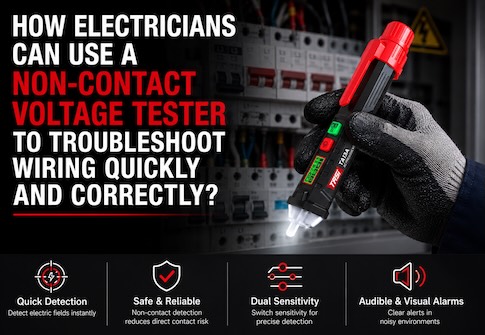
A non-contact voltage tester detects the alternating electric field around an energized conductor without requiring direct contact with exposed metal. One important design difference between models is whether the tester provides a fixed sensitivity or selectable sensitivity levels.
A single-sensitivity tester operates with one predefined detection response, making it simple to use. A dual-sensitivity tester allows the user to switch between two sensitivity levels or detection modes to suit different voltage levels and electrical environments.
It is important to distinguish sensitivity from measurement accuracy. Higher sensitivity does not mean that the tester measures voltage more accurately. An NCV tester is primarily intended to indicate the presence of an AC electric field rather than provide an exact voltage value.
Key Takeaways
● A single-sensitivity voltage tester operates with one fixed sensitivity or detection mode.
● A dual-sensitivity tester provides two selectable sensitivity levels or detection ranges.
● Higher sensitivity makes the tester more responsive to weaker electric fields but can also increase responses to nearby energized conductors.
● Lower sensitivity can help reduce the effective sensing area and improve conductor identification in dense wiring.
● Dual sensitivity does not mean higher measurement accuracy.
● The specified voltage detection range, measurement category, safety rating, and intended application remain important selection criteria.
What Is a Single-Sensitivity Non-Contact Voltage Tester?
A single-sensitivity NCV tester uses a predefined detection threshold. Once the tester is switched on, the user normally only needs to bring the sensing tip close to a cable, socket, terminal, or other test point.
Its internal detection circuit determines when the surrounding AC electric field is strong enough to trigger an audible, visual, or vibrating indication.
● Advantages: Simple operation, minimal mode selection, and fast routine checks of mains wiring, sockets, cables, and electrical equipment.
● Limitations: A fixed sensitivity provides less flexibility when dealing with weak electric fields, lower-voltage circuits, thick insulation, or several energized conductors located close together.
Single sensitivity therefore does not necessarily mean inferior performance. It is simply optimized for straightforward and consistent live-voltage screening.
What Is a Dual-Sensitivity Non-Contact Voltage Tester?
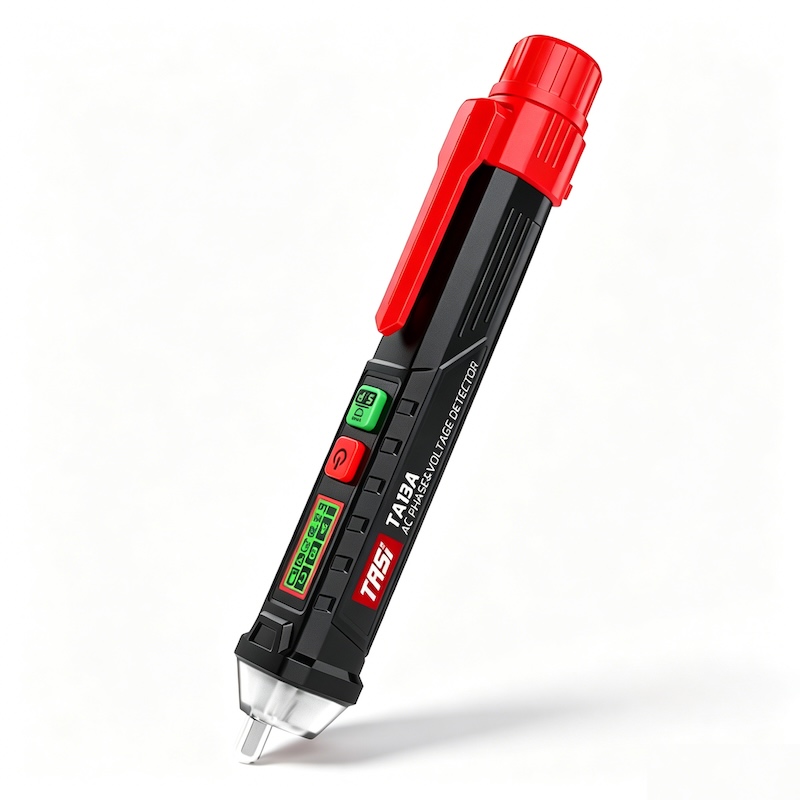
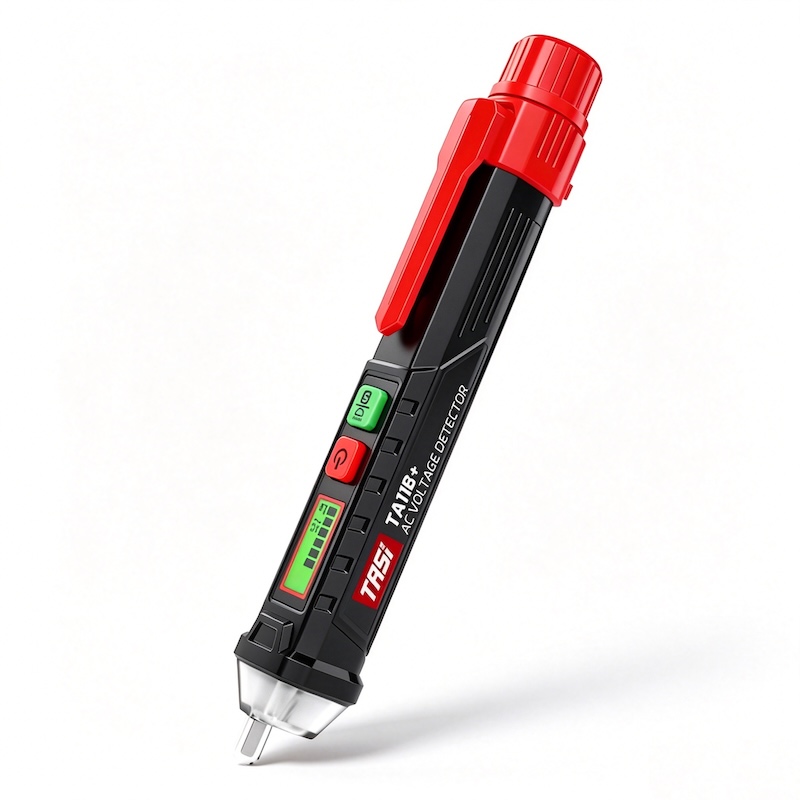
A dual-sensitivity tester provides two different detection response levels within one instrument. Depending on the manufacturer, these may be described as high/low sensitivity, dual sensitivity, dual range, or similar terminology.
In some designs, the two modes correspond to different voltage detection ranges. For example, one mode may be intended for normal mains voltage while another extends detection to lower AC voltages. In other designs, the modes primarily change the tester's sensitivity to surrounding electric fields.
● High sensitivity is useful when detecting weaker electric fields or lower-voltage AC circuits.
● Lower sensitivity can help narrow the sensing area when conductors are located close together.
The main benefit is therefore not simply an additional button or setting. It is the ability to adapt the detector's response to different electrical environments.
Key Differences Between Single and Dual Sensitivity
| Comparison | Single Sensitivity | Dual Sensitivity |
|---|---|---|
| Sensitivity settings | Fixed | Two selectable levels |
| Ease of use | Very simple | Requires mode selection |
| Low-voltage adaptability | Depends on specified range | Usually more flexible |
| Weak electric-field detection | Depends on factory setting | High-sensitivity mode can improve detection |
| Dense wiring identification | Limited by fixed response | Lower sensitivity can improve localization |
| Resistance to nearby-field influence | Depends on design and environment | Sensitivity can be reduced when necessary |
| Typical use | Routine live-voltage checks | Multiple voltage levels and more complex electrical environments |
| Flexibility | Fixed | Higher |
A key point is that dual sensitivity does not automatically mean a wider voltage detection range.
Some products do use two voltage ranges, while others provide two sensitivity thresholds within a similar overall voltage range. Always check the manufacturer's specifications rather than relying on the term “dual sensitivity” alone.
What Is the Difference Between High and Low Sensitivity?
High sensitivity allows the tester to respond to a weaker electric field. Under comparable conditions, the tester may indicate voltage from a greater distance, through thicker insulation, or around a lower-voltage energized conductor.
● Better for detecting weak electric fields.
● Useful for initial scanning and lower-voltage AC circuits.
● More likely to respond to electric fields from nearby energized wiring.
Lower sensitivity requires a stronger local electric field before the tester responds.
● The effective sensing area is generally smaller.
● It can be useful when checking closely spaced conductors.
● It can reduce unwanted responses caused by adjacent energized wiring.
In practical terms, high sensitivity is useful for finding, while lower sensitivity is often more useful for narrowing down the source.
Why Is Higher Sensitivity Not Always Better?
A very sensitive NCV tester can detect electric fields from conductors that are not directly under the sensing tip.
For example, several wires may run next to each other in the same conduit or distribution panel. If only one conductor is energized, a highly sensitive tester may still indicate an electric field when placed near an adjacent conductor because the field extends beyond the energized wire.
This does not necessarily mean that the tester is malfunctioning. It is detecting an AC electric field in the surrounding area.
Reducing sensitivity and bringing the sensing tip progressively closer to individual conductors can help narrow the detection zone.
The objective is therefore not to use maximum sensitivity at all times, but to use an appropriate sensitivity for the test environment.
Why Is Dual Sensitivity Useful in Complex Wiring?
A non-contact voltage tester senses the electric field surrounding an energized AC conductor. In dense wiring systems, fields from neighboring conductors can overlap.
With a fixed-sensitivity tester, the main variable available to the user is the distance between the sensing tip and the conductor.
With a dual-sensitivity tester, the user can adjust both distance and sensitivity.
A practical approach is:
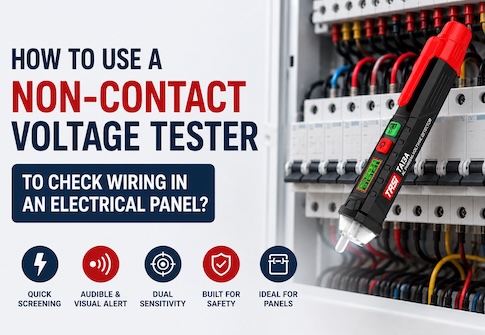
● Use high sensitivity for an initial scan of a cable bundle, electrical panel, or wiring area.
● Identify the general area in which an AC electric field is present.
● Switch to the lower-sensitivity mode.
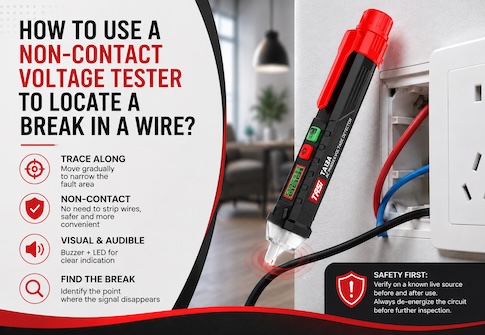
● Move the sensing tip progressively closer to individual conductors to narrow down the likely energized source.
This added flexibility is one of the main advantages of dual-sensitivity designs in electrical troubleshooting.
When Should High-Sensitivity Mode Be Used?
● When checking lower-voltage AC circuits within the tester's specified range.
● When performing a quick scan across a group of cables.
● When detecting conductors through insulation or cable jackets.
● When screening an area for the possible presence of energized wiring.
● When the sensing tip cannot be positioned very close to the conductor.
A high-sensitivity indication confirms that an AC electric field meeting the tester's response threshold has been detected nearby. It does not necessarily prove that the conductor directly in front of the sensing tip is energized.
When Should Lower-Sensitivity Mode Be Used?
● When several wires are positioned close together.
● When working inside densely wired electrical panels or control cabinets.
● When high-sensitivity mode produces an excessively broad indication area.
● When trying to narrow down the location of an energized conductor.
● When nearby electric fields are affecting the initial detection.
A common method is to scan first with high sensitivity and then switch to lower sensitivity for more targeted localization.
Where Is a Single-Sensitivity Tester Suitable?
Single-sensitivity testers are generally sufficient for routine electrical checks where voltage levels and wiring arrangements are relatively predictable.
● Checking wall outlets.
● Screening standard AC power cables.
● Checking switches and terminals for the possible presence of voltage.
● General household electrical maintenance.
● Fast preliminary checks during equipment servicing.
Their main advantage is straightforward operation.
Where Is a Dual-Sensitivity Tester Suitable?
Dual-sensitivity models are particularly useful in more varied or complex electrical environments.
● Electrical installation and maintenance.
● Distribution panel and control-cabinet inspection.
● Troubleshooting densely routed cables.
● HVAC electrical maintenance.
● Industrial equipment servicing.
● Applications involving both standard mains circuits and lower-voltage AC circuits.
● Situations requiring initial scanning followed by more precise localization.
For professional users, the main advantage is greater flexibility in the testing method rather than simply a larger specification number.
Should You Choose Single or Dual Sensitivity?
The choice should be based on the application rather than on the number of sensitivity modes alone.
● Routine mains-voltage checks: A single-sensitivity tester is often sufficient and easier to operate.
● Multiple voltage levels: Consider a dual-sensitivity model and verify the actual voltage range for each mode.
● Dense wiring: Dual sensitivity can provide better control when locating individual energized conductors.
● Lower-voltage AC circuits: Check the specified minimum detection voltage rather than assuming that all dual-sensitivity testers are suitable.
● Industrial applications: Also consider measurement category, safety rating, environmental protection, and intended operating conditions.
● Exact voltage measurement: Use a digital multimeter or suitable contact voltage tester instead of an NCV tester.
The specified detection range and actual application are normally more important than the number of sensitivity settings.
Important Safety Considerations
● Verify tester operation on a known live source before use and recheck it after testing.
● With a dual-sensitivity tester, confirm which sensitivity mode is currently selected.
● If high sensitivity gives an excessively broad response, reduce sensitivity and move closer to the target conductor.
● Shielding, grounded metal enclosures, insulation, wiring geometry, and sensing distance can all affect NCV performance.
● Audible or visual indication should not be interpreted as an exact voltage measurement.
● The absence of an NCV indication must not automatically be treated as proof that a circuit is de-energized.
● Where verification of absence of voltage is required, use an appropriate contact-type test instrument and follow applicable electrical safety procedures.
FAQ
What does single sensitivity mean on a voltage tester?
● It means the tester uses one fixed detection response and does not allow the user to switch between high and low sensitivity.
What does dual sensitivity mean?
● It means the tester provides two selectable detection response levels or, depending on its design, two detection ranges.
Is dual sensitivity always better?
● No. It provides greater flexibility, but a single-sensitivity tester can be entirely suitable for routine outlet, cable, and mains-voltage checks.
Does dual sensitivity always mean two voltage ranges?
● No. Some testers use different voltage ranges, while others primarily change the electric-field sensitivity. The product specification should always be checked.
What is high-sensitivity mode used for?
● It is useful for detecting weaker electric fields, lower-voltage AC circuits within the specified range, and broad initial scanning.
What is lower-sensitivity mode used for?
● It helps narrow the effective sensing area and can improve conductor identification where several energized wires are located close together.
Can a dual-sensitivity NCV tester measure the actual voltage?
● Normally no. It is primarily intended to indicate the presence of an AC electric field, not to provide an accurate voltage value.
If the tester does not indicate voltage, is the circuit definitely de-energized?
● No. Detection can be affected by sensitivity settings, distance, shielding, insulation, and circuit configuration. Use an appropriate contact tester when confirming absence of voltage is required.
Conclusion
The main difference between single-sensitivity and dual-sensitivity non-contact voltage testers is whether the detection response can be adjusted to suit the application.
A single-sensitivity tester provides a fixed response and is well suited to fast, routine checks of outlets, cables, and common AC circuits. A dual-sensitivity tester allows the user to switch between two response levels or detection modes, making it more adaptable to weak electric fields, lower-voltage circuits, dense wiring, and more complex electrical environments.
Dual sensitivity does not mean higher measurement accuracy, nor does it automatically guarantee a wider voltage range. When selecting an NCV tester, consider the specified minimum and maximum detection voltage, sensitivity modes, measurement category, safety rating, operating environment, and intended application.
For routine screening, single sensitivity is often sufficient. For applications that require both broad detection and more targeted localization, dual sensitivity provides greater flexibility.