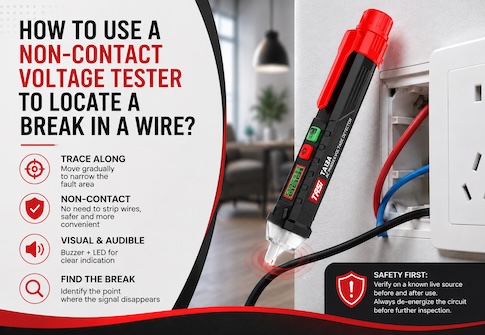
Introduction
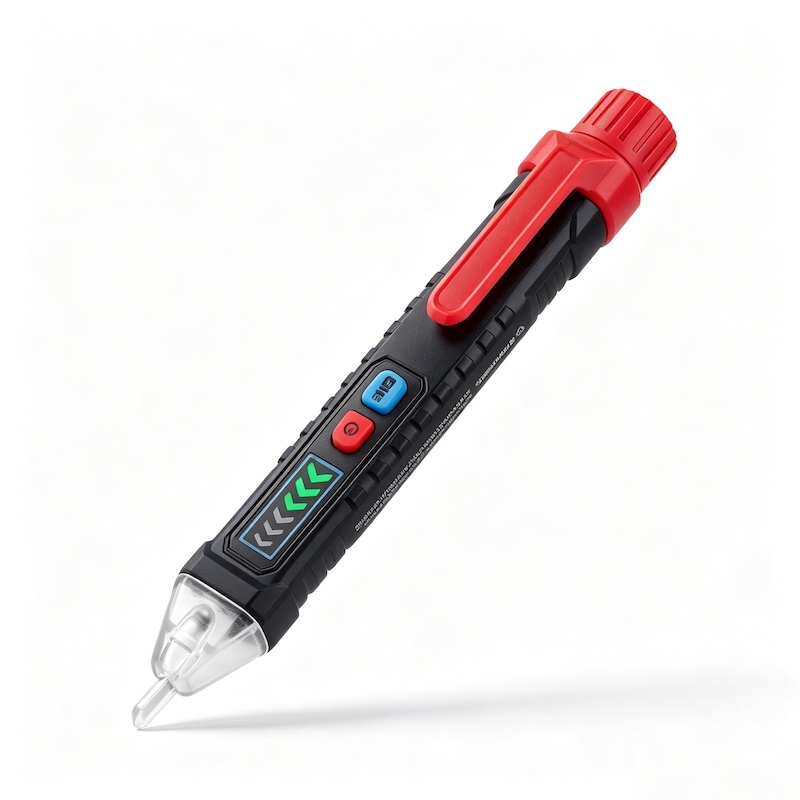
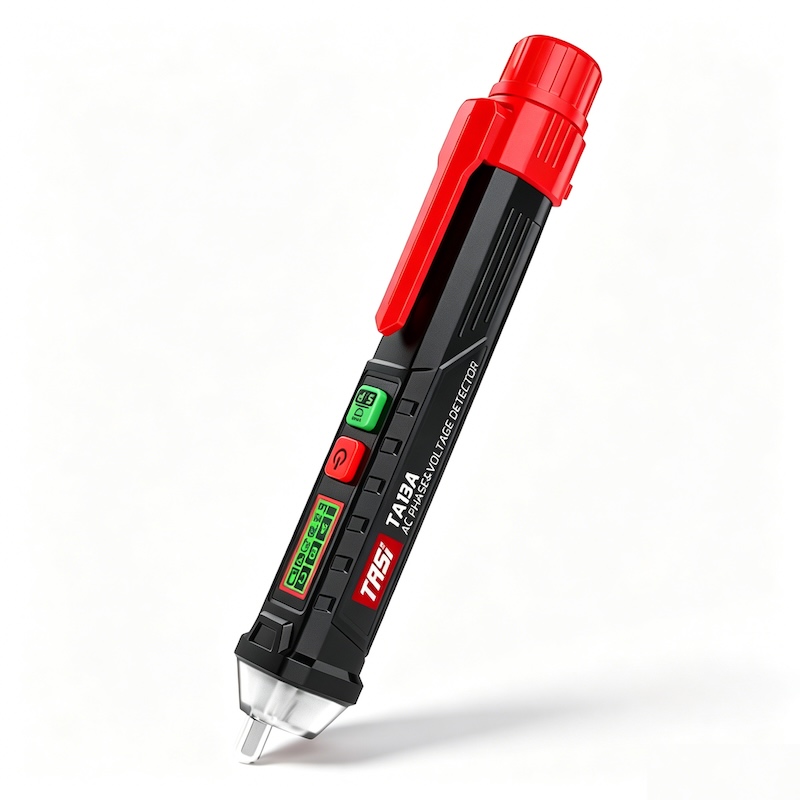
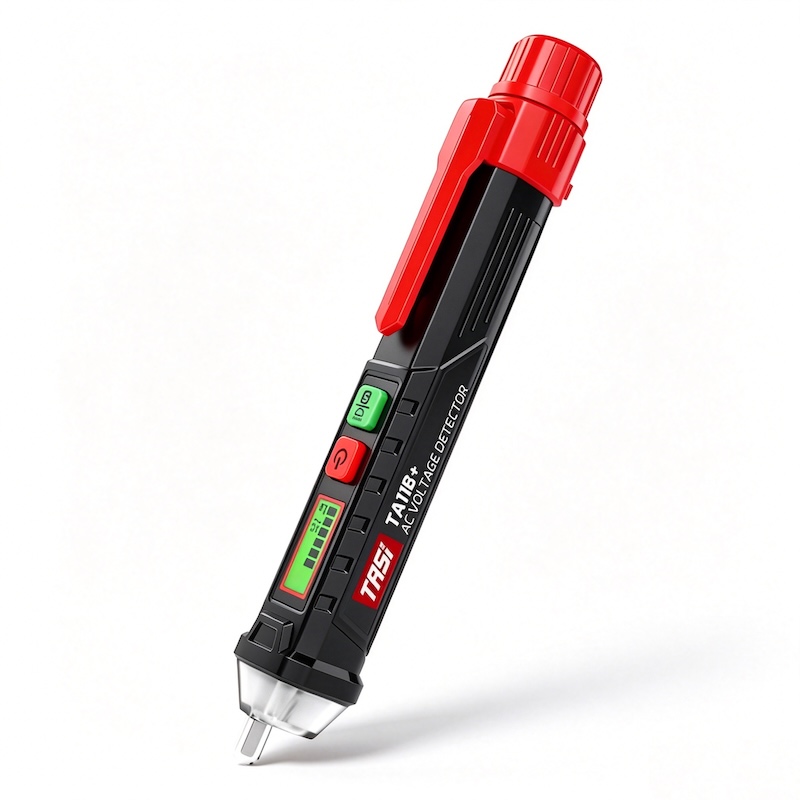
When working with household wiring, electrical installations, or equipment maintenance, it is often necessary to determine which conductor is live and which is neutral. Because a non-contact voltage tester can detect voltage without touching an exposed conductor, it is widely used for preliminary identification.
Under normal AC wiring conditions, an NCV tester will usually provide a stronger audible or visual indication near the live conductor, while the neutral conductor may produce little or no indication. This means the tester can often assist in locating the live wire.
However, a non-contact voltage tester detects the AC electric field surrounding a conductor; it does not directly measure the voltage between live and neutral. Wiring conditions and the surrounding electrical environment can therefore affect the result, so the method cannot guarantee correct live/neutral identification in every situation.
Key Points
● A non-contact voltage tester can usually assist with live-wire identification, but it cannot provide 100% certainty.
● A live conductor normally produces a stronger AC electric field and is therefore more likely to trigger the tester.
● A neutral conductor is normally close to earth potential in a correctly operating system, so its surrounding electric field is usually weaker; however, neutral conductors can still produce an indication.
● Induced voltage, closely routed conductors, an open neutral, incorrect wiring, and high-sensitivity settings can all cause an indication near a neutral conductor.
● No indication does not prove that a conductor is neutral or de-energized.
● For isolation verification, wiring work, or other safety-critical tasks, an appropriate contact voltage tester should be used for confirmation.
Why Can an NCV Tester Usually Identify a Live Wire?
Non-contact voltage testers generally detect AC electric fields through capacitive coupling. When AC voltage is present on a conductor, a changing electric field exists around the conductor.
As the sensing tip approaches the wire, this electric field produces a very small coupled signal. The tester's internal circuitry detects and amplifies the signal. When it exceeds the detection threshold, the instrument activates an LED, buzzer, or other alarm indication.
In a typical single-phase AC system:
● The live conductor normally has a significant AC voltage relative to earth, producing a comparatively strong electric field.
● The neutral conductor, when the system is correctly wired and operating normally, is usually close to earth potential and therefore produces a weaker electric field.
This difference allows an NCV tester to assist with live/neutral identification in many common applications.
However, the tester is fundamentally detecting an electric field, not directly identifying the electrical function of the conductor.
Why Does “Alarm Means Live, No Alarm Means Neutral” Not Always Work?
This rule may appear to work in simple, correctly wired circuits, but it should never be treated as absolute.
An NCV tester responds when the detected AC electric field exceeds its internal threshold. It does not determine whether the conductor is labelled or intended to function as live or neutral.
Several situations are therefore possible:
● The live conductor gives a strong indication and the neutral conductor gives none — the most common normal condition.
● Both live and neutral produce an indication — possibly due to capacitive coupling, closely spaced conductors, excessive sensitivity, or abnormal wiring.
● The live conductor produces only a weak indication — possibly because of thick insulation, greater sensing distance, shielding, or test position.
● The live conductor produces no indication — possibly because the voltage is below the tester's detection range, the electric field is shielded, or the tester or testing conditions are unsuitable.
● The neutral conductor gives a strong indication — potentially indicating an open neutral, abnormal wiring, induced voltage, or another electrical condition requiring further investigation.
An alarm therefore means only that the tester has detected an AC electric field above its threshold. It does not by itself prove that the conductor is live.
Why Can a Neutral Wire Sometimes Trigger the Tester?
A neutral conductor is normally at a relatively low potential, but real electrical installations do not always behave like ideal circuits.
Common causes include:
● Induced voltage. When live and neutral conductors run close together over a significant distance, capacitive coupling from the live conductor can create an electric field around the adjacent conductor.
● High tester sensitivity. A high-sensitivity mode can detect weaker electric fields but is also more susceptible to signals from nearby energized conductors.
● Closely spaced wiring. Inside cables, junction boxes, and outlets, conductors may be too close for the tester to respond exclusively to one wire.
● Voltage on the neutral conductor. A neutral conductor is not necessarily at exactly the same potential as earth at every point. Load current, conductor resistance, and wiring length can create a potential difference.
● Open neutral or wiring fault. Under fault conditions, a conductor expected to be near earth potential may rise to an abnormal voltage.
If a neutral conductor repeatedly produces a strong indication where none is expected, the circuit should be investigated rather than assuming that the NCV tester is defective.
Why Can a Live Wire Sometimes Produce No Indication?
A conductor may be energized even when an NCV tester does not respond.
Possible reasons include:
● The voltage is below the tester's specified detection range.
● The sensing tip is too far from the conductor.
● The conductor has thick insulation.
● Metallic conduit, shielding, or an enclosure reduces the external electric field.
● Adjacent conductors alter the local electric-field distribution.
● The tester battery is weak.
● An inappropriate sensitivity mode has been selected.
● The tester was not function-checked before use.
For this reason, no alarm should never be interpreted automatically as “neutral” or “safe to touch.”
How to Use an NCV Tester to Assist with Live/Neutral Identification
For preliminary conductor identification, the following procedure can improve reliability:
● Before testing, verify the tester on a known energized AC source to confirm correct operation.
● Bring the sensing tip close to each conductor separately, using approximately the same distance and orientation.
● If the tester has high- and low-sensitivity modes, select the mode appropriate to the wiring environment.
● Test conductors individually whenever possible and avoid positioning the sensor close to several adjacent wires at the same time.
● A conductor producing a clearly stronger indication is generally more likely to be live, while one giving a much weaker or no indication is more likely to be neutral.
● If both conductors give strong indications, the response is unstable, or the result conflicts with expectations, do not rely on the NCV tester alone.
A non-contact voltage tester is best regarded as a rapid screening and preliminary identification tool, rather than a definitive means of conductor identification.
When Should You Not Rely Solely on a Non-Contact Voltage Tester?
NCV indication alone is particularly unsuitable in the following situations:
● Live and neutral conductors are contained within the same multicore cable.
● Several energized conductors are routed closely together.
● The wiring uses metallic conduit, shielded cable, or other shielding structures.
● An open neutral, incorrect connection, or other wiring fault is suspected.
● It is necessary to confirm that equipment or a circuit is actually de-energized.
● Conductors will be disconnected, reconnected, repaired, or physically handled.
In these situations, an appropriate contact voltage testing method should be used to confirm the actual electrical condition.
What Is the Difference Between NCV and Contact Voltage Testing?
A non-contact voltage tester primarily detects whether a sufficiently strong AC electric field is present nearby. Its main advantages are speed and the ability to perform preliminary checks without contacting an exposed conductor.
A contact voltage tester establishes an electrical connection to the test points and can therefore assess the potential difference more directly. It is generally more appropriate when confirming actual voltage conditions, evaluating wiring, or verifying isolation.
In practical terms:
● An NCV tester is suitable for quickly locating where AC voltage may be present.
● A contact voltage tester is more suitable for confirming the actual electrical condition.
The two methods serve different purposes and should not automatically be considered interchangeable.
FAQ
Can a non-contact voltage tester identify live and neutral wires with 100% accuracy?
No. It can often assist with identification under normal conditions, but induced voltage, wiring arrangement, circuit condition, and tester sensitivity can affect the result.
Is every wire that triggers an NCV tester definitely live?
No. An alarm indicates that the tester has detected an AC electric field above its threshold. Electric fields induced by nearby energized conductors can also trigger the tester.
Why does the neutral wire sometimes trigger the tester?
Possible reasons include capacitive coupling from a nearby live conductor, high sensitivity, close conductor spacing, voltage drop on the neutral, or a wiring fault.
Does no alarm mean that the wire is neutral?
No. An energized conductor may fail to trigger the tester because of distance, shielding, insulation, detection-range limitations, or tester condition.
Can an NCV tester be used to confirm that a circuit is completely de-energized?
It should not be used as the sole means of proving a circuit de-energized. Before maintenance or conductor contact, follow the applicable electrical safety procedure and verify the voltage condition with an appropriate contact testing device.
Conclusion
Under normal AC wiring conditions, a non-contact voltage tester can often use the difference in electric-field strength around live and neutral conductors to assist in distinguishing between them. The live conductor usually produces a stronger indication, while the neutral conductor generally produces a weaker or no indication.
However, an NCV tester detects an AC electric field rather than directly identifying the function of a conductor. Induced voltage, cable arrangement, faults, shielding, test distance, and sensitivity settings can all affect the result.
For this reason, an NCV tester is useful for rapid live-wire screening and preliminary troubleshooting, but an alarm should not automatically be treated as proof of a live conductor, and no alarm should not be treated as proof of a neutral conductor or a safely isolated circuit.