Introduction
The answer is no.
If a non-contact voltage tester does not alarm, it only means that under the current test conditions the instrument has not detected an AC electric field strong enough to trigger its indication. It does not independently prove that the circuit is completely de-energized.
Non-contact voltage testers are useful for quick preliminary checks, but they should not be the sole means of confirming an electrically safe condition. Before wiring, servicing, disassembly, or any task involving possible contact with exposed conductors, the absence of voltage should be verified using an appropriate test method.
Key Points
● No alarm from an NCV tester does not necessarily mean no voltage is present.
● Low voltage, excessive distance, shielding, or an unsuitable sensitivity setting can prevent detection.
● Weak batteries or a defective tester can also produce a false-negative result.
● Most standard non-contact voltage testers are intended primarily for detecting AC electric fields and cannot reliably confirm the absence of DC voltage.
● Before electrical servicing, verify the circuit with a suitable contact voltage tester or multimeter where appropriate.
● Check the tester on a known energized source before and after testing the target circuit.
Why Does No Alarm Not Prove That a Circuit Is De-Energized?
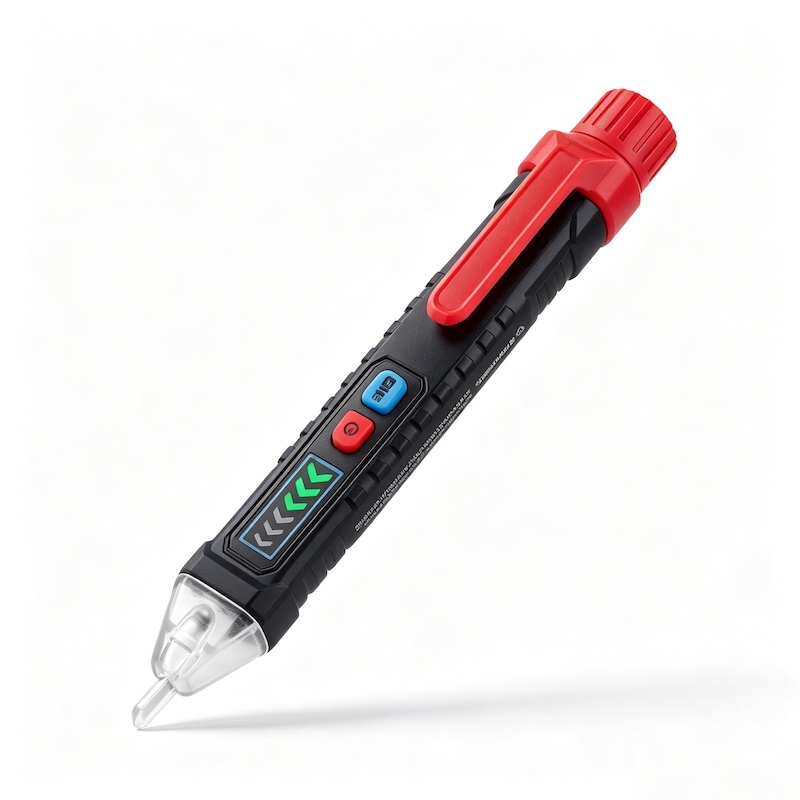
A non-contact voltage tester normally detects the alternating electric field surrounding an energized conductor. When the probe approaches a conductor and the detected field exceeds the tester's trigger threshold, the instrument produces an audible, visual, or vibration indication.
In other words, the tester detects whether a sufficiently strong AC electric field is present nearby. It does not directly measure the actual voltage between conductors.
A conductor may therefore still be energized even when the electric field reaching the tester is too weak to trigger an alarm. For this reason, NCV testing should be regarded as a rapid screening method rather than definitive proof of a zero-voltage condition.
What Can Cause an Energized Circuit to Produce No Alarm?
● Excessive test distance: The electric field detected by the tester generally becomes weaker as the probe moves farther from the conductor.
● Thick insulation: Heavy insulation can reduce the field strength reaching the sensor.
● Metal shielding: Metal conduit, enclosures, armored structures, and shielded cables can significantly attenuate or block the electric field.
● Voltage below the detection range: If the circuit voltage is below the tester's specified detection range, an alarm may not occur. For example, a tester rated for 50–1000 V AC should not be relied upon to detect AC voltages well below 50 V.
● Incorrect sensitivity setting: On testers with high- and low-sensitivity modes, the lower-sensitivity setting may fail to respond to weak electric fields.
● Probe position: Cables may contain line, neutral, and protective conductors. Electric-field strength can vary according to conductor position, cable construction, and test direction.
● Low battery: Insufficient battery power can affect sensing circuitry, the buzzer, or visual indicators.
● Tester malfunction: A defective sensor, circuit, indicator, or other internal component may prevent the tester from responding even near an energized conductor.
Can a Non-Contact Voltage Tester Detect Every Type of Voltage?
No.
Most conventional non-contact voltage testers are designed primarily to detect alternating voltage (AC) by sensing a changing electric field.
Stable DC voltage does not produce the same continuously alternating electric field. As a result, a standard NCV tester generally cannot be used to reliably determine whether a DC circuit is energized.
Therefore, if you are testing batteries, DC power supplies, photovoltaic systems, or other DC circuits, no alarm from a conventional NCV tester must not be interpreted as proof that no DC voltage is present.
How Can You Tell Whether the Circuit Is De-Energized or the Tester Simply Failed to Detect It?
A practical method is to verify the tester against a known energized source.
● Before testing, check the NCV tester on a known energized outlet or conductor.
● Confirm that the tester provides its normal audible and visual indication.
● Test the target circuit.
● After completing the test, check the tester again on the known energized source.
This live-source verification before and after testing helps identify weak batteries, instrument failure, or problems that may have developed during the test.
However, it does not eliminate the inherent limitations of non-contact voltage detection.
How Should the Absence of Voltage Be Verified More Reliably?
For quickly identifying conductors that may be energized, an NCV tester is highly convenient.
However, if the next step involves touching, disconnecting, or servicing conductors, an NCV result alone is not sufficient. The power source should be isolated according to applicable electrical safety procedures, and the absence of voltage should be verified using suitable contact test equipment.
Typical precautions include:
● Isolate the appropriate circuit or disconnecting device.
● Prevent unintended re-energization during the work.
● Verify the circuit using a contact voltage tester or multimeter suitable for the voltage level and measurement category.
● Check all relevant conductor combinations rather than testing only one location.
● Begin work on conductors only after the de-energized condition has been properly verified.
Work on switchboards, distribution systems, high-energy circuits, or other hazardous installations should be performed only by appropriately qualified personnel in accordance with applicable local safety requirements.
What Is a Non-Contact Voltage Tester Best Used For?
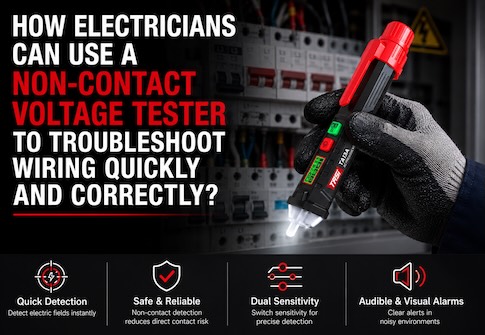
The main advantage of an NCV tester is that it can perform a rapid check without direct contact with exposed conductors. Typical applications include:
● Quickly checking whether AC voltage may be present around an outlet or cable.
● Preliminary identification of a live conductor.
● Checking switches, receptacles, and extension cords for possible energization.
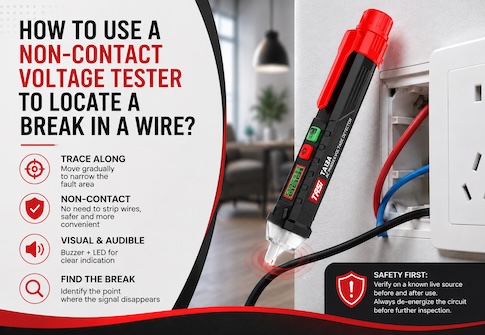
● Assisting with the preliminary location of open circuits in wiring.
● Performing an initial voltage presence check before maintenance.
The key distinction is simple: an NCV tester is better suited to indicating that voltage may be present than to proving that voltage is absent.
FAQ
Can I start electrical work if the non-contact voltage tester gives no alarm?
No. A lack of indication does not rule out hazardous voltage. If exposed conductors will be contacted, isolate the power and verify the absence of voltage with suitable contact test equipment.
Why does the same wire sometimes trigger an alarm and sometimes not?
The result can vary with probe distance, test angle, conductor position inside the cable, insulation thickness, sensitivity mode, and electric fields from adjacent wiring.
Is it normal for low-voltage wiring not to trigger the tester?
Yes. Every NCV tester has a specified detection range. If the voltage is below the lower limit, the tester may not respond.
Can I use an NCV tester through a wall to determine whether hidden wiring is energized?
It should not be treated as a reliable method. Wall thickness, cable depth, conduit, and shielding materials can significantly affect field detection.
How can I check whether the tester itself is working?
Test it on a known energized AC source before and after checking the target circuit. If it does not respond to the known live source, inspect the battery, operating mode, and tester condition.
Does no alarm prove that a DC circuit is de-energized?
No. Standard NCV testers are mainly intended for AC detection and cannot reliably confirm the absence of DC voltage.
Summary
No alarm from a non-contact voltage tester does not prove that a circuit is de-energized. It only indicates that, under the current test conditions, the tester has not detected an AC electric field strong enough to trigger its alarm.
Low voltage, shielding, thick insulation, poor probe position, low battery power, or tester malfunction can all result in an energized conductor producing no indication.
A non-contact voltage tester should therefore be used as a rapid screening tool. Before wiring, servicing, or other work involving conductor contact, isolate the circuit correctly and use appropriate contact test equipment to verify the absence of voltage.