Introduction
An electrical panel or distribution board contains circuit breakers, incoming and outgoing conductors, terminals, and multiple branch circuits. During routine maintenance, inspection, or preliminary troubleshooting, technicians often need a quick way to determine whether AC voltage may be present around a particular breaker, conductor, or circuit.
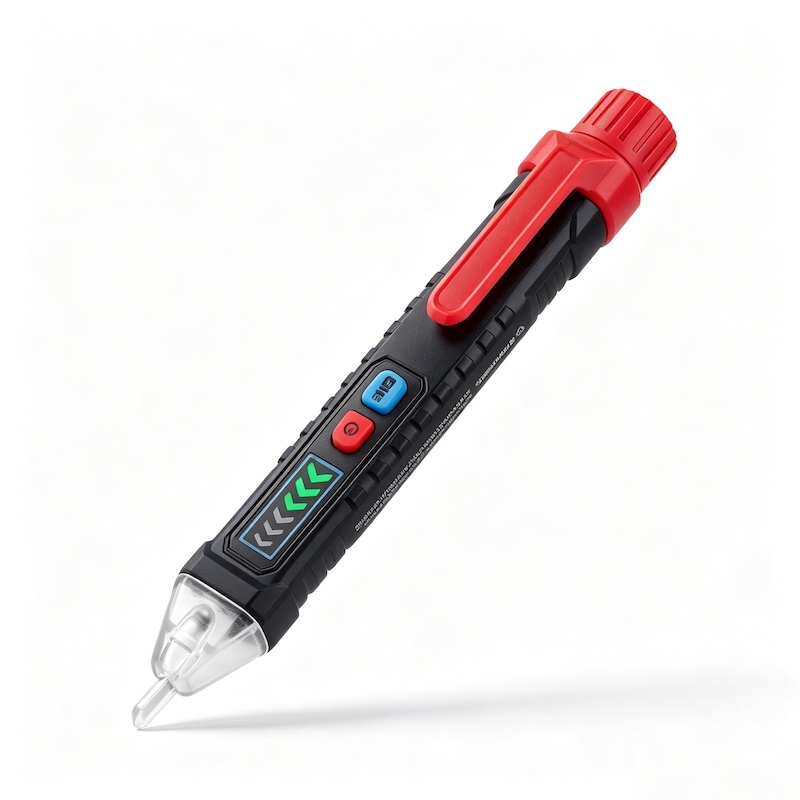
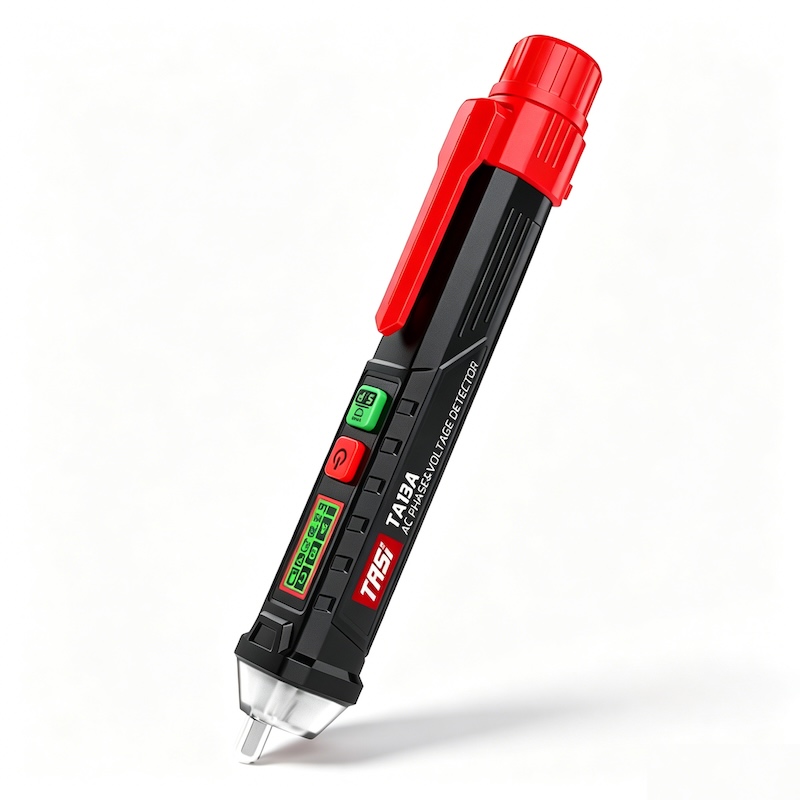
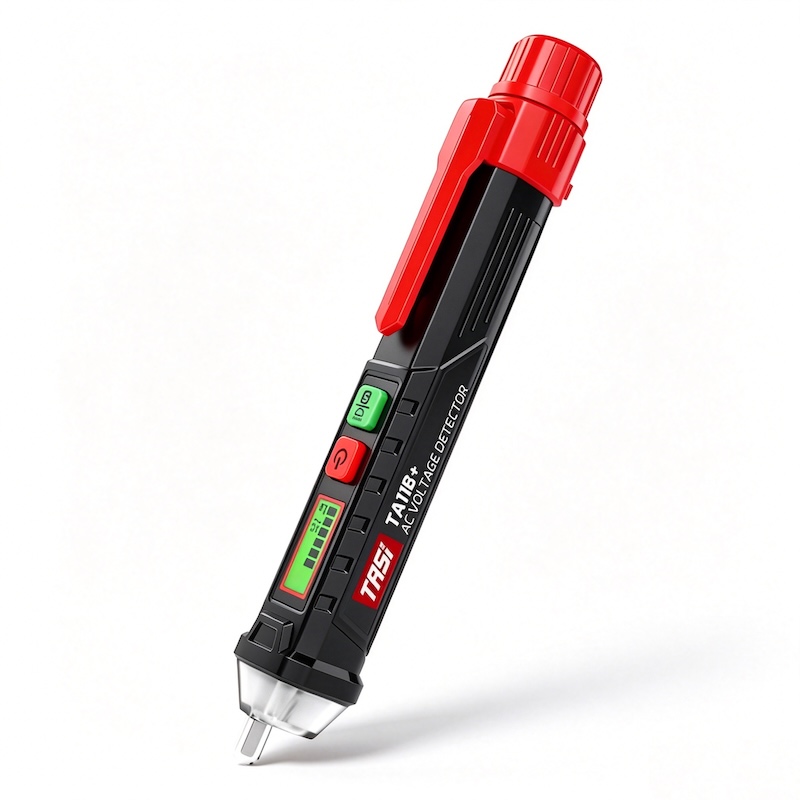
A non-contact voltage tester (NCVT) detects the electric field produced by AC voltage and provides an audible, visual, or sometimes vibration alert without requiring direct contact with an exposed conductor. This makes it useful for preliminary energized-circuit screening in electrical panels.
However, an NCVT indicates the presence of an AC electric field rather than measuring the actual voltage. It must not be used as the sole means of proving that a circuit is de-energized. Electrical panels may contain exposed live parts, hazardous voltages, and arc-flash risks, so work should only be carried out by appropriately trained and qualified personnel.
Key Takeaways
● A non-contact voltage tester is useful for preliminary energized-circuit screening around breakers, branch conductors, and terminal areas in an electrical panel.
● Before testing, verify the tester on a known energized source. After completing the inspection, verify it again to confirm that it remained operational.
● Approach the insulated part of the target conductor with the sensing tip instead of inserting the tester between exposed energized terminals.
● Closely spaced conductors can produce misleading indications because the tester may detect the electric field from an adjacent energized wire.
● A dual-sensitivity tester is often more practical in crowded panels: higher sensitivity can be used for initial screening and lower sensitivity for more precise localization.
● For panel work, pay particular attention to the tester's measurement category (CAT rating) and rated voltage, not only its NCV detection range.
● An NCVT does not replace a multimeter, two-pole voltage tester, or other suitable instrument for formal absence-of-voltage verification.
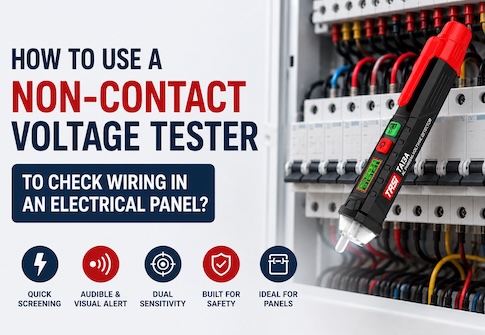
Why Can a Non-Contact Voltage Tester Be Used in an Electrical Panel?
A non-contact voltage tester contains circuitry designed to sense alternating electric fields. When its sensing tip approaches a conductor energized with AC voltage, an alternating electric field may be detectable even through the conductor's insulation.
Once the sensed field exceeds the tester's detection threshold, the instrument typically responds with an audible alarm, LED indication, or vibration.
This allows the user to perform a preliminary check near insulated breaker conductors, branch wiring, and terminal areas without stripping insulation.
Typical applications include:
● Routine electrical panel inspection;
● Preliminary checking of circuit breaker line and load conductors;
● Rapid screening of branch circuits;
● Locating conductors that may still be energized;
● Supporting pre-maintenance safety checks;
● Checking whether an AC electric field remains near a circuit after a breaker has been switched off.
Because the method depends on electric-field strength, results can be affected by conductor spacing, insulation thickness, shielding, grounding conditions, and tester sensitivity.
What Should Be Checked Before Testing an Electrical Panel?
Before approaching an open panel, confirm that both the working environment and the test instrument are suitable for the task.
Check the tester condition
Switch on the tester, confirm that the battery is adequate, and check any available self-test or power-on indication. A tester showing a low-battery warning should not be relied upon for important electrical checks.
Test on a known energized source
Before starting, place the tester near a known energized AC source and confirm that its audible and visual indicators operate normally.
If it does not respond to a known live source, do not use it to assess wiring inside the panel.
Confirm the detection range
Different NCVTs have different AC detection ranges. Models with a lower starting detection voltage are generally more sensitive, while others are designed mainly for standard mains-voltage circuits.
If the panel contains circuits with different voltage levels or low-voltage control wiring, make sure the tester's detection range is appropriate.
Confirm the safety category
When working around electrical distribution equipment, the tester's CAT rating is as important as its voltage rating.
Electrical panels are generally located closer to the distribution system than ordinary electronic equipment or final-use appliances. The tester should therefore have a measurement category and voltage rating appropriate for the actual installation and working environment.
How to Use a Non-Contact Voltage Tester in an Electrical Panel
Ensure that the work area and your hands are dry, verify that the tester is functioning correctly, and avoid contact with exposed conductors.
After opening the panel, do not immediately insert the tester deep into a crowded group of wires. Begin from outside the target area and gradually move toward the conductor or circuit being checked.
Bring the sensing tip close to the insulation of the target conductor while maintaining a controlled distance. If a sufficiently strong AC electric field is present, the tester should provide an audible or visual indication.
Move the tester slowly along the conductor and compare the response at several points rather than relying on a single test location.
Where conductors are closely packed, position the sensing tip as close as safely possible to the intended wire while keeping it away from adjacent energized conductors. This helps reduce interference.
With a dual-sensitivity tester, high sensitivity can be used first to locate a potentially energized area, followed by low sensitivity to narrow down the source.
After completing the inspection, verify the tester again on a known energized source to confirm that it remained functional throughout the procedure.
How to Check the Line and Load Sides of a Circuit Breaker
Circuit breakers are among the most common points checked in an electrical panel.
With the breaker switched on, the NCVT can be brought near the insulated conductors on both the line and load sides.
If the circuit is energized, the tester may provide a clear indication near both locations.
After the breaker is switched off, the load-side conductor can be checked again. A noticeable change in the tester response may provide useful preliminary information about the circuit condition.
However, an important limitation must be understood: even when a breaker is off, the load-side conductor may still produce an NCV indication because of adjacent energized wiring, capacitive coupling, or the high sensitivity of the tester.
Therefore:
● An indication does not necessarily mean that normal supply voltage is present on the target conductor;
● No indication does not prove that the circuit is completely de-energized;
● Before maintenance or direct contact with conductors, follow the required procedure for absence-of-voltage verification.
How to Check Multiple Branch Circuits
Electrical panels often contain multiple breakers and many closely spaced conductors. This is one of the environments in which NCVT readings are most likely to be influenced by adjacent wiring.
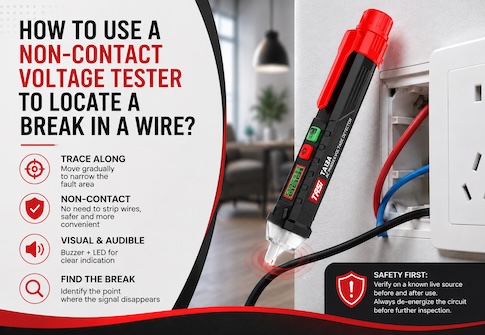
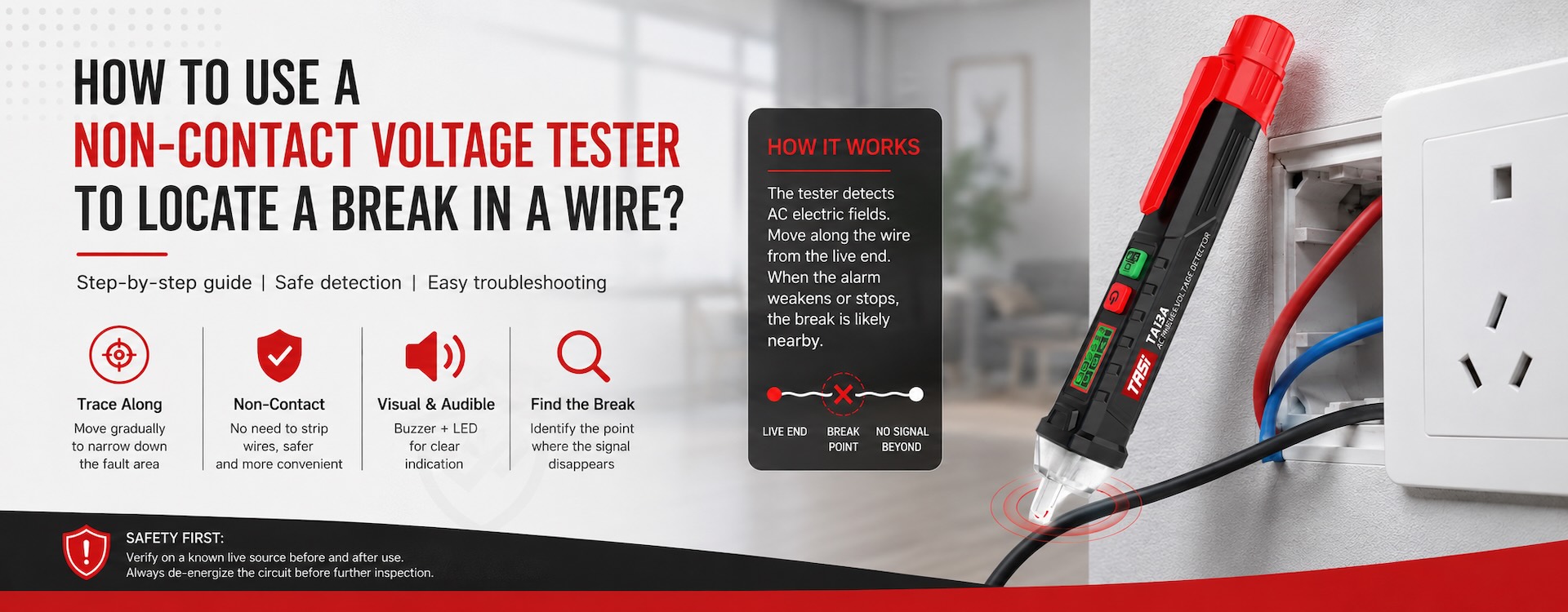
Move the tester along each branch conductor and observe changes in alarm frequency, intensity, or indicator behavior.
If one branch produces a strong response while an adjacent conductor also produces a weaker response, do not assume that both are necessarily energized in the same way.
Instead:
● Reduce tester sensitivity if possible;
● Move the sensing tip closer to the target conductor;
● Increase separation from adjacent energized conductors where practical;
● Repeat the test from several positions;
● Use a suitable contact voltage tester when confirmation is required.
A dual-sensitivity NCVT is particularly useful because it allows broad screening followed by more localized testing.
Single Sensitivity or Dual Sensitivity: Which Is Better for Electrical Panels?
For basic applications such as wall outlets and individual power cords, a single-sensitivity NCVT may be sufficient.
Inside an electrical panel, however, multiple energized conductors may be installed very close together. If the tester is excessively sensitive, it can begin alarming before the sensing tip reaches the intended conductor.
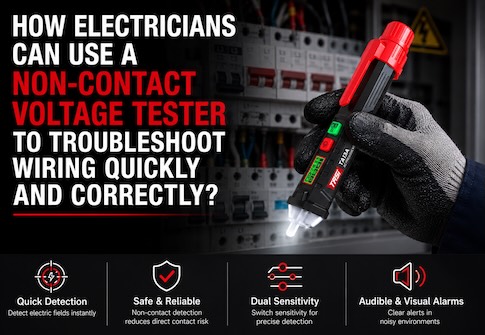
For electricians and technicians who regularly inspect electrical panels, switchboards, or control cabinets, a dual-sensitivity non-contact voltage tester is generally more versatile.
High-sensitivity mode is useful for:
● Quickly determining whether an AC electric field is present in an area;
● Detecting through thicker insulation;
● Initial screening of larger wiring areas.
Low-sensitivity mode is useful for:
● Differentiating between closely spaced conductors;
● Narrowing down the location of an energized conductor;
● Reducing interference from adjacent live wiring;
● Testing around breakers and crowded termination areas.
Higher sensitivity is therefore not always better. In panel work, controlled sensitivity can be more useful than maximum detection distance.
Why Are False Indications Common in Electrical Panels?
Electrical panels are challenging environments for non-contact testing because many energized conductors are concentrated in a small space.
Common influencing factors include:
● Adjacent energized wiring. Electric fields from nearby live conductors may be detected when testing another wire.
● Excessive tester sensitivity. High-sensitivity mode may trigger at a greater distance, making conductor identification more difficult.
● Capacitive coupling. A conductor that is not directly connected to a supply may still develop an induced or coupled voltage when routed alongside energized wiring.
● Conductor arrangement. Phase, neutral, and other conductors within a cable or panel can affect the external electric-field pattern.
● Grounding and body coupling. Flooring, footwear, gloves, and the user's coupling to ground may influence the response of some NCVT designs.
● Shielding and metal structures. Metal enclosures, conduit, and shielded cable can weaken or alter the electric field.
For these reasons, NCV testing in a panel should be treated as a screening technique rather than a precise voltage diagnostic method.
Can Alarm Strength Be Used to Estimate Voltage?
Generally, no.
Some NCVTs vary the buzzer frequency, LED flashing rate, or indication level according to the strength of the detected electric field. The response may become stronger as the tester moves closer to an energized conductor.
However, alarm strength depends on more than voltage. It may also be affected by:
● Distance from the conductor;
● Insulation thickness;
● Nearby energized wiring;
● Sensitivity setting;
● Cable construction;
● Grounding conditions;
● Capacitive coupling between the user and the environment.
The alarm level should therefore not be interpreted as a voltage measurement.
If the actual voltage must be determined—whether 120 V, 230 V, 400 V, or another value—use an appropriate contact measurement instrument.
What Type of Non-Contact Voltage Tester Is Suitable for Electrical Panel Work?
For electrical panels, switchboards, and building wiring, several characteristics deserve particular attention.
Detection range
The tester should cover the AC voltage range encountered in the intended application. If low-voltage control circuits are involved, check the minimum detection voltage carefully.
Dual-sensitivity operation
High and low sensitivity modes provide greater flexibility in crowded wiring environments.
CAT rating
Distribution systems can be exposed to significant transient overvoltages. Select a tester with a measurement category and rated voltage appropriate for the actual point of use rather than choosing solely by maximum NCV detection voltage.
Audible and visual indication
Inside a panel, the operator may not always be able to watch the tester continuously. A combination of buzzer and LED indication improves recognition.
Low-battery indication and self-test
Insufficient battery power can reduce reliability. Low-battery indication, self-test, and clear power-on status are useful features for professional work.
Sensing-tip design
A relatively narrow sensing tip can make it easier to approach individual breaker conductors and crowded wiring areas.
When Should a Non-Contact Voltage Tester Not Be Used Alone?
An NCVT is best suited to answering the question: “Could an AC electric field be present here?”
It should not be used by itself to:
● Prove that a circuit is fully de-energized;
● Measure an exact voltage;
● Confirm whether supply voltage is within its rated value;
● Definitively identify line, neutral, and protective earth conditions;
● Diagnose high-resistance connections;
● Measure DC voltage;
● Diagnose complex open-circuit, leakage, or grounding faults.
Most importantly, before touching conductors, removing breakers, replacing wiring, or carrying out other electrical work, the absence of an NCV indication must never be treated as proof that the circuit is safe.
Use an appropriate contact voltage test method and follow the applicable safe-working procedure to verify absence of voltage.
Safety Considerations When Using an NCVT in an Electrical Panel
Electrical panels may contain exposed energized parts, hazardous voltage, and arc-flash risks. The fact that the tester is “non-contact” does not remove these hazards.
● Panel inspection should be carried out only by personnel with appropriate electrical training and authorization.
● Use a tester with a CAT rating and rated voltage suitable for the actual electrical environment.
● Inspect the tester housing, sensing tip, and battery condition before use.
● Verify the tester on a known energized source before and after testing.
● Do not intentionally touch exposed high-voltage terminals with the tester.
● Keep fingers behind the specified hand or finger guard.
● Never touch a conductor simply because the NCVT does not indicate voltage.
● Stop normal testing if the panel is wet, damaged, or shows signs of an abnormal condition.
● Where formal absence-of-voltage verification is required, use a suitable contact test instrument and the prescribed procedure.
An NCVT can reduce the need for direct contact during preliminary screening, but it does not eliminate the electrical hazards associated with panel work.
FAQ
Can a non-contact voltage tester be used directly on exposed terminals inside an electrical panel?
It may be used near the relevant area in accordance with the manufacturer's instructions and required safety clearances, but there is normally no reason to intentionally touch an exposed live terminal with the tester. Its primary purpose is to detect AC electric fields without direct electrical contact.
Why does the tester still alarm after a circuit breaker is switched off?
The indication may result from adjacent energized conductors, capacitive coupling, induced voltage, or high tester sensitivity. Further testing with an appropriate instrument may be necessary.
Is it normal for every wire in a panel to trigger the tester?
Not necessarily. In crowded panels, a highly sensitive NCVT may respond to the electric field produced by several nearby conductors. Reducing sensitivity, decreasing the distance to the target conductor, and testing each wire individually can improve localization.
If the tester does not alarm, does that mean the breaker output is de-energized?
No. A missing indication can result from distance, shielding, cable construction, tester condition, or environmental factors. Before electrical work begins, formal absence-of-voltage verification is still required.
Can an NCVT determine whether a circuit breaker is defective?
It can help compare the apparent energized condition on the line and load sides, but it cannot by itself confirm that a breaker is faulty. Voltage, resistance, continuity, or other measurements may be required.
Should high or low sensitivity be used in an electrical panel?
High sensitivity is useful for initial screening, while low sensitivity is generally better for identifying individual conductors in crowded wiring areas.
Does CAT rating matter when testing electrical panels?
Yes. The CAT rating relates to the tester's ability to withstand transient overvoltages associated with particular electrical environments. A tester intended for distribution-level work should be selected according to the actual measurement location and installation category.
Conclusion
A non-contact voltage tester is a practical tool for electrical panel inspections, branch-circuit screening, and preliminary troubleshooting. By sensing the AC electric field near breakers, insulated conductors, and termination areas, it can quickly indicate where voltage may be present without requiring initial contact with bare conductors.
For crowded electrical panels, a tester with an appropriate detection range, dual-sensitivity operation, clear audible and visual alerts, and a suitable CAT rating can improve both efficiency and localization.
However, an NCVT should be regarded as an energized-circuit screening tool, not an absence-of-voltage verification instrument. Adjacent wiring, capacitive coupling, shielding, and test distance can all influence the indication. Before removing conductors, replacing breakers, or performing any task involving direct contact with electrical parts, use an appropriate contact test instrument and the required safe isolation and verification procedure.