Introduction
During equipment servicing, electrical maintenance, outlet inspection, and wiring troubleshooting, one of the first tasks is often determining whether a circuit may still be energized.
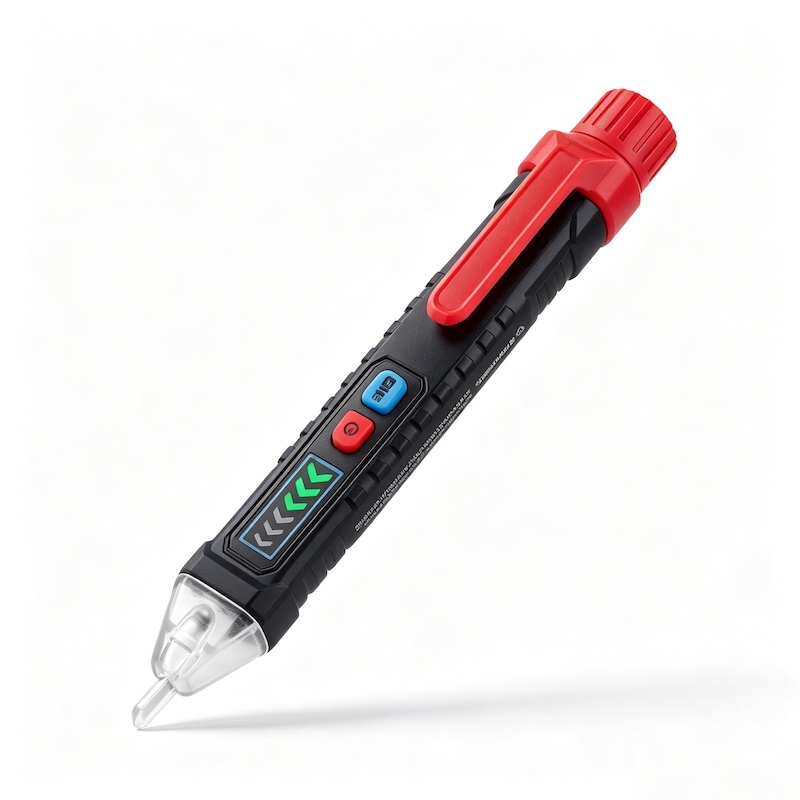
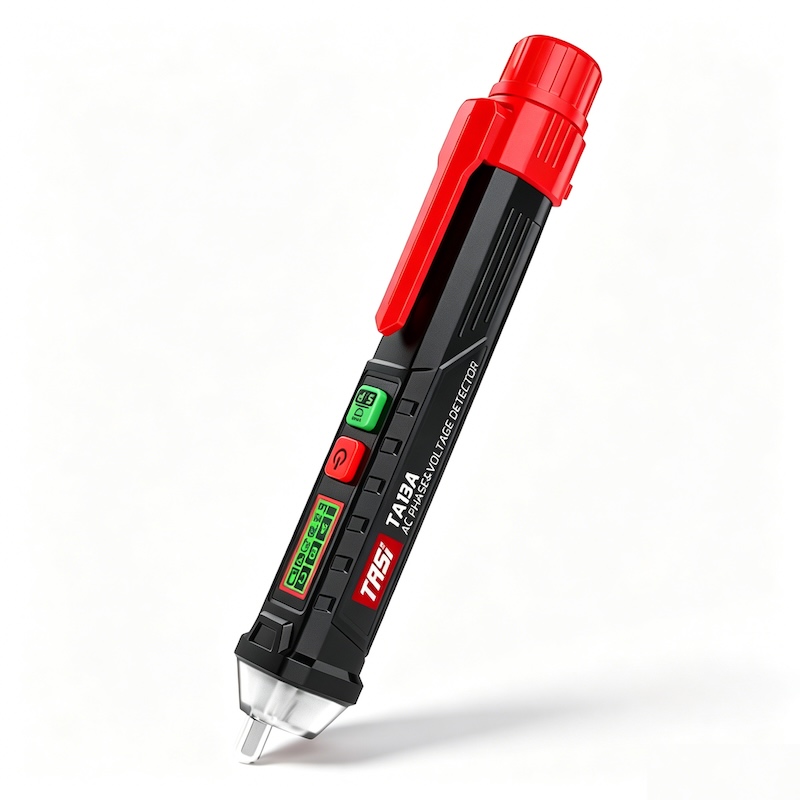
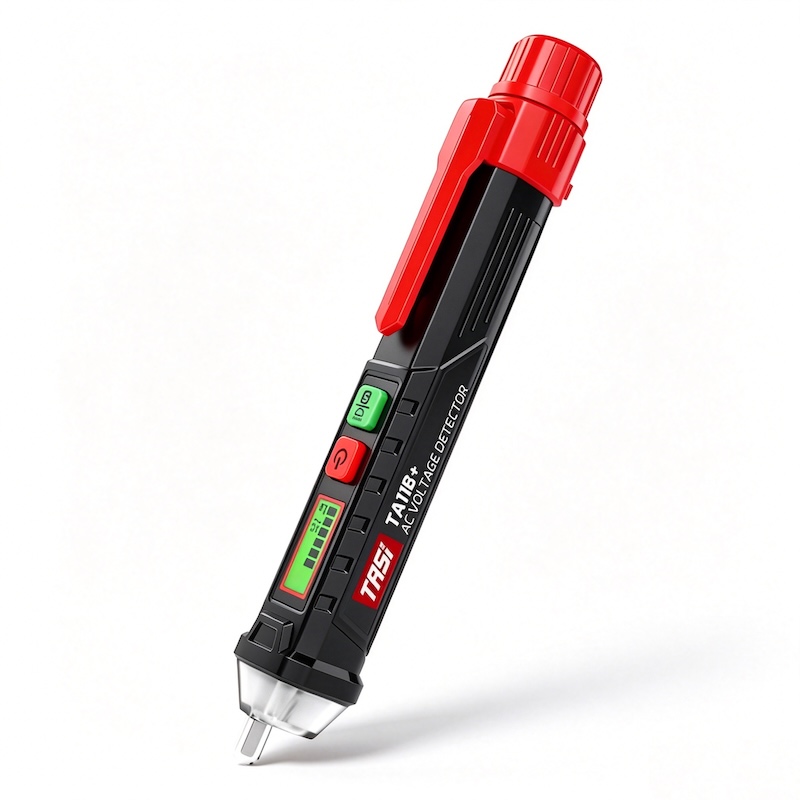
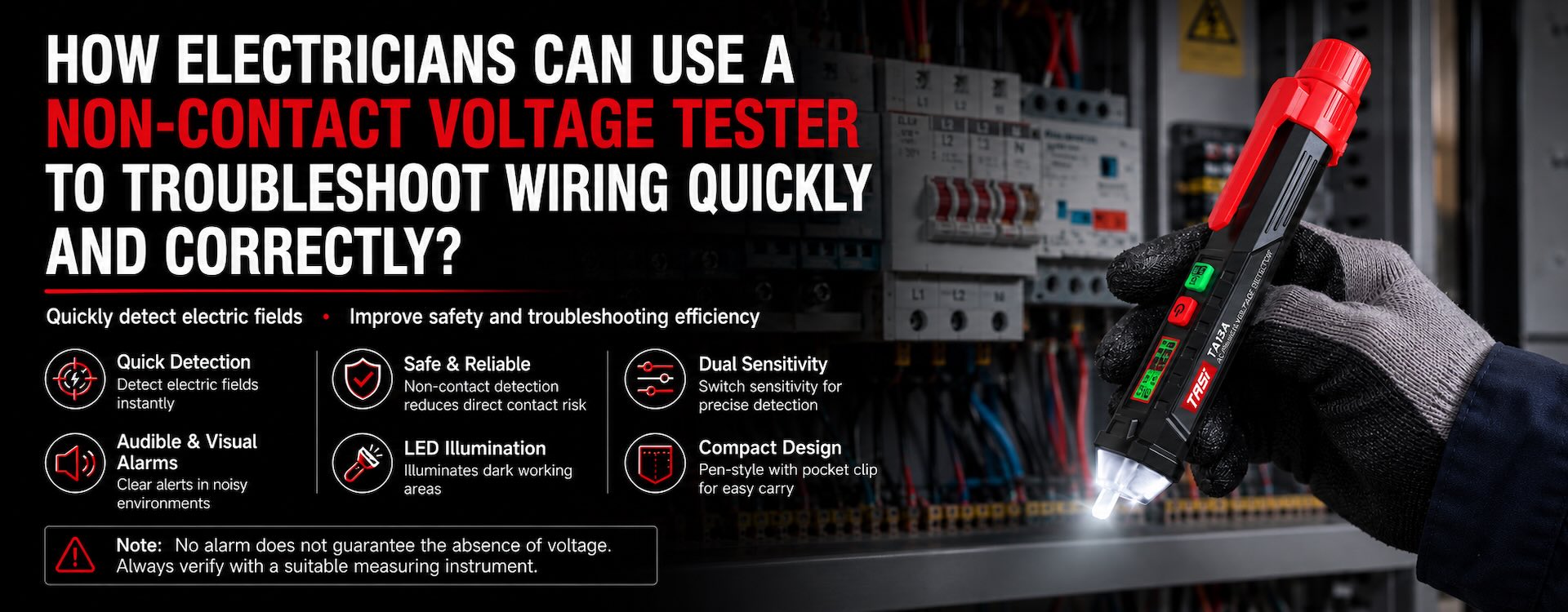
A non-contact voltage tester, commonly referred to as an NCV tester, detects the electric field around an AC conductor without requiring direct contact with bare metal. This makes it a fast and convenient tool for preliminary electrical checks.
Its main advantage is speed, especially when electricians need to screen multiple cables, outlets, switches, or circuits in a short time. However, an NCV tester is fundamentally a voltage-presence screening tool, not a precision voltage measurement instrument.
Its indication can be affected by cable construction, insulation thickness, detection distance, sensitivity setting, shielding, grounding conditions, nearby energized conductors, and the surrounding electromagnetic environment.
For this reason, professional users should not interpret the result simply as “alarm means live” and “no alarm means safe.” An NCV tester is most effective when used as part of a structured troubleshooting process and followed by appropriate contact-based verification where required.
Key Points
● A non-contact voltage tester is useful for rapidly detecting the possible presence of an AC electric field, but it normally does not provide an exact voltage value.
● Before testing, verify the tester on a known energized AC source.
● A practical field workflow is: verify on a known live source, test progressively, narrow down the affected area, and confirm with an appropriate instrument.
● Dual-sensitivity or wide-range models are generally more suitable for professional electrical troubleshooting.
● When working around distribution boards or other higher-energy electrical systems, the tester's CAT measurement category and rated operating conditions are important.
● A lack of indication from an NCV tester must not be used as the sole proof that a circuit is de-energized.
Why a Non-Contact Voltage Tester Is Useful for Field Troubleshooting
Electricians frequently work with multiple conductors, terminals, outlets, switches, circuit breakers, and power cables.
If every point must immediately be checked with a multimeter or contact voltage tester, preliminary troubleshooting can become unnecessarily time-consuming.
An NCV tester is well suited to the first screening stage.
● Quickly check whether an outlet or power cable is associated with an AC electric field;
● Identify conductors that may be energized among several wires;
● Compare voltage presence before and after a switch;
● Follow a cable to help narrow down a suspected open-circuit location;
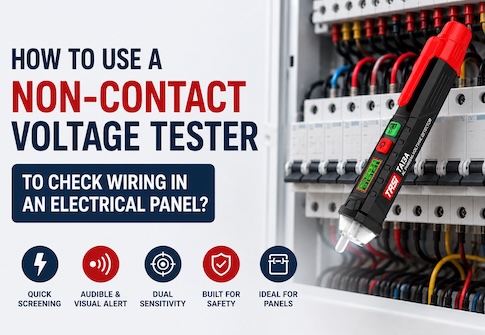
● Screen breakers, outgoing circuits, and wiring inside a distribution board;
● Identify potentially energized wiring before maintenance work begins.
The objective is not to complete the entire electrical diagnosis with the NCV tester. Its main role is to reduce the number of locations that require more detailed testing.
Check the Tester Before Starting Work
Before troubleshooting a circuit, confirm that the NCV tester itself is operating correctly.
Switch on the tester and check its power indication, self-test function, audible alarm, visual indication, or other status indicators according to the product design.
If the tester provides a low-battery warning, make sure the battery condition is suitable for use.
Next, place the sensing tip near a known energized AC source, such as the live side of a properly functioning outlet.
If the tester responds normally with an audible, visual, or vibration indication, its basic detection function is available for the next step.
After testing the target circuit, it is also good practice, where conditions allow, to verify the tester again on a known energized source.
This “known live source before test — target circuit test — known live source after test” approach helps reduce the risk of relying on results obtained with a failed tester, depleted battery, or incorrect operating condition.
How to Check Whether a Power Cable May Be Energized
To screen a typical AC power cable, move the sensing end of the NCV tester close to the cable insulation and slowly scan along the cable.
When the sensing tip enters the effective detection range of a sufficiently strong AC electric field, the tester will normally provide an audible, visual, or vibration indication.
With two-core or multi-core cables, the live and neutral conductors are often positioned close together. Their electric fields can interact, meaning that testing through the outer cable jacket may not reliably identify which internal conductor is live.
In field applications:
● Do not conclude that an entire cable is de-energized simply because no indication is detected at one point;
● Repeat the test from different angles and distances;
● For thick insulation, larger cables, shielded cables, or multi-core cables, a higher sensitivity setting may help during preliminary screening;
● If the electrical state of a specific conductor must be confirmed, use an appropriate contact-based test instrument.
How to Check a Wall Outlet Quickly
Outlet inspection is one of the most common applications for a non-contact voltage tester.
Move the sensing tip close to the different contact openings of the outlet.
Under normal AC wiring conditions, the tester will usually respond more strongly near the live conductor, while the neutral side may produce a weaker response or no indication.
Actual results can vary depending on outlet construction, contact depth, wire position, supply voltage, tester sensitivity, and nearby energized conductors.
If an outlet is expected to be energized but no clear indication is detected, check whether:
● The circuit breaker has tripped or been switched off;
● An upstream switch is open;
● The outlet connection is loose or disconnected;
● The NCV sensitivity setting is appropriate;
● The tester battery is low;
● The outlet faceplate or construction increases the sensing distance.
If the actual outlet voltage, neutral condition, polarity, or grounding arrangement must be verified, use an instrument designed for those measurements.
Using an NCV Tester to Help Identify Live and Neutral Conductors
Where individual insulated conductors can be approached separately and the AC circuit is operating normally, an NCV tester can assist with preliminary identification of the live conductor.
Move the sensing tip close to each insulated conductor individually. The electric field around the live conductor will normally be stronger and is therefore more likely to trigger the tester.
However, inside cable ducts, junction boxes, and distribution boards, conductors are often closely grouped.
The electric field from an energized conductor can capacitively couple into adjacent conductors. This may result in an NCV indication near a neutral conductor or even a disconnected wire.
An NCV tester can therefore assist with preliminary live-conductor identification, but it should not be the sole method used where definitive conductor identification is required.
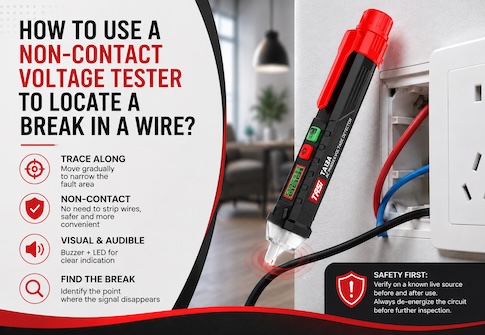
Using an NCV Tester to Help Locate a Wiring Break
A non-contact voltage tester can also help narrow down the location of certain open-circuit faults in AC wiring.
The basic method is to place the target circuit in a condition suitable for AC voltage detection and begin scanning from a point already known to be energized.
Move the sensing tip gradually along the cable.
If the tester gives a consistent indication along one section and the response then weakens substantially or disappears around a particular area, the fault may be located nearby.
Possible causes include:
● A broken conductor;
● A loose or disconnected terminal;
● An open switch or connection point;
● A change in cable routing or construction.
Move the tester back and forth around the transition point to narrow down the suspected area.
Wall materials, metallic conduit, shielding, cable depth, and nearby energized conductors can all affect this method. It should therefore be considered a fault-localization aid, not proof of the exact physical location of a conductor break.
How to Screen Circuits in a Distribution Board
Distribution boards contain multiple circuit breakers, terminals, and closely spaced conductors, making them a common application for professional NCV testing.
A useful approach is to follow the electrical path progressively:
● Check for voltage presence near the incoming supply;
● Check the input side of the relevant circuit breaker;
● Check the output side;
● Check the corresponding outgoing conductor;
● Use changes in indication to narrow down the area requiring further investigation.
For example, if a strong indication is present on the breaker input but no corresponding signal is detected at the output while the breaker is expected to be closed, the breaker, terminal connection, or downstream circuit becomes a logical area for further testing.
Because conductors inside a distribution board are closely packed, electric-field coupling can be significant. At high sensitivity, several neighboring wires may trigger the tester simultaneously.
For this reason, combine sensitivity adjustment, close-range testing, cable routing information, and other electrical measurements when necessary.
How to Use Single- and Dual-Sensitivity Modes
Not all NCV testers use the same sensitivity design.
Single-sensitivity models are simple to operate and are suitable for routine outlet, power-cord, and general wiring checks where the electrical environment is relatively straightforward.
Dual-sensitivity models generally provide greater flexibility for professional troubleshooting.
High-sensitivity mode can be useful for:
● Detecting through thicker insulation;
● Preliminary scanning from a greater distance;
● Searching for concealed wiring;
● Improving detection in weaker electric-field conditions.
Low-sensitivity mode is generally more useful for:
● Closely spaced conductors;
● Differentiating between neighboring energized wires;
● Testing inside distribution boards;
● Reducing unwanted indications caused by adjacent wiring.
A practical professional workflow is to begin with higher sensitivity to locate a suspected energized area, then switch to lower sensitivity to narrow down the target.
Why Detection Distance Affects the Result
A non-contact voltage tester does not operate as a simple contact/no-contact device.
The closer the sensing tip is to the energized conductor, the stronger the detected electric field will generally be. As the distance increases, the field strength at the sensing tip decreases.
The same energized conductor may therefore produce:
● A continuous indication at close range;
● A weaker response at a moderate distance;
● No response when the sensing distance becomes too great.
When comparing different conductors or locations, try to maintain a similar detection distance and sensing angle.
This is especially important when tracing a suspected cable break. If the distance between the tester and the cable changes while scanning, the resulting change in alarm behavior may be mistaken for a wiring fault.
Why False or Unexpected Indications Can Occur
An NCV tester detects an AC electric field, so nearby energized conductors can also influence the result.
Common causes of unexpected indications include:
● Multiple AC conductors installed side by side;
● Closely packed wiring inside a distribution board;
● Excessive detection distance in high-sensitivity mode;
● Capacitive coupling from energized wiring into a disconnected conductor;
● Other energized wiring inside a wall;
● Strong electrical or electromagnetic interference from nearby equipment.
If an indication appears questionable, reduce the sensitivity, move the sensing tip closer to the target conductor, change the sensing direction, and consider the physical wiring arrangement.
A single alarm should not automatically be interpreted as proof that the target conductor is directly connected to an active power source.
Why an Energized Circuit May Sometimes Produce No Indication
The opposite situation is also possible: a conductor may be energized even though the NCV tester does not respond.
Possible causes include:
● Low battery level;
● The tester is not correctly switched on;
● Excessive sensing distance;
● Thick insulation or cable jacket;
● Metallic conduit or electrical shielding;
● Sensitivity set too low;
● Voltage below the tester's effective detection range;
● Cable construction or grounding conditions that reduce the detectable electric field;
● The voltage type is not the AC voltage for which the tester is designed.
For this reason, no NCV indication does not prove that hazardous voltage is absent.
This limitation is particularly important before touching conductors, disconnecting wiring, or carrying out electrical repair work.
How to Improve Field Troubleshooting Efficiency
Professional electricians can use an NCV tester as the first stage of a structured troubleshooting process.
A practical workflow is:
● Verify that the tester is functioning correctly;
● Confirm the detection range and sensitivity setting;
● Begin at a known supply point;
● Work progressively along the electrical path;
● Narrow down the area when the indication changes;
● Repeat the check from different angles and distances;
● Verify critical points with another suitable electrical test instrument.
This systematic approach creates a clearer fault-finding sequence than randomly checking multiple points and helps reduce both missed faults and incorrect conclusions.
What Professional Electricians Should Look for in an NCV Tester
For professional troubleshooting, the voltage range alone is not enough. The tester should be selected according to the actual electrical environment.
Detection Range
The rated AC detection range should cover the circuits normally encountered during maintenance. A wider range may increase versatility, but the tester must always be used within the manufacturer's specified ratings.
Sensitivity
Dual-sensitivity operation can provide greater flexibility where wiring is closely grouped, concealed, or exposed to complex electric-field conditions.
Alarm Indication
Combined audible and visual indications make the tester easier to recognize in the field. In noisy industrial environments, a clear visual warning is particularly useful.
CAT Measurement Category
For work on distribution boards, distribution systems, or higher-energy installations, select a tester with a CAT measurement category and voltage rating appropriate for the intended electrical environment. Always remain within the manufacturer's rated operating conditions.
Self-Test and Low-Battery Indication
Features that help confirm the instrument's operating state can reduce the risk of incorrect conclusions caused by battery or tester failure.
Mechanical Design and Portability
A clearly defined sensing tip, non-slip housing, pocket clip, and controls that can be operated while wearing gloves can improve field usability.
Electrical Safety Considerations
Non-contact detection reduces the need to touch exposed conductors, but it does not eliminate electrical hazards.
● Inspect the tester housing and sensing tip for visible damage before use;
● Confirm that the voltage rating and CAT category are appropriate for the electrical environment;
● Never exceed the manufacturer's specified operating conditions;
● Do not touch a conductor simply because the NCV tester gives no indication;
● Do not use an NCV tester as a substitute for accurate voltage measurement;
● Where absence of voltage must be confirmed, follow the applicable safe working procedure and use an appropriate test instrument;
● In higher-energy environments such as distribution equipment, follow relevant electrical safety procedures and use appropriate personal protective equipment.
The greatest value of an NCV tester is its ability to quickly identify potentially energized areas and narrow down the troubleshooting range. It is not a replacement for a complete electrical safety verification procedure.
FAQ
Can an NCV tester confirm that a circuit is safely de-energized?
Not by itself. A lack of indication may be caused by distance, shielding, sensitivity, battery condition, or wiring configuration. Before touching conductors or carrying out electrical work, use the appropriate safety procedure and suitable test equipment to verify absence of voltage.
Why does the tester alarm near several wires at the same time?
Electric-field coupling can occur when conductors are closely grouped, particularly in high-sensitivity mode. Reduce sensitivity, move the sensing tip closer to each conductor, and compare the responses individually.
Can a non-contact voltage tester show the exact voltage?
Most conventional NCV testers are designed to indicate the presence of an AC electric field within their rated detection range. They do not provide an accurate voltage value like a digital multimeter.
Can an NCV tester locate a broken wire?
It can assist with preliminary troubleshooting of some AC wiring. Scanning along the circuit and observing where the indication changes may help narrow down a suspected fault area, but a disappearing signal does not by itself identify the exact physical break.
Should high or low sensitivity be used inside a distribution board?
Because distribution-board conductors are closely spaced, high sensitivity can cause indications from neighboring circuits. Higher sensitivity can be useful for initial screening, followed by lower sensitivity to narrow down the target conductor.
Does wearing insulating gloves affect NCV detection?
The response of some NCV testers can be influenced by body coupling, grip, and environmental conditions. Always use the instrument according to the manufacturer's instructions and never remove required personal protective equipment simply to increase sensitivity.
Why should the tester be checked again on a known live source after testing?
This confirms that the instrument was still functioning correctly at the end of the test. If the tester has failed or the battery has become depleted, the earlier results may need to be reassessed.
Conclusion
A non-contact voltage tester is an efficient tool for rapid electrical troubleshooting in the field. By detecting the AC electric field without direct contact with exposed conductors, it can help electricians screen outlets, power cables, switches, distribution boards, and some concealed wiring, while also assisting with preliminary live-conductor identification and fault localization.
Effective use depends on more than simply observing whether the tester alarms. A structured process should be followed: verify the instrument first, begin at a known supply point, test progressively along the circuit, use changes in indication to narrow down the problem, and adjust sensitivity, detection distance, and sensing direction to reduce incorrect conclusions.
For professional users, an appropriate detection range, dual sensitivity, clear audible and visual indication, and a CAT measurement category suitable for the intended electrical environment can significantly improve field usability.
Most importantly, an NCV tester is primarily a rapid screening and voltage-presence indication tool. It does not replace appropriate contact-based measurements or the required procedure for verifying absence of voltage before electrical work.