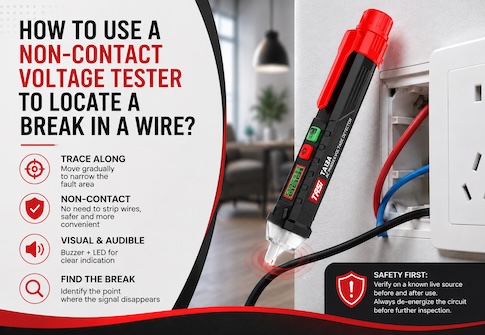
Introduction
Under normal conditions, the live conductor (L) carries a significant AC voltage relative to earth, while the neutral conductor (N) is normally close to earth potential. In suitable test conditions, a non-contact voltage tester will therefore usually alert strongly near the live conductor and may show little or no response near neutral.
However, users sometimes find that both live and neutral trigger an alert.
This does not necessarily indicate a defective tester, nor does it mean that live and neutral are at the same voltage. A non-contact voltage tester does not directly measure the potential difference between conductors. Instead, it senses the alternating electric field surrounding energized wiring.
As a result, capacitive coupling between conductors, tester sensitivity, cable construction, load conditions, and neutral faults can all cause an NCV tester to respond near both wires.
Key Points
● A non-contact voltage tester detects changes in an AC electric field, not the actual voltage value between conductors.
● When live and neutral conductors are close together, the electric field from the live conductor can couple into the area around the neutral conductor.
● High-sensitivity modes and low-voltage detection ranges are more likely to respond to weak induced signals.
● A neutral conductor carrying load current is not necessarily at exactly 0 V at every point because voltage drop can occur along the conductor.
● A loose, open, incorrectly connected, or otherwise faulty neutral can develop an abnormal potential that requires investigation.
● NCV indication alone should not be used as the final method for identifying conductors or verifying a de-energized circuit.
Why Can an NCV Tester Respond to Both Live and Neutral?
When the probe of a non-contact voltage tester approaches an energized AC conductor, the changing electric field around the conductor creates a small signal in the tester through capacitive coupling.
The tester's high-impedance sensing circuit amplifies and evaluates this signal. When it exceeds the instrument's detection threshold, the tester activates its buzzer, LED, display, or other warning indication.
In other words, the tester determines:
● Whether a sufficiently strong AC electric field is present near the probe;
● Whether the detected signal exceeds the instrument's alarm threshold.
It does not directly determine:
● The exact voltage on the conductor;
● Whether the conductor is definitely live or neutral.
This distinction is essential when interpreting an alert on both conductors.
Capacitive Coupling from the Live Conductor Is a Common Cause
In mains cables, outlets, junction boxes, and cable ducts, live and neutral conductors are often installed close together.
The alternating voltage on the live conductor produces a changing electric field. Because neighboring conductors have distributed capacitance between them, part of this signal can be capacitively coupled toward the neutral conductor or other adjacent wires.
When the tester is placed near neutral, it may therefore be responding to the electric field originating from the nearby live conductor rather than to a full mains voltage actually present on neutral.
This is more likely when:
● Live and neutral run closely in parallel;
● Several conductors are bundled in the same cable or conduit;
● The test point is physically close to the live conductor;
● Insulation thickness is relatively small;
● The tester is operating in a high-sensitivity mode.
For this reason, testing the outside of an intact multi-core cable can sometimes produce an alert at several positions along the cable.
High Sensitivity Makes Neutral Alerts More Likely
Some non-contact voltage testers provide dual sensitivity or multiple detection ranges. A lower-voltage range is designed to detect weaker electric fields, while a higher-voltage range is typically more suitable for conventional mains detection.
In high-sensitivity mode, the detection threshold is lower. The tester may therefore respond not only to a strong field from the live conductor but also to:
● Coupled electric fields from nearby energized conductors;
● Weak induced voltages;
● Electric fields from surrounding electrical equipment;
● Low-level signals created by distributed capacitance within a cable.
As a result, both live and neutral may trigger an indication, although the live conductor may still produce a stronger response.
If the tester allows sensitivity selection, comparing the response at different settings can help. A signal that appears only in the most sensitive mode may indicate a relatively weak coupled or induced field.
Neutral Is Not Always Exactly 0 V Everywhere
Under ideal conditions, neutral is close to earth potential. In practical wiring, however, every conductor has some resistance.
When load current flows through the neutral conductor, a voltage drop develops along its length. Consequently, the neutral-to-earth voltage at a point remote from the supply neutral may not be exactly zero.
The neutral voltage drop generally becomes more significant when:
● Load current is higher;
● Cable length is greater;
● Conductor resistance is higher.
Therefore, “neutral” should not be interpreted as “absolutely zero volts at every location and under every operating condition.”
However, this normal voltage drop is not equivalent to the normal mains voltage on the live conductor. An NCV alert on both wires does not mean they are at the same potential.
Induced Voltage Can Also Trigger an Alert
A conductor running parallel to an energized live wire over a significant distance may acquire an induced potential through capacitive coupling, even if it is not directly connected to the supply.
Because NCV testers use very high-impedance sensing circuits, they can respond to extremely small electric-field signals.
These signals are sometimes referred to as induced or “ghost” voltages.
Typical characteristics include:
● They may be detected by high-impedance instruments;
● They usually have very limited current-sourcing capability;
● They are more noticeable with high-sensitivity NCV detection;
● NCV indication alone cannot determine their exact voltage or available current.
For this reason, an NCV alert should not automatically be interpreted as evidence of a stable power source capable of supplying significant current.
Electronic Equipment Can Introduce Additional Coupling
Modern electrical installations often include switch-mode power supplies, EMI filters, variable-frequency drives, LED drivers, and other electronic circuits.
These devices can contain capacitors, filtering networks, and high-frequency switching stages that make the electrical environment more complex than a simple live-neutral circuit.
In some installations, an NCV tester may therefore respond to both power-frequency electric fields and additional electrical interference.
This behavior can be more noticeable in control cabinets, LED lighting systems, industrial installations, and areas containing numerous electronic devices.
A Faulty Neutral Can Also Carry an Abnormal Potential
Although capacitive coupling is a common explanation, not every neutral alert should be dismissed as induction.
A neutral conductor can develop an abnormal potential when a wiring fault occurs, including:
● Loose or high-resistance neutral connections;
● Open neutral conductors;
● Incorrect live-neutral wiring;
● Problems with the supply neutral connection;
● Fault conditions associated with connected loads or wiring.
An open or poorly connected neutral can allow downstream conductors to assume unexpected potentials through connected loads.
If a circuit that previously behaved normally suddenly produces a strong neutral indication, especially together with malfunctioning equipment, abnormal lighting behavior, or other symptoms, further investigation is required.
Why Is It Difficult to Distinguish Live and Neutral Through an Intact Cable?
When live and neutral are contained inside the same insulated cable, the distance between them may be very small.
Placing an NCV tester against the outside of the cable can therefore expose the probe to electric fields from several conductors at the same time.
Even if the probe appears to be closer to the neutral side of the cable, the detected field may still originate mainly from the live conductor.
For this reason, external cable testing is generally more suitable for determining:
Whether an AC electric field may be present nearby.
It is less suitable for determining:
Exactly which internal conductor is live or neutral.
The smaller the conductor spacing and the higher the tester sensitivity, the more pronounced this limitation can become.
How Can You Tell Normal Coupling from a Wiring Problem?
If both live and neutral trigger the tester, consider the test conditions before assuming there is a fault.
● Verify tester operation: Before and after testing, follow the manufacturer's instructions and confirm the tester's response on a known energized AC source where appropriate.
● Check the test location: If testing through the outer sheath of a multi-core cable, several positions may respond to the same live conductor.
● Compare indication strength: Some testers provide graduated audible or visual indications. The live conductor may produce a stronger response, although indication strength is not an accurate voltage measurement.
● Change sensitivity where available: Weak coupled signals may disappear at a lower-sensitivity setting.
● Look for other abnormal symptoms: Equipment malfunction, unusual lighting behavior, or suspected neutral problems should be investigated using appropriate test methods.
If the actual voltage must be determined, a neutral fault must be assessed, or a circuit must be verified as de-energized, use an appropriate contact voltage tester or measuring instrument rated for the installation and follow applicable electrical safety procedures.
Does an Alert on Both Wires Mean the Tester Is Inaccurate?
Not necessarily.
The primary purpose of a non-contact voltage tester is to quickly identify the possible presence of an AC electric field. It is not intended to replace a multimeter or two-pole voltage tester for precise voltage measurement.
If the tester detects an electric field coupled into the area around the neutral conductor, an alert can be consistent with its operating principle.
The important point is how the indication is interpreted.
The correct interpretation is:
The probe has detected an AC electric-field signal above the tester's threshold.
It should not automatically be interpreted as:
This conductor must be the live wire.
Can an NCV Tester Be Used Alone to Identify Live and Neutral?
It should not be used as the sole method.
When conductors are physically separated, interference is limited, and the live conductor produces a clearly stronger electric field, an NCV tester can be useful for preliminary identification.
However, the result may be affected by conductor spacing, sensitivity, capacitive coupling, the surrounding environment, and the user's coupling to earth.
NCV testers are particularly useful for:
● Rapidly checking for the possible presence of AC voltage;
● Preliminary tracing of potentially energized conductors;
● Quick screening of outlets, cables, and equipment.
Where reliable identification of live, neutral, protective earth, actual voltage, or safe isolation is required, use a test method and instrument appropriate for the task.
FAQ
Why does my non-contact voltage tester beep on both live and neutral?
The most common reason is capacitive coupling from the live conductor into the area around the neutral conductor. High-sensitivity testers can detect these weak fields. Neutral voltage drop or wiring faults can also produce an indication.
Does an alert on neutral mean the neutral wire is energized?
Not necessarily. The alert may be caused by an electric field induced from a nearby live conductor. The actual neutral-to-earth voltage should be confirmed using an appropriate contact measurement method when necessary.
Why do both conductors trigger the tester in high-sensitivity mode?
High-sensitivity mode has a lower detection threshold and can respond to weaker electric fields, including capacitive coupling and induced signals.
Does an alert on both live and neutral mean the wiring is incorrect?
Not necessarily. This can occur in correctly wired circuits because of electric-field coupling. However, strong or unexpected neutral indications accompanied by other abnormal symptoms should be investigated.
Can a non-contact voltage tester confirm that a circuit is de-energized?
It should not be the only method used to establish safe isolation. Before electrical work, follow the applicable safety procedure and verify circuit status with suitable test equipment.
Conclusion
An NCV tester alerting on both live and neutral does not necessarily mean that both conductors are at the same voltage.
Because a non-contact voltage tester detects an AC electric field, capacitive coupling, induced voltage, high sensitivity, load current, cable construction, and the surrounding electrical environment can all cause a response near the neutral conductor.
At the same time, neutral is not guaranteed to remain at exactly 0 V under all conditions. Voltage drop, loose connections, an open neutral, or wiring faults can produce abnormal potentials that require attention.
The correct interpretation of an NCV alert is therefore that the tester has detected an AC electric-field signal near the probe—not that the conductor is automatically confirmed as live.
For rapid preliminary checks, NCV testers are highly useful. For reliable conductor identification, actual voltage measurement, or verification of safe isolation, use suitable contact test equipment and appropriate electrical safety procedures.