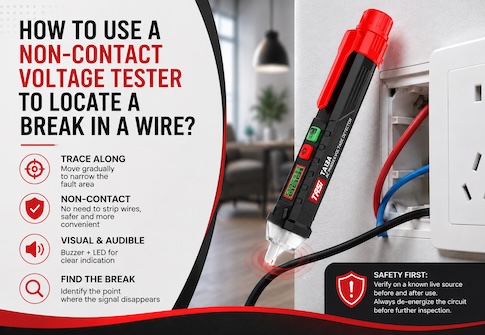
Introduction
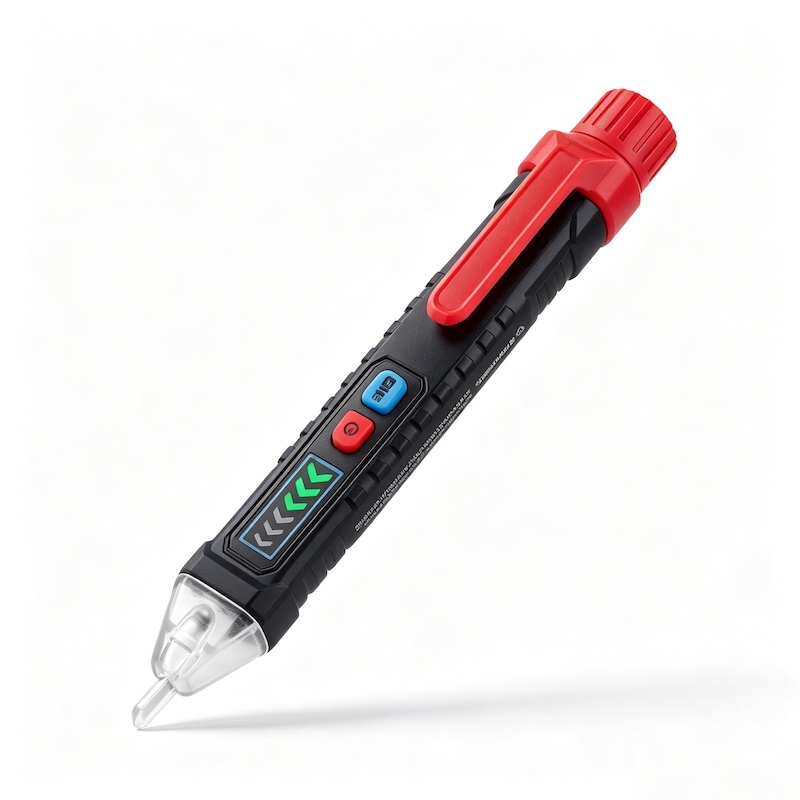
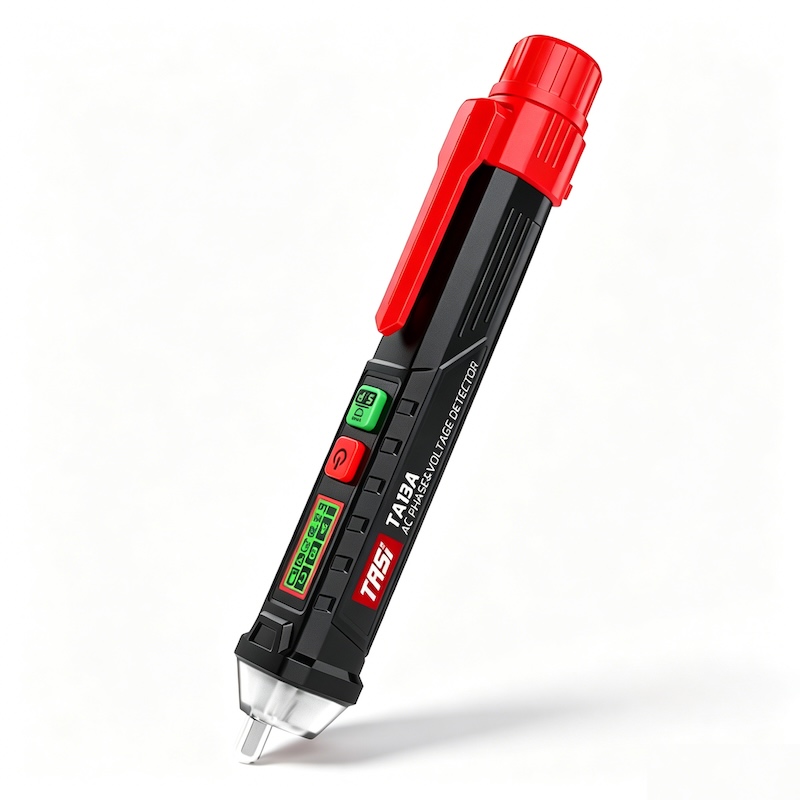
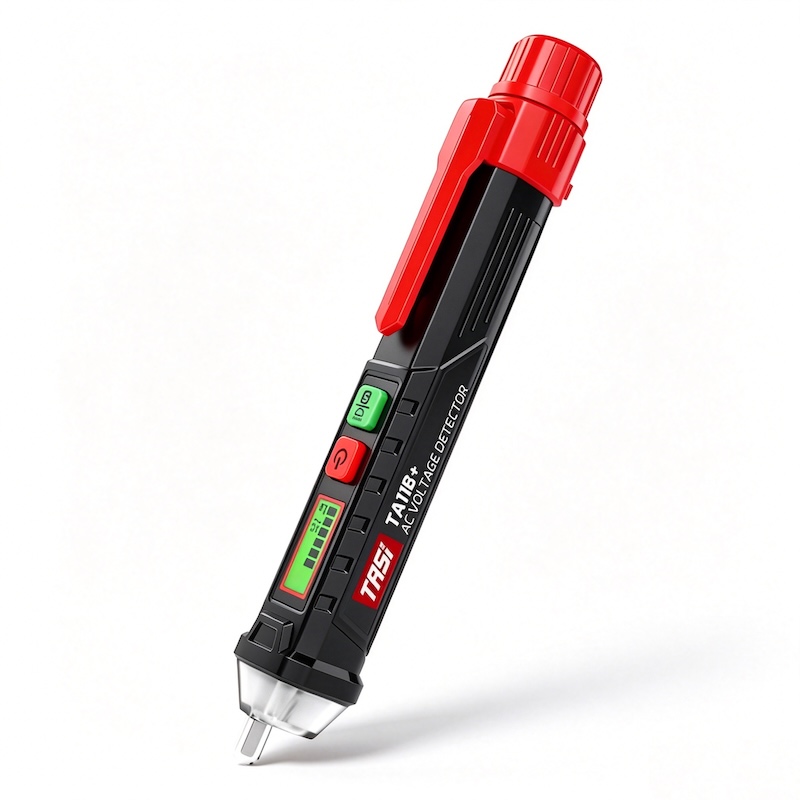
Non-contact voltage testers are commonly used to check outlets, power cords, switches, terminals, and other electrical points for the presence of AC voltage. But can the same tester detect an energized wire hidden behind a wall?
The answer is: sometimes, under suitable conditions, but not reliably enough for precise in-wall wire location.
If the conductor is close to the wall surface and the wall is made from a relatively thin, non-metallic material such as drywall or wood paneling, a high-sensitivity non-contact voltage tester may respond. Detection becomes much less reliable as wall thickness, conductor depth, shielding, or structural complexity increases.
Key Points
● A non-contact voltage tester detects the AC electric field surrounding an energized conductor; it does not directly detect the physical wire itself.
● Some high-sensitivity models may detect shallow energized wiring behind thin drywall, wood panels, or similar non-metallic materials.
● Thick masonry, concrete, metal framing, metal conduit, and greater wire depth can significantly reduce detection reliability.
● An alarm only indicates that an AC electric field may be present nearby. It does not determine the exact wire location, depth, or route.
● No alarm does not prove that there is no energized wiring behind the wall.
● Before drilling, cutting, or chasing a wall, a dedicated wall scanner or professional wire-tracing tool should be used where accurate hidden-wire detection is required.
Why Can a Non-Contact Voltage Tester Sometimes Detect a Wire Through a Wall?
A non-contact voltage tester typically works through capacitive coupling. An energized AC conductor produces a changing electric field. When the sensing tip enters a sufficiently strong field, the tester detects the signal and activates an audible, visual, or combined alarm.
This means the sensing tip does not always need to touch the wire insulation directly.
If an energized conductor is installed close to the wall surface and the wall material does not attenuate the electric field too strongly, part of that field may still be detectable from outside the wall. Moving a high-sensitivity tester slowly across the surface may therefore produce an alarm near the wiring.
However, this is electric-field sensing rather than precise hidden-wire locating.
When Is In-Wall Wiring Easier to Detect?
Whether concealed wiring can be detected depends on both the installation and the tester.
● Thin wall material: Drywall, thin wood panels, and similar non-metallic materials generally allow better detection than thick brick or concrete.
● Shallow wire depth: The closer the conductor is to the wall surface, the stronger the electric field is likely to be at the sensing tip.
● Energized circuit: Standard NCV testers primarily detect AC electric fields. An unenergized wire normally cannot be located simply because a conductor is physically present.
● Higher tester sensitivity: Dual-range or high-sensitivity testers are generally more capable of detecting weaker electric fields.
● No metallic shielding: Ordinary insulated conductors are usually easier to sense than wiring enclosed by metallic conduit or shielding.
Even when these conditions are favorable, reliable detection is not guaranteed.
What Can Cause Through-Wall Detection to Fail?
Wall construction is important, but it is not the only factor.
● Excessive wall thickness: The greater the distance between the sensing tip and conductor, the weaker the detectable electric field may become.
● Thick brick or concrete construction: Structural complexity, reinforcing steel, metallic components, and greater installation depth can affect detection.
● Metal conduit: Metallic conduit can shield the electric field and make the enclosed conductor difficult to detect with a standard NCV tester.
● Shielded cable: Cable shielding can reduce the electric field available outside the cable.
● Low circuit voltage: If the voltage is below the tester's specified detection range, the tester may not respond.
● Insufficient tester sensitivity: Detection range and sensitivity vary by model. Not all NCV testers provide the same performance through building materials.
● Low battery condition: Weak batteries or abnormal tester operation can affect detection performance.
● Nearby energized wiring: Multiple circuits, outlets, switches, or other electrical equipment may create overlapping electric fields and interfere with the result.
For this reason, the same tester may behave very differently on different walls and electrical installations.
Why Does the Alarm Position Not Necessarily Match the Exact Wire Position?
This is one of the most important limitations when using an NCV tester near concealed wiring.
The tester responds to an electric field distributed through the surrounding space rather than to the physical centerline of the conductor. At high sensitivity, the tester may begin alarming before the sensing tip is directly above the wire.
For example, when moving the tester from left to right across a wall, the alarm may begin some distance before the actual conductor location and continue for some distance after passing it.
The result may therefore be an alarm zone rather than a precise line showing the cable position.
If several energized conductors are installed close together, their electric fields may overlap and widen the apparent detection area further.
An alarm location should therefore not be interpreted as proof that a wire is directly behind one exact point on the wall.
Is High-Sensitivity Mode Better for Detecting Wires Behind Walls?
If a tester provides high- and low-sensitivity ranges, the high-sensitivity setting is generally more likely to detect a weaker or more distant electric field. It can therefore be useful for preliminary scanning of a wall.
However, higher sensitivity is not always better.
Increasing sensitivity also makes the tester more responsive to nearby outlets, parallel wiring, power cords, and other electrical sources. The alarm area may become wider, reducing positional accuracy.
High-sensitivity mode is therefore more suitable for answering:
“Could there be energized AC wiring in this area?”
It is not suitable for reliably answering:
“Exactly where is the wire located behind the wall?”
If the Tester Does Not Alarm, Does That Mean There Is No Wire in the Wall?
No.
A non-contact voltage tester that does not alarm only indicates that, under the current test conditions, it has not detected an AC electric field strong enough to trigger the tester. It does not prove that no wiring is present or that a conductor is definitely de-energized.
Possible causes of a false negative include:
● The wire is installed too deep in the wall.
● The wall is too thick.
● The wiring is inside metal conduit.
● The cable is shielded.
● The voltage is below the tester's detection range.
● The sensing tip is too far from the conductor.
● The tester battery is weak or the tester is not functioning correctly.
For drilling, cutting, chasing, or other work that could contact concealed wiring, the absence of an NCV alarm must not be treated as confirmation that the area is safe.
If the Tester Alarms, Does That Confirm There Is a Wire Directly Behind the Wall?
Not necessarily.
An alarm indicates that the tester is sensing an AC electric field nearby. The source is not always a single conductor directly behind the sensing tip.
Possible sources include:
● Energized wiring inside the wall.
● Wiring associated with a nearby outlet or switch.
● Electrical equipment on the opposite side of the wall.
● Other circuits running parallel to the scan area.
● A more distant power cable detected in high-sensitivity mode.
A non-contact voltage tester is therefore better suited to indicating that energized AC may be present nearby than to identifying an exact concealed-wire position.
What Is the Difference Between an NCV Tester and an In-Wall Wire Detector?
The two tools are designed for different purposes.
A non-contact voltage tester is primarily intended to provide a quick indication of the presence of AC voltage around outlets, power cables, switches, circuit breakers, terminals, and similar electrical points.
A wall scanner or professional wire tracer is designed specifically to locate concealed services behind walls, floors, or other structural surfaces. Depending on the instrument, it may also detect metal, studs, or other hidden structures.
For a preliminary check of whether energized wiring may be present in a general wall area, a high-sensitivity NCV tester can be useful as an additional screening tool.
For determining a concealed wire route—particularly before drilling, mounting, cutting, or wall chasing—a dedicated wall scanner or wire-tracing system is the more appropriate choice.
What Should Be Considered When Using an NCV Tester Near Concealed Wiring?
● Before use, verify the tester on a known energized source to confirm correct operation.
● If sensitivity selection is available, a higher-sensitivity range may be used for an initial broad scan.
● Keep the sensing tip close to the wall and move it slowly in different directions while observing changes in the alarm response.
● Do not test only one point; compare readings across the surrounding area and from more than one direction.
● Consider interference from nearby outlets, switches, power cables, and other electrical equipment.
● After testing, verify the tester again on a known energized source to confirm that it is still operating correctly.
● Do not rely on an NCV result as the sole safety check before drilling, cutting, or electrical work.
Where concealed wiring may be affected by construction work, use detection equipment intended for that purpose and follow appropriate electrical safety procedures.
FAQ
Can a non-contact voltage tester detect wires through drywall?
Possibly. If the drywall is relatively thin, the conductor is close to the surface, and the circuit is energized with AC voltage, a high-sensitivity tester may respond. Detection depends on wall thickness, wire depth, and tester sensitivity.
Can an NCV tester detect wiring through concrete?
Detection cannot be guaranteed. Concrete walls are often thicker, may contain reinforcing steel, and may place the wiring farther from the surface, making NCV detection unreliable.
Does the wire have to be energized for an NCV tester to detect it?
Generally, yes. A standard non-contact voltage tester relies on detecting an AC electric field. A de-energized conductor will not normally trigger the NCV function simply because the wire is present.
Can an NCV tester determine how deep the wire is?
No. Alarm intensity may change with distance, but it is also affected by voltage, wall material, cable construction, and tester sensitivity. The depth cannot be calculated reliably from the alarm response.
Can a non-contact voltage tester trace the exact route of a wire behind a wall?
Not reliably. It detects the surrounding electric field, which may extend beyond the physical position of the conductor.
If I am going to drill into a wall and the NCV tester does not alarm, is it safe to drill?
No. The absence of an alarm does not confirm that concealed energized wiring is absent. Use equipment designed for locating hidden services before drilling, cutting, or wall chasing.
Conclusion
A non-contact voltage tester may detect energized wiring through a thin, non-metallic wall under suitable conditions, but it should not be considered a reliable through-wall wire-location tool.
Wall material, thickness, conductor depth, voltage, metallic shielding, tester sensitivity, and nearby circuits can all affect the result.
An NCV tester is best used as a quick indication that an AC electric field may be present in an area. When the exact location or route of concealed wiring must be identified—especially before drilling, cutting, or wall chasing—a dedicated wall scanner or professional wire-tracing tool should be used.