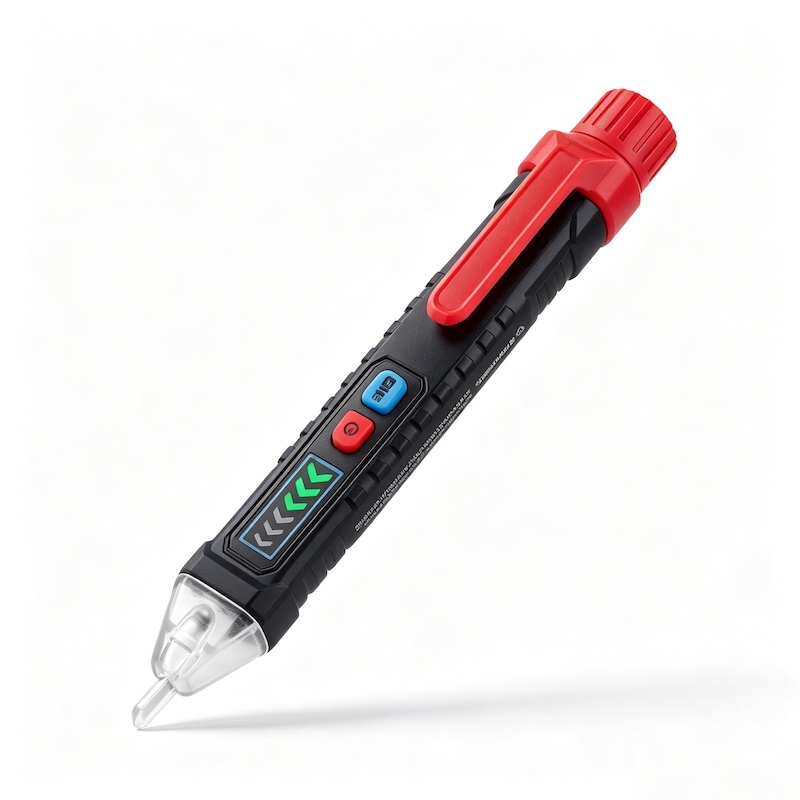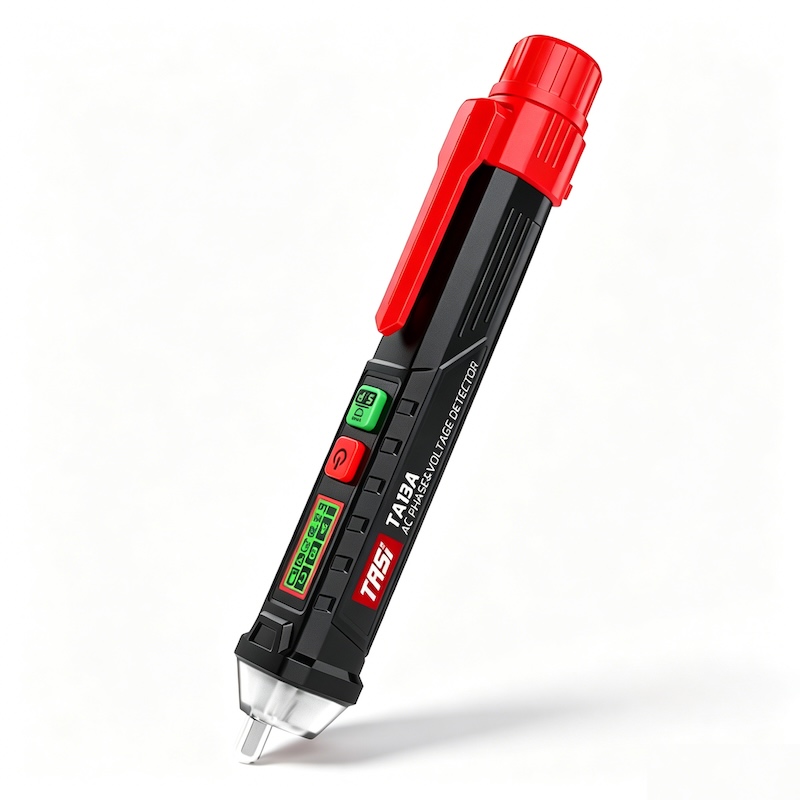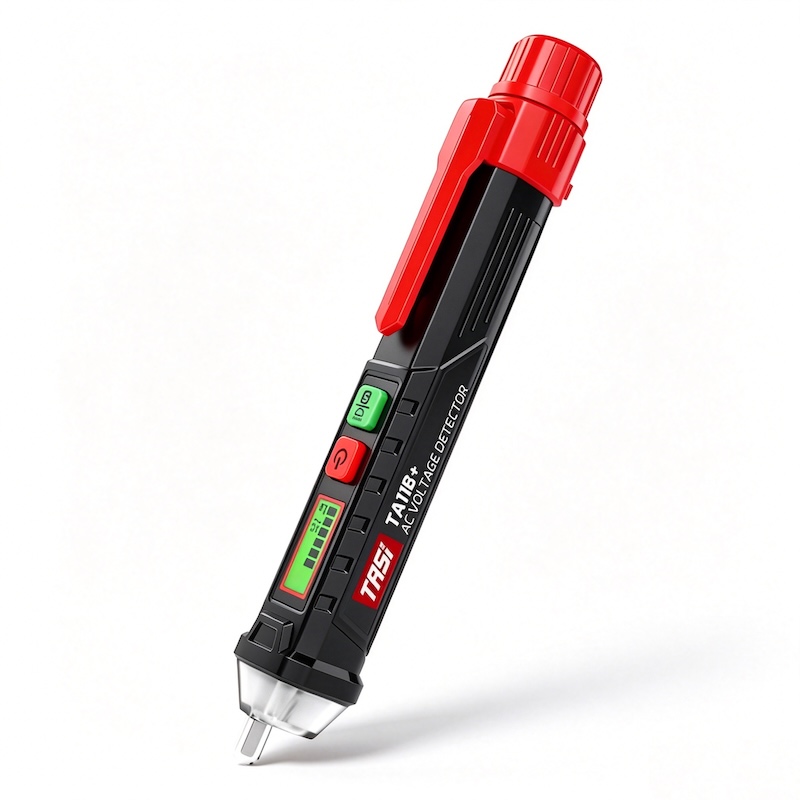
Introduction
Non-contact voltage testers are commonly specified with detection ranges such as “12–1000 V AC” or “50–1000 V AC.” Both may have the same upper limit of 1000 V, but their lower detection thresholds differ significantly.
The most important difference is that a 12–1000 V model is designed to respond to weaker electric fields associated with lower AC voltages, while a 50–1000 V tester is generally optimized for standard mains-voltage applications.
However, these ratings should not be confused with voltage measurement ranges. An NCV tester detects the electric field around an energized AC conductor; it does not measure the actual voltage in the same way as a digital multimeter.
Key Takeaways
● The main difference between 12–1000 V and 50–1000 V NCV testers is the minimum detection voltage and corresponding sensitivity.
● A 12–1000 V tester is more capable of detecting weaker AC electric fields and lower-voltage AC circuits.
● A 50–1000 V tester is well suited to common mains wiring, outlets, power cords, switches, and distribution circuits.
● Higher sensitivity is not always preferable because nearby energized conductors and electromagnetic interference may cause unwanted indications.
● The specified range describes the approximate operating range of the NCV function; it does not indicate measurement accuracy.
● A non-contact voltage tester is useful for preliminary voltage-presence checks but should not be the sole means of proving that a circuit is de-energized.
What Do 12–1000 V and 50–1000 V Mean?
The markings “12–1000 V AC” and “50–1000 V AC” normally indicate the rated AC voltage detection range of the non-contact voltage function.
In simple terms:
● 12–1000 V AC: designed to detect AC electric fields associated with voltages from approximately 12 V up to 1000 V.
● 50–1000 V AC: designed to detect AC electric fields associated with voltages from approximately 50 V up to 1000 V.
The lower figure should be understood as a specified detection threshold under defined operating conditions, not as an absolute switching point.
Actual response can vary with insulation thickness, distance from the conductor, AC frequency, probe orientation, surrounding electric fields, battery condition, and the design of the tester itself.
What Is the Main Difference Between the Two Ranges?
The essential difference can be summarized as follows:
12–1000 V provides greater sensitivity to low-voltage AC electric fields, while 50–1000 V is primarily intended for conventional electrical systems.
| Comparison | 12–1000 V NCV Tester | 50–1000 V NCV Tester |
|---|---|---|
| Rated minimum detection voltage | Approx. 12 V AC | Approx. 50 V AC |
| Low-voltage detection capability | Higher | More limited |
| Typical sensitivity | Higher | Relatively lower |
| Standard mains detection | Suitable | Suitable |
| Low-voltage AC circuits | Better suited | May not respond in some cases |
| Response to weak electric fields | More sensitive | Less sensitive |
| Influence from nearby energized conductors | Requires greater attention | Generally less pronounced |
| Typical use | Low-voltage + standard electrical testing | Standard electrical testing |
If the main requirement is checking conventional mains wiring, both ranges may be suitable. If lower-voltage AC control circuits are also involved, the 12–1000 V range offers greater flexibility.
Why Is a 12–1000 V Tester More Sensitive?
A non-contact voltage tester typically works by sensing the alternating electric field around an energized conductor through capacitive coupling.
When the probe approaches an energized AC conductor, the internal detection circuit senses the field and activates an audible, visual, or combined indication.
Lower AC voltages usually produce weaker detectable electric fields. To detect voltage starting at approximately 12 V AC, the tester therefore needs to respond to smaller electric-field signals.
This is why a lower detection threshold is generally associated with greater sensitivity.
Some dual-range NCV testers apply the same principle by offering a high-sensitivity mode for lower-voltage systems and a standard-sensitivity mode for conventional mains wiring.
The difference between 12–1000 V and 50–1000 V is therefore more than simply “38 volts.” It reflects a practical difference in how readily the tester responds to weaker AC electric fields.
What Applications Are Better Suited to 12–1000 V?
The main advantage of a 12–1000 V range is its ability to detect lower-voltage AC circuits and weaker electric fields.
Typical applications may include:
● Low-voltage AC control circuits;
● Certain doorbell circuits;
● Thermostat and HVAC control wiring;
● Low-voltage lighting systems;
● Irrigation control systems;
● Security and automation circuits;
● Standard AC outlets, power cords, and distribution wiring.
This broader detection range can be useful for electricians, HVAC technicians, and maintenance personnel who work with both mains-voltage and lower-voltage AC systems.
However, the presence of “12 V” in the specification does not mean that the tester can detect every 12 V circuit. Automotive 12 V systems, for example, are normally DC systems, while conventional NCV testers are primarily intended for detecting AC electric fields.
What Applications Are Better Suited to 50–1000 V?
A 50–1000 V non-contact voltage tester is mainly intended for conventional AC electrical systems.
Typical applications include:
● Checking whether an AC power cord is energized;
● Checking for voltage around receptacles;
● Testing switch wiring;
● Inspecting circuit breakers and distribution wiring;
● Locating energized conductors;
● Routine residential, commercial, and industrial electrical maintenance.
For users whose work is mainly focused on standard mains circuits and who rarely need to test lower-voltage AC control systems, a 50–1000 V range is generally sufficient for preliminary voltage-presence checks.
Is 12–1000 V Always Better Than 50–1000 V?
No.
A 12–1000 V tester provides a wider nominal detection range, but a wider range does not automatically mean better performance in every application.
Higher sensitivity improves the ability to detect weak electric fields, but it can also make the tester more responsive to neighboring energized conductors.
In crowded cable trays, outlet boxes, control cabinets, or distribution panels, a highly sensitive tester may respond before the probe is directly adjacent to the intended conductor.
Because NCV testers respond to electric fields rather than making direct electrical contact, their indications can be affected by distance, surrounding conductors, insulation, and electromagnetic conditions.
As a practical guideline:
● Choose 12–1000 V when low-voltage AC detection is frequently required.
● Choose 50–1000 V when most work involves standard mains circuits.
● In electrically crowded environments, sensitivity selection and correct test technique are more important than simply choosing the lowest possible detection threshold.
Why Can a High-Sensitivity Mode Seem Too Sensitive?
In high-sensitivity mode, an NCV tester can respond to electric fields even when the probe is not immediately next to the target conductor.
This is particularly noticeable where several conductors are routed close together. An energized wire can create an electric field that is detected near adjacent conductors.
This does not necessarily indicate a fault in the tester. It is a consequence of non-contact electric-field detection.
For more reliable identification:
● Move the probe slowly and observe changes in indication strength;
● Position the probe as close as practical to the target conductor;
● Avoid approaching several conductors at the same time;
● If available, compare the result using different sensitivity settings;
● Use an appropriate contact-type electrical tester when confirmation is required.
Can a 12–1000 V Tester Determine the Actual Voltage?
No.
A “12–1000 V” specification describes the operating range of the NCV detection function. It does not mean the instrument can measure and display the exact voltage between 12 V and 1000 V.
If the tester alarms near a conductor, it indicates that an AC electric field meeting the tester's detection conditions is present. It cannot tell whether the circuit is operating at 24 V, 120 V, 230 V, or another voltage.
Some NCV testers use different LED colors, bar indicators, or changing buzzer frequencies to show relative field strength. These indications should not be interpreted as an accurate voltage measurement because probe distance and surrounding conditions also affect signal strength.
Use a suitable digital multimeter or contact-type voltage tester when the actual voltage value must be determined.
Why Might a 12 V Circuit Not Trigger a 12–1000 V Tester?
A 12–1000 V rating does not guarantee an alarm on every 12 V AC circuit under all conditions.
NCV performance depends on several factors:
● Actual AC voltage;
● Distance between the probe and conductor;
● Insulation thickness;
● Shielding around the conductor;
● AC frequency;
● Probe orientation and position;
● Capacitive coupling between the user, instrument, and surroundings;
● Nearby energized conductors;
● Battery level and tester condition.
At low AC voltages, the available electric-field signal is weaker. Thick insulation or increased distance can further reduce the signal reaching the sensor.
The rated range should therefore always be interpreted together with the manufacturer's specified operating conditions.
How Should a Dual-Sensitivity NCV Tester Be Used?
Some non-contact voltage testers combine multiple detection ranges in a single instrument by providing high- and low-sensitivity settings.
A practical approach is:
● Standard power wiring and receptacles: start with the normal-sensitivity range.
● Low-voltage AC control circuits: use the high-sensitivity range.
● If the high-sensitivity mode responds over too wide an area: switch to lower sensitivity and move closer to the conductor.
● If the target conductor is unclear: compare indications at different probe positions and sensitivity levels.
● If the actual voltage must be confirmed: use a suitable contact-type measuring instrument.
The purpose of dual sensitivity is not to operate continuously at maximum sensitivity. It allows the user to select a response level appropriate to the electrical environment.
Should You Choose 12–1000 V or 50–1000 V?
The choice should be based primarily on the type of circuits normally encountered.
A 50–1000 V tester is generally suitable for:
● Residential mains wiring;
● Standard outlets;
● Power cords;
● Distribution panels;
● Switches and lighting circuits.
A 12–1000 V model offers additional flexibility for users who also work with:
● HVAC control systems;
● Low-voltage AC control wiring;
● Doorbell circuits;
● Low-voltage lighting;
● Automation equipment.
For mixed environments, an NCV tester with selectable sensitivity ranges can be especially useful.
Detection range should not be the only selection criterion. Measurement category, electrical safety rating, alarm method, ingress protection, self-test features, and intended operating environment should also be considered.
What Should You Consider When Using Either Type?
Regardless of the detection range, an NCV tester should be treated as a rapid voltage-presence screening tool rather than a complete electrical measurement instrument.
Recommended practices include:
● Verify the tester on a known live source before use;
● Recheck it on a known live source after testing where appropriate;
● Do not assume that a circuit is completely de-energized solely because the NCV tester does not indicate voltage;
● Be aware that low voltage, thick insulation, shielding, excessive distance, and low battery condition can affect detection;
● In high-sensitivity mode, consider the influence of nearby energized conductors;
● Standard NCV functions are primarily intended for AC electric-field detection and should not be assumed to detect ordinary DC circuits;
● Use a suitable contact-type instrument when the actual voltage must be confirmed.
FAQ
What is the biggest difference between 12–1000 V and 50–1000 V NCV testers?
The primary difference is the rated minimum detection voltage. A 12–1000 V model is designed to detect weaker electric fields associated with lower AC voltages, while a 50–1000 V model is aimed mainly at conventional AC power systems.
Is a 12–1000 V tester more sensitive?
Generally, yes. Detecting lower AC voltages requires the tester to respond to weaker electric-field signals.
Can a 50–1000 V tester detect 220 V or 230 V AC?
Yes. Both 220 V and 230 V are within the rated 50–1000 V AC range, although actual detection still depends on insulation, distance, and environmental conditions.
Can a 12–1000 V tester detect a 12 V automotive battery?
Normally not. Automotive battery systems are DC, whereas standard non-contact voltage testers are primarily designed to detect AC electric fields.
Why might a 12–1000 V tester alarm from farther away?
Its higher sensitivity allows it to respond to weaker electric fields, including fields from nearby energized conductors.
Can a 12–1000 V tester show the actual voltage?
No. It indicates the possible presence of AC voltage but does not provide an accurate voltage measurement.
Is a lower minimum detection voltage always better?
No. Greater sensitivity extends low-voltage capability but can also increase susceptibility to nearby electric fields. The correct range depends on the application.
Can either tester prove that a circuit is de-energized?
An NCV tester is useful for preliminary checks, but a lack of indication alone should not be treated as definitive proof that a circuit is de-energized.
Conclusion
The fundamental difference between 12–1000 V and 50–1000 V non-contact voltage testers is their minimum detection voltage and resulting sensitivity.
A 12–1000 V tester is better suited to detecting weaker AC electric fields and expands the range of applications to include certain low-voltage control, HVAC, doorbell, and low-voltage lighting systems. A 50–1000 V tester is primarily intended for conventional AC power cords, receptacles, switches, circuit breakers, and distribution wiring.
A wider detection range does not necessarily mean better performance in every environment. NCV detection is influenced by insulation, distance, nearby conductors, and electromagnetic conditions.
When selecting a tester, consider not only whether the lower threshold is 12 V or 50 V, but also the types of circuits being tested, required sensitivity, electrical safety rating, and operating environment. For mixed low-voltage and mains-voltage work, a 12–1000 V or dual-sensitivity NCV tester generally provides greater flexibility.