What Type of Voltage Tester Should You Choose for Low-Voltage Circuit Testing?

Publisher: Amy Published: 2026-04-03 Reading Time: 5min. 0sec.
Tags: low-voltage circuit testingvoltage tester selectionnon-contact voltage testertwo-pole voltage detectorelectrical safety

Introduction

Low-voltage circuit testing can mean quickly checking whether a wire is energised, confirming that equipment has been isolated before maintenance, or measuring the actual voltage. Each task calls for a different instrument.
A non-contact voltage tester is suitable for preliminary screening around wires, sockets or equipment. To confirm the absence of voltage, use a suitably rated two-pole voltage detector. For voltage readings and fault-finding, choose an appropriate multimeter. Start by defining the task, then check the tester’s detection range and safety rating.


Key Points

● A non-contact voltage tester is useful for preliminary checks, but it cannot confirm that a circuit is voltage-free.
● For low-voltage signals or DC circuits, check the minimum detection voltage and whether the tester supports AC or DC.
● To check for the presence or absence of voltage, choose a contact-type two-pole voltage detector rated for the system under test.
● Check the rated voltage, CAT rating, indication method and instrument condition before use.


Choose the Tester Based on the Task

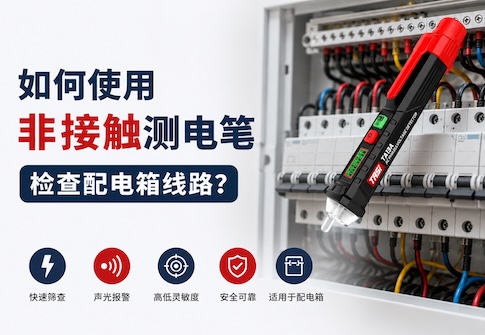
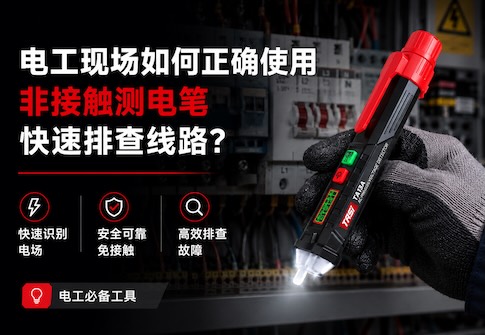
● Quickly identifying an energised wire: A non-contact voltage tester senses the AC electric field and gives an audible or visual alert without touching an exposed conductor. It can help with preliminary screening or locating a wire, but it does not display an exact voltage reading.
● Checking whether a circuit is energised or voltage-free: Use a contact-type two-pole voltage detector with ratings suitable for the circuit and installation category. IEC 61243-3 applies to two-pole low-voltage voltage detectors. Non-contact detectors can help identify energised equipment, but should not be used to prove that a circuit is voltage-free. webstore.iec.ch
● Measuring voltage or troubleshooting: Use a multimeter with the required AC/DC voltage ranges, input protection and safety rating. Before measuring continuity or resistance, isolate the power supply and verify the circuit condition in accordance with the applicable safety procedure.


Key Selection Criteria

● Detection range: Check that the minimum detection voltage and maximum rated voltage cover the circuit you intend to test. For low-voltage control circuits such as 12 V or 24 V, check whether the tester can detect that voltage.
● AC/DC and frequency: Many non-contact voltage testers detect AC electric fields. For DC circuits or control signals, confirm that the specifications explicitly support the required current type, frequency and voltage range.
● Sensitivity settings: High/low or multi-level sensitivity can help adapt to different wire distances and installation conditions. Higher sensitivity may increase interference from adjacent live wires; lower sensitivity may miss a wire that is farther away or has a weaker electric field.
● Audible and visual alerts: A tester with both light and sound indications is easier to use in dim areas, noisy environments or situations where a quick status check is needed.
● Safety rating and construction: Check that the rated voltage and CAT rating are appropriate for the test point and working environment. Inspect the probe, housing and insulation for damage. The CAT rating does not replace the rated voltage; check both the product markings and the user manual.
● Self-test and battery indicator: A weak battery or faulty instrument can affect readings. A battery indicator or self-test feature helps with checks before use. Follow the manual to confirm that the tester is functioning correctly.


Choose by Application

● Preliminary checks on household wiring and sockets: Choose a non-contact voltage tester with audible and visual alerts, adjustable sensitivity and a detection range that covers the AC circuit. Use it to locate potentially energised wires as an initial check.
● Distribution boards and equipment wiring: A non-contact tester can be used for initial screening. Depending on the task, follow up with a suitably rated two-pole voltage detector or multimeter. Metal enclosures, cable shielding and wire spacing can affect non-contact detection.
● Low-voltage control circuits: For low-voltage DC signals, use a multimeter or dedicated instrument whose specifications clearly support the required voltage and signal type. A standard AC non-contact voltage tester may not detect these circuits.
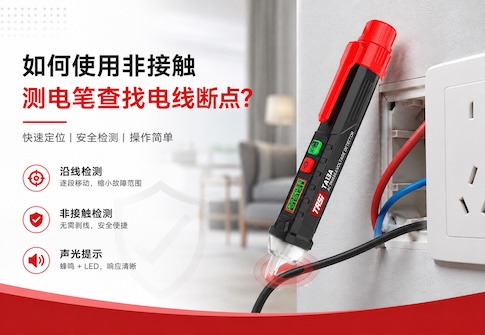
● Preliminary tracing or locating a break: A non-contact tester can help compare indications at different points along a wire, but it should not be used alone to determine the exact break location. Cable shielding, insulation thickness, distance from the probe and the tester’s condition can all affect the indication. media.fluke.com


Safety Precautions

● Before and after using a non-contact tester, check its response on a known live source within the tester’s rated range. If it does not respond, check the battery and instrument condition. media.fluke.com
● No alert from a non-contact tester does not prove that a circuit is voltage-free. Shielded cables, metal enclosures, thick insulation, distance, the user’s coupling to ground and battery condition can all affect detection. media.fluke.com
● Before maintenance, isolate the power supply and use a suitable contact-type instrument to verify the circuit condition. A non-contact test cannot replace verification of the absence of voltage.
● Set the function, range and test points in accordance with the user manual. Stop using the instrument if the housing is damaged, the probe is cracked or the insulation is worn. Live testing should be performed by qualified personnel in accordance with site safety procedures.


FAQ

● Can a non-contact voltage tester confirm that a circuit is de-energised? No. It is suitable for preliminary detection of energised circuits, but should not be used on its own to confirm the absence of voltage.
● Can a non-contact voltage tester show the exact voltage? No. It generally indicates whether an electric field has been detected. Use a suitable measuring instrument when you need a voltage reading.
● Can one tester detect both AC and DC? Not necessarily. Check whether the specifications explicitly support AC, DC and the required voltage range.
● If the tester gives no alert, can maintenance begin? No. No indication does not prove that a circuit is voltage-free. Isolate the power supply and use a contact-type instrument in accordance with the applicable safety procedure.


Summary

Choose a tester according to the task: a non-contact voltage tester is useful for preliminary screening, a two-pole voltage detector is suited to contact voltage checks, and a multimeter is used for voltage measurements and troubleshooting. Check the minimum detection voltage, AC/DC support, sensitivity, rated voltage and CAT rating. Follow the product instructions and site safety procedures, and never treat a non-contact test as proof that a circuit is voltage-free.

Related Products
TA881A TA881A Non-Contact Voltage Detector

TA881A

TA881A
Non-Contact Voltage Detector
Non-Contact | Audible and Visual Alarm
Abstract:
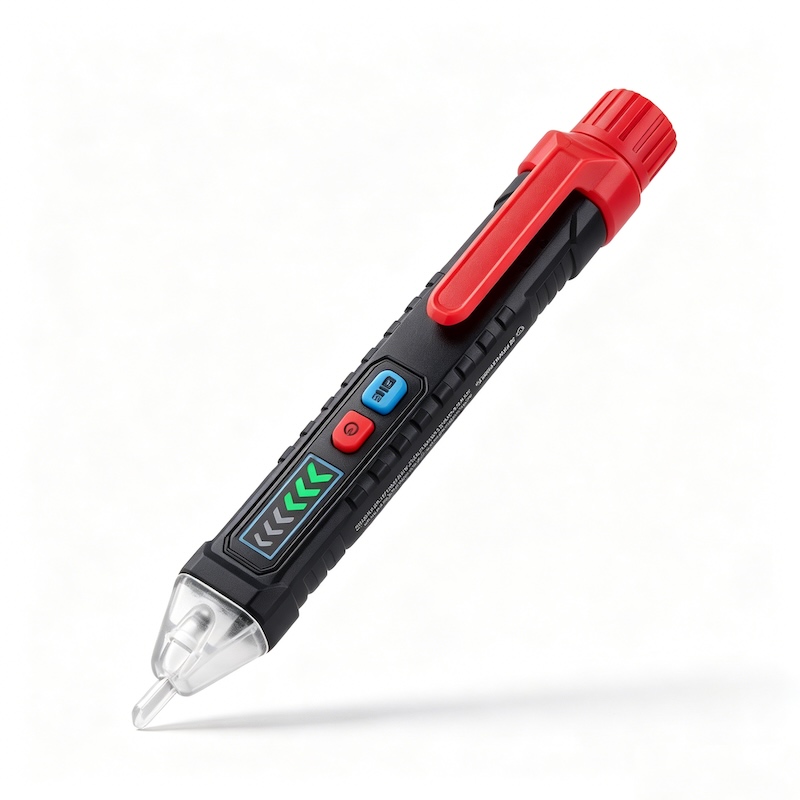
TA881A is a professional Non-Contact Voltage Tester, NCV Voltage Detector, AC Voltage Detector Pen, Voltage Test Pen and Electrical Tester designed for fast and safe AC voltage detection without direct contact with live conductors. Using advanced electromagnetic induction technology, the tester can quickly identify whether an AC electrical line is energized while maintaining a safe distance from the conductor. It supports a wide AC voltage detection range of 12V to 1000V, making it suitable for residential, commercial and industrial electrical inspection applications. The TA881A features dual sensitivity modes, including high sensitivity mode (12–1000V) and low sensitivity mode (48–1000V), allowing users to select the appropriate detection level for different environments such as wall wiring inspection, electrical panels, power distribution systems, control cabinets and machinery maintenance. Designed according to EN61326-1 and EN61010 safety standards, with CAT III 1000V safety rating, the tester provides reliable protection during electrical troubleshooting. The integrated live wire identification function, combined with audible and visual alarms, helps users quickly locate live wires, check cable conditions and identify wiring faults. With a compact pen-style design, built-in LED flashlight and battery-powered operation, TA881A is widely used in home electrical installation, electrical engineering, facility maintenance, HVAC and mechanical equipment servicing, industrial production line inspection, low-voltage engineering, building maintenance and electrical safety checks. TA881A is an essential handheld electrical testing tool for electricians, technicians, engineers and maintenance professionals requiring safe, efficient and portable AC voltage detection.
View More ›
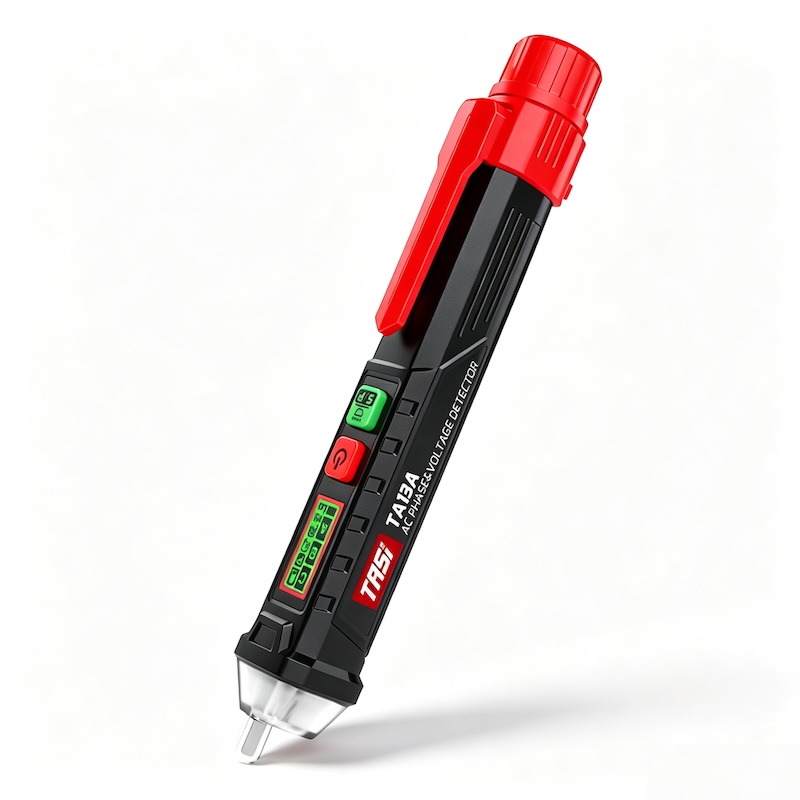
TA13A TA10 Series Non-Contact Voltage Tester

TA13A

TA10 Series
Non-Contact Voltage Tester
Audible and Visual Alarm | Phase Sequence Detection
Abstract:
The TASI TA10 Series Non-Contact Voltage Tester Pen includes two compact electrical testing tools, TA11B+ and TA13A, also known as non-contact voltage detectors, NCV testers, voltage sensing pens, electrical test pens, AC voltage detectors, and electrician inspection tools. Equipped with advanced NCV (Non-Contact Voltage Detection) technology, these testers can detect AC voltage without stripping wires or making direct contact with live conductors, improving safety and efficiency during electrical inspection. The TA10 Series supports 12~1000V AC voltage detection with adjustable high and low sensitivity modes, allowing electricians to quickly locate electrical fields from a distance or accurately identify live wires at close range. Featuring a digital display, audible and visual alarms, LED flashlight, low battery indication, and automatic power-off function, the tester provides clear and reliable electrical inspection results. The TA11B+ model is designed for basic non-contact voltage detection and live/neutral wire identification, while the TA13A adds a three-phase phase sequence testing function for checking three-phase power systems, motors, control cabinets, and industrial electrical equipment. With its compact pen-style design, high safety protection, and easy operation, the TA10 Series Non-Contact Voltage Tester is widely used in home electrical installation, building maintenance, facility management, industrial electrical inspection, factory power distribution maintenance, automation equipment servicing, HVAC electrical troubleshooting, construction projects, fire protection system inspection, and professional electrician applications. It is an essential handheld electrical safety tester for electricians, technicians, maintenance engineers, and installation professionals.
View More ›
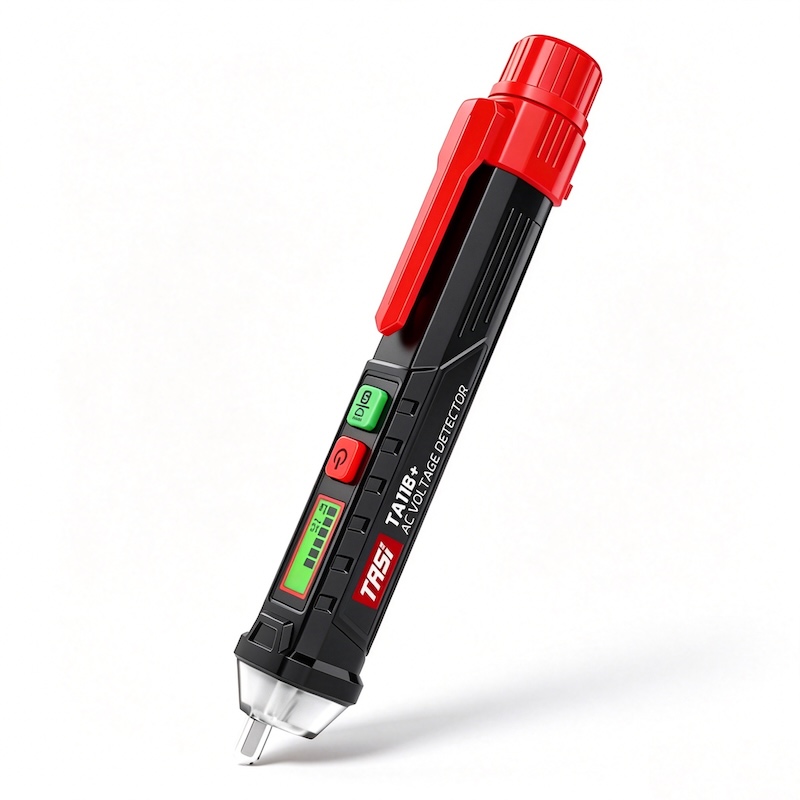
TA11B+ TA10 Series Non-Contact Voltage Tester

TA11B+

TA10 Series
Non-Contact Voltage Tester
Non-Contact | Audible and Visual Alarm
Abstract:
The TASI TA10 Series Non-Contact Voltage Tester Pen includes two compact electrical testing tools, TA11B+ and TA13A, also known as non-contact voltage detectors, NCV testers, voltage sensing pens, electrical test pens, AC voltage detectors, and electrician inspection tools. Equipped with advanced NCV (Non-Contact Voltage Detection) technology, these testers can detect AC voltage without stripping wires or making direct contact with live conductors, improving safety and efficiency during electrical inspection. The TA10 Series supports 12~1000V AC voltage detection with adjustable high and low sensitivity modes, allowing electricians to quickly locate electrical fields from a distance or accurately identify live wires at close range. Featuring a digital display, audible and visual alarms, LED flashlight, low battery indication, and automatic power-off function, the tester provides clear and reliable electrical inspection results. The TA11B+ model is designed for basic non-contact voltage detection and live/neutral wire identification, while the TA13A adds a three-phase phase sequence testing function for checking three-phase power systems, motors, control cabinets, and industrial electrical equipment. With its compact pen-style design, high safety protection, and easy operation, the TA10 Series Non-Contact Voltage Tester is widely used in home electrical installation, building maintenance, facility management, industrial electrical inspection, factory power distribution maintenance, automation equipment servicing, HVAC electrical troubleshooting, construction projects, fire protection system inspection, and professional electrician applications. It is an essential handheld electrical safety tester for electricians, technicians, maintenance engineers, and installation professionals.
View More ›
TA882A TA882 Series Digital Voltage Tester

TA882A

TA882 Series
Digital Voltage Tester
Contact / Non-Contact | Audible and Visual Alarm
Abstract:
The TASI TA882Series Digital Voltage Tester Pen is a compact and multifunctional electrical testing tool designed for voltage detection, circuit inspection and wiring troubleshooting. Also known as a voltage test pen, electrical tester pen, digital test screwdriver, circuit detector pen, non-contact voltage detector and electrician test tool, the TA882 Series is widely used in home electrical installation, construction wiring, industrial equipment maintenance, power distribution inspection, facility management and daily electrical troubleshooting. Supporting 12~300V AC voltage detection, the TA882 Series integrates multiple functions including live/neutral wire identification, continuity buzzer testing, DC polarity detection and battery polarity checking. With both non-contact sensing and contact measurement modes, the tester allows users to quickly locate hidden wires, identify live circuits and accurately measure voltage values in different working environments. The TA882A features a dual-color red and green backlit display. The screen shows green during normal testing and automatically changes to red with audible and visual alarms when dangerous voltage levels are detected, providing enhanced safety awareness during electrical inspection. The TA882B adopts a clear green backlight display, offering simple and reliable voltage measurement for daily maintenance applications. Equipped with a built-in LED flashlight, the tester provides additional illumination for dark distribution boxes, equipment cabinets and night-time repair work. The integrated 3.7V/220mAh rechargeable lithium battery with Type-C charging interface eliminates frequent battery replacement. Low battery warning and 5-minute auto power-off functions improve energy efficiency and extend operating convenience. Featuring a lightweight pen-style design with only approximately 46g weight, the TA882 Series Digital Voltage Tester Pen is easy to carry and operate with one hand. It is an ideal electrical inspection tool for electricians, maintenance technicians, contractors, DIY users and professionals working in residential, commercial, industrial and electrical service applications.
View More ›
Related Technical Articles
Related FAQs
Related Solutions