Introduction
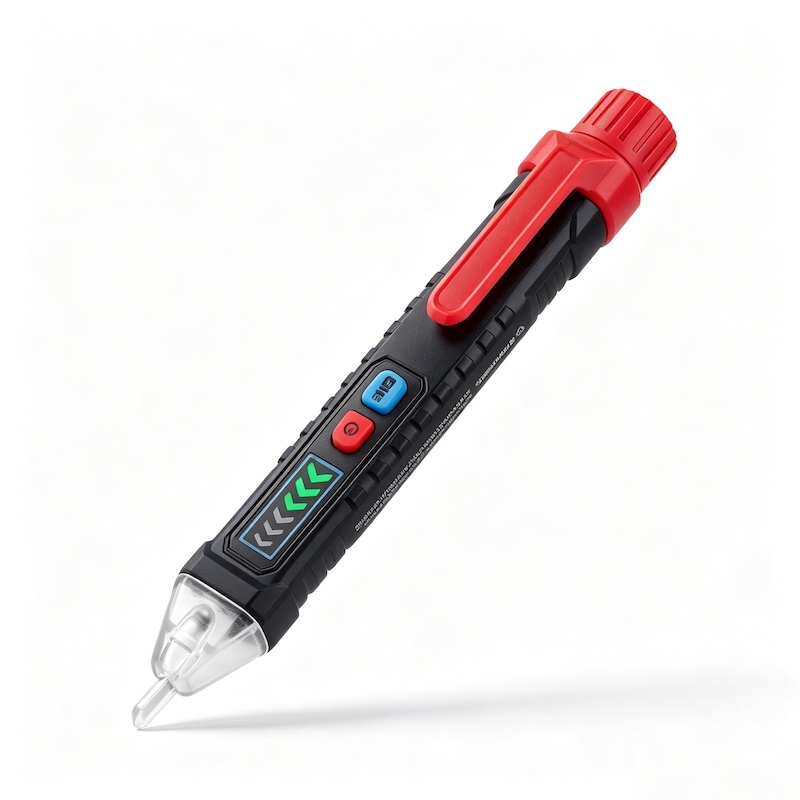
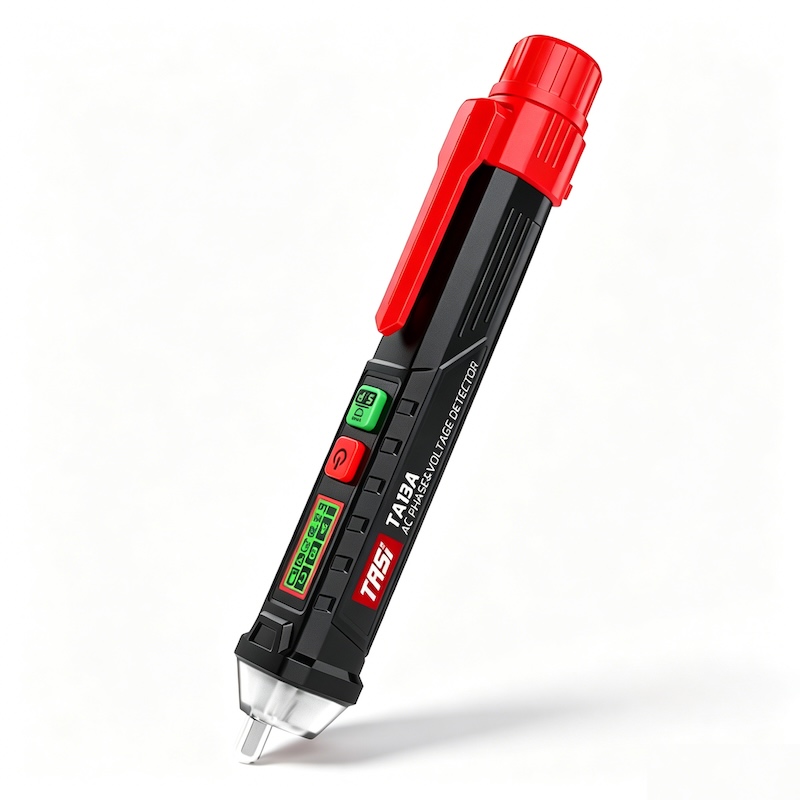
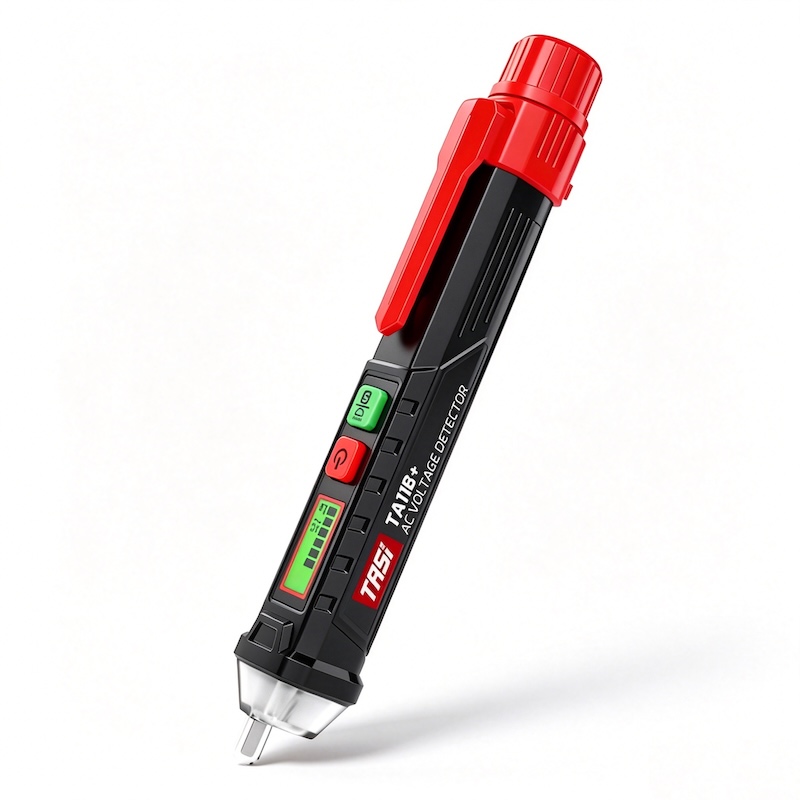
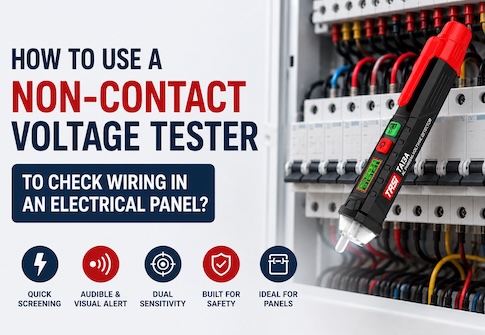
A non-contact voltage tester (NCV tester) detects the electric field around an energized AC conductor without requiring direct contact with exposed metal. It is widely used for quick checks of outlets, wires, cables, switches, and electrical distribution equipment.
Although an NCV tester is simple to operate, it detects electric fields rather than directly measuring the actual voltage between conductors. Test position, distance, sensitivity setting, insulation, shielding, and surrounding electrical conditions can therefore affect the result.
Common operating mistakes include failing to verify the tester on a known live source, holding the sensing tip too far from the conductor, treating a lack of indication as proof that a circuit is de-energized, or overlooking interference from nearby energized conductors. Understanding these limitations helps improve detection reliability and reduces the risk of incorrect conclusions.
Key Points
● A non-contact voltage tester detects the presence of an AC electric field; it does not provide an exact voltage measurement.
● Before and after testing, verify the tester on a known energized source whenever practical.
● Probe position, distance, insulation thickness, and sensitivity settings can all affect detection performance.
● No alert does not, by itself, prove that a circuit is de-energized.
● Closely spaced conductors can produce capacitive coupling and cause nearby wires to trigger the tester.
● For critical electrical work or before contacting conductors, use an appropriate method to verify the absence of voltage.
Failing to Verify the Tester Before Use
One of the most common mistakes is beginning a test without first confirming that the voltage tester is operating correctly.
A weak battery, incorrect power state, internal fault, damaged indicator, or defective buzzer may prevent the tester from responding normally. In such a condition, an energized conductor could incorrectly appear to be de-energized.
A more reliable procedure is:
● Turn on the tester and check it against a known energized outlet or conductor.
● Perform the intended test.
● After testing, check the tester again on the known energized source.
● If either verification fails, stop relying on the tester and inspect the battery or instrument condition.
This “verify–test–verify” approach helps identify instrument problems that could otherwise produce a false negative.
Assuming No Alert Means the Circuit Is Definitely De-Energized
A non-contact voltage tester that does not indicate voltage is only showing that it has not detected a sufficiently strong AC electric field under the current test conditions.
A lack of indication may occur because:
● The voltage is below the tester's effective detection range.
● The sensing tip is too far from the conductor.
● The insulation is unusually thick.
● The conductor is inside metallic conduit, an enclosure, or another shielding structure.
● The selected sensitivity is unsuitable.
● The electrical configuration or grounding conditions produce a weak detectable field.
● The battery is weak or the tester is malfunctioning.
An NCV tester is therefore best used as a rapid screening tool rather than as the sole means of proving that a circuit is safe to work on. Before servicing, disconnecting, or touching conductors, use an appropriate voltage verification method for the application.
Holding the Sensing Tip Too Far from the Conductor
NCV testers respond to the electric field surrounding an AC conductor. In general, the field detected by the instrument becomes stronger as the sensing tip moves closer to the energized conductor.
If the tip is held too far from a wire, outlet slot, or terminal, the field may not be strong enough to exceed the tester's detection threshold, resulting in a missed indication.
Move the sensing end gradually toward the target area while remaining within the instrument's operating instructions. When testing insulated wiring, slowly scan along the outer surface rather than making only a quick pass from a distance.
Testing at the Wrong Position
The strength of the electric field can vary considerably around the same circuit. As a result, different probe positions may produce different indications.
For example, when testing an outlet, placing the sensing tip near the center of the faceplate rather than close to the relevant live slot may produce an unstable or weak response.
Similarly, in a multicore cable, the energized conductor may be positioned farther from one side of the outer jacket than another.
A more reliable approach is to:
● Test several positions around the target area.
● Move the tester slowly along the wire or around the outlet.
● Compare indications from different positions rather than relying on a single point.
Relying on a Single Test
Making one quick pass and immediately concluding that a circuit is not energized increases the possibility of a false result.
Electric-field detection can vary with probe orientation, distance, conductor arrangement, and surrounding conditions. Testing from more than one position provides additional information.
This is particularly useful around outlets, junction boxes, multicore cables, and electrical panels. If readings or indications vary significantly, investigate further rather than relying on the first result.
Ignoring High- and Low-Sensitivity Modes
Some non-contact voltage testers provide two or more sensitivity ranges. Each setting is designed for different conditions.
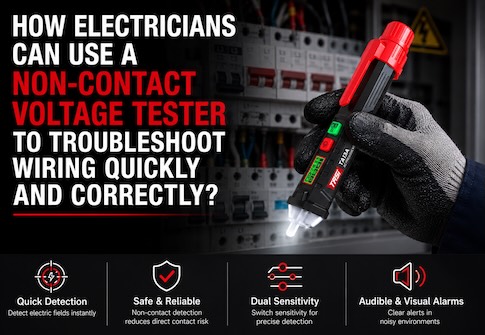
High-sensitivity mode can detect weaker electric fields and is useful for locating concealed wiring, detecting lower-level signals, or performing a wider initial scan. However, it is also more susceptible to electric fields from adjacent energized conductors and induced voltage.
Low-sensitivity mode requires a stronger field to trigger an indication and can help narrow the detection area when several conductors are close together.
A common mistake is to use the highest sensitivity setting for every test and assume that every indication corresponds to a directly energized conductor. A better method is to use higher sensitivity for initial scanning and, where appropriate, switch to lower sensitivity to localize the likely source.
Treating the Alert Location as the Exact Position of the Live Conductor
An NCV tester detects an electric field that extends beyond the physical conductor. An alert does not necessarily mean that the conductor directly beneath the sensing tip is the only source of the detected field.
When several wires run closely together, an energized line conductor can influence adjacent neutral conductors, disconnected wires, or nearby metallic parts through electric-field coupling.
An NCV tester is therefore useful for identifying areas where an AC electric field is present, but it cannot always identify the exact energized conductor in complex wiring arrangements. When conductor status must be confirmed, use additional appropriate electrical test methods.
Ignoring Interference from Nearby Energized Conductors
In electrical panels, junction boxes, cable trays, raceways, and wiring bundles, conductors are often installed close together. The electric field from an energized conductor can capacitively couple to adjacent wiring.
This may result in:
● A strong indication on the energized line conductor.
● A weaker indication on a nearby neutral conductor.
● An indication on a disconnected wire.
● Several conductors appearing energized when high-sensitivity mode is selected.
Do not assume that every conductor producing an NCV indication has the same electrical condition. Where practical, reduce sensitivity, move the sensing tip closer to the individual conductor, and compare the strength and location of the response. Use another suitable test instrument when the actual voltage condition must be established.
Assuming a Stronger Alert Always Means a Higher Voltage
Some NCV testers use changes in buzzer frequency, LED behavior, or display indication to represent relative electric-field strength. This should not be interpreted as a precise voltage measurement.
Alert intensity can also be affected by:
● Distance between the sensing tip and conductor.
● Insulation thickness.
● Conductor arrangement.
● Selected sensitivity.
● Capacitive coupling between the user, tester, and ground.
● Electric fields from other nearby energized conductors.
Two locations producing different alert levels therefore do not necessarily have proportionally different voltages. Use a suitable voltage-measuring instrument when an actual voltage value is required.
Testing Through Metallic Shielding and Assuming the Internal Circuit Is De-Energized
Metal enclosures, conduit, shielding, and some building materials can significantly reduce the external electric field.
For example, an energized conductor inside metallic conduit may produce little or no detectable field outside the conduit.
Therefore, no NCV indication on the outside of a metallic raceway does not prove that the conductors inside are de-energized. The same limitation applies to metal electrical enclosures and shielded cables.
Ignoring Battery Condition or Automatic Power-Off
Most non-contact voltage testers are battery powered. As the batteries become depleted, sensitivity, audible indication, visual indication, or general operating stability may be affected.
Some testers also include an automatic power-off function. If the instrument switches itself off during a period of inactivity, continued testing may produce no indication even when voltage is present.
During use:
● Confirm that the tester is powered on.
● Check or replace batteries if indications become abnormal.
● Follow the manufacturer's battery-storage recommendations during long periods of non-use.
● Do not assume that the tester is operating correctly based only on its appearance.
Ignoring Environmental Conditions
Non-contact voltage detection can be influenced by surrounding electric fields. Complex electrical installations, high-density wiring, and environments with significant electromagnetic interference may produce less predictable indications than simple residential circuits.
Moisture, heavy contamination, physical damage, and operation outside the manufacturer's specified environmental conditions can also affect performance or safety.
Always confirm that the tester's ratings, operating environment, and safety category are appropriate for the intended application.
Using the Tester Outside Its Rated Range or Measurement Category
Different NCV testers have different voltage detection ranges, maximum operating ratings, and measurement categories.
A common mistake is assuming that every non-contact voltage tester can be used in any electrical installation.
Household outlets, distribution boards, and service entrance circuits can be exposed to different transient overvoltage levels. Before use, verify that the instrument's voltage rating and CAT measurement category are suitable for the installation.
The highest voltage printed on the tester should not be the only criterion used to determine whether the instrument is appropriate for the application.
Using an NCV Tester as a Universal Electrical Test Instrument
The main advantages of a non-contact voltage tester are speed, convenience, and the ability to detect an AC electric field without exposing the conductor. It does not replace all other electrical test instruments.
Typical applications include:
● Rapid screening for the presence of an AC electric field.
● Preliminary identification of potentially energized conductors.
● Quick checks of outlets, switches, and cables.
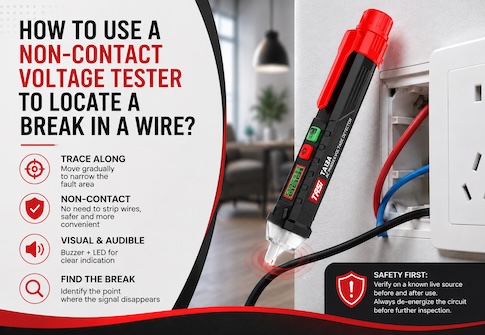
● Supporting certain troubleshooting tasks such as locating possible wiring interruptions.
It is not designed to:
● Measure an exact voltage value.
● Measure current, resistance, or continuity.
● Confirm the absence of voltage under every possible condition.
● Reliably distinguish line, neutral, and induced voltage in every complex installation.
Understanding these limitations is essential for correct use.
FAQ
Can I assume a circuit is de-energized if the NCV tester does not alert?
No. A lack of indication only means that the tester did not detect a sufficiently strong AC electric field under the current conditions. Distance, insulation, shielding, sensitivity, battery condition, and circuit configuration can all affect the result. Use an appropriate verification method before electrical work.
Why does the tester still alert after the circuit has been switched off?
Nearby energized conductors can capacitively couple voltage or an electric field onto adjacent wiring. A sensitive NCV tester may still respond, especially where wires run closely together.
Does the tester need to touch the wire?
Normally, no contact with exposed conductive material is required. However, excessive distance from the conductor can reduce sensitivity.
Why does the same wire produce different indication levels at different positions?
Conductor position, insulation thickness, probe distance, nearby wiring, and electric-field distribution can all influence the response.
Can an NCV tester measure the actual voltage?
Normally not. It is intended to detect the presence of an AC electric field. Alert strength should not be treated as an accurate voltage value.
Should I check the tester before every use?
Yes. Checking it on a known energized source before testing helps identify weak batteries, an incorrect power state, or other faults. Rechecking after the test provides additional confirmation that the tester remained operational.
Conclusion
A non-contact voltage tester is easy to use, but reliable results depend on correct technique. Common mistakes include failing to verify the tester, using an unsuitable test position or distance, relying on a single scan, ignoring sensitivity settings, mistaking induced electric fields for directly energized conductors, and treating a no-alert result as proof of absence of voltage.
For better results, verify the tester before use, select an appropriate sensitivity level, test from multiple positions, and interpret indications in the context of the wiring arrangement. Most importantly, treat an NCV tester as a rapid AC electric-field screening tool rather than the final means of verifying every electrical condition. For servicing, disassembly, or direct contact with conductors, use an appropriate voltage verification procedure for the work being performed.