Introduction
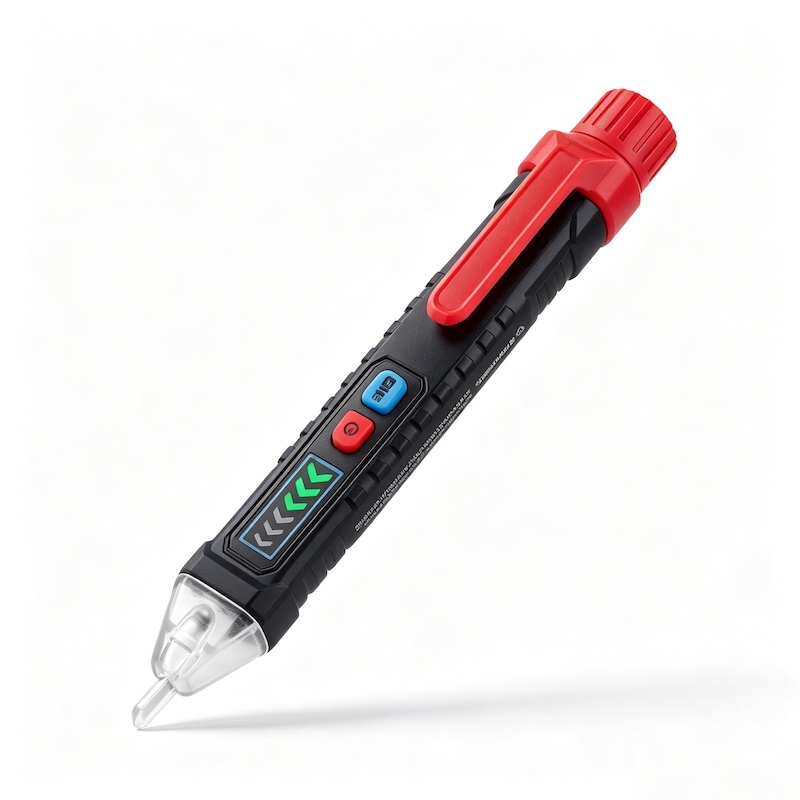
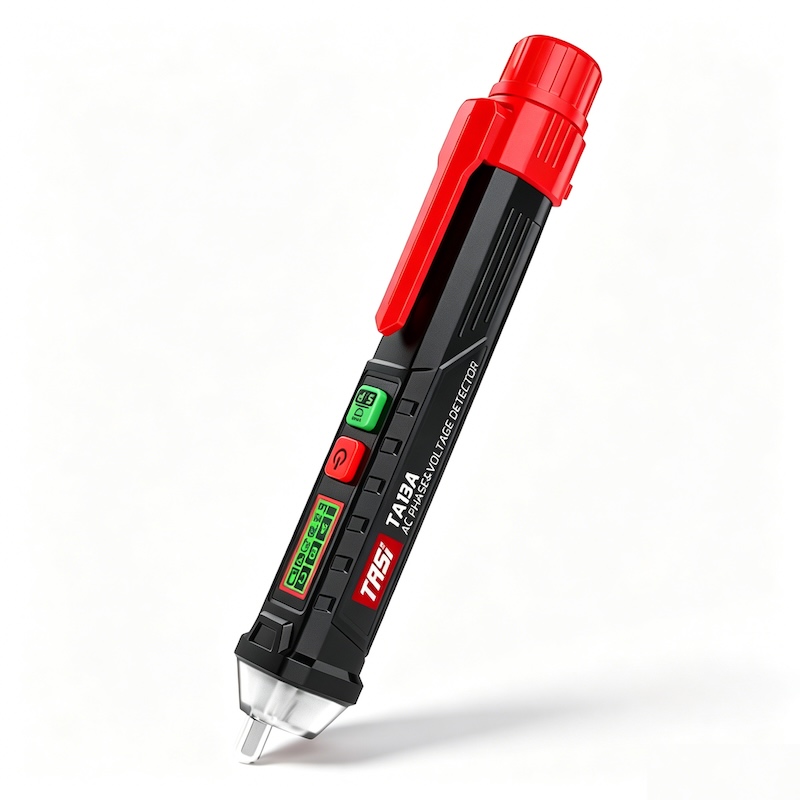
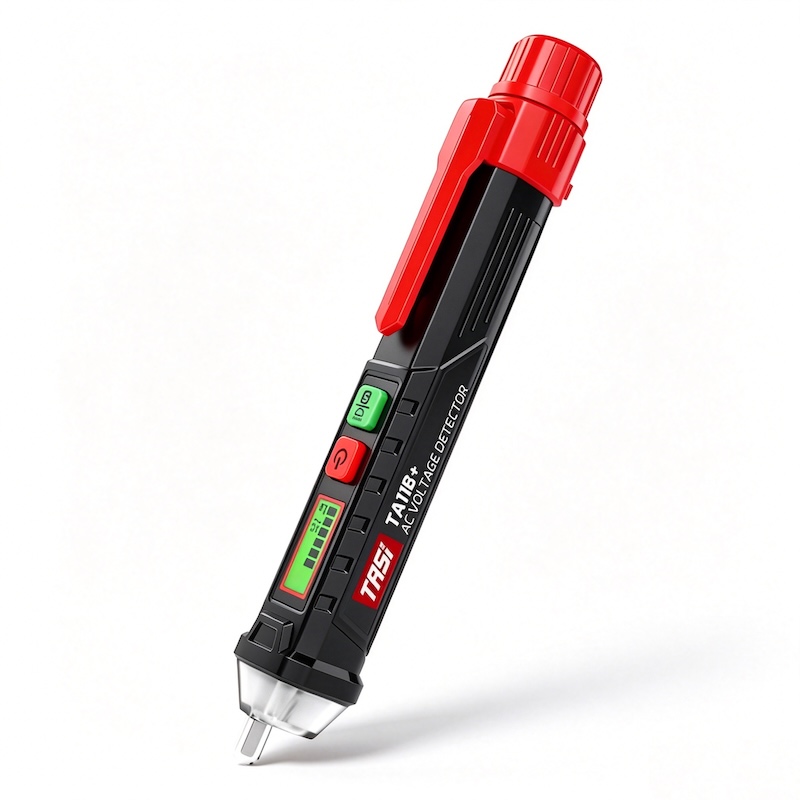
A non-contact voltage tester (NCV tester) allows users to identify the possible presence of voltage without directly touching an exposed conductor.
This leads to a common question: if the tester can detect voltage through insulation, can it also detect batteries, DC power supplies, photovoltaic systems, or other DC circuits?
For most conventional handheld NCV testers, the answer is: they are primarily designed for AC voltage and generally cannot reliably detect stable DC voltage.
This is not because DC circuits do not create an electric field. The main reason is that conventional NCV testers are designed to sense the time-varying electric field associated with alternating voltage.
Key Takeaways
● Most conventional non-contact voltage testers are designed for AC voltage rather than DC voltage.
● NCV testers normally detect the alternating electric field produced by AC voltage.
● A stable DC voltage creates an electrostatic field, but without continuous field variation, a standard NCV circuit usually cannot detect it reliably.
● A tester may occasionally respond near a DC circuit, but this should not be treated as confirmation that the circuit is energized.
● A digital multimeter or another instrument designed for DC measurement should be used to measure DC voltage.
● Specialized non-contact DC voltage or electrostatic-field detection technologies do exist, but they should not be confused with conventional AC NCV testers.
What Type of Voltage Does a Non-Contact Voltage Tester Normally Detect?
Most non-contact voltage testers are designed primarily for AC voltage in building electrical systems, power distribution, maintenance, and general electrical troubleshooting.
Typical applications include:
● Checking whether an AC receptacle is energized;
● Identifying the live conductor in wiring;
● Checking for AC voltage around switches and terminals;
● Performing preliminary checks for breaks in energized wiring;
● Screening for the presence of voltage before servicing electrical equipment.
Detection ranges vary by model. Typical examples include 12–1000 V AC, 50–1000 V AC, or similar ranges.
If the specification states “AC Voltage Detection” or gives the detection range in “VAC,” the NCV function is intended for alternating voltage. It should not be assumed that the same numerical range also applies to DC voltage.
Why Can an NCV Tester Detect AC Voltage Easily?
A non-contact voltage tester does not directly measure the numerical voltage of a conductor. Instead, it senses changes in the electric field around an energized conductor.
With a typical 50 Hz or 60 Hz AC supply:
● The voltage magnitude changes continuously;
● The surrounding electric field changes accordingly;
● The polarity and field direction vary periodically.
This changing electric field can couple capacitively to the sensing electrode at the tip of the tester and its surrounding environment.
The high-impedance detection circuit inside the tester amplifies, filters, and evaluates the resulting weak signal. Once the signal exceeds the detection threshold, the tester may activate an LED, buzzer, vibration alert, or display indication.
For this reason, conventional NCV testers are especially effective at detecting time-varying electric fields.
Why Can’t a Standard NCV Tester Reliably Detect DC Voltage?
DC voltage also produces an electric field around a conductor. However, once the DC voltage becomes stable, the corresponding electric field also becomes essentially static.
For example, if a conductor remains at a constant potential of 100 V DC, an electrostatic field can exist around it, but that field does not continue to alternate like a 50 Hz or 60 Hz AC field.
For a conventional NCV tester that relies on capacitive coupling and AC signal detection:
● An AC electric field continuously generates a changing detectable signal;
● A stable DC electric field does not continuously generate the same type of AC-coupled signal;
● The tester's circuitry may therefore fail to recognize the static field as an energized condition.
As a result, a DC conductor may be energized even when a standard NCV tester gives no indication.
No NCV indication does not mean that a DC circuit is de-energized.
This is one of the most important limitations to understand when working around DC systems.
Why Might an NCV Tester Sometimes Respond Near a DC Power Source?
Users may occasionally observe an NCV tester flashing or beeping near certain DC equipment. This does not necessarily mean that the tester can reliably detect DC voltage.
Possible reasons include:
● The DC voltage has just changed. Switching a DC supply on or off, or rapidly changing its voltage, produces a temporary change in the electric field that may generate a transient signal.
● AC or high-frequency components are present. Switching power supplies, inverters, and DC-DC converters operate with rapidly changing internal signals that may be detected by an NCV tester.
● Ripple or electrical interference is present. A practical DC supply may contain AC ripple, switching noise, or electromagnetic interference.
● Nearby AC wiring is being detected. If AC and DC conductors are routed close together, the tester may be responding to the nearby AC electric field rather than the target DC conductor.
For these reasons, an occasional NCV response near a DC system should not be used as reliable proof that the DC circuit is energized or de-energized.
Can a Battery Be Tested with a Non-Contact Voltage Tester?
Standard batteries, rechargeable cells, and low-voltage DC power sources generally cannot be tested reliably with a conventional NCV tester.
Examples include:
● 1.5 V dry-cell batteries;
● 3.7 V lithium-ion cells;
● 5 V USB power supplies;
● 12 V automotive batteries;
● 24 V DC control supplies.
These sources generally provide relatively stable DC voltage, and many are also below the effective detection threshold of typical NCV testers.
A digital multimeter set to the DC voltage function is a more appropriate instrument. The test leads are connected directly across the positive and negative terminals to measure the actual voltage.
Can an NCV Tester Be Used on Solar PV Systems?
A conventional AC NCV tester should not be relied upon to determine whether a photovoltaic DC circuit is energized.
Solar modules generate DC voltage, and series-connected modules can produce substantial DC voltages. Even if a conventional NCV tester does not indicate voltage, the PV circuit may still be energized.
Important considerations include:
● PV modules may continue generating DC voltage whenever sufficient light is present;
● Switching off the AC-side disconnect does not necessarily remove voltage from the DC side;
● A standard AC NCV result should not be used to verify that a PV DC circuit is de-energized.
PV systems should be tested using instruments with voltage ratings, measurement categories, and safety ratings appropriate for the specific system, together with the required safe working procedures.
Can a Standard NCV Tester Be Used on Electric Vehicles and High-Voltage DC Systems?
A conventional NCV tester should not be used as the primary voltage-verification instrument for EV traction batteries, high-voltage DC buses, or other high-voltage DC systems.
Electric-vehicle battery systems may operate at several hundred volts DC. However, a higher voltage does not automatically mean that a conventional AC NCV tester can detect it.
The underlying limitation is still the detection principle: conventional NCV testers are designed primarily to sense alternating electric fields, whereas traction batteries supply mainly DC voltage.
High-voltage DC systems should be tested with equipment specifically suitable for the voltage level and application and in accordance with the manufacturer's procedures and applicable electrical safety requirements.
Are There Devices That Can Detect DC Voltage Without Contact?
Yes. However, these instruments do not necessarily use the same detection principle as conventional AC NCV testers.
Specialized non-contact DC voltage or electrostatic-field detectors can use technologies such as electrostatic field sensing, field-gradient detection, vibrating electrodes, or field mills to detect static or quasi-static electric fields.
Typical applications may include:
● High-voltage DC transmission systems;
● Electrostatic measurements;
● Specialized industrial electrical systems;
● High-voltage DC maintenance;
● Laboratory electric-field measurements.
A more accurate statement is therefore:
A conventional handheld NCV tester generally cannot reliably detect stable DC voltage, but specialized instruments designed for non-contact DC electric-field or voltage detection can perform this type of measurement.
Always check the manufacturer's specifications to determine whether a specific tester supports DC detection.
Which Instrument Should Be Used to Measure DC Voltage?
To determine whether voltage is present in a DC circuit, use an instrument specifically designed for DC voltage measurement.
Common options include:
● Digital multimeter: Suitable for batteries, DC power supplies, electronic equipment, and control circuits.
● DC voltmeter: Suitable for continuous monitoring or dedicated DC voltage measurement.
● Specialized high-voltage test equipment: Used for PV systems, high-voltage DC installations, EV systems, and other demanding applications.
● Specialized non-contact DC detector: Used in certain high-voltage, electrostatic-field, or inaccessible-conductor applications.
Instrument selection should consider not only the voltage range but also the required safety rating, measurement category, and intended operating environment.
Common Misconceptions About Non-Contact Voltage Testers
“If voltage is present, an NCV tester should always indicate it.”
Not necessarily. Detection depends on voltage type, voltage magnitude, tester sensitivity, distance, insulation thickness, grounding conditions, and the surrounding electric-field environment.
“If the DC voltage is high enough, a standard NCV tester will definitely detect it.”
Not necessarily. Conventional NCV testing depends primarily on a changing electric field rather than voltage magnitude alone.
“If the tester does not beep, the circuit is safe.”
This is a dangerous assumption. An NCV tester is a screening tool and should not be the sole basis for declaring an unknown circuit de-energized, especially in DC systems.
“An NCV tester can replace a multimeter.”
No. An NCV tester is generally used to screen for the possible presence of AC voltage. A digital multimeter can provide an actual voltage measurement. The two instruments serve different purposes.
How Can You Tell Whether a Voltage Tester Supports DC Detection?
The most reliable approach is to check the manufacturer's technical specifications rather than judging from the appearance or the term “non-contact.”
Look for:
● Whether the voltage range is specified as AC or DC;
● Whether the product states “AC Voltage Detection”;
● Whether “DC Voltage Detection” or DC electric-field detection is explicitly specified;
● Whether the sensing method is NCV, electrostatic-field detection, or another dedicated technology;
● Which voltage types and applications are listed in the operating instructions.
If a product is specified as “NCV: 50–1000 V AC,” it should be interpreted as 50–1000 V AC non-contact voltage detection, not as 50–1000 V DC detection.
FAQ
Can a non-contact voltage tester detect 12 V DC?
A conventional NCV tester generally cannot reliably detect 12 V DC. A digital multimeter set to DC voltage is more suitable for automotive batteries and 12 V power systems.
Why can an NCV tester detect 230 V AC but not the same DC voltage?
The main difference is not simply the voltage magnitude. AC produces a continuously changing electric field, whereas stable DC mainly produces a static electric field. Conventional NCV circuits are designed primarily for the former.
Is it normal for an NCV tester to occasionally respond to a DC supply?
Yes. This may occur during switching, because of ripple, high-frequency switching signals, or interference from nearby AC wiring. Such a response does not confirm reliable DC detection capability.
Can I use an NCV tester to test a car battery?
It is not recommended. A typical automotive battery provides approximately 12 V DC and should be tested with a digital multimeter or another appropriate DC measuring instrument.
Can a standard NCV tester detect DC voltage in a solar PV system?
It should not be relied upon for this purpose. PV systems can contain significant DC voltage and should be tested with instruments designed and rated for the specific DC system.
Are there non-contact testers that support both AC and DC detection?
Specialized products using different sensing technologies are available. DC capability must be explicitly stated by the manufacturer and should never be assumed simply because the instrument has an NCV function.
Conclusion
Conventional non-contact voltage testers mainly identify voltage by sensing the alternating electric field generated by AC voltage. They are therefore particularly useful for quick screening of receptacles, wiring, distribution equipment, and other AC electrical systems.
Stable DC voltage also creates an electric field, but it does not normally vary continuously. As a result, a conventional AC NCV tester cannot reliably detect a DC circuit in the same way.
In practical use:
● Conventional NCV testers are primarily intended for AC and should not automatically be assumed to support DC;
● An occasional indication near a DC circuit does not prove reliable DC detection;
● No NCV indication does not prove that a DC circuit is de-energized;
● Batteries, DC power supplies, PV systems, and other DC circuits should be tested with instruments designed for DC voltage measurement;
● DC detection capability should always be verified from the specific product specifications and operating instructions.
Understanding the detection principle and limitations of an NCV tester helps prevent incorrect conclusions and ensures that the appropriate test instrument is selected for both AC and DC electrical work.