Introduction
Traditional contact-type voltage testing normally requires a probe or electrode to make direct electrical contact with a conductor or test point. A non-contact voltage tester (NCVT or NCV tester) can perform an initial check for AC voltage around wires, outlets, switches, and other electrical components without touching exposed conductive parts.
It does not measure voltage “through” the insulation in the same way as a voltmeter. Instead, an energized AC conductor produces a time-varying electric field around it. The sensing electrode inside the tester detects this field, and the internal electronics process the resulting signal before activating an LED, buzzer, or other indication.
A non-contact voltage tester should therefore be understood primarily as an AC electric-field detection tool, not as an instrument for accurately measuring voltage magnitude.
Key Takeaways
● A non-contact voltage tester primarily detects the alternating electric field surrounding an energized AC conductor.
● The sensing tip does not need to touch exposed metal, allowing initial voltage checks through certain types of insulation.
● Very small induced signals are processed through high-impedance input circuitry, amplification, filtering, and threshold detection.
● When the detected signal exceeds the designed threshold, the tester activates an audible, visual, or combined indication.
● An NCV tester detects whether an electric field meets its detection criteria; it does not directly measure the actual voltage value.
● Detection can be affected by distance, insulation, shielding, grounding, nearby energized conductors, and capacitive coupling between the user and the environment.
● A non-contact voltage tester is useful for rapid screening, but it should not be the sole instrument used to establish a confirmed absence of voltage for safety-critical electrical work.
What Is a Non-Contact Voltage Tester?
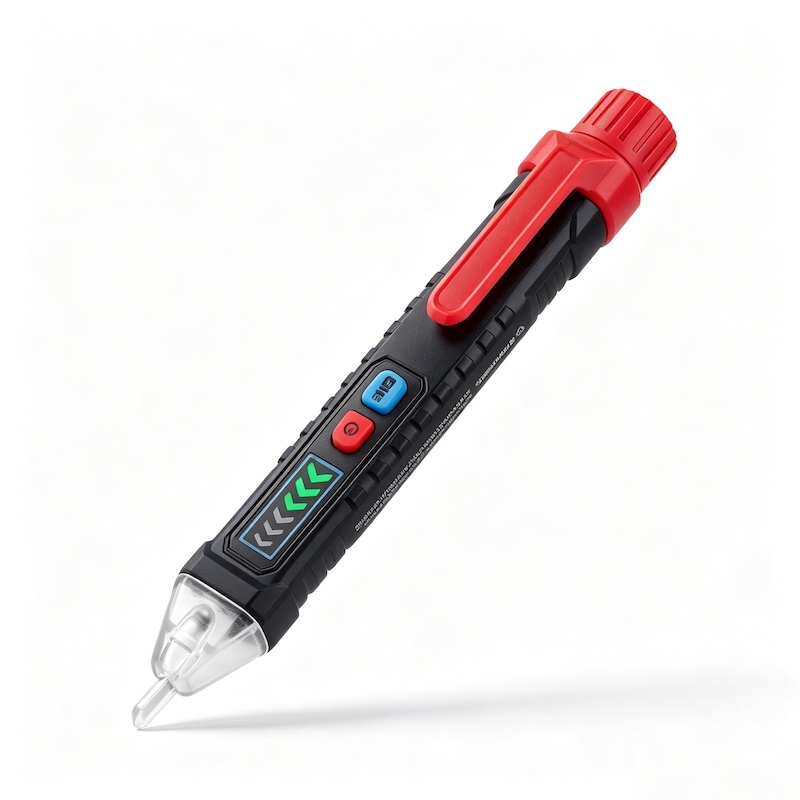
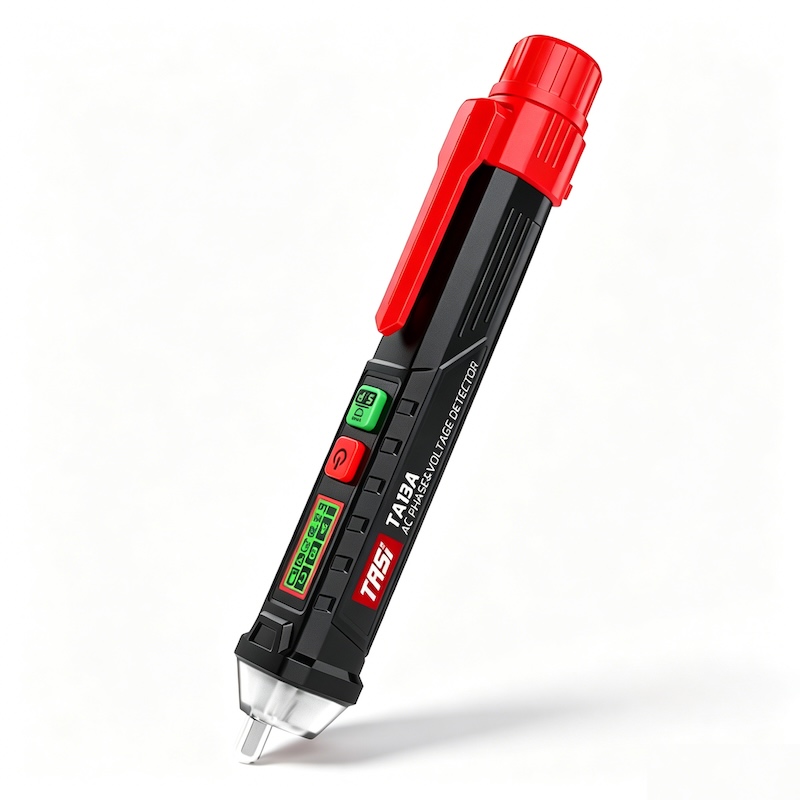
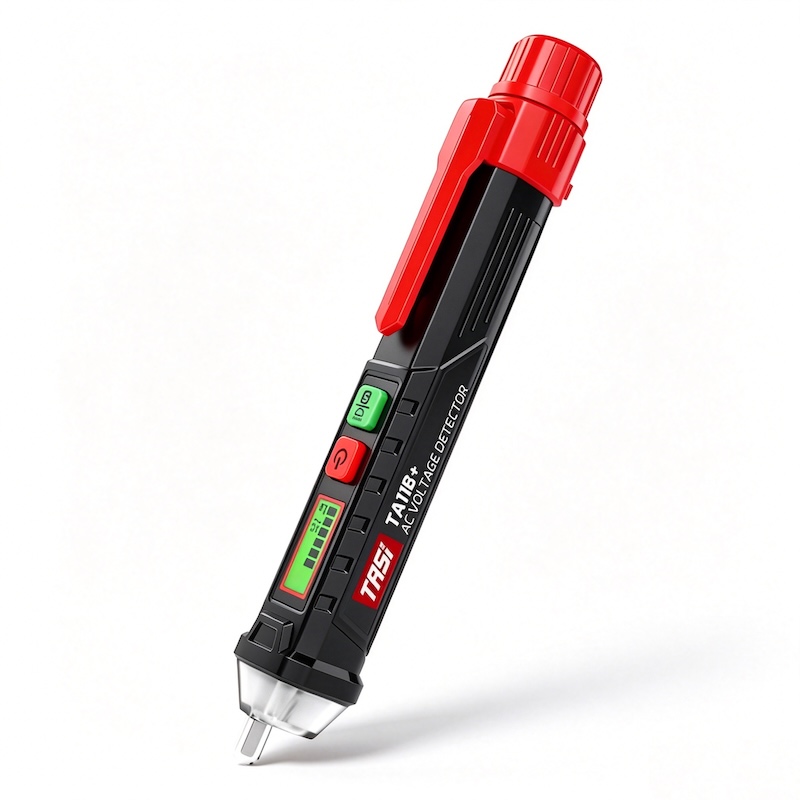
A non-contact voltage tester is a portable instrument used to determine whether AC voltage may be present near wires, cables, outlets, switches, and other electrical components.
Unlike a digital multimeter or a two-pole voltage tester, which normally requires direct electrical connection to the test points, an NCV tester generally only needs to be brought close to the area being checked.
When the sensing tip approaches an energized AC phase conductor, the alternating electric field surrounding the conductor capacitively couples to the sensing electrode inside the tester. If the resulting signal reaches the instrument's detection threshold, the tester produces an audible or visual warning.
“Non-contact” therefore means that the sensing electrode does not need to make direct conductive contact with the exposed live conductor. It does not mean that detection is independent of distance, insulation, or environmental conditions.
What Is the Core Operating Principle of a Non-Contact Voltage Tester?
The operating principle is based primarily on the alternating electric field produced by AC voltage and capacitive coupling.
When an AC voltage is applied to a conductor, the conductor's electrical potential changes periodically relative to its surroundings. This produces a time-varying electric field.
As the sensing tip of the tester approaches the conductor, a very small capacitive coupling is established between the energized conductor and the sensing electrode. This coupling does not require a metallic connection. It occurs through the surrounding space, air, and insulation around the wire.
At the same time, the tester, the user, and the surrounding environment may also form a small capacitive path relative to ground. The resulting very small alternating signal can then be detected by the high-impedance electronic circuitry inside the tester.
In simplified terms:
● The energized AC conductor generates an alternating electric field.
● The sensing tip enters this electric field.
● Capacitive coupling develops between the conductor and sensing electrode.
● The tester detects the resulting weak AC signal.
● When the signal reaches the internal threshold, the tester activates an alarm.
Because this process does not normally require direct electrical contact with the exposed conductor, non-contact detection becomes possible.
How Does the Internal Detection Process Work?
Circuit designs vary between manufacturers and models, but a typical NCV tester can be understood as performing several consecutive functions.
● The sensing electrode receives the electric-field signal
The tip contains or is connected to a sensing electrode. When it approaches an energized AC conductor, capacitive coupling produces a very small alternating signal at this electrode.
● A high-impedance circuit receives the weak signal
Because the coupled signal is very small, the front-end circuit typically has a high input impedance. This helps reduce loading of the sensed signal and improves sensitivity.
● The signal is amplified and processed
The weak input signal may then pass through amplification, filtering, or other signal-conditioning stages. These stages help distinguish the useful AC-field signal from unwanted interference.
● The tester performs threshold detection
The processed signal is compared with an internally defined detection threshold. If the signal reaches the required level, the tester determines that an AC electric field consistent with a potentially energized conductor is present nearby.
Different models have different voltage ranges and sensitivity levels, so the distance at which two testers begin to indicate may not be identical.
● Audible and visual indications are activated
After detection, the instrument normally activates an LED, buzzer, or both. Some models use multiple indication levels, different LED colors, or changes in beeping frequency to represent relative field strength.
These indications are useful for locating or comparing field strength, but they should not be interpreted as accurate voltage measurements.
Why Can It Detect Voltage Without Touching the Conductor?
The key reason is that an electric field exists outside an energized conductor and can extend through air and certain insulating materials.
For example, although the copper conductor inside an insulated wire is covered by plastic insulation, an AC electric field can still exist outside that insulation.
When an NCV tester is brought close enough to the cable, its sensing electrode may detect this alternating field without requiring the insulation to be removed.
This allows the user to perform an initial check without exposing the conductor.
However, detection is affected by insulation thickness, dielectric properties, cable construction, and the distance between the sensing tip and the conductor. Shielded cables or conductors enclosed in grounded metal can significantly reduce the external electric field and may prevent reliable non-contact detection.
Why Do Non-Contact Voltage Testers Mainly Detect AC Voltage?
Most conventional NCV testers are designed to detect the time-varying electric field associated with AC voltage.
Because AC voltage changes magnitude and polarity over time, the corresponding electric field also changes continuously. Through capacitive coupling, this variation produces an alternating signal that can be detected electronically.
A stable DC voltage produces a substantially static electric field after steady-state conditions are reached. It therefore does not provide the same continuously changing signal used by conventional NCV detection circuits.
For this reason, a standard non-contact voltage tester should not automatically be assumed to detect DC voltage. The specified voltage type and detection range of the particular tester must always be checked.
Why Can the User's Body Affect Detection?
The user and surrounding environment can form part of the capacitive coupling path used during non-contact voltage detection.
The human body has a small parasitic capacitance relative to ground and surrounding objects. When a person holds the tester normally, this coupling can provide an environmental reference that helps the detector respond to the AC electric field.
If the user is strongly insulated from ground—for example by standing on highly insulating surfaces or using certain protective equipment—the capacitive relationship may change. This can influence the sensitivity of some NCV testers.
This is one reason why the same tester may begin indicating at slightly different distances under different environmental conditions or handling methods.
Why Is the Tester More Likely to Indicate as It Gets Closer to a Live Conductor?
In general, the closer the sensing electrode is to an energized conductor, the stronger the coupled electric-field signal becomes. The signal is therefore more likely to exceed the tester's detection threshold.
As the distance increases, the coupled signal normally becomes weaker. Once it falls below the detection threshold, the indication may stop.
However, alarm distance cannot be used to calculate actual conductor voltage.
For example, a higher-voltage cable with thick insulation or effective shielding may produce a weaker externally detectable field than a lower-voltage conductor that is less shielded.
Detection distance is influenced by:
● AC voltage level;
● distance between the conductor and sensing tip;
● insulation material and thickness;
● conductor size and arrangement;
● shielding;
● nearby grounded objects;
● adjacent energized conductors;
● tester sensitivity;
● capacitive coupling between the user and environment.
For this reason, indication distance or signal strength should only be used as a supplementary observation.
Why Do Some NCV Testers Have High- and Low-Sensitivity Modes?
Some non-contact voltage testers offer multiple sensitivity settings or detection ranges so that they can be used in different electrical environments.
A higher-sensitivity mode may be useful for detecting lower AC voltages or weaker electric fields, while a standard or lower-sensitivity mode may be more appropriate for common mains-voltage applications.
Higher sensitivity, however, is not always better.
A highly sensitive setting may respond more readily to neighboring energized conductors, induced fields, or stray electric fields. This can make it more difficult to identify the intended conductor in densely wired installations.
The appropriate sensitivity mode should therefore be selected according to the circuit, environment, and manufacturer's operating instructions.
Why Can a Non-Contact Voltage Tester Give a False Indication?
Because the tester responds to an AC electric field rather than making a direct electrical connection to the conductor, fields from other sources can sometimes influence the result.
Common causes include:
● electric-field coupling from adjacent energized conductors;
● closely spaced parallel wiring;
● induced or capacitively coupled voltage on nearby conductors;
● highly sensitive detection settings;
● multiple energized components inside distribution panels or equipment;
● electrically noisy environments.
An alarm should therefore be interpreted as meaning that the tester has detected an AC electric field exceeding its internal threshold at that location.
It does not, by itself, prove that the specific conductor being checked is energized at a particular voltage.
When necessary, the condition should be verified using an appropriate contact-type voltage tester or measuring instrument.
Why Might the Tester Fail to Indicate Even When Voltage Is Present?
Non-contact detection can also produce false-negative results. No indication does not automatically mean that the circuit is completely de-energized.
Possible causes include:
● the voltage is below the tester's specified detection range;
● the sensing tip is too far from the conductor;
● the insulation is unusually thick;
● the cable is shielded;
● the conductor is enclosed in grounded metal conduit or a metal enclosure;
● nearby grounded metal reduces the detectable field;
● capacitive coupling between the user and ground is weak;
● the battery is depleted;
● the tester has not powered up correctly or is malfunctioning.
For electrical maintenance or any situation involving personal safety, a lack of NCV indication should therefore not be treated as sufficient proof of absence of voltage.
Can a Non-Contact Voltage Tester Tell You the Exact Voltage?
Generally, no.
A conventional NCV tester is designed primarily to identify the presence of an AC electric field that meets its detection criteria. It is a screening instrument rather than a precision voltage-measuring instrument.
Even if a tester uses multiple LED colors, different buzzer frequencies, or several indication levels to show relative field strength, those indications do not normally correspond directly to exact values such as 120 V, 230 V, or 400 V.
If the actual circuit voltage is required, an appropriate digital multimeter, voltage tester, or other suitable measuring instrument should be used.
What Is a Non-Contact Voltage Tester Used For?
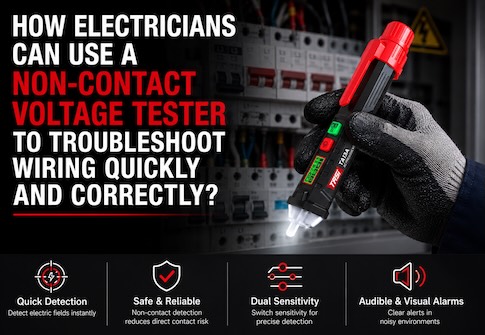
Because it is quick to use and does not normally require contact with exposed conductors, an NCV tester is useful for initial electrical checks and troubleshooting.
Typical applications include:
● checking whether AC voltage may be present near a wire;
● identifying the live side of an outlet;
● checking for potentially energized wiring around switches;
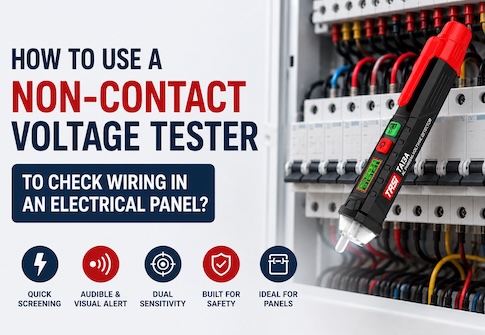
● performing initial checks on wiring and breakers in distribution panels;
● screening power cords, extension leads, and electrical equipment for AC supply;
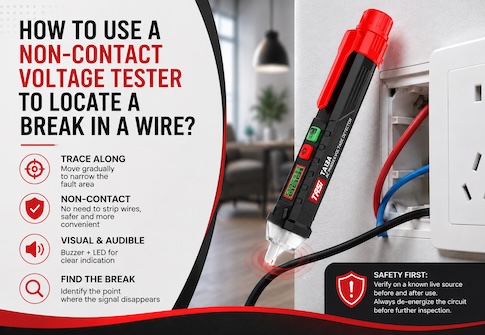
● assisting with the location of certain breaks in AC wiring;
● performing an initial energized-state check before maintenance.
In dense wiring systems, installations with multiple parallel conductors, or shielded structures, results should be interpreted together with knowledge of the circuit arrangement.
How Should a Non-Contact Voltage Tester Be Used Correctly?
Proper operating practices help reduce the risk of incorrect conclusions.
● Inspect the tester housing, sensing tip, and battery condition before use.
● Power on the tester and perform any required self-check according to the manufacturer's instructions.
● Before testing an unknown circuit, verify the tester on a known energized AC source whenever appropriate.
● Move the sensing tip gradually toward the wire, outlet, or test location.
● Observe the LED, buzzer, or other indication.
● Do not use indication distance as a measurement of actual voltage.
● After the test, where required by the procedure, verify the tester again on a known live source.
● If actual voltage or confirmed absence of voltage must be established, use an appropriate contact-type voltage test instrument and follow the applicable electrical safety procedure.
For maintenance work or other safety-critical tasks, a single “no indication” result from an NCV tester should never be the only basis for determining that a circuit is safe to touch.
What Is the Difference Between Non-Contact and Contact Voltage Testing?
The main difference lies in the detection method and intended purpose.
A non-contact voltage tester senses an alternating electric field and can perform a rapid initial check without contacting exposed metal. It is particularly useful for screening and locating potentially energized AC wiring.
A contact-type voltage tester establishes a direct electrical connection to the test points. Depending on the instrument, it can provide a much more definitive voltage check and may also provide an actual voltage value.
The two methods therefore serve different purposes.
A non-contact voltage tester is best suited to answering:
● “Could an energized AC conductor be present here?”
A contact-type voltage instrument is better suited to answering:
● “What is the actual voltage between these test points?”
● “Has this circuit been properly verified as de-energized?”
Understanding this distinction is essential for using an NCV tester correctly.
Main Factors That Affect NCV Detection
The result of a non-contact voltage test is influenced by more than the nominal circuit voltage.
● Detection distance: Greater distance normally produces a weaker coupled signal.
● Insulation thickness: Thick insulation can reduce the externally detectable electric field.
● Shielding: Shielded cable can significantly attenuate the field.
● Metal enclosures: Grounded conduit, cabinets, and other metal structures can shield the field.
● Voltage level: Voltage below the specified detection range may not trigger the tester.
● Adjacent conductors: Nearby energized wiring can cause unwanted indications.
● User and environment: Different capacitive coupling to ground can affect sensitivity.
● Tester sensitivity: Detection thresholds and ranges differ between models.
● Battery condition: A weak battery may affect correct operation.
For reliable interpretation, the test environment, circuit construction, and manufacturer's specified detection range should always be considered together.
FAQ
Why can a non-contact voltage tester detect voltage without touching the copper conductor?
Because an energized AC conductor produces an alternating electric field. The sensing electrode detects this field through capacitive coupling, so direct electrical contact with exposed copper is not always necessary.
Can an NCV tester detect voltage through wire insulation?
In many cases, yes. Detection performance depends on insulation material and thickness, voltage level, distance, and tester sensitivity.
Can a non-contact voltage tester detect DC voltage?
A conventional NCV tester is primarily designed for AC electric-field detection and generally should not be relied on for stable DC voltage. Always check the specified detection type and range.
Does an NCV alarm mean the conductor is definitely at 220 V or 230 V?
No. An alarm indicates that the tester has detected an AC electric field above its detection threshold. It does not determine the exact voltage.
Why can two wires both trigger the tester?
Electric-field coupling from a nearby live conductor, parallel wiring, induced voltage, or a high-sensitivity setting can cause another conductor to trigger an indication.
Why might a live wire not trigger the tester?
Possible reasons include excessive distance, thick insulation, shielding, grounded metal, voltage below the detection range, weak user-to-ground coupling, low battery condition, or tester malfunction.
Can I assume a circuit is de-energized if the tester does not indicate?
No. Non-contact voltage testers can produce false-negative results. Safety-critical verification of absence of voltage should use the appropriate contact-type test method and applicable electrical safety procedure.
Can an NCV tester replace a digital multimeter?
No. An NCV tester is mainly used to detect the possible presence of an AC electric field, whereas a digital multimeter can measure actual voltage and other electrical quantities.
Summary
A non-contact voltage tester works by detecting the alternating electric field and capacitive coupling associated with an energized AC conductor, rather than by directly contacting the conductor to measure voltage.
When the sensing tip approaches an energized conductor, a very small alternating signal is coupled to the internal sensing electrode. High-impedance circuitry then amplifies, filters, and evaluates the signal. If it exceeds the detection threshold, the tester activates an LED, buzzer, or other warning.
This method makes NCV testers quick and convenient for initial checks on wires, outlets, switches, and electrical equipment.
However, an NCV tester detects an electric field rather than the exact circuit voltage. Insulation, shielding, metal enclosures, detection distance, adjacent conductors, environmental coupling, and battery condition can all affect the result.
The correct role of a non-contact voltage tester is therefore as a rapid AC-voltage screening tool. Where an exact voltage value or reliable verification of de-energization is required, an appropriate contact-type voltage test instrument and the relevant electrical safety procedure should be used.