Introduction
When a wire becomes open-circuit, the fault may be hidden beneath insulation, inside cable trunking, junction boxes, or even within a wall. Visual inspection alone is therefore often insufficient.
Because a non-contact voltage tester can detect the electric field around an AC conductor without touching exposed metal, it can sometimes be used to trace a wire and identify the approximate area where a break has occurred.
A non-contact voltage tester can help locate certain wire breaks, but it normally cannot determine the exact fault position on its own.
Its effectiveness depends on whether the circuit is energized, which conductor is broken, the cable construction, the surrounding electrical environment, and the sensitivity of the tester.
Key Points
● A non-contact voltage tester detects the electric field surrounding an energized AC conductor.
● On an accessible live AC conductor, the tester can be moved along the cable to look for a significant change in the detected signal.
● A transition from consistent indication to no indication may suggest a nearby break, but it does not prove the exact location.
● Capacitive coupling from nearby energized conductors may cause the tester to continue indicating voltage beyond the actual break.
● Shielded cables, metal conduit, thick insulation, and multicore cables can make fault tracing more difficult.
● An NCV tester is best used for preliminary troubleshooting; confirmation may require a multimeter, continuity test, or dedicated cable fault locator.
● No indication from a non-contact voltage tester must not be used as the sole proof that a circuit is de-energized and safe to touch.
Why Can a Non-Contact Voltage Tester Help Locate a Wire Break?
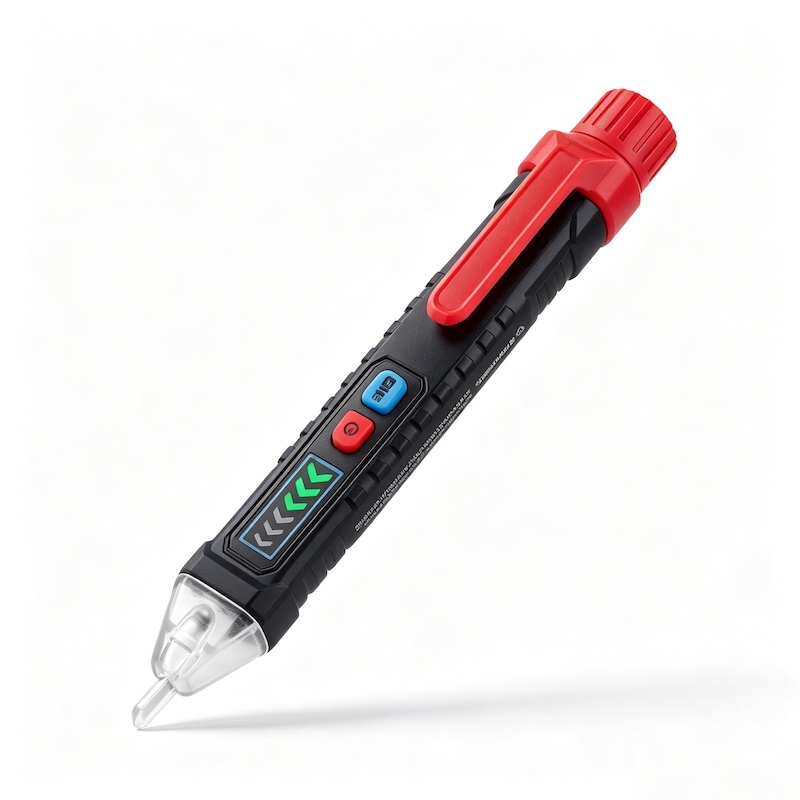
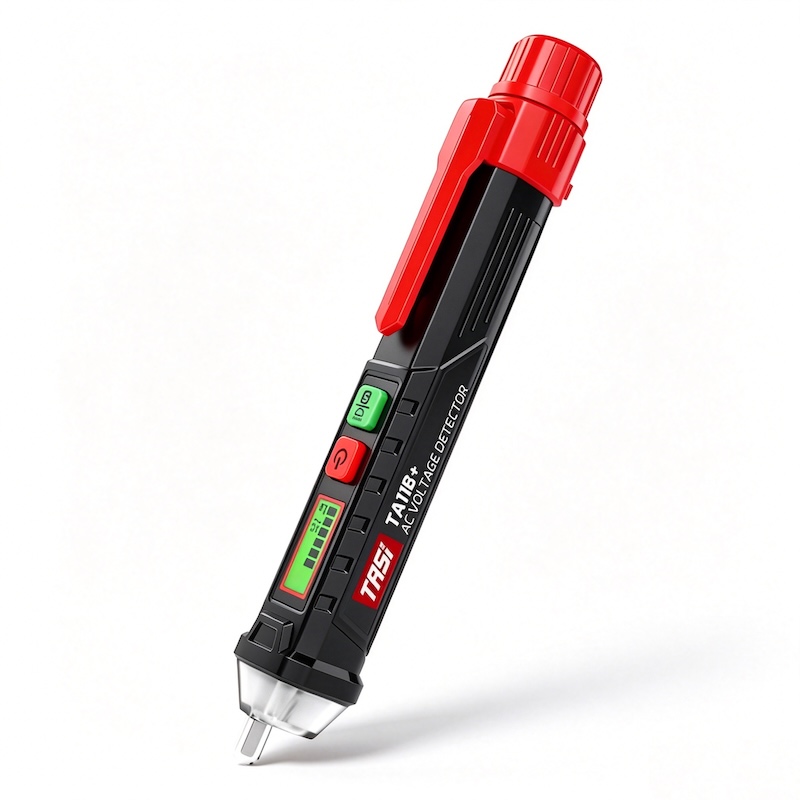
A non-contact voltage tester contains a sensing electrode designed to detect the alternating electric field produced around an energized AC conductor. When the probe is brought close to a live conductor, the tester may provide an audible, visual, or combined alarm without making electrical contact with the conductor.
Consider an AC line conductor that runs from the supply to a load and has developed a complete open circuit.
● Between the supply and the break, the conductor is normally still energized, so the tester can detect its electric field.
● Beyond the break, the conductor is no longer directly connected to the supply, so the field may become significantly weaker or disappear.
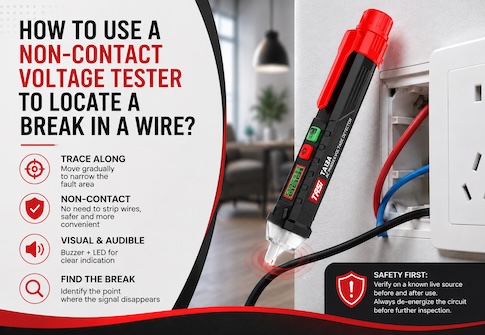
● By moving the tester gradually along the cable, the user may identify an area where the indication changes noticeably.
The tester is therefore not detecting the physical break itself. It is detecting a change in the AC electric field around the conductor.
How Can a Non-Contact Voltage Tester Be Used to Trace a Wire Break?
Where conditions are suitable, a sectional comparison method can be used for preliminary troubleshooting.
● First verify that the tester is operating correctly by checking it on a known live AC source.
● Begin near the supply end of the conductor.
● Keep the probe at a reasonably consistent distance from the cable while moving it slowly along the route.
● Observe whether the audible or visual indication remains stable.
● If a strong, consistent indication suddenly becomes significantly weaker or disappears, inspect that section more closely.
● Repeat the test on both sides of the suspected location and gradually narrow the search area.
● Once a suspected fault area has been identified, confirm it using an appropriate electrical test method.
The distance and orientation between the probe and cable should remain as consistent as possible. A change in probe position alone can alter the indication.
Why Is the Point Where the Alarm Stops Not Necessarily the Actual Break?
A non-contact voltage tester detects an electric field rather than the electrical continuity of a conductor. Its indication can therefore be affected by factors other than a physical break.
For example, a conductor beyond a break may run parallel to another energized wire. Capacitive coupling can induce a voltage on the disconnected conductor, and a sensitive NCV tester may still respond to the resulting electric field.
The opposite can also occur. A continuous conductor may produce a weak or absent indication at a particular point because of thick insulation, increased probe distance, shielding, or changes in cable construction.
For this reason, the better approach is to identify an area where the indication changes significantly, rather than assuming that the first point with no alarm is the exact break.
What Factors Can Affect Wire-Break Detection?
● Nearby live conductors: Adjacent energized wires may create electric fields that are also detected by the tester.
● Multicore cables: Closely spaced line, neutral, and other conductors can make it difficult to identify the status of one individual conductor.
● Metal shielding: Shielded cable, metal trunking, or metal conduit can attenuate or block the electric field.
● Insulation thickness: Thicker cable insulation or outer jackets generally reduce the field available at the surface.
● Tester sensitivity: High-sensitivity modes can detect weaker fields but are also more susceptible to induced voltages and interference.
● Probe distance: Even a small change in probe-to-cable distance can affect the indication.
● Circuit voltage: Higher AC voltages generally produce stronger detectable fields, while lower voltages may fall below the tester's detection capability.
● Installation environment: Walls, metal structures, cable routing, and grounding conditions can all influence the result.
Which Types of Wire Breaks Are Easier to Detect?
The most favorable condition is usually an accessible AC line conductor that can be clearly distinguished from nearby wiring and has a known route.
For example, a complete break in an extension lead or a relatively isolated internal AC conductor may produce a noticeable transition between the energized section and the disconnected section.
Detection becomes less reliable when cables are buried deep inside walls, bundled with several energized conductors, or installed inside metal conduit or shielded structures.
Can the Same Method Be Used to Find a Broken Neutral Conductor?
Not reliably.
A non-contact voltage tester normally responds most strongly to a line conductor because it has a significant AC potential relative to earth. Under normal conditions, a neutral conductor is close to earth potential and may produce little or no detectable electric field.
If the neutral conductor becomes open-circuit, its voltage can also be influenced by connected loads, circuit configuration, and capacitive coupling.
For this reason, an NCV tester is more suitable for identifying changes in the energized state of a line conductor than for confirming continuity of a neutral conductor.
Where neutral continuity must be verified, an appropriate contact measurement or continuity test should be used.
Can a Non-Contact Voltage Tester Find a Break Inside a Wall?
Sometimes, but the result can be highly uncertain.
If the cable is relatively close to the wall surface, is not shielded by metal, and the tester has sufficient sensitivity, the electric field may be detectable from outside the wall. Moving the tester along the cable route may then help identify an approximate area where the signal changes.
However, wall thickness, reinforcing steel, metal conduit, cable depth, and nearby energized wiring can all affect the reading.
An NCV tester should therefore be regarded as a preliminary tracing tool rather than a precise in-wall fault locator.
Why Can the Tester Still Indicate Voltage Beyond the Break?
This is a common situation when tracing broken conductors.
Although the conductor beyond the break is no longer directly connected to the supply, it may run close to an energized conductor and develop an induced voltage through capacitive coupling.
Because a non-contact voltage tester is specifically designed to detect small AC electric fields, it may respond to this induced signal.
In a multicore cable, another live conductor inside the same sheath may also generate a field strong enough to trigger the tester.
Therefore, an NCV alarm means that a sufficient AC electric field has been detected nearby. It does not necessarily mean that the conductor being examined can deliver normal operating voltage or current.
What Is the Advantage of a Dual-Sensitivity Voltage Tester for Wire Tracing?
Some non-contact voltage testers provide high- and low-sensitivity modes or separate voltage detection ranges.
A high-sensitivity mode can be useful for locating weak electric fields during an initial scan. However, it is also more likely to respond to induced voltage or nearby energized wiring.
A lower-sensitivity mode may reject weaker coupled fields and can therefore help distinguish a strongly energized conductor from a small induced signal.
If a section produces an indication in high-sensitivity mode but little or no indication in low-sensitivity mode, induced voltage or nearby-field interference should be considered before concluding that the conductor is normally energized.
When Should Other Test Methods Be Used?
If the objective is to confirm exactly where a conductor has opened, a non-contact voltage tester alone is usually insufficient.
Depending on the circuit and applicable safety procedures, further testing may include voltage measurement with a multimeter, a continuity test on a verified de-energized circuit, resistance measurement, or a dedicated cable fault locator.
A continuity test performed on an appropriately isolated and de-energized conductor directly evaluates whether electrical continuity exists. It is therefore better suited than NCV detection for confirming whether a conductor is actually broken.
The main value of a non-contact voltage tester is rapid preliminary screening and narrowing the fault area.
What Safety Precautions Should Be Followed?
● Verify correct tester operation on a known live source before and after use.
● Do not assume that a circuit is de-energized simply because the tester does not indicate voltage.
● Ensure that the tester's rated voltage range and CAT rating are suitable for the measurement environment.
● Do not remove insulation or touch exposed conductors merely to improve non-contact detection.
● Before repair, disconnection, or physical contact with wiring, verify the circuit condition using the appropriate safety procedure and test equipment.
● Work beyond the user's training or competence should be performed by qualified electrical personnel.
Most importantly, absence of an NCV indication must not be treated as the sole confirmation that a circuit is safe to touch.
FAQ
Can a non-contact voltage tester really locate a broken wire?
It can help narrow down the approximate fault area on certain energized AC line conductors, but it normally cannot identify the exact break by itself.
Why does the tester suddenly stop indicating at one point?
A nearby break is one possibility, but increased insulation thickness, shielding, greater probe distance, lower field strength, or inadequate tester sensitivity may produce the same result.
Why does the tester still indicate after the wire has broken?
The disconnected section may pick up an induced voltage through capacitive coupling, or the tester may be sensing another energized conductor nearby.
Can an NCV tester locate a break within a few centimetres?
There is no universal positioning accuracy. Results depend on circuit voltage, cable construction, insulation, sensitivity, probe distance, and the surrounding electrical environment.
Can it detect a broken wire inside a wall?
It may help identify an approximate area in favorable conditions, but wall construction, cable depth, metal structures, and nearby wiring can significantly affect the result.
Can it detect a broken neutral?
Not reliably. NCV testers are generally better suited to detecting the electric field around line conductors than to confirming neutral continuity.
Does no alarm mean the wire is definitely broken?
No. No indication may also result from a de-energized circuit, voltage below the detection range, excessive distance, shielding, thick insulation, a depleted battery, or tester malfunction.
What should I do after identifying a suspected break?
Confirm the fault using an appropriate electrical measurement method, such as a continuity test on a safely isolated circuit or another suitable diagnostic instrument.
Conclusion
A non-contact voltage tester can use changes in the electric field around an AC conductor to help identify the approximate location of certain wire breaks and narrow the troubleshooting area.
However, it detects electric fields rather than conductor continuity. Nearby energized wires, induced voltage, multicore cable construction, shielding, insulation thickness, and measurement distance can all lead to misleading indications.
For reliable fault diagnosis, an NCV tester should therefore be used as a preliminary screening tool and followed by an appropriate contact measurement, continuity test, or dedicated fault-location method. A lack of NCV indication alone must never be considered sufficient proof that a conductor is safely de-energized.