Introduction
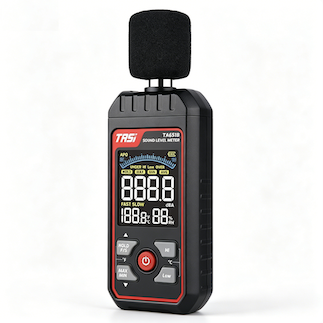
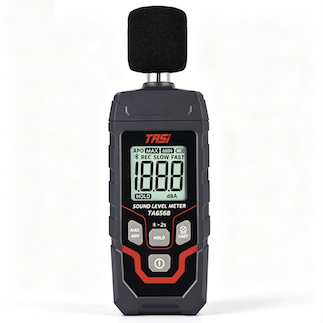
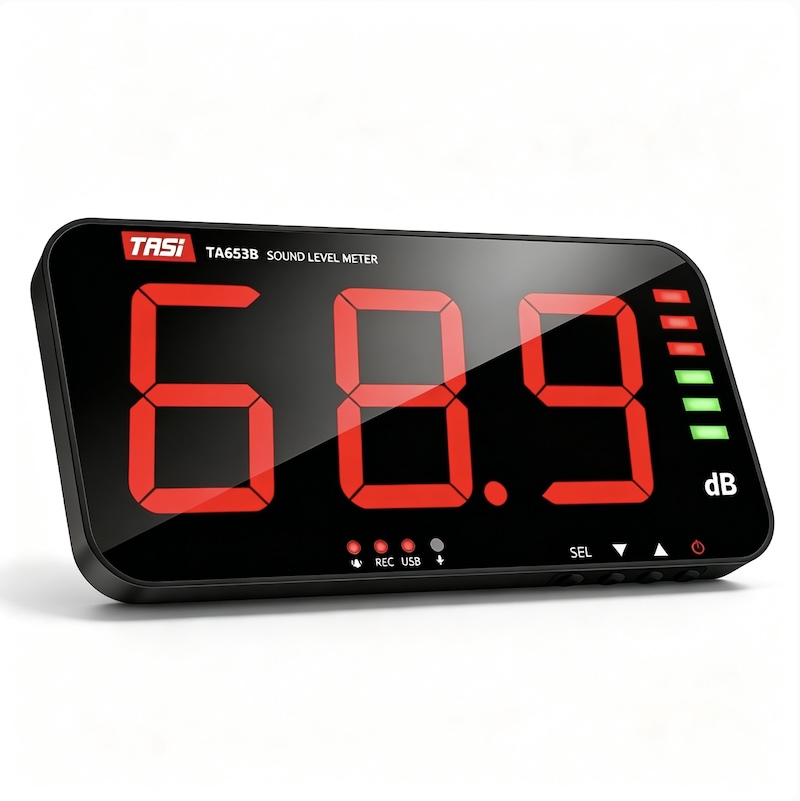
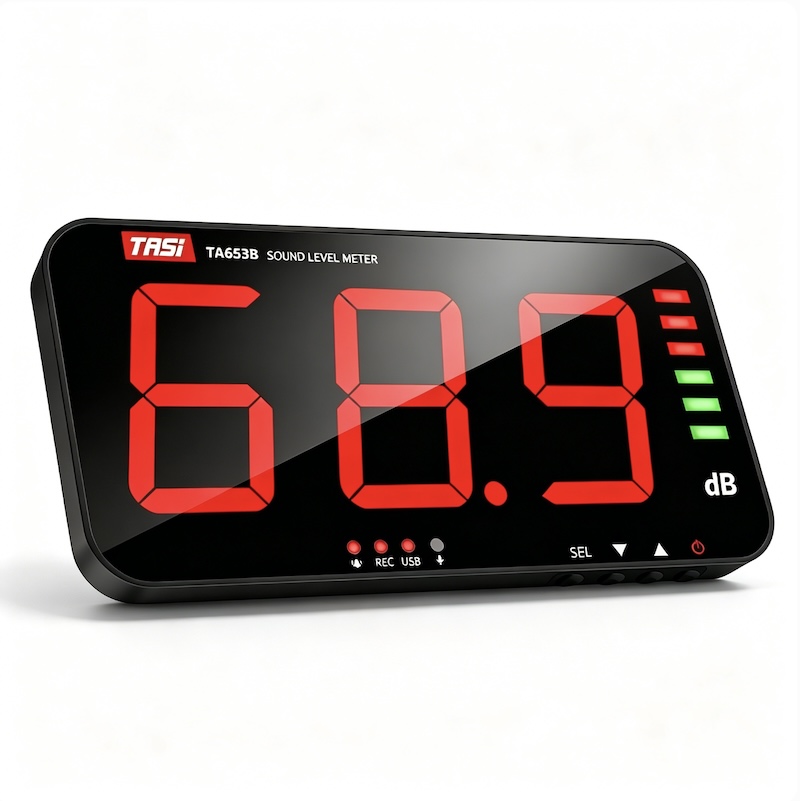
When using a digital sound level meter, you will often see readings expressed in “dBA.” For example, workplace noise may be measured at 85 dBA, while background noise in a relatively quiet environment may be around 40–50 dBA.
This often raises two questions: What is the difference between dBA and dB? Why is noise not simply measured in dB?
In simple terms, dB is a logarithmic unit used to express ratios of physical quantities, while dBA indicates that the measured sound pressure level has been processed using A-frequency weighting.
A-weighting adjusts the contribution of different frequencies to more closely reflect the frequency sensitivity of human hearing. For this reason, dBA is widely used to assess environmental noise, occupational noise exposure, and many everyday acoustic environments.
Key Points
● dBA represents a sound pressure level measured with A-frequency weighting.
● A-weighting does not physically alter the sound; it applies defined frequency-dependent corrections during measurement.
● Human hearing is more sensitive to mid-frequency sounds and less sensitive to low and some high frequencies, so equal physical sound pressure levels do not necessarily sound equally loud.
● dBA is widely used for environmental noise, workplace noise, machinery noise, and general acoustic assessment.
● dBA is not the only weighting used in acoustics. dBC and other weighting methods may be more appropriate when low-frequency or high-level sounds are of particular interest.
What Is dBA?
dBA, also written as dB(A), indicates a sound pressure level measured using the A-weighting network.
The terms can be understood as follows:
● dB (decibel) is a logarithmic unit used to express the ratio between two physical quantities.
● A indicates that A-frequency weighting has been applied.
● dBA therefore represents a sound level calculated after A-weighting has been applied to the measured acoustic signal.
dBA is not a completely separate unit from dB. Rather, it specifies the frequency weighting used to obtain the stated decibel value.
For example, if a sound level meter displays:
LA = 82 dBA
this means that the instrument has applied A-frequency weighting and calculated an A-weighted sound level of 82 dB.
In professional acoustics, you may also encounter terms such as LA, LAeq, LAF, and LAS, which provide additional information about frequency weighting, time weighting, or equivalent continuous sound level.
Why Is A-Weighting Needed?
Sound consists of many frequencies, but the human ear does not respond equally to all of them.
In general, human hearing is relatively sensitive to frequencies in the mid-frequency range, particularly around several kilohertz, while sensitivity decreases considerably at lower frequencies.
As a result, a low-frequency sound and a mid-frequency sound with the same physical sound pressure level may not be perceived as equally loud.
If a sound level meter only reported the unweighted physical sound pressure, the reading would not fully reflect the frequency-dependent response of human hearing.
A-weighting was developed to address this issue.
It applies a defined frequency response that reduces or adjusts different frequency components so that the resulting measurement better represents the general frequency sensitivity of human hearing.
How Does A-Weighting Treat Different Frequencies?
A-weighting does not treat every frequency equally.
In simplified terms:
● Mid-frequency sounds, where human hearing is relatively sensitive, receive comparatively little correction.
● Low-frequency sound is attenuated significantly.
● Some high-frequency components are also adjusted.
For example, a sound containing substantial low-frequency energy may have a relatively high unweighted sound pressure level, while its A-weighted dBA reading may be significantly lower.
This does not mean that the actual low-frequency sound pressure has decreased. It means that the low-frequency component is given less weight according to the A-weighting response.
Therefore, dBA is essentially a frequency-weighted indicator for noise assessment.
What Is the Difference Between dB and dBA?
dB and dBA should not be regarded as two completely independent units.
dB is a general logarithmic unit and requires additional context to indicate what is being measured. In acoustics, it may refer to sound pressure level or sound power level, while the decibel is also widely used in electronics and communications.
dBA, by contrast, clearly indicates that A-frequency weighting has been applied to an acoustic measurement.
For example:
● 80 dB: Without additional information, the frequency weighting is not clear.
● 80 dBA: Clearly indicates an A-weighted sound level of 80 dB.
For professional noise measurement, recording only a “dB” value is generally incomplete. The measurement record should also specify the frequency weighting, time weighting, and other relevant measurement conditions.
Why Is dBA Commonly Used for Environmental Noise?
Environmental noise assessment usually focuses on how sound affects people rather than on acoustic energy alone.
Road traffic, construction activity, commercial areas, residential environments, and public spaces all create noise that is ultimately experienced through human hearing. A-weighting is therefore useful because it provides a standardized measurement that broadly reflects human frequency sensitivity.
dBA also offers several practical advantages:
● It is widely recognized and standardized in acoustic measurement practice.
● It allows measurements from different locations and instruments to be compared more easily.
● It is suitable for many types of broadband environmental noise.
● Many environmental noise assessment methods and limit values are based on A-weighted sound levels.
For general environmental noise surveys, A-weighting is therefore one of the most commonly used sound level meter settings.
Why Is dBA Commonly Used for Workplace Noise Measurement?
Occupational noise measurement evaluates the sound exposure experienced by workers over a defined period.
Industrial machinery, fans, motors, compressors, production lines, and processing equipment can produce continuous, intermittent, or fluctuating noise. Standardized acoustic metrics are needed to evaluate potential effects on hearing.
A-weighted sound levels are therefore widely used for:
● Workplace noise surveys;
● Occupational noise exposure assessment;
● Equivalent continuous sound level measurement;
● Comparing noise before and after control measures;
● Evaluating operating noise from industrial equipment.
A commonly used metric is LAeq, the A-weighted equivalent continuous sound level. It converts varying sound energy over a specified period into the level of a hypothetical steady sound containing the same total acoustic energy.
Does dBA Equal Perceived Loudness?
Not exactly.
A-weighting is a standardized frequency correction based on general characteristics of human hearing, but subjective perception is also influenced by factors such as:
● Frequency content;
● Duration;
● Tonal characteristics;
● Impulsive characteristics;
● Overall sound pressure level;
● Individual hearing differences;
● Environmental and psychological conditions.
Two sounds with the same dBA value may therefore be perceived differently.
dBA should be regarded as a standardized noise measurement and comparison metric, rather than as an exact representation of subjective loudness.
What Is the Difference Between dBA and dBC?
Many professional sound level meters provide C-frequency weighting in addition to A-weighting. Measurements are usually expressed as dBC or dB(C).
The main difference is how low-frequency sound is treated.
● dBA: Applies stronger attenuation to low frequencies and is commonly used for environmental and occupational noise assessment.
● dBC: Applies much less low-frequency attenuation, retaining more low-frequency energy and making it useful for high sound levels, low-frequency noise, and certain peak-related measurements.
Large machinery, engines, industrial fans, or amplified music systems may contain substantial low-frequency energy. In these cases, the dBC value may be higher than the corresponding dBA value.
A large difference between dBC and dBA can indicate significant low-frequency content, although frequency spectrum analysis is required to determine the actual spectral distribution.
Why Are FAST and SLOW Still Needed When Measuring dBA?
A-weighting addresses the frequency response, while FAST and SLOW address the time response of the measurement. They describe different aspects of sound level measurement.
A complete measurement may involve:
● Frequency weighting: A, C, or Z;
● Time weighting: FAST or SLOW;
● Measurement metric: maximum, minimum, equivalent continuous level, and others.
For example:
dBA + FAST
means that A-frequency weighting is applied together with FAST time weighting.
dBA + SLOW
uses the same A-weighting but provides a more slowly changing and stable display response.
Therefore, selecting dBA alone is not sufficient. FAST, SLOW, or other measurement parameters should also be selected according to the measurement objective.
When Is dBA Appropriate?
dBA is suitable for many applications where human noise exposure or the acoustic environment is the primary concern, including:
● Office noise;
● Schools and classrooms;
● Hospitals and public buildings;
● Residential environments;
● Road traffic noise;
● Factory and workshop noise;
● HVAC system noise;
● General machinery noise surveys;
● Construction noise;
● Everyday environmental sound level measurement.
For these applications, A-weighting provides a widely accepted and comparable measurement basis.
When Is dBA Alone Not Enough?
Although dBA is widely used, it cannot describe every characteristic of a sound.
Additional parameters may be required in situations such as:
● Pronounced low-frequency noise: dBC or spectrum analysis may also be required.
● Impulsive noise: Peak sound pressure level may be important.
● Machinery fault diagnosis: Overall sound level alone does not identify abnormal frequencies; spectrum analysis is usually necessary.
● Acoustic product development: Z-weighting, octave-band, or one-third-octave-band analysis may be required.
● Complex sound-source comparison: Two sources with the same dBA value can have very different frequency spectra.
dBA is therefore an important measurement parameter, but it is not a complete description of a sound.
What Should You Consider When Measuring dBA with a Sound Level Meter?
To obtain meaningful and comparable dBA measurements, measurement conditions should be controlled as consistently as possible.
● Set the sound level meter to A-frequency weighting.
● Select FAST or SLOW time weighting according to the measurement objective.
● Ensure that the instrument range is suitable for the expected sound level.
● Check that the microphone and instrument are operating correctly before measurement.
● Perform acoustic calibration when required by the measurement procedure.
● Avoid unnecessary reflections caused by the operator, walls, or large nearby objects.
● For outdoor measurements, consider wind noise and use a windscreen when appropriate.
● For fluctuating noise, do not rely only on a single instantaneous reading; consider LAeq, Lmax, and other relevant metrics.
● When comparing measurements, keep the position, distance, time weighting, frequency weighting, and other conditions consistent.
Only when measurement conditions are clearly defined can different dBA values be compared meaningfully.
FAQ
What does the “A” in dBA mean?
It refers to A-frequency weighting, a defined frequency response used by sound level meters to adjust different frequency components.
Are dBA and dB the same?
Not exactly. dB is the general decibel unit, while dBA specifically indicates that A-frequency weighting has been applied.
Why do sound level meters often use dBA by default?
Because many environmental and occupational noise measurements are concerned with human exposure, and A-weighting broadly reflects the frequency sensitivity of human hearing.
Does a higher dBA value always mean more dangerous noise?
Under otherwise equal conditions, a higher dBA value indicates a higher A-weighted sound level. However, noise risk also depends on exposure duration, sound characteristics, and the assessment method.
Which is more accurate, dBA or dBC?
Neither is inherently more accurate. They use different frequency weightings for different purposes. dBA is common for environmental and occupational noise, while dBC can be useful for low-frequency or high-level sound.
Will two sounds at 80 dBA always sound the same?
No. They may have the same A-weighted overall level but very different frequency spectra, temporal characteristics, and subjective qualities.
Should machinery noise be measured in dBA?
Yes, when evaluating general machinery noise or human noise exposure. For fault diagnosis, low-frequency analysis, or identifying specific noise components, additional frequency weighting or spectrum analysis may be required.
Summary
dBA is the sound pressure level measured after applying A-frequency weighting. It is one of the most widely used indicators in environmental and occupational noise measurement.
A-weighting is used because human hearing does not respond equally to all frequencies. By reducing the contribution of low-frequency and some high-frequency components, A-weighting produces a measurement that is more suitable for many human-centered noise assessments.
However, dBA does not describe every characteristic of sound. Low-frequency noise, impulsive noise, machinery diagnostics, and advanced acoustic analysis may also require dBC, peak sound pressure levels, equivalent continuous sound levels, or frequency spectrum analysis.
When using a sound level meter, it is therefore important not only to ask “how many dBA?” but also to consider the frequency weighting, time weighting, measurement position, measurement duration, and purpose of the assessment.