Introduction
Sound levels are commonly expressed in decibels (dB). A quiet office may measure only a few tens of decibels, while industrial machinery can produce levels of 80 dB, 90 dB or more.
However, the decibel has one important characteristic: it is a logarithmic scale, not a linear scale.
This means that 80 dB is not simply “twice as much” as 40 dB, and the difference between 90 dB and 80 dB cannot be interpreted in the same way as ordinary arithmetic values.
The logarithmic form is used mainly because acoustic quantities cover an extremely wide dynamic range, while the human auditory system responds more naturally to relative changes than to simple linear changes. Understanding this principle is essential for interpreting sound pressure levels, sound level meter readings and changes in noise levels correctly.
Key Points
● A decibel expresses the ratio between two quantities using a logarithmic scale.
● Acoustic quantities span a very wide range, so logarithms compress extremely large numerical ratios into manageable values.
● Human hearing responds strongly to relative changes in sound rather than simple linear increases.
● Sound power and sound intensity ratios are normally expressed using 10 × log₁₀.
● Sound pressure level uses 20 × log₁₀ because sound intensity is proportional to the square of sound pressure under defined conditions.
● Doubling sound power or intensity corresponds to an increase of approximately 3 dB.
● Doubling sound pressure corresponds to an increase of approximately 6 dB.
● 0 dB does not mean the complete absence of sound; it represents equality with a defined reference value.
A Decibel Is Not a Direct Unit of Sound Magnitude
It is common to think of dB in the same way as volts, amperes, metres or kilograms. Strictly speaking, however, the decibel works differently.
A decibel represents the ratio between two quantities of the same type.
For sound power, for example, the measured sound power can be compared with a defined reference sound power. For sound pressure level, the measured sound pressure is compared with a defined reference sound pressure.
Therefore, when a sound level is stated as 80 dB, the value does not mean that the sound contains “80 units of decibels.” Instead, a logarithmic calculation converts the ratio between the measured acoustic quantity and its reference value into a more convenient number.
This approach is used not only in acoustics but also in electronics, telecommunications, radio-frequency engineering and signal processing, where very large ratios frequently need to be expressed.
Acoustic Quantities Cover an Extremely Wide Range
One of the main reasons for using a logarithmic scale is the enormous dynamic range of sound.
For sound pressure in air, the commonly used reference value is:
20 μPa (20 micropascals)
This is close to the threshold of human hearing under defined conditions. At the other end of the range, very intense sounds can produce acoustic pressures of several tens of pascals or more.
If sound levels were expressed only as linear pressure values, measurements would need to cover quantities ranging from a few millionths of a pascal to tens or even hundreds of pascals.
Such figures would be inconvenient to read, compare and interpret.
A logarithmic scale compresses this enormous physical range into values that are much easier to work with, commonly from around 0 dB SPL to 140 dB SPL in practical acoustic contexts.
For example:
● Near the threshold of hearing: approximately 0 dB SPL
● Quiet environment: approximately 30–40 dB SPL
● Normal conversation: approximately 60 dB SPL
● Relatively high industrial noise: approximately 80–100 dB SPL
● Very high sound-pressure environments: above 120 dB SPL
The logarithmic scale therefore converts a very large physical range into a compact and practical numerical scale.
Why Not Use a Linear Scale?
Consider two sound sources where one has ten times the sound power of the other.
If the difference continues to increase, the ratios could become:
● 100 times
● 1,000 times
● 10,000 times
● 1,000,000 times
On a linear scale, these numbers quickly become cumbersome.
Using a base-10 logarithmic scale:
● 10 times the power = +10 dB
● 100 times the power = +20 dB
● 1,000 times the power = +30 dB
● 10,000 times the power = +40 dB
● 1,000,000 times the power = +60 dB
A logarithmic scale therefore turns multiplication of physical ratios into addition of decibel values.
This is one of the major practical advantages of using dB.
Why Is a Logarithmic Scale Also Suitable for Human Hearing?
The enormous physical range of sound is only part of the reason. Human hearing itself does not respond to sound intensity in a simple linear manner.
For example, if the acoustic power of a sound doubles, a listener does not necessarily perceive it as exactly twice as loud.
Human hearing is particularly sensitive to relative changes, and the subjective perception of loudness depends on several factors, including frequency, sound level, duration and individual hearing characteristics.
For this reason, logarithmic representation is useful when describing the broad range of sound that humans can hear.
However, an important distinction must be made: dB is an objective way of expressing an acoustic quantity, while loudness is a subjective auditory perception.
An increase of around 10 dB may often be perceived as a substantial increase in loudness and is sometimes described, under certain conditions, as approximately twice as loud. This is only an approximate psychoacoustic relationship and should not be treated as a fixed physical rule.
Why Do Sound Power and Sound Intensity Use 10 log?
For power-related quantities such as sound power and sound intensity, the decibel relationship is generally written as:
L = 10 × log₁₀(X / X₀)
where:
● L is the level in decibels;
● X is the measured quantity;
● X₀ is the reference quantity;
● log₁₀ is the base-10 logarithm.
If sound power becomes 10 times greater:
10 × log₁₀(10) = 10 dB
Therefore, a tenfold increase in power corresponds to an increase of 10 dB.
If the power becomes 100 times greater:
10 × log₁₀(100) = 20 dB
A hundredfold increase in power therefore corresponds to 20 dB.
This demonstrates why a change in dB cannot be interpreted as a simple linear change.
Why Does Sound Pressure Level Use 20 log?
A sound level meter primarily measures sound pressure level (SPL).
For sound in air, a reference sound pressure of 20 μPa is conventionally used. Sound pressure level is therefore expressed as:
Lp = 20 × log₁₀(p / p₀)
where:
● Lp is the sound pressure level in dB;
● p is the measured sound pressure;
● p₀ is the reference sound pressure, normally 20 μPa in air.
Why is the multiplier 20 instead of 10?
Under defined acoustic conditions, sound intensity is proportional to the square of sound pressure:
Sound intensity ∝ sound pressure²
Because power quantities use a 10-logarithm relationship, applying that relationship to a squared pressure ratio results in a factor of 20.
If sound pressure doubles:
20 × log₁₀(2) ≈ 6.02 dB
Therefore, doubling sound pressure corresponds to an increase of approximately 6 dB.
Why Does a 3 dB Increase Mean Approximately Twice the Power?
For power-related acoustic quantities:
L = 10 × log₁₀(P₂ / P₁)
If the power doubles:
10 × log₁₀(2) ≈ 3.01 dB
Therefore:
Twice the power ≈ +3 dB
Conversely:
Half the power ≈ −3 dB
This is one of the most useful rules of thumb in acoustics.
For example, if two identical, independent and incoherent sound sources operate simultaneously under the same measurement conditions, the combined sound level will theoretically be approximately 3 dB higher than the level produced by either source alone.
What Do Changes of 3 dB, 6 dB and 10 dB Mean?
Different changes in dB correspond to different physical ratios.
| Change in Level | Sound Power / Intensity | Sound Pressure |
|---|---|---|
| +3 dB | Approx. 2× | Approx. 1.41× |
| +6 dB | Approx. 4× | Approx. 2× |
| +10 dB | 10× | Approx. 3.16× |
| +20 dB | 100× | 10× |
| +30 dB | 1,000× | Approx. 31.6× |
This table illustrates an important point.
An increase from 60 dB to 70 dB is only a numerical change of 10 dB, but it corresponds to a tenfold increase in sound intensity.
An increase from 60 dB to 80 dB represents a 20 dB difference and therefore corresponds to 100 times the sound intensity.
Relatively small changes in dB can therefore represent very large changes in acoustic energy.
Why Can Two 60 dB Sound Sources Not Simply Be Added to Make 120 dB?
Because dB is logarithmic, sound levels from multiple sources cannot normally be added using ordinary arithmetic.
For example, if two independent sound sources each produce 60 dB under equivalent conditions, their combined level is approximately:
63 dB
not 120 dB.
The individual dB values must first be converted to their corresponding linear energy values. These values are then added before the result is converted back to decibels.
Therefore:
● Two equal independent sound levels normally produce an increase of approximately 3 dB;
● 60 dB + 60 dB ≈ 63 dB;
● 80 dB + 80 dB ≈ 83 dB.
This principle is especially important when evaluating multiple machines, industrial installations and environmental noise sources.
Does 0 dB Mean Complete Silence?
No.
0 dB SPL does not mean that there are no acoustic pressure fluctuations.
It means that the measured RMS sound pressure is equal to the defined reference sound pressure:
20 μPa
This reference value is approximately related to the human threshold of hearing under specific conditions.
Because a decibel expresses a ratio relative to a reference value, negative sound pressure levels are also physically possible.
If the measured sound pressure is lower than 20 μPa, the resulting sound pressure level can be below 0 dB SPL.
Therefore:
● 0 dB does not mean no sound;
● 0 dB SPL means that sound pressure equals the reference pressure;
● A negative dB SPL value does not mean “negative sound,” but rather a sound pressure below the reference value.
Why Is the Logarithmic Relationship Important When Using a Sound Level Meter?
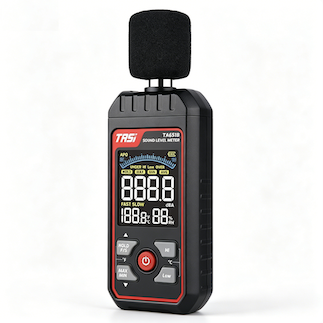
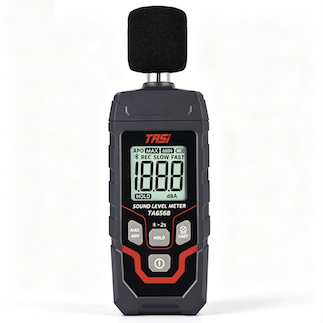
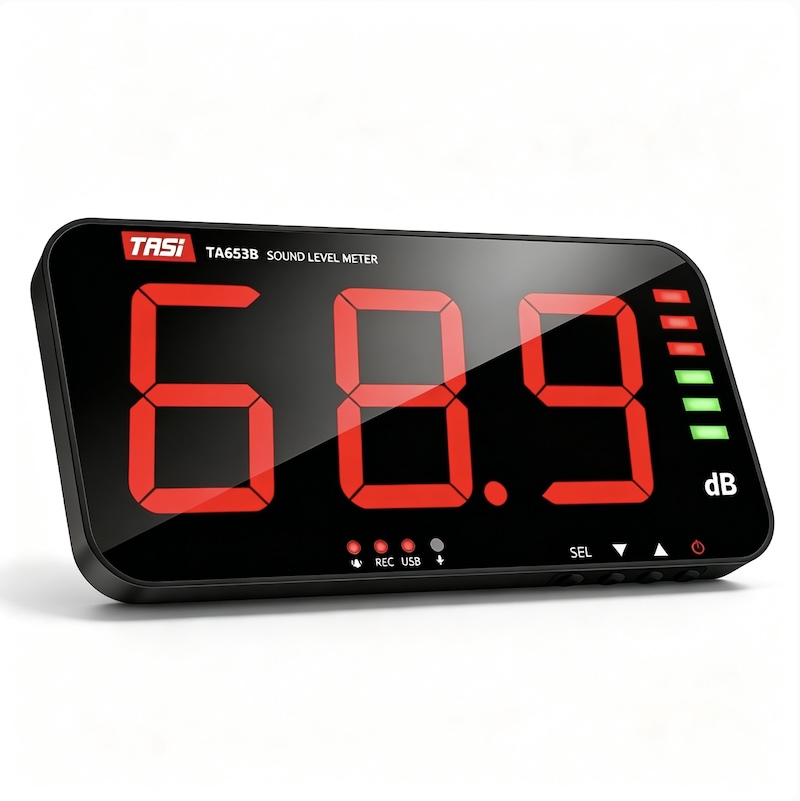
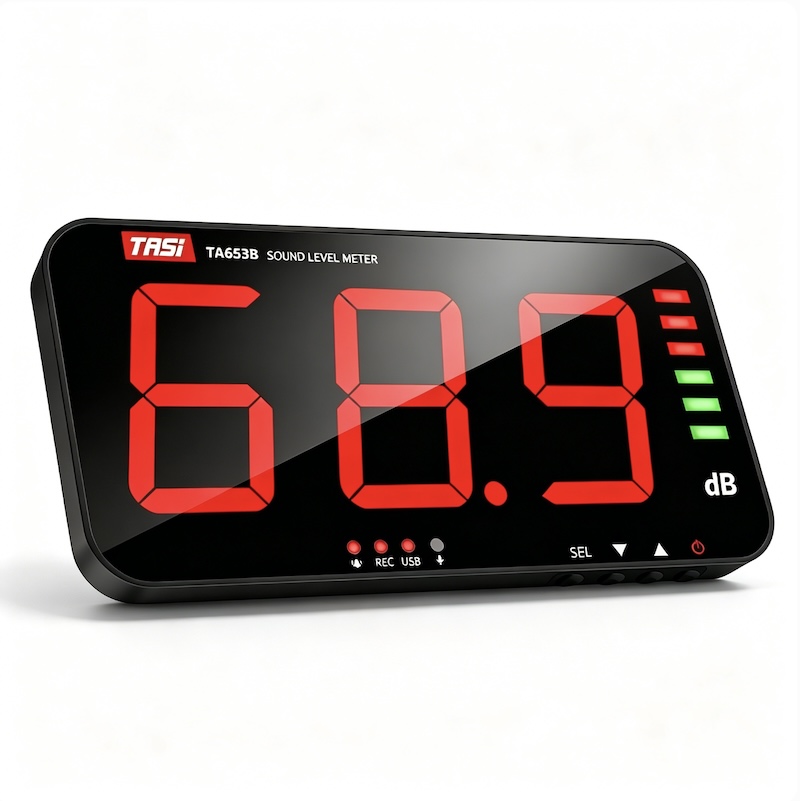
A digital sound level meter displays results directly in dB, so users do not normally need to perform logarithmic calculations manually. However, understanding the underlying relationship is essential for interpreting measurement results correctly.
For example, if machine noise decreases from 80 dB to 77 dB, the numerical change appears to be only 3 dB. In terms of sound power or intensity, however, this represents an approximate reduction by half.
Likewise, an increase from 80 dB to 90 dB is only a 10 dB change numerically, but the sound intensity becomes approximately ten times greater.
Understanding these relationships helps when evaluating:
● The effectiveness of noise-control measures;
● Noise differences between machines;
● The combined effect of multiple sound sources;
● Changes in workplace noise conditions;
● Trends in long-term sound-level measurements.
For this reason, dB readings should never be interpreted as ordinary linear numbers.
FAQ
Q: Why are decibels expressed logarithmically?
A: Sound does not have to be represented logarithmically in every theoretical context, but acoustic quantities cover an extremely large dynamic range and are often compared as ratios. A logarithmic scale compresses this range and makes calculations and comparisons much more practical.
Q: Is 80 dB twice as much as 40 dB?
A: No. The difference is 40 dB. In terms of sound intensity, this corresponds to a ratio of 10,000:1, not 2:1.
Q: What does a 3 dB increase mean?
A: For sound power or sound intensity, an increase of approximately 3 dB means that the energy has roughly doubled. It does not mean that the perceived loudness has necessarily doubled.
Q: What does a 6 dB increase mean?
A: For sound pressure, an increase of approximately 6 dB corresponds to approximately twice the sound pressure. The associated sound intensity is approximately four times greater.
Q: What does a 10 dB increase mean?
A: Physically, a 10 dB increase corresponds to ten times the sound intensity. The perceived change in loudness depends on frequency, initial sound level and other psychoacoustic factors.
Q: Does 0 dB mean complete silence?
A: No. 0 dB SPL means that the sound pressure is equal to the standard reference pressure of 20 μPa in air.
Q: Why do two 60 dB sources not produce 120 dB?
A: Because decibels are logarithmic values and cannot normally be added directly. Two independent equal 60 dB sources produce approximately 63 dB under ideal equivalent conditions.
Q: Does a sound level meter also use logarithmic calculations internally?
A: Yes. A sound level meter converts acoustic pressure into an electrical signal and processes it using functions such as frequency weighting, time weighting and RMS detection before converting the resulting quantity into a decibel value.
Conclusion
The decibel uses a logarithmic scale because acoustic quantities span an exceptionally wide dynamic range and are commonly evaluated as ratios. Logarithmic conversion makes these large physical differences much easier to express, compare and analyse.
It also transforms multiplicative relationships into convenient level differences. Doubling sound power or intensity corresponds to approximately +3 dB, increasing power by a factor of ten corresponds to +10 dB, and doubling sound pressure corresponds to approximately +6 dB.
Decibels should therefore never be interpreted like ordinary linear numbers. Understanding their logarithmic nature is fundamental to interpreting sound pressure levels, sound intensity, sound power, combined sound sources and the effectiveness of noise-control measures.