Introduction
Road traffic, industrial equipment, construction work, commercial activities, and community noise can all contribute to outdoor environmental noise. Compared with indoor measurements, outdoor sound propagation is more strongly influenced by wind, ground conditions, buildings, distance, and continuously changing background sounds.
For this reason, simply switching on a sound level meter and recording a single decibel value is usually not sufficient to describe the actual acoustic environment.
A reliable outdoor noise measurement should consider instrument performance, measurement position, measurement parameters, measurement duration, and site conditions. Where measurements are intended for long-term trend analysis, complaint investigation, boundary noise assessment, or regulatory compliance, the applicable measurement standards and local requirements should also be followed.
Key Points
● The measurement objective should be defined first, as different applications may require different measurement locations and durations.
● Environmental noise is commonly measured using A-weighting and expressed in dBA.
● For fluctuating environmental noise, a single instantaneous reading is generally not representative; time-averaged parameters such as equivalent continuous sound level are often more useful.
● Measurements should avoid unnecessary sound reflections from walls, vehicles, the operator, and other nearby objects.
● A suitable microphone windscreen should normally be used outdoors, and wind, rain, and other weather conditions should be considered.
● Acoustic calibration checks before and after measurement help confirm that the instrument remained stable during the measurement period.
● Measurement records should include location, distance, time, weather conditions, main noise sources, and relevant operating conditions.
Define the Purpose of the Outdoor Noise Measurement
Before starting, determine what the measurement is intended to establish. Different objectives may require different methods.
● General environmental noise survey: Used to understand typical noise levels around residential areas, schools, industrial sites, or public spaces.
● Road traffic noise assessment: Requires consideration of traffic volume, vehicle types, vehicle speed, and time-of-day variations.
● Industrial equipment noise measurement: Operating conditions and the distance between the measurement point and the equipment should be recorded.
● Construction noise assessment: Measurements should cover representative activities such as drilling, cutting, excavation, or operation of heavy machinery.
● Noise complaint investigation: The measurement location should represent the affected receiver position as closely as possible, while distinguishing the target source from background noise.
● Regulatory or standards-based measurement: Instrument class, microphone position, measurement duration, and evaluation parameters should follow the applicable local requirements.
For a quick field check, a relatively simple procedure may be sufficient. For formal environmental assessment, measurement conditions and data traceability require much stricter control.
Choose a Suitable Sound Level Meter
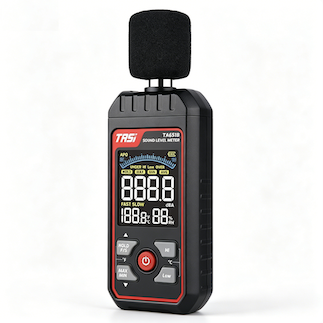
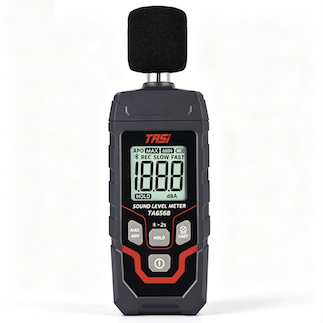
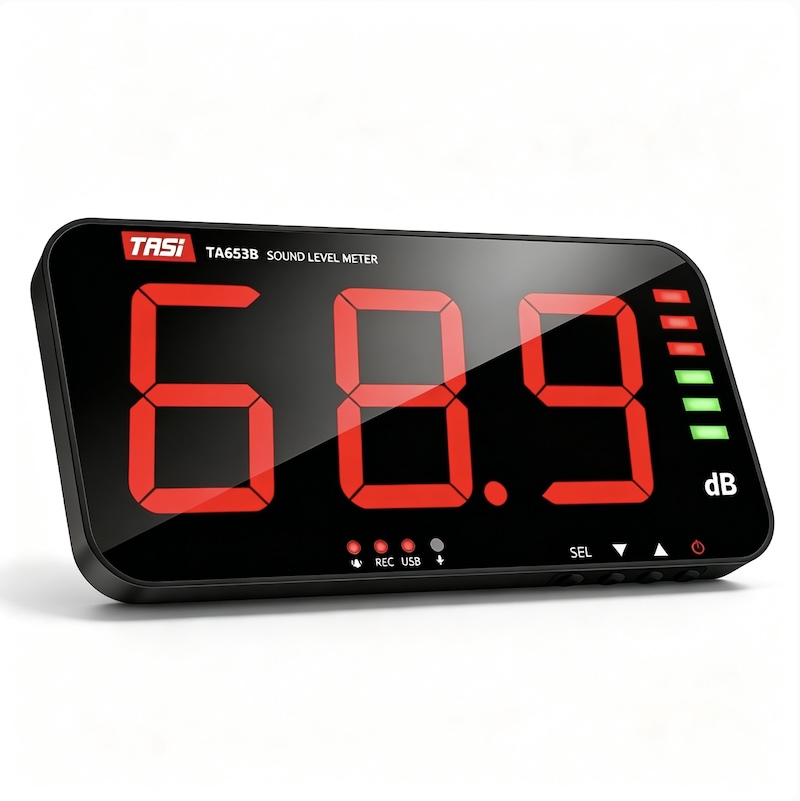
Outdoor environmental noise is commonly measured with a digital sound level meter or an integrating-averaging sound level meter.
For many general environmental surveys, a Class 2 instrument may be suitable. Higher-precision acoustic measurements or measurements carried out for specific regulatory purposes may require a Class 1 instrument.
Important instrument functions include:
● A-frequency weighting;
● FAST and SLOW time weighting;
● LAeq measurement;
● MAX or maximum level recording;
● Data logging or data export;
● A measurement range suitable for the expected sound levels;
● Compatibility with an acoustic calibrator.
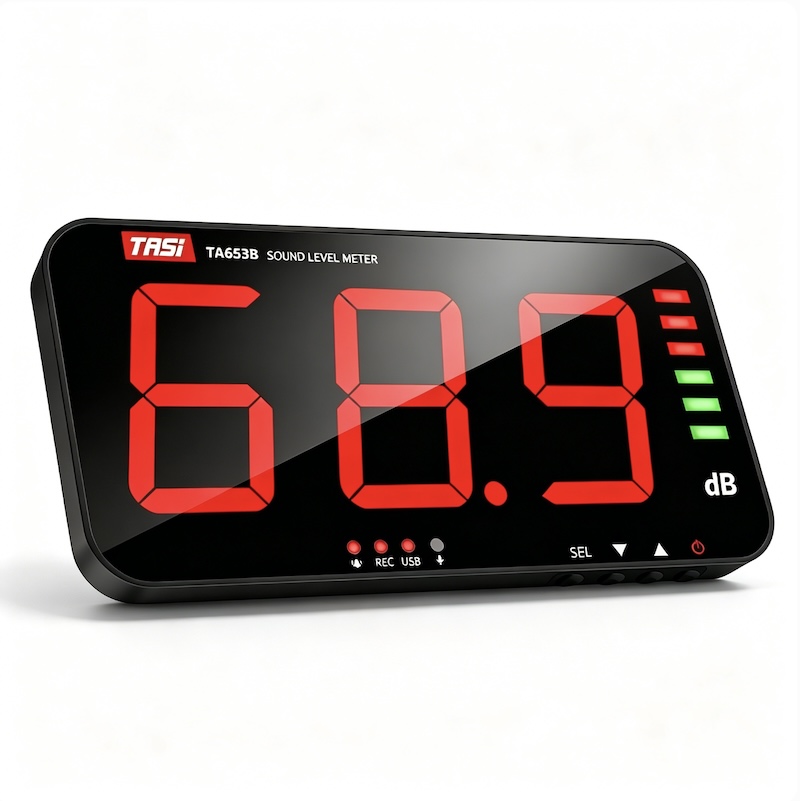
If a basic sound level meter is used only to observe real-time decibel values, remember that an instantaneous reading represents only one moment and may not describe a continuously changing noise environment.
Which Parameters Are Commonly Used for Outdoor Noise Measurement?
Environmental noise is rarely constant. A passing vehicle, for example, may cause the sound level to rise rapidly and then fall again once it has passed.
For this reason, outdoor noise measurement often involves more than a single instantaneous value.
● dBA / A-weighted sound level: A-weighting adjusts the response at different frequencies to better approximate the relative sensitivity of human hearing. It is widely used for environmental noise assessment.
● LAeq,T: The A-weighted equivalent continuous sound level over a specified period T. It represents a fluctuating noise as a constant sound level containing the same acoustic energy over the measurement period.
● LAFmax: The maximum A-weighted sound level measured using FAST time weighting. It can be useful for passing vehicles, equipment start-up events, impacts, and other short-duration noise events.
● LAFmin: The lower sound level observed during the measurement period and sometimes used as supplementary information.
● Statistical sound levels: Some professional instruments can also record parameters such as L10, L50, and L90 for further assessment of traffic noise, background conditions, and environmental sound variations.
The appropriate parameters depend on the measurement objective and the applicable environmental noise assessment method.
Select the Measurement Location Correctly
Measurement position is one of the most important factors affecting outdoor noise results. Even when the source remains unchanged, changing the distance or microphone position can significantly change the measured sound level.
For a general environmental survey, the microphone may often be positioned approximately 1.2–1.5 m above the ground to represent a typical human listening height. However, this is a common field arrangement rather than a universal requirement for all types of environmental noise measurement.
When selecting a measurement point:
● Choose a location that is representative of the area or receiver being evaluated.
● Avoid placing the microphone unnecessarily close to walls, fences, large vehicles, or other major reflecting surfaces.
● Do not change the distance to the target noise source without a specific reason.
● When comparing multiple locations, keep measurement height, distance, and instrument settings as consistent as possible.
● For road traffic, site boundary, building façade, or specific receiver measurements, position the microphone according to the relevant measurement procedure.
If the objective is specifically to assess sound at a building façade, window, or defined receiver location, the measurement point should not be moved simply to obtain a free-field value.
Minimize the Influence of the Operator and Nearby Objects
Sound can be reflected or blocked by the operator, walls, vehicles, and other nearby objects. The person carrying out the measurement can therefore influence the microphone response.
Where possible, mount the sound level meter or microphone on a tripod and allow the operator to stand at an appropriate distance.
If the instrument must be handheld:
● Do not cover the microphone with your hand.
● Do not position your body between the microphone and the main sound source.
● Keep the holding position consistent between measurements.
● Avoid unnecessary movement while recording data.
● Follow the manufacturer's instructions regarding microphone orientation.
Consistent measurement geometry is particularly important when comparing data from different locations or different times.
Why Is a Windscreen Needed for Outdoor Measurements?
Airflow across a microphone can create pressure fluctuations that the microphone may register as low-frequency noise. This can make the displayed sound level higher than the actual environmental sound level.
A suitable microphone windscreen should therefore normally be used for outdoor measurements.
Its main purposes are to:
● Reduce wind-induced microphone noise;
● Provide limited mechanical protection for the microphone;
● Reduce direct exposure to dust and other environmental contaminants.
A windscreen does not make measurements reliable under all wind conditions. In strong wind, measurement results can still be significantly affected even when a windscreen is fitted.
Consider Weather Conditions
Outdoor sound propagation is closely related to meteorological conditions, so relevant weather information should be recorded during formal measurements.
Important factors include:
● Wind speed and direction;
● Temperature;
● Relative humidity;
● Rainfall;
● Whether the ground is wet;
● Other unusual weather conditions.
Strong wind can produce microphone wind noise and can also influence sound propagation. Rain can introduce additional noise as droplets strike the windscreen, ground, vegetation, or nearby structures.
For higher-quality environmental measurements, strong winds, heavy rain, and other unsuitable conditions should generally be avoided unless the purpose of the measurement is specifically to assess the acoustic environment under those conditions.
Choose a Representative Measurement Duration
Outdoor noise often changes over time, so measurement duration should reflect the characteristics of the noise source rather than simply being based on convenience.
For example:
● Continuously operating equipment with stable sound levels may be assessed using a relatively short but representative measurement period.
● Road traffic measurements should include a sufficient number of vehicles to reflect typical traffic conditions.
● Construction noise measurements should cover representative work cycles rather than periods when machinery is temporarily inactive.
● Intermittent equipment should ideally be measured through a complete start, operation, and stop cycle.
● Environments with substantial long-term variation may need separate measurements during daytime, evening, or other relevant periods.
For traffic, construction, and other highly variable noise, a reading lasting only a few seconds is usually not representative. Time-averaged parameters such as LAeq are generally more meaningful than a single instantaneous sound level.
Set the Frequency Weighting Correctly
For environmental noise assessments mainly concerned with human perception and community impact, A-frequency weighting is commonly used and results are expressed in dBA.
A-weighting applies different corrections across the frequency spectrum so that the measurement more closely reflects the relative frequency sensitivity of human hearing.
Some sound level meters also provide C-weighting or Z-weighting:
● A-weighting is widely used for general environmental and occupational noise assessment.
● C-weighting can be useful when assessing high-level noise or sound containing substantial low-frequency energy.
● Z-weighting provides an approximately unweighted frequency response and is mainly used for more detailed acoustic analysis.
Results obtained with different frequency weightings should not be treated as interchangeable. When comparing multiple locations or measurement periods, keep the frequency weighting consistent.
Should FAST or SLOW Be Used?
FAST and SLOW are time-weighting settings that determine how quickly the displayed sound level responds to changes.
● FAST: Responds more quickly and is useful for observing passing vehicles, equipment events, and other rapidly changing sounds.
● SLOW: Produces a more stable display and can make it easier to read sound levels that fluctuate moderately.
FAST is often useful when observing short-term variations or maximum sound levels, while SLOW can be convenient for visually monitoring relatively stable noise.
For formal measurement, however, the required time weighting should be selected according to the acoustic parameter being recorded and the applicable measurement procedure.
Perform a Calibration Check Before Measurement
For reliable outdoor noise measurements, an acoustic calibrator compatible with the sound level meter should be used to check the instrument before measurement.
A typical procedure includes:
● Switch on the sound level meter and confirm that the battery condition is satisfactory.
● Inspect the microphone and windscreen.
● Fit the acoustic calibrator correctly to the microphone.
● Switch on the calibrator.
● Check whether the displayed value corresponds to the specified calibration level.
● Make any permitted adjustment in accordance with the instrument instructions.
● Remove the calibrator and begin the field measurement.
For formal measurement projects, a calibration check should also normally be carried out after the measurement session to confirm that the instrument has not experienced significant drift.
If the difference between the pre- and post-measurement checks exceeds the allowable limit for the project, the cause should be investigated and the measurement may need to be repeated.
Basic Procedure for Measuring Outdoor Environmental Noise
A complete field procedure can be organized as follows:
● Define the measurement objective and required acoustic parameters.
● Select a sound level meter suitable for the application.
● Check the battery, microphone, and windscreen.
● Carry out a pre-measurement acoustic calibration check where required.
● Select the measurement point and record its location, height, and distance from the main sound source.
● Mount the instrument on a tripod or hold it in a stable position.
● Fit the microphone windscreen.
● Select A-weighting and the required time weighting.
● Configure LAeq, MAX, or other required measurement parameters.
● Observe the site to confirm that the operating conditions are representative.
● Start the measurement and keep the microphone position unchanged.
● Record significant noise events, weather conditions, and source operating status.
● Save the data at the end of the measurement period.
● Perform a post-measurement calibration check where required.
For surveys involving multiple locations, establish a consistent measurement procedure in advance so that all positions are assessed under comparable conditions.
How Can You Determine Whether a Measurement Is Representative?
Outdoor sound levels vary continuously. Recording a value does not necessarily mean that the value accurately represents the typical noise environment at that location.
Consider the following:
● Was the main noise source operating normally?
● Was traffic volume reasonably representative of normal conditions?
● Did unusual events such as horns, alarms, or shouting occur?
● Was the measurement duration long enough to cover the typical operating or noise cycle?
● Were weather conditions suitable?
● Was there temporary construction or another unusual background source?
● Are repeated measurements at different times reasonably consistent?
For highly variable environments, longer measurement periods or repeated measurements are generally more reliable than a single short reading.
Distinguish the Target Noise from Background Noise
When investigating industrial equipment, construction activity, or another specific source, the measurement location usually contains other sounds such as traffic, birds, people, or nearby machinery.
If the objective is to evaluate a specific source, the influence of background noise should be considered.
Where possible, measure separately:
● The total sound level with the target source operating normally;
● The background sound level when the target source is not operating.
If the target noise level is close to the background level, a simple sound level reading may not be sufficient to determine the contribution of the target source accurately.
In such cases, longer measurements, a different measurement position, or more advanced acoustic analysis may be necessary.
An environmental noise record should therefore describe not only the measured dBA value, but also the acoustic conditions under which the value was obtained.
What Information Should Be Recorded?
Complete field records improve comparability between measurements and help explain unusual results during later analysis.
Record at least:
● Measurement date and exact time;
● Measurement location;
● Microphone height;
● Approximate distance from the main sound source;
● Sound level meter model;
● Frequency weighting;
● FAST, SLOW, or other relevant time-weighting settings;
● LAeq, maximum level, and other recorded parameters;
● Measurement start and end times and total duration;
● Main noise sources;
● Operating status of equipment or construction machinery;
● Traffic conditions;
● Wind speed, wind direction, and general weather conditions;
● Whether a microphone windscreen was fitted;
● Pre- and post-measurement calibration check results;
● Any unusual noise events during the measurement.
For long-term surveys or comparisons across multiple locations, a standardized measurement record form is recommended.
How Should Road Traffic Noise Be Measured?
Road traffic noise is highly dynamic and changes with vehicle type, traffic volume, speed, and distance.
When measuring road traffic noise:
● Keep the microphone position relative to the road fixed.
● Do not change the measurement point between measurement periods without a defined reason.
● Record the measurement time and general traffic conditions.
● Use a sufficiently long measurement period to capture representative traffic flow.
● Note unusual events such as heavy vehicles, motorcycles, or horn use.
● When comparing several road locations, keep measurement conditions as consistent as possible.
A single reading taken during a quiet interval between two vehicles clearly does not represent the actual traffic noise environment. For road traffic, an equivalent continuous sound level measured over a representative period is generally more useful.
How Should Outdoor Industrial and Machinery Noise Be Measured?
When measuring outdoor noise from fans, compressors, cooling towers, machinery, or other fixed industrial sources, operating conditions should be recorded together with the sound level.
Important information includes:
● Whether the equipment is operating at full load or another defined condition;
● How many units are operating simultaneously;
● Distance between the microphone and the equipment;
● Whether the measurement direction remains consistent;
● Presence of walls, factory buildings, or other reflecting structures;
● Presence of road traffic or other background noise.
When comparing machinery noise before and after maintenance, keep operating load, microphone position, distance, instrument settings, and environmental conditions as consistent as possible. Otherwise, differences between the two results may not be caused solely by the equipment.
Common Mistakes in Outdoor Noise Measurement
● Relying only on an instantaneous decibel value: A single reading may not represent a variable environment.
● Not using a windscreen: Airflow across the microphone can introduce significant measurement error.
● Measuring too close to a wall: Reflections can change the measured sound level.
● Using different source distances between measurements: Results become difficult to compare directly.
● Using a measurement period that is too short: This is particularly problematic for traffic, construction, and intermittent equipment.
● Allowing the operator to obstruct the microphone: The body can shield or reflect sound.
● Changing measurement settings between tests: Results using different frequency or time weightings should not be compared directly.
● Ignoring background noise: The measured value represents all sound reaching the microphone, not only the target source.
● Ignoring weather conditions: Wind and rain can influence both the measurement and sound propagation.
● Failing to document site conditions: Without adequate records, unusual data can be difficult to interpret later.
FAQ
Is outdoor environmental noise normally measured in dB or dBA?
A-weighted sound levels expressed in dBA are commonly used for general environmental noise assessment. The required frequency weighting should nevertheless be selected according to the measurement objective and applicable procedure.
Is a windscreen always required for outdoor noise measurement?
A microphone windscreen is normally recommended outdoors. Even relatively light airflow can affect microphone measurements, particularly when the environmental sound level is low.
How high should the sound level meter be above the ground?
For general field surveys, a microphone height of approximately 1.2–1.5 m is common. However, there is no single height that applies to every measurement. Boundary, road traffic, façade, and regulatory measurements may require specific microphone positions.
Can outdoor noise be assessed from a measurement lasting only a few seconds?
Usually not. For road traffic, construction, and other variable environments, a few seconds of data are unlikely to be representative. The measurement duration should reflect the characteristics of the noise source.
Is FAST or SLOW better for outdoor measurements?
Neither is universally better. FAST responds more clearly to rapidly changing sounds, while SLOW provides a steadier display. Formal measurements should use the time weighting required for the selected acoustic parameter and measurement procedure.
Why do measurements at the same location vary from one test to another?
Traffic volume, equipment operation, wind speed, wind direction, measurement position, background noise, and measurement time can all vary. Some variation in outdoor environmental sound levels is therefore normal.
Can a smartphone noise app be used for outdoor environmental noise measurement?
A smartphone app can be useful for basic trend observation, but microphone frequency response, measurement range, calibration capability, and device-to-device consistency are generally not comparable with a professional sound level meter. Professional instruments should be used when reliable or formal measurement data are required.
Can outdoor noise be measured in the rain?
For general environmental surveys, significant rainfall is normally undesirable because raindrops can create additional sound on the windscreen, ground, vegetation, and surrounding surfaces. If the purpose is specifically to study the acoustic environment during rainfall, the measurement objective is different.
Should the sound level meter be calibrated before measurement?
For professional or formal measurements, a pre-measurement acoustic calibration check is recommended, followed by a post-measurement check where required, to confirm that the instrument remained stable.
Should a Class 1 or Class 2 sound level meter be used outdoors?
Both instrument classes are used for different acoustic applications. Class 1 instruments have tighter performance requirements and are used for higher-precision or professional measurements, while Class 2 instruments are suitable for many general field surveys. Regulatory measurements should use the instrument class required by the applicable local rules or measurement procedure.
Conclusion
Outdoor environmental noise measurement involves much more than switching on a sound level meter and recording a single dB value. Reliable and representative results depend on the measurement location, distance, duration, frequency weighting, weather conditions, background noise, and operating status of the sound source.
For general field surveys, a suitable sound level meter used with A-weighting, a microphone windscreen, and a stable measurement position can provide useful data. For traffic, construction, and other fluctuating sound environments, time-averaged parameters such as LAeq are usually more informative than instantaneous readings.
Where results are intended for environmental assessment, complaint investigation, or regulatory compliance, the applicable environmental noise measurement standards and local requirements should be followed when selecting the instrument class, measurement position, duration, and evaluation method.
Consistent measurement conditions and complete field documentation are fundamental to obtaining accurate, comparable, and traceable outdoor noise data.