Introduction
Noise in real-world environments is rarely constant. Machinery start-up, metal impacts, pneumatic exhaust, changes in equipment load, and passing vehicles can all produce short-duration increases in sound level.
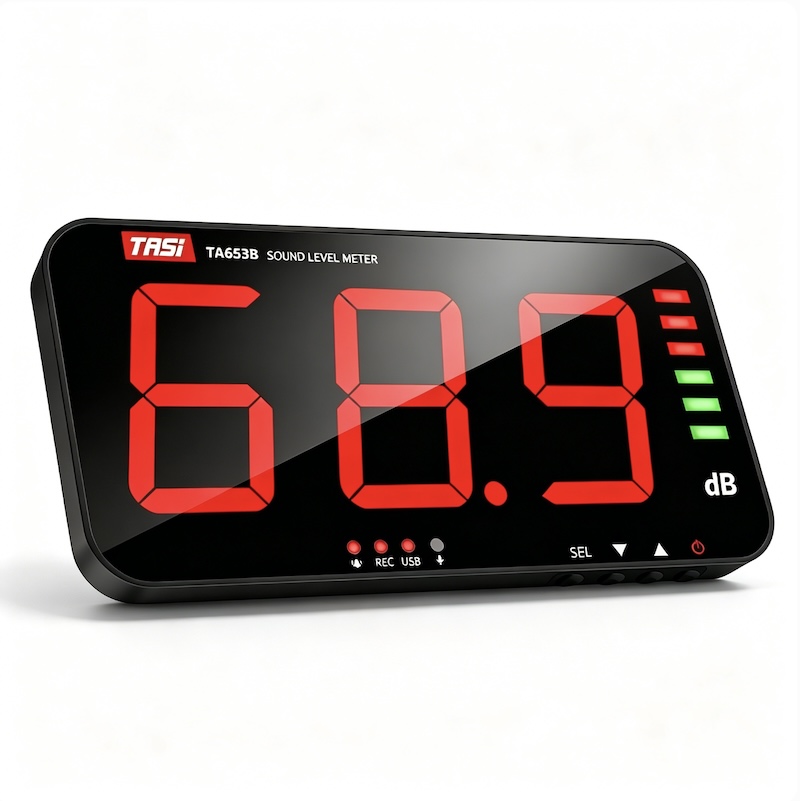
If an operator only watches the live display of a sound level meter, the highest reading may easily be missed. This is why many digital sound level meters include a MAX Hold function.
When MAX Hold is enabled, the instrument continues measuring while retaining the highest sound level detected during the measurement period. This makes it easier to identify the maximum displayed sound level without continuously watching the screen.
However, MAX Hold is primarily a maximum-reading retention function. It is not the same as standard HOLD, nor is it necessarily equivalent to a professional acoustic Peak measurement.
Key Points
● MAX Hold records the highest sound level detected during a measurement period.
● When a new reading exceeds the stored value, the MAX Hold value is updated automatically.
● Lower subsequent readings normally do not replace the stored maximum.
● MAX Hold is useful for machinery, production lines, construction work, and other fluctuating-noise applications.
● HOLD freezes the current reading, while MAX Hold continues measuring and retains the highest reading.
● MAX Hold and Peak sound level are different measurement concepts and should not be treated as interchangeable.
● For overall noise exposure or environmental noise assessment, parameters such as Leq, frequency weighting, time weighting, and measurement duration may also be required.
What Is the MAX Hold Function on a Sound Level Meter?
MAX Hold stands for Maximum Hold.
When this function is activated, the sound level meter does not stop measuring. Instead, it continuously compares each new sound level reading with the maximum value already stored.
For example, suppose the meter records the following values:
● 72.4 dB
● 76.8 dB
● 81.3 dB
● 79.6 dB
● 84.1 dB
● 77.5 dB
If MAX Hold has been active throughout the measurement, the retained value will be 84.1 dB.
Even if the sound level later falls to 77.5 dB, the maximum value normally remains at 84.1 dB until the MAX Hold function is reset, cleared, or exited.
How Does MAX Hold Work?
Functionally, MAX Hold can be regarded as a continuously operating maximum-value comparator.
After the microphone detects sound pressure, the signal is processed according to the instrument's measurement settings, such as frequency weighting and time weighting. The resulting sound level readings are then compared while MAX Hold is active.
● If the new reading is lower than the stored maximum, the displayed maximum remains unchanged.
● If the new reading is higher than the stored maximum, the new value replaces the previous maximum.
● This process continues until the measurement is stopped or the stored maximum is reset.
MAX Hold therefore does not simply freeze a single reading. It continuously searches for the highest measured value during the selected measurement period.
Why Is MAX Hold Useful in Noise Measurement?
In a relatively stable acoustic environment, sound level readings may vary only slightly, making continuous observation practical.
Many real-world sound sources, however, fluctuate significantly. A high sound level may occur only briefly. If the operator is also observing equipment operation, recording data, or moving between measurement positions, the highest reading can easily be missed.
MAX Hold helps prevent this.
For example, a machine may normally operate between 78 and 82 dB but briefly rise to 88 dB during a specific part of its operating cycle. A live display may show this higher value only momentarily, while MAX Hold retains it for later review.
The function is therefore useful when the measurement needs to answer questions such as:
● What was the highest displayed sound level during the measurement?
● What was the maximum level during machine start-up?
● Which machine produced the higher maximum reading?
● What was the highest level reached during one operating cycle?
Where Is MAX Hold Commonly Used?
MAX Hold is particularly useful where sound levels change frequently or rapidly.
● Machinery inspection: Motors, fans, compressors, pumps, machine tools, and other equipment may produce changing sound levels during operation.
● Start-up and shutdown testing: Machines may generate temporarily higher noise during starting, braking, or load transitions.
● Production-line measurement: Pressing, cutting, assembly, and conveying processes may produce repetitive high-level noise events.
● Construction environments: Drills, cutters, breakers, and other tools often generate strongly fluctuating sound levels.
● HVAC and facility maintenance: Fans, compressors, and cooling equipment may produce different sound levels under different operating conditions.
● Preliminary environmental noise checks: The function can help identify higher sound levels caused by passing vehicles or intermittent equipment operation.
MAX Hold is most suitable for quickly capturing and comparing maximum displayed values. For formal environmental or occupational noise assessment, additional parameters are normally required.
What Is the Difference Between MAX Hold and HOLD?
The names are similar, but the functions operate differently.
HOLD normally freezes the current display reading.
For example, if the meter shows 78.6 dB and HOLD is activated, the display remains at 78.6 dB even if the actual sound level changes.
MAX Hold, by contrast, continues measuring and retains the highest reading obtained.
In simple terms:
● HOLD: freezes the reading shown at that moment.
● MAX Hold: continues measuring and retains the highest reading.
HOLD is useful when an operator wants to preserve a current reading temporarily, while MAX Hold is more appropriate when the objective is to determine the highest value occurring over a period of time.
What Is the Difference Between MAX Hold and MAX?
Terminology varies between sound level meter manufacturers.
Some instruments display MAX, others use MAX Hold, and some provide combined MAX/MIN functions.
On many portable digital sound level meters, MAX and MAX Hold serve a similar purpose: storing the maximum displayed sound level during a measurement period. However, the method of updating, resetting, and displaying the stored value can differ between models.
For this reason, the exact operating behaviour should always be confirmed in the instrument's user manual.
Is MAX Hold the Same as Peak Measurement?
No.
This is an important distinction in sound measurement.
MAX Hold generally records the highest sound level produced by the instrument's normal measurement processing, which may include selected frequency weighting and time weighting.
A professional Peak sound level measurement is designed to capture very short-duration instantaneous sound-pressure peaks and uses a different measurement response.
Impact, collision, or explosive-type sounds can occur extremely quickly. A standard MAX Hold function may not fully represent the true acoustic Peak level of such events.
Therefore:
● MAX Hold identifies the highest displayed sound level during a measurement period.
● Peak measurement is intended for very short-duration sound-pressure peaks.
● If a measurement specifically requires a Peak parameter, an instrument with a dedicated Peak measurement capability should be used.
A MAX Hold value should not automatically be treated as a Peak sound level.
Is MAX Hold Affected by FAST and SLOW Time Weighting?
Normally, yes.
If a sound level meter allows the operator to select FAST or SLOW time weighting, the MAX Hold value is generally based on the sound level readings produced using the selected time weighting.
FAST responds more quickly to changes in sound level, while SLOW provides a more stable display and reacts more gradually.
As a result, the maximum value recorded from the same fluctuating sound source may differ depending on the selected time weighting.
For meaningful comparison, keep the following conditions consistent:
● Frequency weighting, such as A or C weighting;
● Time weighting, such as FAST or SLOW;
● Measurement position and distance;
● Measurement duration;
● Equipment operating condition.
How to Use MAX Hold Correctly
Exact operating procedures depend on the sound level meter model, but the general process is similar.
● Switch on the sound level meter and confirm that it is operating correctly.
● Select the required frequency weighting, such as A weighting.
● Select FAST or SLOW time weighting according to the application.
● Position the microphone at the required measurement point and keep the meter stable.
● Activate MAX or MAX Hold.
● Allow the measurement to cover the complete operating cycle or required measurement period.
● Read the retained maximum sound level after the test.
● Record the measurement settings, location, duration, and equipment operating condition for comparison.
When comparing several machines, use the same measurement configuration and similar measurement conditions.
What Should Be Considered When Using MAX Hold?
MAX Hold is simple to use, but its value is meaningful only when measurement conditions are controlled.
● Do not treat the maximum value as an average noise level. A short high-level event does not represent the entire measurement period.
● Keep measurement duration consistent. A 10-second measurement and a 10-minute measurement do not have the same probability of capturing a maximum event.
● Avoid operator interference. Touching the microphone, striking the instrument, speaking close to it, or other accidental sounds may become the recorded maximum.
● Consider background noise. A nearby sound source may produce the maximum reading instead of the equipment being tested.
● Record measurement settings. Different frequency and time weightings can produce different maximum values.
● Do not confuse MAX Hold with Peak measurement. Where Peak measurement is required, confirm that the instrument supports a dedicated Peak function.
Can MAX Hold Be Used to Determine Whether Noise Exceeds a Limit?
Not by itself.
MAX Hold is useful for identifying a high sound level occurring during a test, but many noise assessments also depend on duration, average level, equivalent continuous sound level, and the specified measurement method.
A brief high-level noise event and a high sound level maintained for several hours do not represent the same overall exposure.
Professional noise evaluation may therefore consider:
● Real-time sound level;
● Equivalent continuous sound level, Leq;
● Maximum sound level, Lmax;
● Peak sound level, Lpeak;
● Frequency weighting;
● Time weighting;
● Measurement duration.
MAX Hold should therefore be regarded as one useful measurement function rather than a complete noise-assessment method.
When Is MAX Hold Especially Useful?
MAX Hold is particularly useful when noise varies significantly and the main question is how high the sound level became.
Typical examples include:
● Measuring the highest level during motor start-up;
● Comparing the maximum sound levels of different fans;
● Checking the maximum level during a complete machine operating cycle;
● Identifying whether equipment load changes cause unusually high noise;
● Retaining the highest reading when the operator cannot continuously watch the display.
If the objective is to evaluate overall noise over time, parameters such as Leq are more appropriate.
FAQ
Q: Does the sound level meter continue measuring when MAX Hold is active?
Yes. MAX Hold normally continues measuring and updates the stored value whenever a higher reading occurs.
Q: Does MAX Hold show the loudest sound that occurred?
It shows the highest sound level recorded under the selected measurement settings and response characteristics. For extremely short impulse sounds, it may not represent the true Peak sound level.
Q: Why does the reading decrease after I exit MAX Hold?
After MAX Hold is disabled, the instrument returns to displaying the current live sound level, which may be lower than the previously stored maximum.
Q: Will MAX Hold give the same result in FAST and SLOW modes?
Not necessarily. The two time weightings respond differently to rapidly changing sound, so the maximum recorded value may differ.
Q: Can MAX Hold replace Leq?
No. MAX Hold records a maximum sound level, while Leq represents the equivalent continuous sound level over a defined measurement period.
Q: Can MAX Hold be used to compare different machines?
Yes, as a quick comparison, provided that measurement distance, position, frequency weighting, time weighting, and measurement duration are kept consistent.
Conclusion
MAX Hold is a practical function on digital sound level meters that continuously compares sound level readings and retains the highest value measured.
It is particularly useful for machinery inspection, production-line testing, equipment start-up measurements, and other applications where sound levels fluctuate significantly.
However, MAX Hold represents the highest recorded sound level and should not be confused with an average noise level or a dedicated acoustic Peak measurement. For professional noise assessment, parameters such as frequency weighting, time weighting, Leq, Peak level, and measurement duration may also need to be considered.
Understanding the purpose and limitations of MAX Hold helps ensure that this function is used correctly in noise measurement and equipment maintenance.