Introduction
In motors, rollers, conveyors, printing machines, textile equipment, and other rotating machinery, two speed parameters are commonly encountered: RPM (revolutions per minute) and linear speed.
RPM indicates how fast a component rotates, while linear speed indicates how fast its surface—or a material driven by that surface—moves. For example, knowing that a roller rotates at 500 RPM is not enough to determine the conveyor speed because the result also depends on the roller diameter.
Therefore, converting RPM to linear speed requires both rotational speed and the effective diameter or circumference of the rotating component.
Key Takeaways
● RPM represents the number of revolutions completed per minute and is commonly expressed as RPM or r/min.
● Linear speed represents distance traveled per unit time and is commonly expressed in m/min or m/s.
● RPM alone cannot be converted directly to linear speed; the rotating diameter or circumference is also required.
● The basic relationship is: linear speed = distance traveled per revolution × revolutions per minute.
● For a circular roller or shaft, the distance traveled per revolution is normally equal to its circumference: π × diameter.
● In real machinery, effective diameter, belt thickness, material thickness, deformation, and slip may affect the actual speed.
What Do RPM and Linear Speed Mean?
RPM stands for revolutions per minute and indicates how many complete revolutions a rotating component makes in one minute.
For example:
● 100 RPM means 100 revolutions per minute.
● 1,500 RPM means 1,500 revolutions per minute.
● 3,000 RPM means 3,000 revolutions per minute.
RPM describes rotational frequency only. It does not directly indicate how far the surface of the rotating component travels.
Linear speed describes the distance traveled by a point or material along its direction of motion over a given time. Common industrial units include:
● m/min: metres per minute.
● m/s: metres per second.
● ft/min: feet per minute.
● mm/s: millimetres per second.
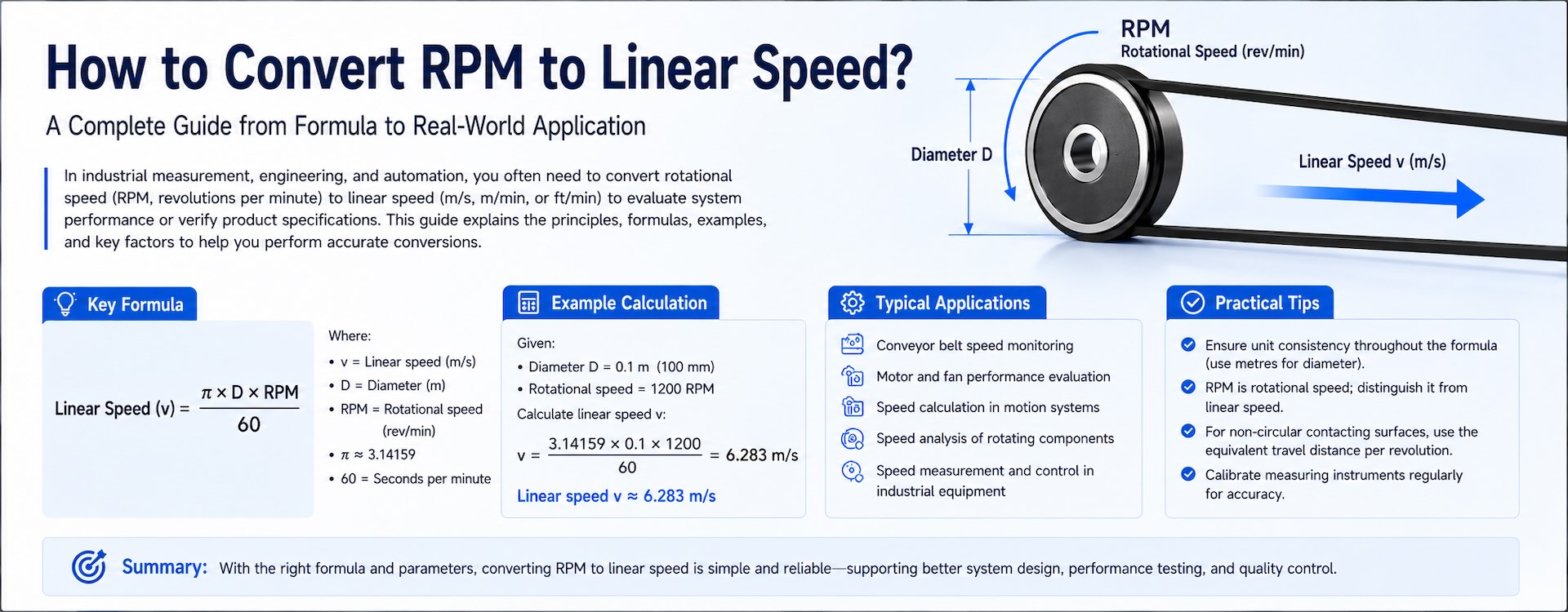
For the outer surface of a circular roller, drum, or wheel, one complete revolution corresponds theoretically to one circumference of travel. Therefore, if RPM and diameter are known, the theoretical linear speed can be calculated.
Basic Formula for Converting RPM to Linear Speed
For a circular rotating component with diameter D, the circumference is:
C = π × D
Where:
● C = circumference.
● D = diameter of the rotating component.
● π = pi, approximately 3.1416.
If the rotational speed is n RPM, the component completes n revolutions per minute. Therefore:
Linear speed = π × D × n
When D is expressed in metres:
v = π × D × n
Where:
● v = linear speed in m/min.
● D = effective diameter in metres.
● n = rotational speed in RPM.
Example: a roller with a diameter of 0.1 m rotates at 500 RPM.
v = 3.1416 × 0.1 × 500
v ≈ 157.08 m/min
The theoretical surface speed of the roller is therefore approximately 157.08 m/min.
How to Convert RPM to m/min
Converting RPM to metres per minute is one of the most common calculations in industrial applications.
The process is:
● Determine the rotational speed in RPM.
● Measure or obtain the effective diameter of the roller, drum, or wheel.
● Convert the diameter to metres.
● Calculate π × diameter × RPM.
Example: a conveyor drum has a diameter of 200 mm and rotates at 120 RPM.
Convert the diameter:
200 mm = 0.2 m
Calculate the circumference:
3.1416 × 0.2 ≈ 0.6283 m
The drum surface therefore travels theoretically about 0.6283 m per revolution.
Multiply by RPM:
0.6283 × 120 ≈ 75.40 m/min
The theoretical linear speed is therefore:
75.4 m/min
How to Convert RPM to m/s
To obtain metres per second, the m/min value can be divided by 60.
The formula is:
v = π × D × n ÷ 60
Where:
● v = linear speed in m/s.
● D = diameter in metres.
● n = rotational speed in RPM.
Example: a 100 mm diameter wheel rotates at 600 RPM.
Convert the diameter:
100 mm = 0.1 m
Calculate:
v = 3.1416 × 0.1 × 600 ÷ 60
v ≈ 3.14 m/s
The theoretical linear speed is therefore approximately:
3.14 m/s
Expressed in m/min:
3.14 × 60 ≈ 188.5 m/min
Both values describe the same physical speed in different units.
How to Calculate Linear Speed When Circumference Is Known
If the actual circumference or travel distance per revolution is already known, there is no need to calculate it from the diameter.
Use:
v = C × n
Where:
● v = linear speed.
● C = distance traveled per revolution.
● n = rotational speed in RPM.
For example, if a measuring wheel has a circumference of 0.5 m and rotates at 200 RPM:
v = 0.5 × 200
v = 100 m/min
The corresponding linear speed is therefore 100 m/min.
In practical machinery, using a known effective circumference can sometimes provide a more representative value than relying only on nominal diameter.
Why Can the Same RPM Produce Different Linear Speeds?
The same RPM does not necessarily mean the same linear speed because linear speed also depends on diameter.
Consider two rollers rotating at 500 RPM:
● Roller A: diameter 50 mm.
● Roller B: diameter 200 mm.
For Roller A:
v = 3.1416 × 0.05 × 500 ≈ 78.54 m/min
For Roller B:
v = 3.1416 × 0.2 × 500 ≈ 314.16 m/min
Both rollers rotate at 500 RPM, but Roller B has four times the diameter and therefore four times the theoretical surface speed.
This is why RPM alone is insufficient when evaluating conveyors, rollers, wheels, or similar equipment.
Why Is Diameter Critical When Converting RPM to Linear Speed?
RPM describes the number of rotations, while the distance traveled during each rotation depends on the circumference.
A larger diameter produces a larger circumference. At the same RPM, a larger rotating component therefore travels a greater surface distance per minute.
In general:
● At constant RPM, increasing diameter increases linear speed.
● At constant diameter, increasing RPM increases linear speed.
● If both RPM and diameter change, the calculation must be updated.
In practical applications, the relevant value is normally the effective working diameter, which may differ from the nominal diameter shown on a drawing or specification.
Why Can Actual Linear Speed Differ from the Calculated Value?
The RPM-to-linear-speed formula gives a theoretical result based on ideal geometry. Actual machine speed may differ for several reasons.
Common factors include:
● Slip: Relative movement between a drive roller and belt or material can cause the actual material speed to be lower than the theoretical value.
● Effective diameter changes: Rubber rollers may deform under load, changing their working diameter.
● Material thickness: On winding and unwinding systems, the effective radius changes as material builds up or is removed.
● Belt thickness: The belt itself may increase the effective running radius above the bare pulley diameter.
● Diameter measurement error: Because linear speed is directly proportional to diameter, diameter error directly affects the calculated result.
● RPM fluctuation: Load changes, drive control, or mechanical conditions may cause rotational speed to vary.
Where accuracy is important, theoretical calculations are useful for design and estimation, but actual operating speed should be verified by direct measurement when possible.
Can RPM Be Used Directly to Calculate the Speed of Winding Equipment?
Special care is required.
For a fixed-diameter roller, RPM can be converted to linear speed relatively easily because the diameter remains essentially constant.
However, in rewinders, unwinders, cable reels, paper rolls, film rolls, and textile machinery, the effective diameter changes continuously as material is wound or unwound.
At a constant 100 RPM:
● A smaller roll diameter produces a lower linear speed.
● As roll diameter increases, linear speed increases even if RPM remains unchanged.
For processes that require constant linear speed, the control system normally has to adjust RPM continuously as the roll diameter changes.
A single fixed diameter should therefore not be used for the entire calculation when the effective roll diameter varies during operation.
How to Calculate RPM from Linear Speed
The relationship can also be rearranged to calculate rotational speed from a known linear speed.
Use:
n = v ÷ (π × D)
Where:
● n = rotational speed in RPM.
● v = linear speed in m/min.
● D = diameter in metres.
Example: a conveyor requires a linear speed of 60 m/min and uses a drive drum with a diameter of 150 mm.
Convert the diameter:
150 mm = 0.15 m
Calculate:
n = 60 ÷ (3.1416 × 0.15)
n ≈ 127.3 RPM
Ignoring slip and other losses, the drum therefore needs to rotate at approximately 127 RPM.
This calculation is commonly used in conveyor design, gearbox ratio selection, and production-line speed setting.
How Can a Tachometer Be Used to Determine Linear Speed?
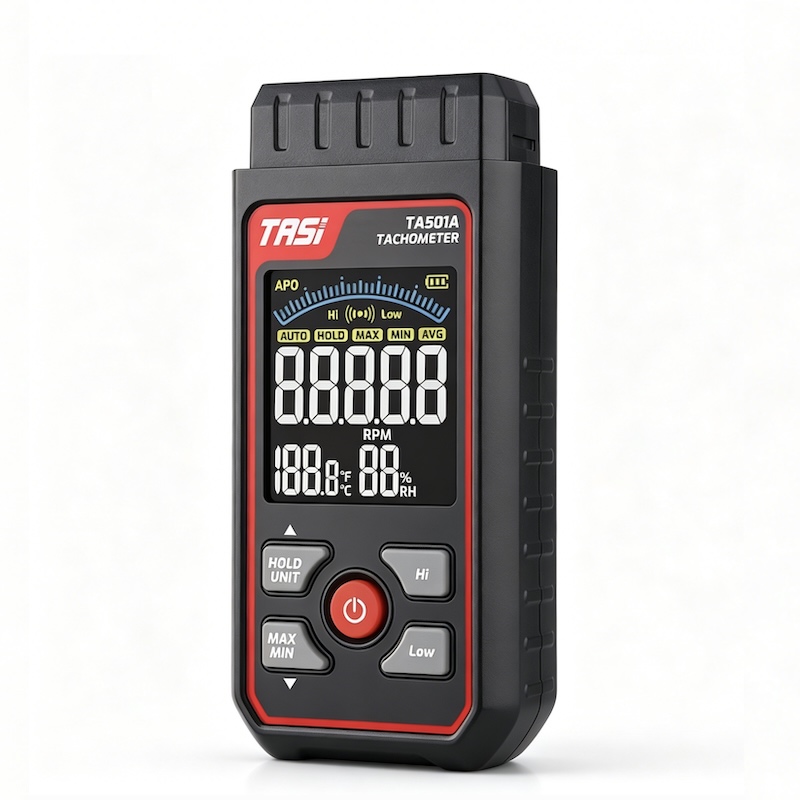
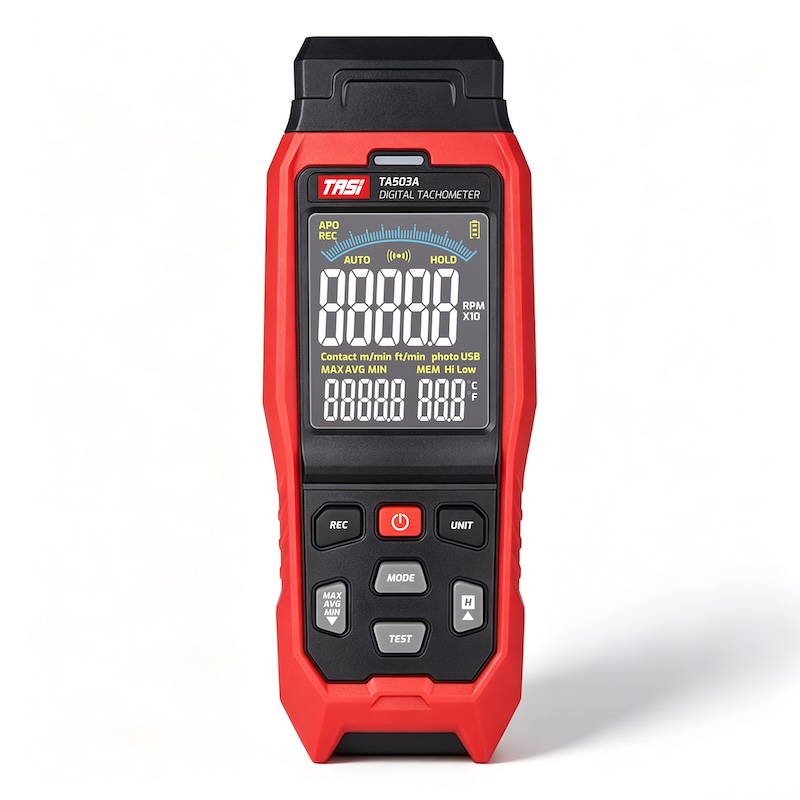
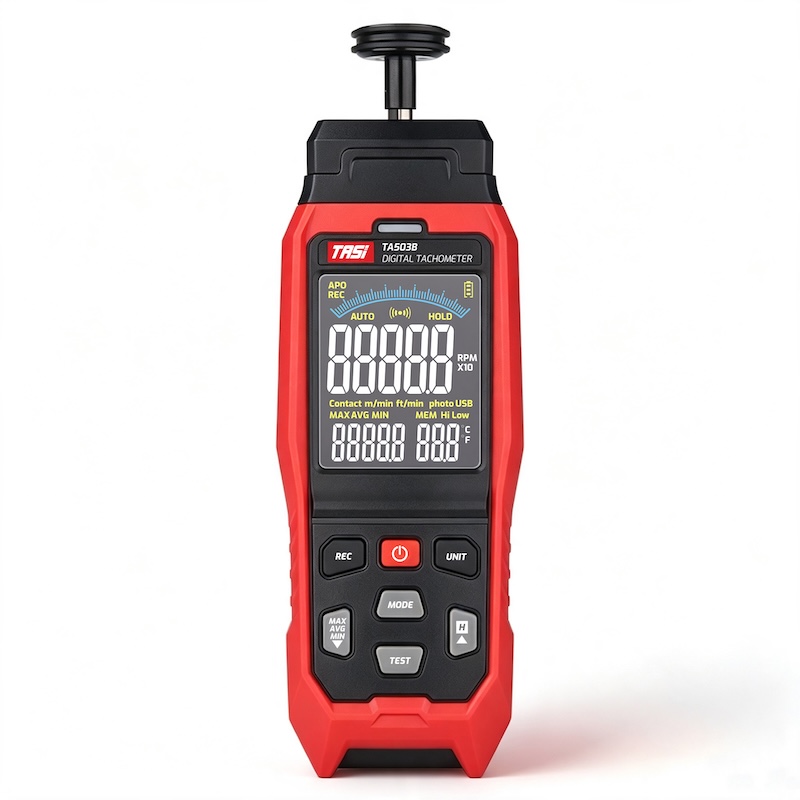
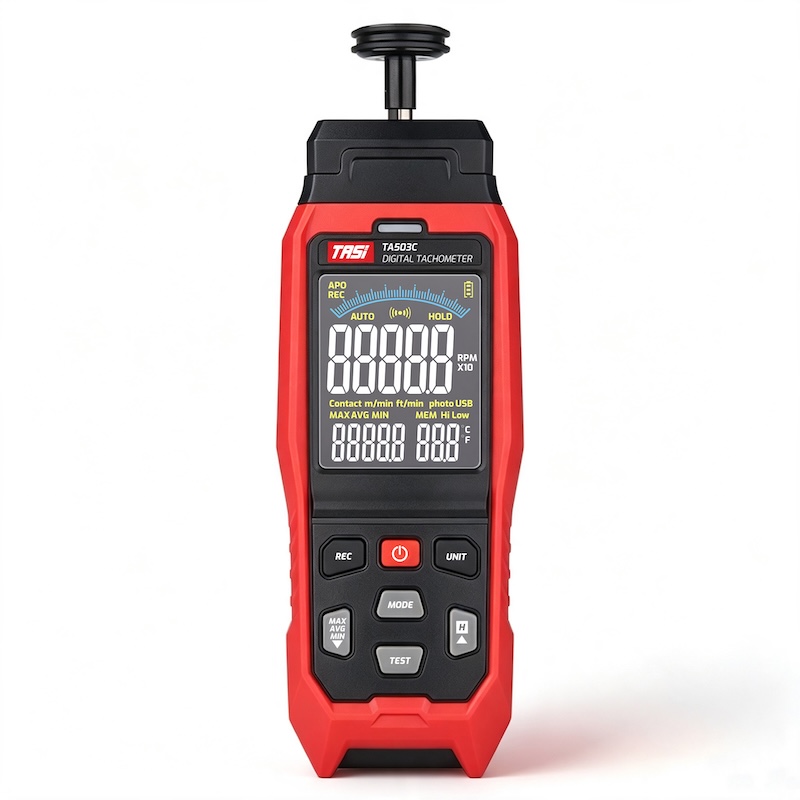
Digital tachometers are generally available in non-contact and contact types.
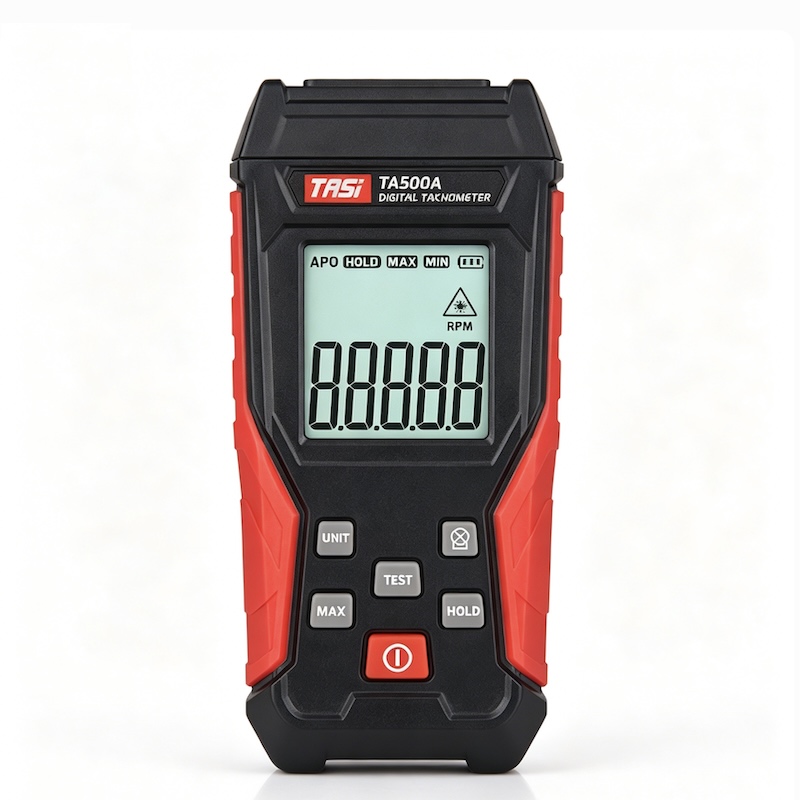
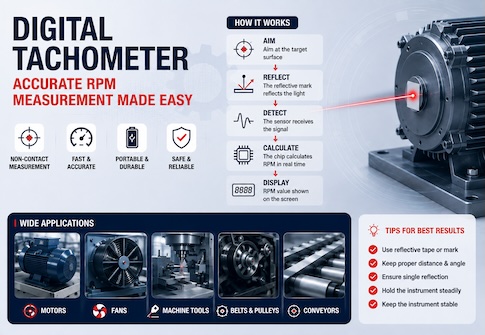
A non-contact tachometer measures rotational speed optically or with a laser. If the instrument displays only RPM, linear speed can be calculated using the measured RPM and the effective diameter of the rotating component.
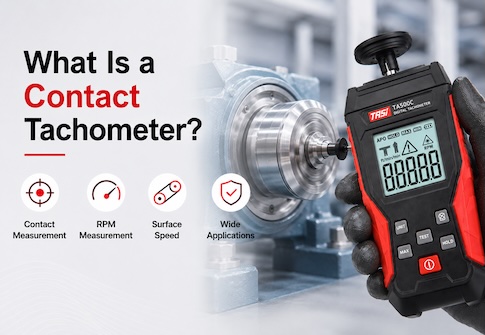
A contact tachometer measures RPM by physically contacting the rotating component. Some contact tachometers also support direct surface-speed measurement when used with a dedicated measuring wheel, allowing values such as m/min or m/s to be measured directly.
In practice:
● For motor shafts, fans, or rotating components, RPM measurement is usually sufficient.
● If roller diameter is known, linear speed can be estimated from RPM.
● For conveyor belts, paper, film, cable, or other moving materials, direct surface-speed measurement may provide a more representative result.
● Where significant slip exists, drive-shaft RPM may not represent the actual material speed.
What Units Should Be Checked When Converting RPM to Linear Speed?
Unit consistency is one of the most common sources of calculation errors.
If diameter is entered in metres:
v = π × D × RPM
the result is directly obtained in m/min.
If diameter is entered in millimetres, use:
v = π × D × RPM ÷ 1000
where D is in millimetres and v is in m/min.
Example:
D = 50 mm
n = 1,000 RPM
v = 3.1416 × 50 × 1,000 ÷ 1000
v ≈ 157.08 m/min
Before calculating, confirm:
● Whether diameter is expressed in mm, cm, or m.
● Whether the required result is m/min or m/s.
● Whether rotational speed is actually expressed in RPM.
● Whether the diameter used is nominal or the actual effective working diameter.
FAQ
Can RPM be converted directly to m/min?
Not from RPM alone. RPM describes rotational speed, while m/min describes linear speed. The diameter, radius, circumference, or travel distance per revolution is also required.
How many m/min is 1,000 RPM?
There is no single answer. A 50 mm diameter wheel at 1,000 RPM has a theoretical surface speed of about 157.1 m/min, while a 100 mm wheel at the same RPM has a speed of about 314.2 m/min.
Does higher RPM always mean higher linear speed?
Yes, if the effective diameter remains constant. When comparing components with different diameters, RPM alone cannot determine which has the higher linear speed.
Should radius or diameter be used in the formula?
The common formula v = π × D × n uses diameter D. If radius r is used instead, the equivalent formula is v = 2 × π × r × n.
Why does the calculated conveyor speed differ from the actual speed?
Possible causes include belt slip, pulley diameter tolerance, belt thickness, roller deformation, and RPM fluctuations. Direct measurement of the belt or material may be preferable when actual operating speed is required.
Can a non-contact tachometer measure m/min directly?
It depends on the instrument. Many non-contact tachometers primarily measure RPM, requiring linear speed to be calculated from diameter. Some instruments may include conversion functions; the product specification should be checked.
Conclusion
RPM and linear speed describe different aspects of motion. RPM indicates how many revolutions occur per minute, while linear speed indicates how far a surface or material travels in a given time.
For a fixed-diameter roller, drum, or wheel, the fundamental relationship is:
Linear speed = π × effective diameter × RPM
When diameter is expressed in metres, the result is obtained in m/min. Divide by 60 to convert m/min to m/s.
In practical applications, effective diameter, belt or material thickness, roller deformation, and mechanical slip should also be considered. RPM-based calculations are highly useful for fixed-diameter systems and engineering estimates, while direct linear-speed measurement is generally more representative when slip or changing roll diameter is involved.