Introduction
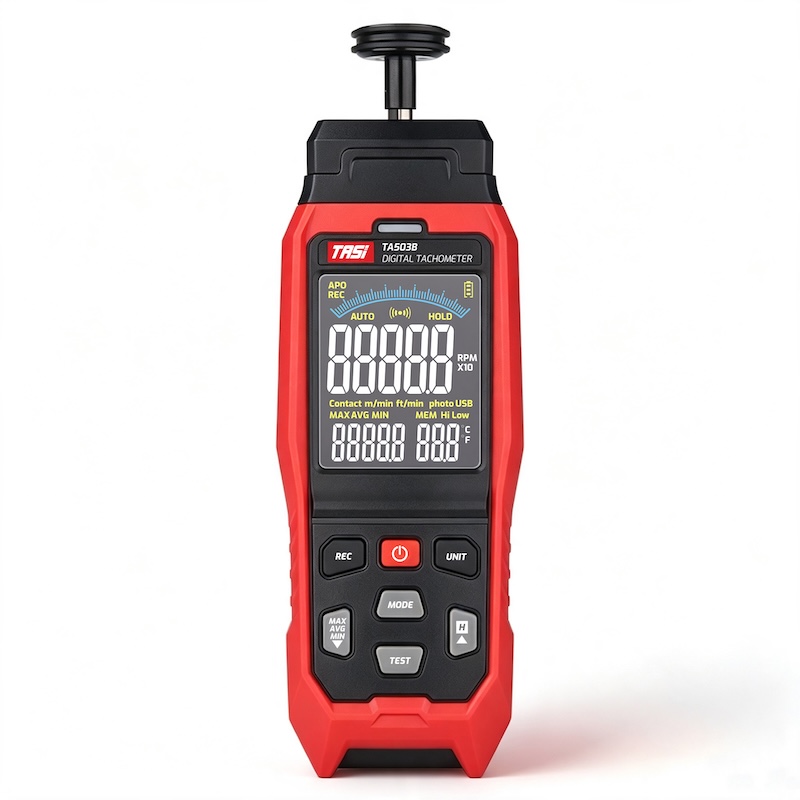
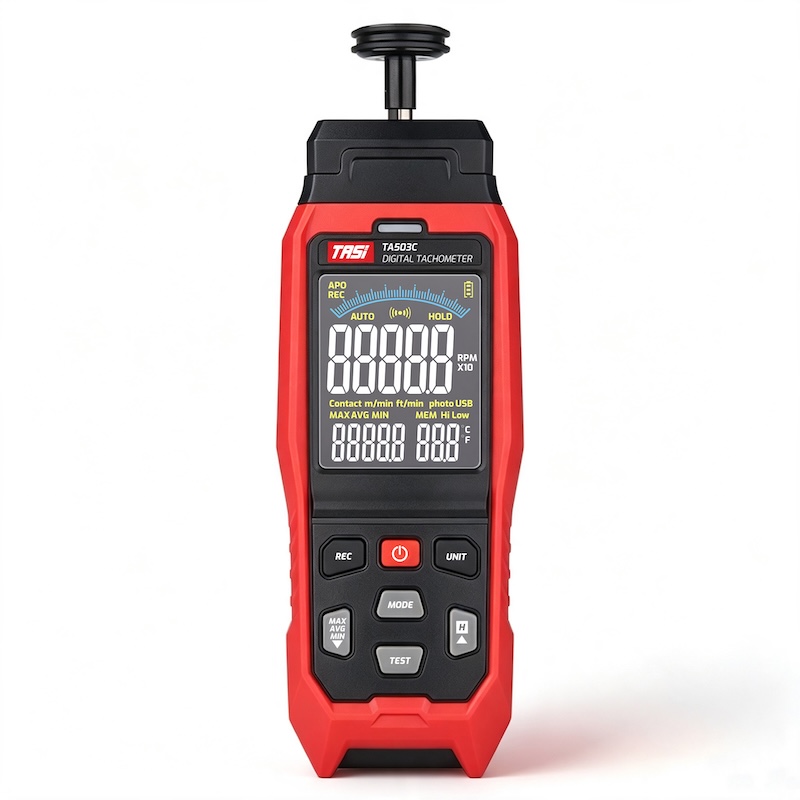
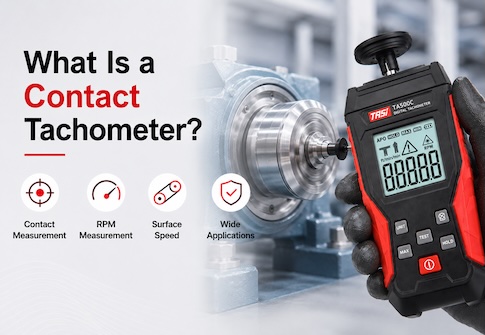
A contact tachometer measures rotational speed or surface speed through direct mechanical contact with a moving component. Unlike a non-contact tachometer, it normally does not require reflective tape or an optical signal, but the measuring attachment must remain in stable contact with the target.
Correct operating technique is important not only for measurement accuracy but also for operator safety. When measuring motor shafts, fan shafts, rollers, or other rotating components, the correct attachment, contact point, alignment, and applied pressure must all be considered to prevent slipping or excessive loading of the rotating part.
Key Points
● A contact tachometer must physically contact the rotating shaft or moving surface.
● Select the correct contact tip according to the shape of the shaft end when measuring RPM.
● A dedicated measuring wheel is normally required for surface speed measurement.
● Keep the instrument properly aligned to minimize side loading and slippage.
● Apply only enough pressure to maintain stable contact.
● Record the result only after the displayed value has stabilized.
● For high-speed, exposed, or hazardous rotating parts, confirm that contact measurement can be performed safely before starting.
What Should Be Checked Before Measurement?
Before using a contact tachometer, inspect both the instrument and its measuring accessories.
● Check the contact tip, measuring wheel, and attachment points for wear, looseness, or damage.
● Make sure the battery level is sufficient and that the display and controls operate normally.
● Select the correct measurement mode, such as RPM or surface speed.
● Choose the appropriate contact tip or measuring wheel for the application.
● Confirm that the expected rotational or surface speed is within the instrument's specified measuring range.
A worn or contaminated measuring attachment can slip against the target and cause unstable or low readings. Clean or replace damaged accessories before measurement when necessary.
How Do You Measure the Speed of a Rotating Shaft?
When measuring the rotational speed of a motor shaft, drive shaft, or similar component, use a contact tip suited to the shaft-end geometry.
● Switch on the tachometer and select RPM mode.
● Install the appropriate contact tip and make sure it is securely fitted.
● Allow the machine to reach stable operating speed.
● Align the contact tip with the center of the rotating shaft.
● Move the tachometer gradually toward the shaft until stable contact is established.
● Keep the instrument aligned with the shaft axis and avoid excessive angular or lateral movement.
● Wait until the display stabilizes, then record the RPM value.
The contact tip should be positioned as close as possible to the center of the shaft end. Significant misalignment can cause vibration, slipping, unstable readings, and increased operating risk.
For high-speed shafts, do not press the contact tip abruptly against the rotating surface. Establish contact smoothly while maintaining firm control of the instrument.
How Much Contact Pressure Should Be Applied?
More pressure does not necessarily produce a more accurate measurement.
The correct approach is to apply only enough force to keep the contact tip engaged with the rotating shaft without slipping.
If the pressure is too low, the contact tip may slip and the reading may fluctuate or indicate a value below the actual speed. Excessive pressure can add unnecessary load to the rotating system, accelerate wear of the measuring attachment, and potentially affect the operating speed of small motors or low-power equipment.
Once the reading is stable and no slippage is occurring, additional pressure should be avoided.
How Do You Measure Surface Speed?
Contact tachometers equipped with a measuring wheel can be used to measure the surface speed of conveyors, rollers, wire, paper, and other continuously moving materials.
● Install the compatible measuring wheel.
● Select the required surface speed mode and measurement unit.
● Place the measuring wheel gently against the moving surface.
● Align the wheel so that it rotates in the same direction as the target movement.
● Keep the wheel rolling steadily without lateral slipping.
● Wait for the displayed value to stabilize before recording the result.
The wheel must rotate synchronously with the target surface. If the wheel slips, the displayed value may appear stable but still be inaccurate.
Why Is Alignment Important?
When measuring shaft speed, the contact tip should be positioned as close as possible to the shaft centerline, with the applied force directed along the shaft axis.
If the tachometer is significantly tilted, additional side force is introduced at the contact point. This increases the risk of slipping, vibration, and unstable readings.
For surface speed measurement, the measuring wheel should rotate naturally in the direction of movement. A large angle between the wheel and the moving surface can cause sideways slippage and measurement error.
When Should the Reading Be Recorded?
The displayed value may change briefly when the contact tip first touches the rotating component. The initial reading should therefore not normally be recorded immediately.
Maintain stable alignment and consistent contact pressure until the reading settles.
If the tachometer provides functions such as Data Hold, Maximum, Minimum, or Average, these can be used according to the measurement requirement. Operating procedures may differ by model, so the product manual should be followed.
For applications requiring greater confidence in the result, repeat the measurement under the same conditions and compare the readings for consistency.
What Are Common Contact Tachometer Operating Errors?
● Contacting away from the shaft center: This can cause vibration or slipping and reduce reading stability.
● Applying excessive pressure: This may increase mechanical load and accelerate accessory wear.
● Applying insufficient pressure: The contact tip can slip, resulting in a reading lower than the actual speed.
● Holding the instrument at an excessive angle: Side loading can reduce contact stability.
● Allowing the measuring wheel to slip sideways: This can introduce significant error in surface speed measurements.
● Using the wrong attachment: Different shaft shapes and applications require the correct contact tip or measuring wheel.
● Recording the value before stabilization: The initial transient reading may not represent the actual operating speed.
● Ignoring accessory wear: Worn contact tips or wheels can change the friction characteristics and effective dimensions of the attachment, affecting measurement results.
What Safety Precautions Should Be Followed?
Because a contact tachometer must approach and physically touch moving machinery, contact measurement generally requires greater attention to operator safety than non-contact measurement.
● Confirm that there is sufficient working space around the rotating component.
● Keep loose clothing, long hair, gloves, and other objects away from exposed rotating parts.
● Never touch a rotating shaft, coupling, belt, pulley, or impeller by hand.
● Do not attempt contact measurement on components that are unstable, vibrating excessively, or unsafe to access.
● For very high-speed equipment, inaccessible shaft ends, or machinery with protective guarding, a non-contact tachometer may be the safer measurement method.
● After measurement, move the tachometer completely away from the rotating component before changing modes, adjusting accessories, or performing other operations.
The specified measurement range of the tachometer does not automatically mean that every machine operating within that range can be measured safely by contact. Machine design, rotational speed, guarding, access, and the working environment must also be considered.
FAQ
Can a contact tachometer be used directly on a motor shaft?
Yes, provided that the shaft end has a suitable contact point and can be approached safely. Keep the contact tip centered on the shaft and apply only the pressure required for stable contact.
Why does the tachometer reading keep changing?
Common causes include inconsistent contact pressure, off-center positioning, contact tip slippage, actual speed variation, or worn measuring accessories. Check the mechanical contact first.
Does pressing harder improve accuracy?
No. Excessive pressure can add load to the machine and affect its actual speed. Apply only enough force to prevent slipping and maintain a stable reading.
Can a contact tachometer measure conveyor belt speed?
Yes, if the instrument supports surface speed measurement and a suitable measuring wheel is installed. The wheel must roll in the direction of belt movement without slipping.
Is a contact tachometer suitable for high-speed equipment?
It depends on the application. Where the rotating part cannot be approached safely, the shaft end is inaccessible, or the speed is very high, a non-contact tachometer is normally more appropriate.
How should I choose between a contact and non-contact tachometer?
Use a contact tachometer when the shaft end can be accessed safely and direct RPM or surface speed measurement is required. Use a non-contact tachometer when the equipment is high-speed, difficult to access, guarded, or unsuitable for direct mechanical contact.
Conclusion
Correct use of a contact tachometer depends on selecting the appropriate measuring attachment, maintaining proper alignment, and applying stable but moderate contact pressure.
For rotational speed measurement, keep the contact tip centered on the shaft. For surface speed measurement, make sure the measuring wheel rolls smoothly in the direction of travel without slipping. Record the result only after the display has stabilized.
Because contact measurement requires close access to moving machinery, safety must always take priority. Where direct contact cannot be performed safely, a non-contact tachometer should be considered instead.