Introduction
In motors, fans, rollers, conveyor systems, textile machinery, printing equipment, and other rotating machinery, two speed units are commonly encountered: RPM and m/min.
RPM indicates how many complete revolutions a rotating component makes per minute, whereas m/min indicates how many metres an object or surface moves in one minute. Although both describe operating speed, they represent different forms of motion and cannot be compared directly without additional information.
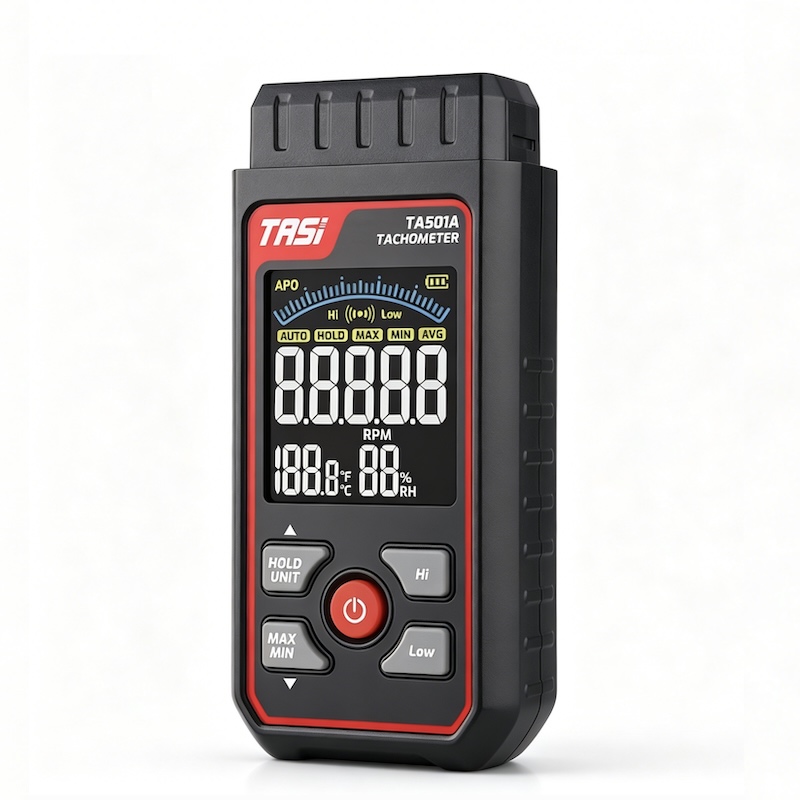
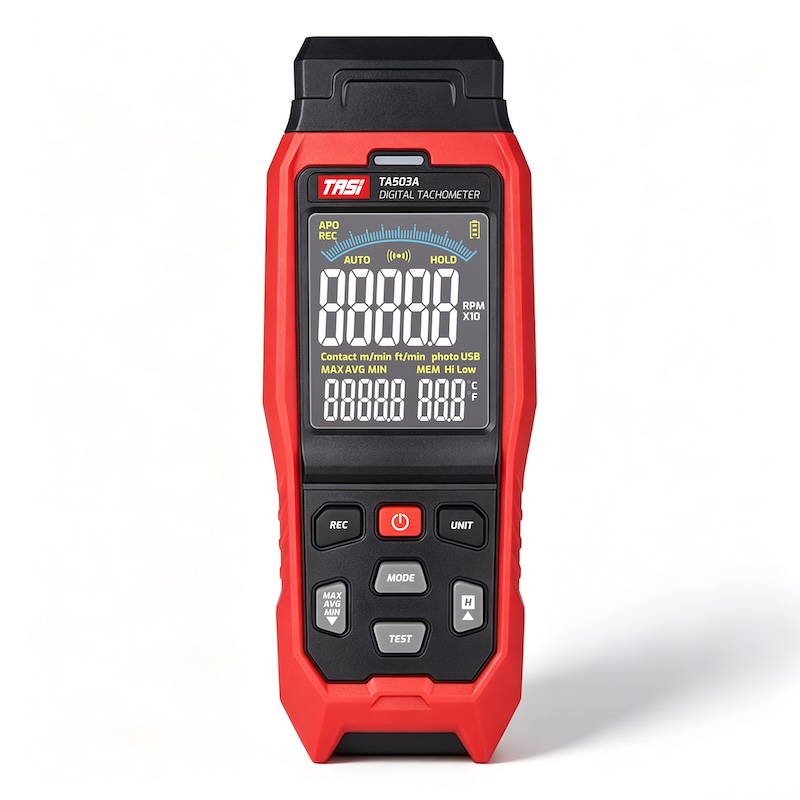
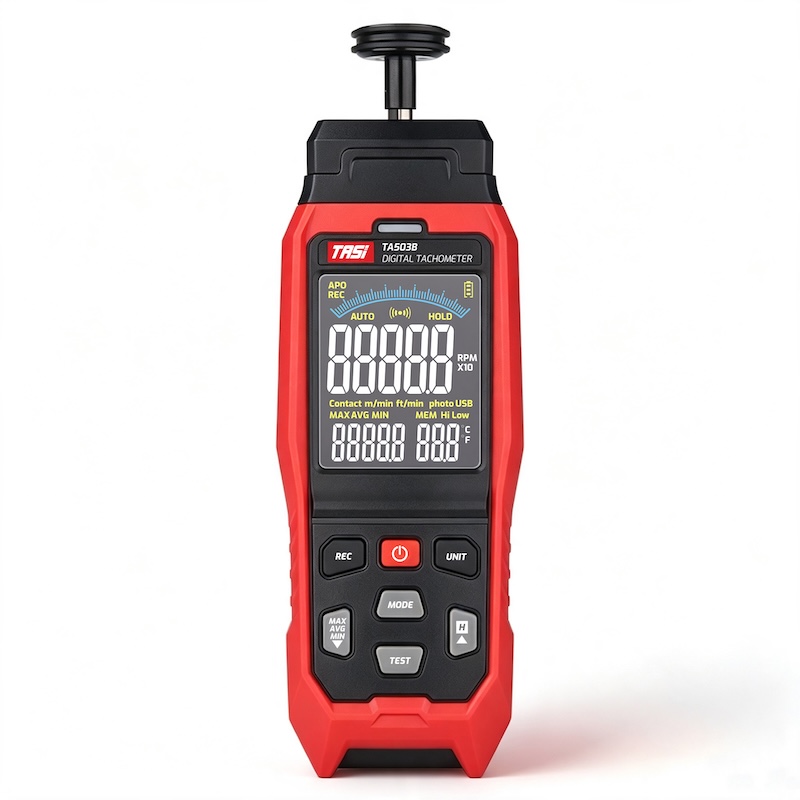
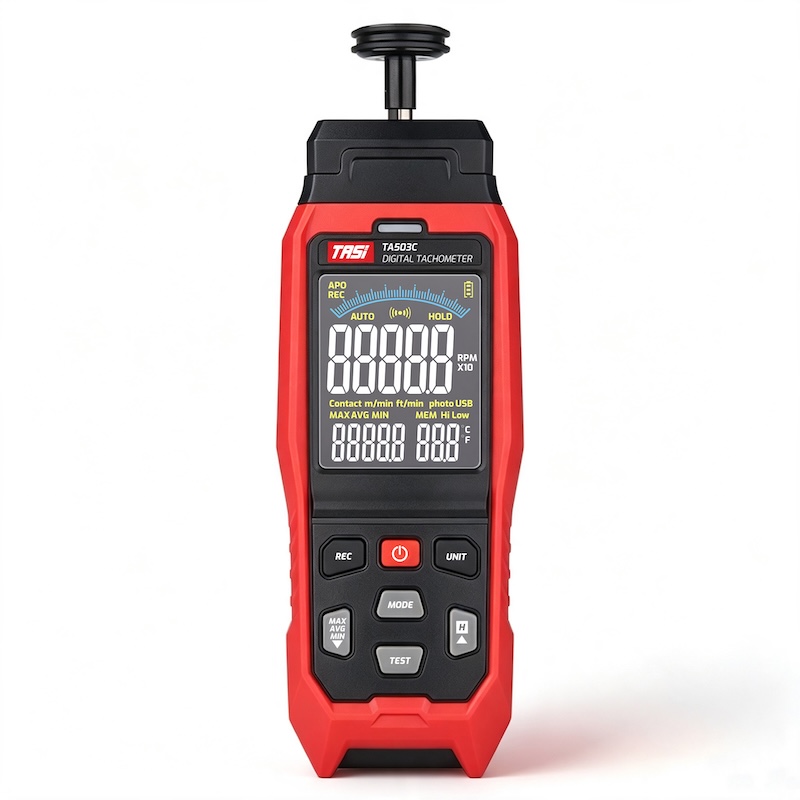
When the diameter of a rotating component is known, rotational speed can be converted into linear speed using its circumference. This is also why many contact tachometers can measure not only RPM but also linear speed in m/min when fitted with a measuring wheel.
Key Takeaways
● RPM represents rotational speed, or the number of revolutions completed per minute.
● m/min represents linear speed, or the distance travelled per minute.
● There is no fixed conversion factor between RPM and m/min; the effective diameter or circumference of the rotating component must also be known.
● At the same RPM, a larger roller diameter produces a higher surface linear speed.
● Non-contact tachometers are mainly used for RPM measurement, while contact tachometers with measuring wheels can directly measure linear speed such as m/min.
● In conveying, winding, printing, and textile applications, linear speed is often as important as rotational speed.
What Is RPM?
RPM stands for Revolutions Per Minute. It indicates how many complete revolutions a rotating component makes in one minute.
For example:
● A motor shaft operating at 1,500 RPM completes 1,500 revolutions per minute.
● A fan running at 3,000 RPM completes 3,000 revolutions per minute.
● A roller operating at 100 RPM completes 100 revolutions per minute.
RPM is therefore primarily used to describe rotational motion and is commonly applied to:
● Motors;
● Fans and blowers;
● Pumps;
● Machine-tool spindles;
● Engines;
● Rollers;
● Pulleys;
● Gears and drive shafts.
Photoelectric or laser non-contact tachometers typically determine RPM by detecting a periodic optical signal generated once per revolution.
What Is m/min?
m/min means metres per minute and is a unit of linear speed.
It indicates the distance an object travels along a path in one minute.
For example, if a conveyor belt operates at 60 m/min, the belt surface theoretically travels 60 metres every minute.
m/min is commonly used for:
● Conveyor belt speed;
● Roller surface speed;
● Paper transport speed;
● Printing line speed;
● Wire and cable production speed;
● Textile feed speed;
● Film processing and winding speed;
● Continuous processing of timber, panels, and similar materials.
Unlike RPM, m/min describes actual travel distance rather than the number of rotations.
What Is the Main Difference Between RPM and m/min?
The fundamental difference is the type of motion being described.
● RPM describes rotational motion.
● m/min describes linear motion or tangential surface speed.
Consider a roller rotating at 100 RPM.
Knowing only that the roller operates at 100 RPM tells us that it completes 100 revolutions per minute. It does not tell us how far the roller surface travels during that time.
That depends on the roller diameter.
For example:
● Roller A has a diameter of 50 mm.
● Roller B has a diameter of 200 mm.
If both rotate at 100 RPM, Roller B has a much greater circumference and therefore a substantially higher surface speed.
For this reason, the same RPM does not necessarily mean the same linear speed.
How Is RPM Converted to m/min?
For circular components such as rollers, wheels, and pulleys, theoretical linear speed can be calculated from circumference.
The basic relationship is:
Linear speed = Circumference × Revolutions per minute
The circumference is:
Circumference = π × Diameter
Therefore:
v = π × D × n
Where:
● v = linear speed in m/min;
● D = rotating component diameter in metres;
● n = rotational speed in RPM;
● π ≈ 3.1416.
If the diameter is specified in millimetres:
v = π × D × n ÷ 1000
Here, D is in mm and the resulting v is in m/min.
Example: Converting RPM to m/min
Assume a roller has a diameter of 100 mm and rotates at 500 RPM.
Its circumference is approximately:
3.1416 × 100 = 314.16 mm
or:
0.31416 m
At 500 revolutions per minute:
0.31416 × 500 = 157.08 m/min
Therefore:
A 100 mm diameter roller operating at 500 RPM has a theoretical surface speed of approximately 157.1 m/min.
This example also shows that roller diameter directly affects linear speed even when RPM remains unchanged.
Why Can the Same RPM Produce Different Linear Speeds?
Different diameters produce different circumferences, so each revolution covers a different linear distance.
For example, consider a 50 mm roller and a 100 mm roller, both rotating at 100 RPM.
For the 50 mm roller:
3.1416 × 50 × 100 ÷ 1000 ≈ 15.71 m/min
For the 100 mm roller:
3.1416 × 100 × 100 ÷ 1000 ≈ 31.42 m/min
Although their rotational speeds are identical, the larger roller has approximately twice the surface speed.
Therefore, RPM alone does not always provide a complete indication of actual machine or process speed.
Why Do Some Applications Use RPM While Others Use m/min?
The appropriate parameter depends on what needs to be monitored or controlled.
For motors, spindles, fans, and similar equipment, rotational speed is usually the primary concern, so RPM is commonly used.
Typical examples include:
● Checking whether a motor reaches its expected operating speed;
● Verifying fan speed;
● Measuring machine-tool spindle speed;
● Comparing the speeds of drive and driven shafts.
For conveying, winding, or continuous processing equipment, the actual movement of the material is often more important, so m/min is commonly used.
Typical examples include:
● Conveyor belt speed;
● Paper feed speed in printing equipment;
● Cable pulling speed;
● Film winding speed;
● Textile feed speed.
In simple terms, RPM indicates how fast a component rotates, while m/min indicates how fast a surface or material travels.
How Does a Tachometer Measure RPM?
RPM can be measured using either contact or non-contact methods.
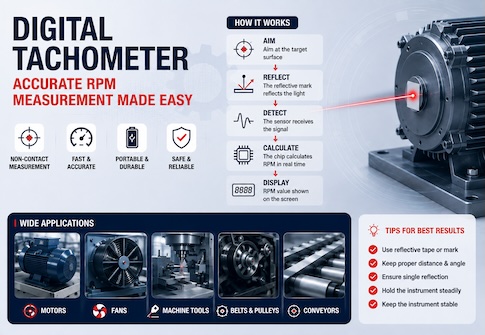
A non-contact tachometer typically uses photoelectric or laser reflection. A reflective marker is applied to the rotating target, and the instrument detects the repeating reflected signal to calculate RPM.
This method is suitable for:
● Motor shafts;
● Fans;
● Pulleys;
● Spindles;
● High-speed rotating components;
● Components that should not be contacted directly.
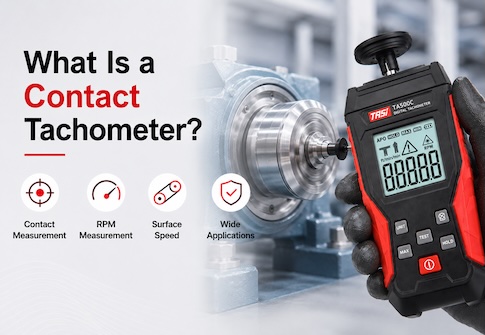
A contact tachometer measures RPM by placing a contact tip against the centre of a rotating shaft and mechanically detecting its rotation.
How Does a Tachometer Measure m/min?
Contact tachometers with linear-speed capability normally use a dedicated measuring wheel.
The measuring wheel is placed against moving surfaces such as:
● Conveyor belts;
● Drive rollers;
● Paper;
● Cables;
● Wire;
● Roller surfaces.
As the target moves, it turns the measuring wheel. Because the wheel circumference is known, the instrument can calculate the distance travelled per unit time and display linear speed in units such as:
● m/min;
● m/s;
● ft/min.
The principle is essentially the same relationship between rotational speed and wheel circumference.
Does Linear Speed Calculated from RPM Always Equal the Actual Speed?
Not necessarily.
A value calculated from RPM and diameter represents theoretical linear speed. In practical machinery, several factors may cause a difference between calculated and actual speed.
● Belt slip: The surface speed of a drive pulley may differ from the actual belt speed.
● Roller slip: Relative movement can occur between a roller and the material being transported.
● Changing effective diameter: In winding applications, roll diameter changes continuously as material accumulates.
● Mechanical deformation: Rubber wheels and soft rollers may deform under pressure, changing their effective rolling diameter.
● Measurement position: Different points in a transmission system may have different speed relationships.
When the actual speed of a conveyor belt, paper web, cable, or other moving material is important, direct linear-speed measurement with a contact measuring wheel is often more representative than calculation from shaft RPM alone.
Why Is RPM Alone Insufficient for Winding Applications?
Winding equipment provides a clear example of the difference between RPM and linear speed.
Suppose a winding reel maintains a constant RPM.
As more material is wound onto the reel, its outside diameter increases.
Because:
Linear speed = π × Diameter × RPM
an increasing diameter causes the surface linear speed to rise even when RPM remains unchanged.
For film, paper, cable, and textile winding systems, maintaining a constant material speed therefore requires RPM to be adjusted as the roll diameter changes.
This is one reason why industrial control systems may monitor both rotational and linear speed.
Should You Measure RPM or m/min?
The correct parameter depends on the measurement objective.
● Measure RPM when you need to know how many revolutions per minute a motor shaft, spindle, fan, or roller completes.
● Measure m/min when you need to know how far a conveyor belt, paper web, cable, or material actually travels per minute.
● Measure both when analysing the relationship between roller rotation and material transport speed.
● Where belt slip, roller slip, or changing roll diameter is possible, RPM alone may not accurately represent actual linear speed.
Understanding the difference helps prevent the assumption that a normal shaft RPM automatically means the process or conveyor speed is also correct.
FAQ
Are RPM and m/min the same type of speed unit?
No. RPM represents the number of revolutions per minute and describes rotational speed, while m/min represents metres travelled per minute and describes linear speed.
Can RPM be converted directly to m/min?
Not from RPM alone. The effective diameter or circumference of the rotating wheel, roller, or other component must also be known.
At the same RPM, does a larger roller have a higher linear speed?
Yes. Assuming no slip, a larger roller has a greater circumference and therefore a higher surface speed at the same RPM.
Can a non-contact tachometer directly measure m/min?
Most photoelectric or laser non-contact tachometers are primarily designed for RPM measurement. Some instruments may provide additional calculation functions, but direct linear-speed measurement is normally performed using a contact measuring wheel.
Why can a contact tachometer measure m/min?
Its measuring wheel has a known diameter or circumference. By measuring how many times the wheel rotates while in contact with a moving surface, the instrument calculates the distance travelled per unit time.
Why can the m/min calculated from roller RPM differ from the actual conveyor belt speed?
Possible causes include belt slip, roller slip, effective-diameter errors, mechanical deformation, and differences in measurement position.
Conclusion
RPM and m/min both describe machine operating speed, but they represent different physical quantities.
RPM indicates how many revolutions a rotating component completes per minute, while m/min indicates how many metres an object or surface travels per minute.
For circular rotating components, the relationship is:
Linear speed (m/min) = π × Diameter (m) × Rotational speed (RPM)
The same RPM therefore does not necessarily produce the same linear speed because component diameter is also a determining factor.
RPM is generally more relevant for motors, fans, shafts, and spindles, while m/min is often more useful in conveying, printing, textile, cable, and winding processes. Correctly distinguishing between these parameters helps provide a more accurate assessment of machine condition and process speed.