Introduction
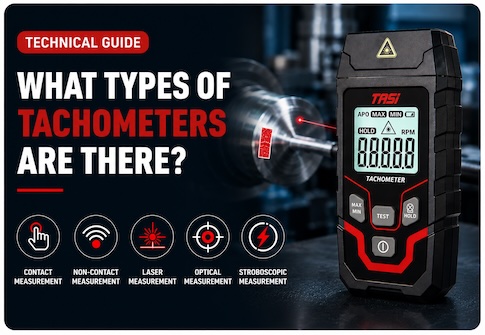
Rotational speed is an important parameter for evaluating the operating condition of motors, fans, shafts, rollers, pulleys, and many other types of rotating machinery. Depending on the measurement method, digital tachometers are generally divided into non-contact tachometers and contact tachometers.
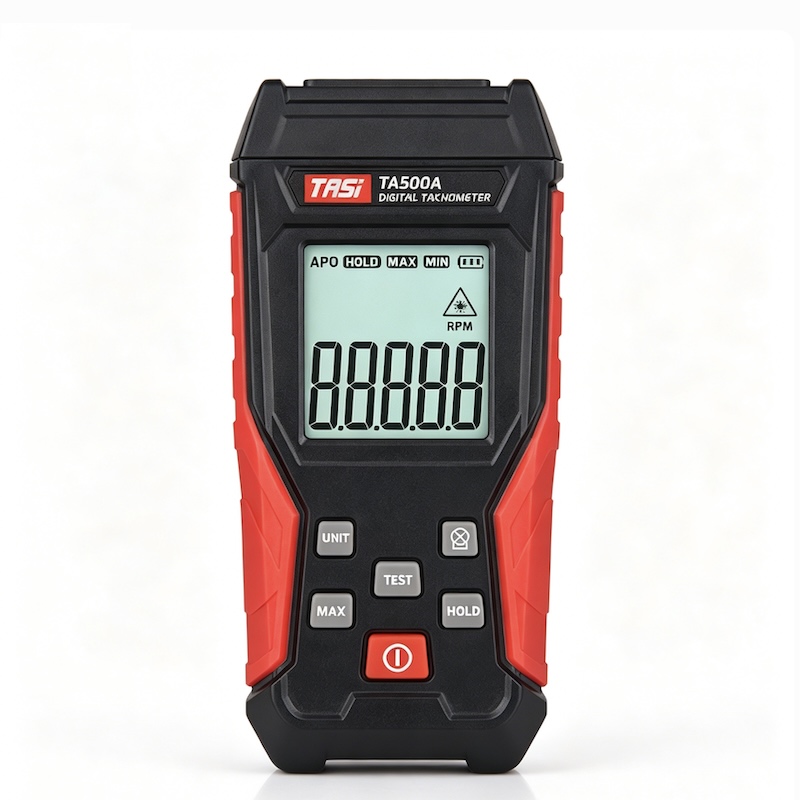
Both can measure rotational speed, but their measurement principles and operating methods are significantly different. A non-contact tachometer normally detects optical or laser reflection signals without physically touching the rotating component. A contact tachometer, by comparison, uses a contact tip or measuring wheel that must directly touch the target.
For this reason, neither technology is universally “better.” The correct choice depends on the equipment design, rotational speed range, measurement safety, and whether surface linear speed also needs to be measured.
Key Takeaways
● Non-contact tachometers measure rotational speed using optical or laser reflection without touching the rotating component.
● Contact tachometers use a contact tip or measuring wheel that physically touches a shaft, roller, or moving surface.
● High-speed, hazardous, or difficult-to-reach rotating equipment is generally better suited to non-contact measurement.
● Low-speed shafts, rollers, and applications requiring surface linear-speed measurement are often better suited to contact tachometers.
● The best choice depends on the target, available access, safe working distance, and required measurement parameters.
Key Differences Between Non-Contact and Contact Tachometers
The fundamental difference between the two types of tachometers is whether physical contact with the rotating component is required during measurement.
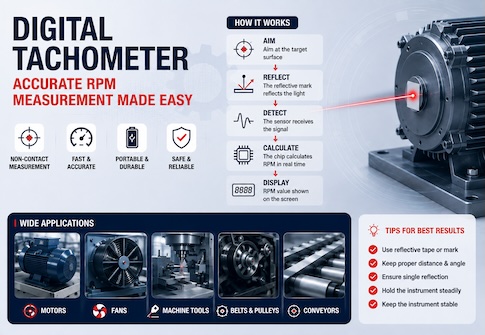
● Non-contact tachometer: Typically directs a light beam at a reflective mark on the rotating object and detects the periodic reflected signal. Rotational speed is calculated from the number of detected pulses over a given time.
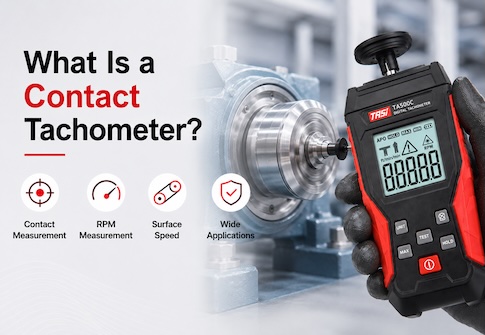
● Contact tachometer: Uses a conical tip, concave tip, or measuring wheel in direct contact with a rotating shaft, roller, or other moving component. The instrument calculates rotational or linear speed from the rotation of the contact attachment.
In simple terms, a non-contact tachometer reads a repeating rotational signal from a distance, while a contact tachometer follows the motion of the target mechanically.
| Comparison | Non-Contact Tachometer | Contact Tachometer |
|---|---|---|
| Measurement method | Optical/laser reflection | Mechanical contact |
| Physical contact required | No | Yes |
| Typical targets | Motor shafts, fans, impellers, spindles | Shafts, rollers, belts, moving surfaces |
| High-speed measurement | Generally advantageous | Contact safety must be considered |
| Measurement in confined areas | Depends on optical access | Depends on physical access |
| Reflective tape | Usually required | Not required |
| Surface linear-speed measurement | Usually not the primary function | Possible with a measuring wheel |
| Safe operating distance | Greater | Shorter |
How Does a Non-Contact Tachometer Measure Speed?
Non-contact tachometers typically operate using the photoelectric reflection principle. In most applications, a clearly identifiable reflective marker, such as reflective tape, is attached to a rotating shaft, disc, or other rotating component.
The tachometer directs light toward the rotating part. Each time the reflective marker passes through the measurement point, a distinct reflected signal is detected. The instrument counts these signals over a defined period and converts them into RPM (revolutions per minute).
For example, if a rotating shaft has one effective reflective mark, each detected reflection corresponds to one complete revolution.
The main advantage is that no physical contact with the equipment is required, making this method particularly suitable for:
● High-speed motor shafts and spindles;
● Fans, impellers, and other components that are difficult to contact safely;
● Locations with mechanical pinch or entanglement hazards;
● Equipment that should be measured from a safer distance;
● Applications where the measuring instrument should not mechanically influence the rotating component.
How Does a Contact Tachometer Measure Speed?
A contact tachometer uses a mechanical attachment that directly touches the target.
For shaft-speed measurement, a conical or concave contact tip is typically installed and positioned steadily against the center of the rotating shaft. As the shaft rotates, it drives the tachometer attachment, allowing the instrument to calculate RPM from the attachment's rotational speed.
Some contact tachometers can also be fitted with a measuring wheel. When the wheel is placed against a belt, roller, or moving material, the instrument calculates surface speed from the wheel's rotation.
With an appropriate measuring wheel, a contact tachometer can therefore be used not only for rotational speed but also for:
● Belt speed;
● Conveyor surface speed;
● Roller circumferential speed;
● Cable and wire travel speed;
● Linear speed of other moving mechanical surfaces.
This is one of the main functional advantages of contact tachometers over conventional non-contact models.
What Is the Difference in Measurement Safety?
From an operator-safety perspective, non-contact measurement generally offers a clear advantage.
A non-contact tachometer can measure from a certain distance, so the operator does not need to place the instrument directly against a high-speed rotating shaft. This reduces the need for hands and measuring equipment to approach moving machinery.
A contact tachometer, however, must remain physically engaged with the target. When measuring high-speed shafts, exposed couplings, or mechanically complex equipment, additional attention must be paid to rotating parts, pinch points, and nearby structures.
This does not mean contact tachometers are inherently unsafe. Where a clearly defined contact point is available, the speed is appropriate, and sufficient working space is provided, contact measurement remains practical and effective.
For high-speed or hazardous rotating components, however, non-contact measurement should normally be considered first.
Which Type Should Be Used for High-Speed Equipment?
For high-speed motors, machine-tool spindles, high-speed fans, and similar machinery, a non-contact tachometer is generally the preferred option.
The main reason is not simply that non-contact instruments may support high RPM values. More importantly, direct mechanical contact becomes more difficult and potentially hazardous as rotational speed increases.
For reliable non-contact measurement, ensure that:
● The target area provides a detectable reflected signal;
● The reflective tape or marker is correctly installed;
● The tachometer is within its specified measurement distance;
● The light beam remains steadily aligned with the measurement area.
When these conditions are met, high-speed rotational measurements can be performed without touching the shaft.
Which Type Should Be Used for Low-Speed Shafts?
For simple low-speed shafts that can be accessed safely, either method may be suitable.
If the shaft is easily accessible and provides a clear, stable center contact point, a contact tachometer can be particularly straightforward because no reflective tape is required.
If personnel should not approach the rotating component while the equipment is operating, or if protective structures surround the shaft, a non-contact tachometer may be more appropriate.
Low speed therefore does not automatically mean that a contact tachometer should be used. Equipment design and safety conditions remain the determining factors.
Which Type Should Be Used for Belt or Conveyor Speed?
If the required measurement is not RPM but the linear speed of a belt, conveyor, roller, or moving material, a contact tachometer with a measuring wheel is generally the more suitable choice.
When the measuring wheel is placed directly against the moving surface, the instrument calculates travel distance from wheel rotation and can display linear speed in units such as m/min or ft/min, depending on the model.
A conventional non-contact tachometer primarily detects periodic rotational signals and therefore does not normally provide a direct surface linear-speed measurement.
When selecting an instrument for this type of application, confirm that it supports contact linear-speed measurement and the required measurement units.
Does Reflective Tape Affect Non-Contact Tachometer Measurement?
Reflective tape plays an important role in non-contact rotational-speed measurement.
The tachometer must detect a clear periodic optical change as the target rotates. If the surface itself does not provide a sufficiently strong and repeatable reflection difference, reflective tape is used to create a reliable measurement marker.
When applying reflective tape:
● Position it where it can consistently pass through the measurement beam;
● Ensure sufficient optical contrast between the reflective area and surrounding surface;
● Keep the mounting surface clean and free from oil and dust;
● For standard RPM measurement, one effective reflective mark is normally used;
● Avoid nearby highly reflective surfaces that could generate false signals.
Where reflective material cannot conveniently be attached, a contact tachometer may be more practical.
Which Type of Tachometer Is More Accurate?
It is not correct to assume that either contact or non-contact tachometers are inherently more accurate.
Measurement performance first depends on the instrument's specified accuracy, resolution, and measurement range, as well as the actual measurement conditions.
Non-contact measurements can be affected by:
● Incorrect reflective-tape placement;
● Poor beam alignment;
● Incorrect measuring distance;
● Other highly reflective surfaces nearby;
● Vibration causing unstable reflected signals.
Contact measurements can be affected by:
● Misalignment between the contact tip and shaft axis;
● Unstable contact pressure;
● Slippage of the contact attachment;
● Slippage between a measuring wheel and the moving surface;
● Changes in contact angle during measurement.
Correct instrument selection and proper operating technique are therefore often more important than choosing between contact and non-contact technology alone.
When Is a Non-Contact Tachometer the Better Choice?
A non-contact tachometer is generally preferable when:
● The equipment operates at relatively high speed;
● Direct contact with the rotating component is difficult or undesirable;
● A greater working distance from rotating machinery is preferred;
● Reflective tape can be applied to the measurement surface;
● RPM is the primary measurement requirement;
● Mechanical influence from the measuring instrument should be avoided.
Typical applications include motor maintenance, fan testing, pump inspection, machine-tool spindle measurement, impeller measurement, and routine inspection of industrial rotating machinery.
When Is a Contact Tachometer the Better Choice?
A contact tachometer is often suitable when:
● The shaft has a convenient and safe contact point;
● Reflective tape cannot easily be installed;
● Low-speed shafts need to be measured directly;
● Roller or wheel rotational speed needs to be measured;
● Surface linear speed is required in addition to RPM;
● Belts, conveyors, or other moving surfaces need to be checked.
Contact measurement is therefore particularly useful for mechanical maintenance, production-equipment setup, and conveyor-system inspection.
How to Choose Between the Two Types
Start by identifying exactly what needs to be measured rather than comparing instrument specifications alone.
● High-speed motors, fans, or spindles: Give priority to a non-contact tachometer.
● Exposed shafts that can be contacted safely: Either method may be suitable depending on site conditions.
● Rotating parts that should not be approached: Choose non-contact measurement.
● Reflective tape cannot be installed: Consider a contact tachometer.
● Belt or conveyor linear speed is required: Choose a contact tachometer with a suitable measuring wheel.
● Multiple types of targets are encountered: Consider a combination digital tachometer supporting both contact and non-contact measurement.
In addition to measurement method, verify that the instrument's measurement range, accuracy, resolution, measuring distance, display functions, and linear-speed capability meet the application requirements.
FAQ
Is a non-contact tachometer always better than a contact tachometer?
No. Non-contact models are advantageous for high-speed or difficult-to-contact machinery, while contact models are convenient for accessible shafts and linear-speed measurement. The correct choice depends on the application.
Does a non-contact tachometer require reflective tape?
Most photoelectric non-contact tachometers require a clearly identifiable reflective marker. Reflective tape is normally needed when the target surface cannot provide a stable reflected signal by itself.
Can a contact tachometer measure belt speed?
Yes, if the instrument supports a measuring wheel and linear-speed measurement. The wheel can be placed against the belt or moving surface to determine surface speed.
Which type should be used for a high-speed motor?
A non-contact tachometer is generally preferred because it does not require the measuring instrument to touch the high-speed rotating shaft, allowing a greater working distance and reducing contact-related risk.
Can RPM readings from contact and non-contact tachometers be compared directly?
Yes, provided both instruments are operating correctly, the measurement method is appropriate, and the same rotating component is being measured. Differences may still occur because of instrument accuracy and measurement conditions.
Are there tachometers that support both measurement methods?
Yes. Some digital tachometers support both optical non-contact and mechanical contact measurement, making them suitable for users who work with different types of rotating machinery and linear-speed applications.
Conclusion
The main difference between non-contact and contact tachometers is whether the instrument must physically touch the rotating component during measurement.
Non-contact tachometers use optical or laser reflection signals and are particularly suitable for high-speed, hazardous, or difficult-to-access rotating equipment. Contact tachometers obtain mechanical motion directly through a contact tip or measuring wheel and are well suited to accessible shafts, rollers, belts, conveyors, and other linear-speed applications.
When selecting a tachometer, first determine whether the application requires rotational speed or linear speed, then consider equipment speed, mechanical configuration, safe operating distance, reflective-tape installation, and available working space.
For industrial maintenance and equipment inspection involving a wide variety of targets, a digital tachometer that supports both contact and non-contact measurement can provide greater flexibility.