Introduction
A digital tachometer is a commonly used measuring instrument for determining the rotational speed of motors, fans, shafts, pulleys, rollers, and other rotating equipment. Measurement results are normally expressed in RPM, or revolutions per minute.
Digital tachometers vary significantly in measurement principle, range, accuracy, resolution, working distance, and available functions. Selecting an instrument simply because it offers a high maximum RPM does not necessarily mean it is suitable for the intended application.
For example, a high-speed motor that cannot be approached safely is generally better measured with a non-contact tachometer. A contact tachometer may be more suitable for low-speed shafts or when measuring the surface speed of rollers. Where both measurement methods are regularly required, a combination contact/non-contact tachometer may provide greater flexibility.
The correct selection process should therefore begin with the actual measurement object and operating conditions before considering individual instrument specifications.
Key Points
When selecting a digital tachometer, consider the following factors:
● Measurement method: contact, non-contact, or both;
● Measurement target: motor shaft, fan, pulley, roller, or another rotating component;
● Speed range: expected minimum and maximum operating speed;
● Accuracy: required performance for maintenance, adjustment, or laboratory testing;
● Resolution: particularly important at low rotational speeds or when small speed changes must be observed;
● Measuring distance: important for optical and laser non-contact tachometers;
● Reflective target conditions: optical tachometers require a clear and stable reflected signal;
● Required functions: HOLD, maximum, minimum, average, memory, and related functions;
● Operating environment: vibration, dust, strong ambient light, confined spaces, and exposed high-speed rotating parts;
● Frequency of use: occasional inspection and professional routine maintenance may require different levels of durability and usability.
Decide Between Contact and Non-Contact Measurement First
The first step when selecting a digital tachometer is determining how the speed should be measured.
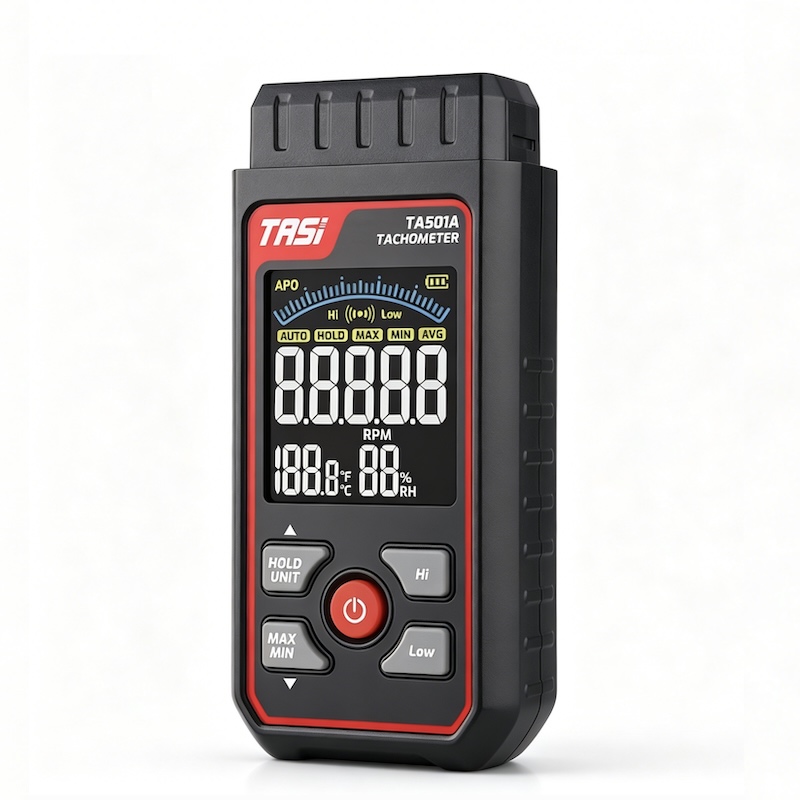
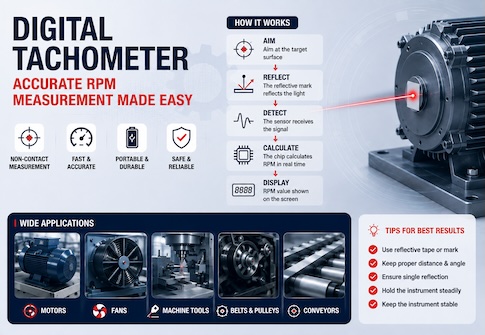
A non-contact digital tachometer normally uses an optical or laser-assisted reflective measurement method. A reflective mark is applied to the rotating component, and the instrument calculates rotational speed by detecting the frequency of the reflected signal.
This method is particularly suitable for:
● High-speed rotating equipment;
● Shafts that cannot be contacted conveniently;
● Fans, motors, centrifuges, and similar equipment;
● Applications where the measuring instrument must not introduce mechanical load;
● Situations where a safe distance from the rotating component is preferred.
Because the sensor does not physically contact the rotating part, non-contact measurement is widely used for high-speed equipment and routine industrial maintenance.
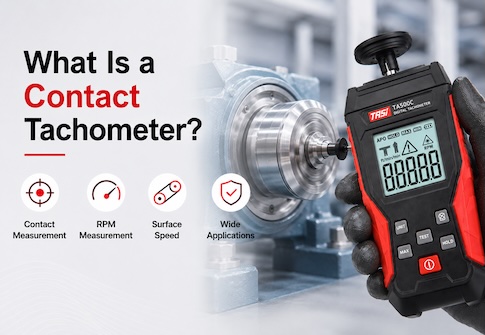
A contact digital tachometer uses a contact tip or measuring wheel that physically touches the rotating shaft or moving surface. Rotational or linear speed is calculated from the resulting mechanical movement.
It is particularly suitable for:
● Low- or medium-speed shafts that can be contacted safely;
● Rollers, conveyors, and other surface-speed applications;
● Measurements requiring units such as m/min or ft/min;
● Rotating components where reflective tape cannot be applied conveniently.
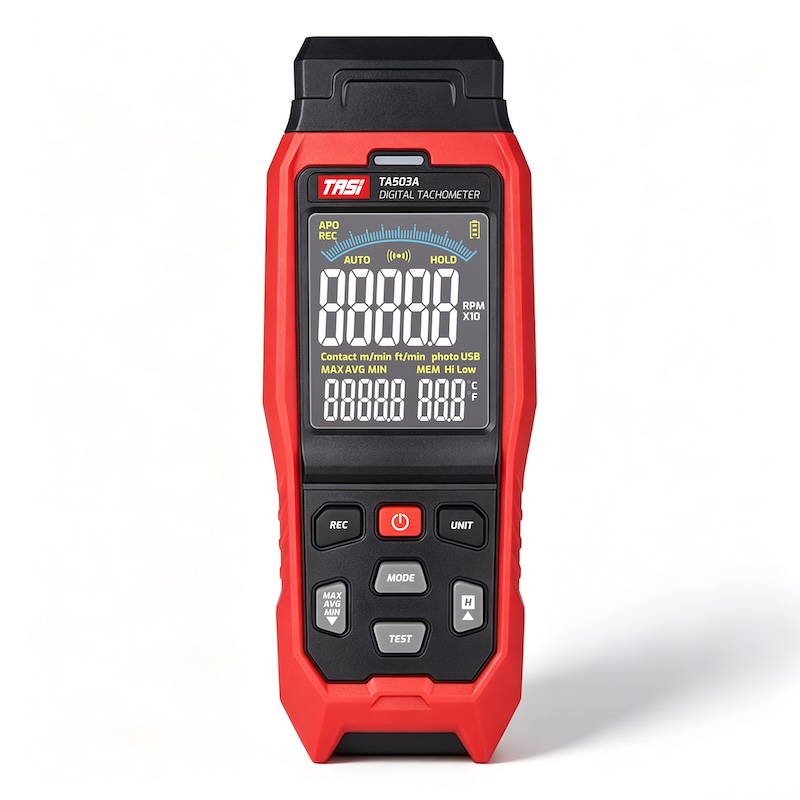
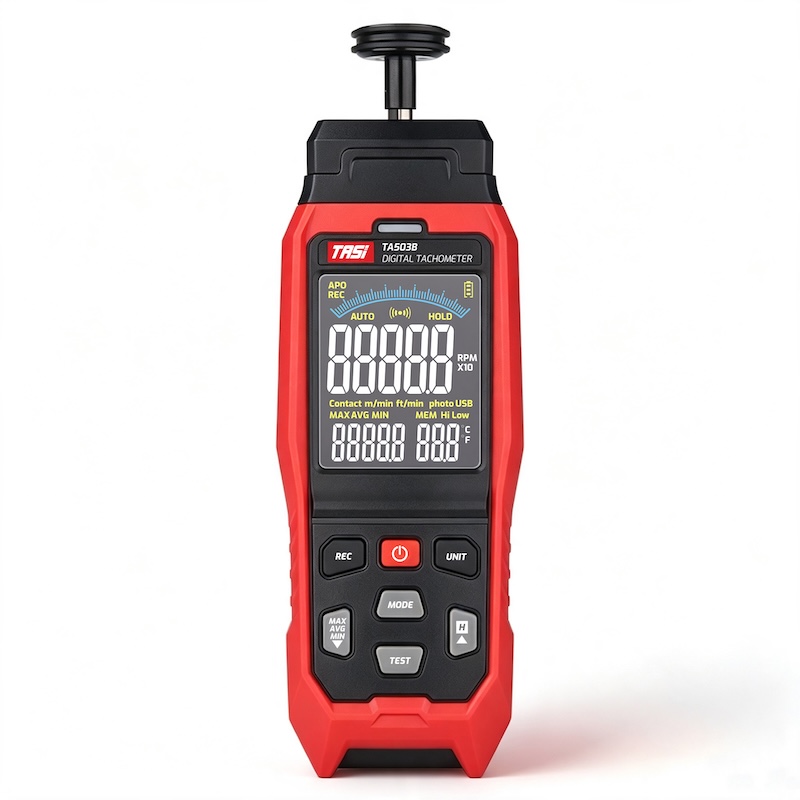
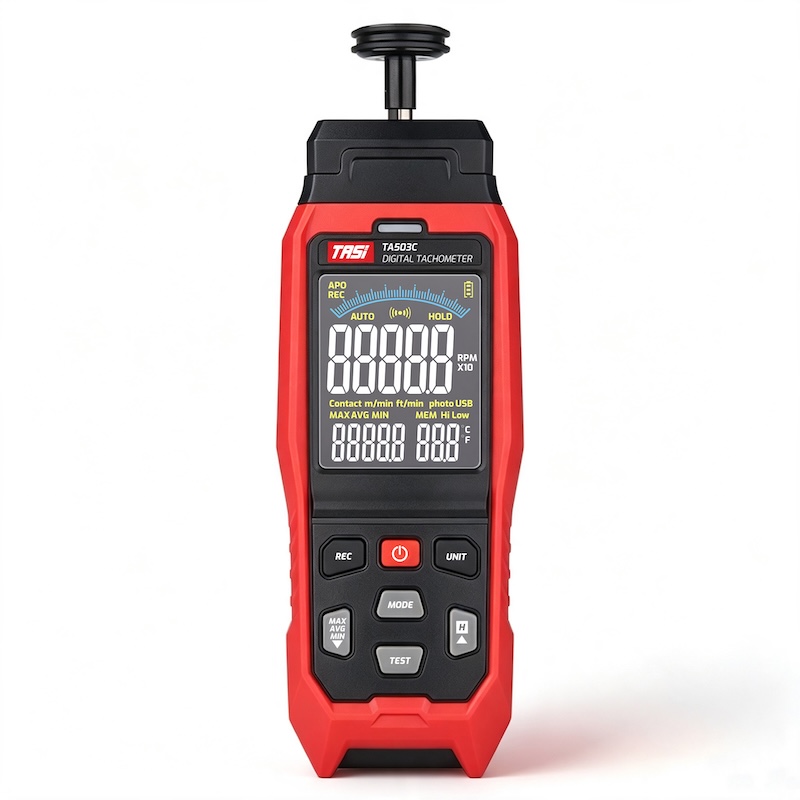
If both motor RPM and roller surface speed need to be measured regularly, a combined contact and non-contact digital tachometer can reduce the need to carry separate instruments.
Choose the Measurement Method According to the Equipment
The mechanical design of the equipment often determines the most suitable measurement method.
For example, when measuring a motor output shaft, direct contact may be inconvenient if the shaft rotates at high speed or is located close to couplings, guards, or other mechanical components. In this case, non-contact measurement is generally preferable.
Fans, impellers, and other high-speed rotating equipment are also typically better suited to non-contact tachometers.
For rollers, conveyors, and similar machinery, a contact tachometer with a measuring wheel can be more practical when surface speed is required in addition to RPM.
Before selecting an instrument, determine:
● Can the measuring point be approached safely?
● Can the rotating component be contacted directly?
● Is there a suitable surface for reflective tape?
● Is rotational speed or linear surface speed required?
● Can the application tolerate slight mechanical contact during measurement?
Answering these questions usually makes it much easier to identify the appropriate tachometer type.
A Wider Measurement Range Is Not Always Better
Digital tachometers normally specify a measurement range extending from a minimum RPM value to several tens of thousands of RPM or more.
The selected instrument should cover the equipment's actual operating speed range with an appropriate margin.
For example, if a machine normally operates at approximately 3,000 RPM, there is little benefit in choosing an instrument solely because it offers an exceptionally high maximum range. Performance within the actual working range—particularly accuracy, resolution, and measurement stability—is more important.
For high-speed motors, centrifuges, and power tools, sufficient upper-range capability is essential.
For slow shafts, low-speed machinery, and laboratory equipment, the minimum measurable speed and low-speed resolution are generally more important.
A practical selection principle is:
The complete operating speed range of the equipment should fall comfortably within the tachometer's specified measurement range.
Consider Accuracy and Resolution Separately
Accuracy and resolution are two different tachometer specifications and should not be confused.
Accuracy indicates how closely the displayed result can represent the actual rotational speed.
For routine equipment inspections where the main objective is to identify significant speed abnormalities, extremely high accuracy may not be necessary.
For machine setup, research, process monitoring, or comparative measurements, accuracy becomes considerably more important.
Resolution indicates the smallest change in rotational speed that the instrument can display or distinguish.
For example, when observing a difference between 100 RPM and 101 RPM on a slow-speed machine, finer resolution may be important. At rotational speeds of tens of thousands of RPM, the measurement range and overall accuracy may be more critical.
A display with more digits does not automatically mean that the instrument is more accurate.
For Non-Contact Tachometers, Check the Measuring Distance
When selecting an optical or laser non-contact tachometer, the practical measuring distance should also be considered.
The effective distance can be influenced by:
● The optical system of the instrument;
● Reflective tape size;
● Surface condition of the target;
● Measurement angle;
● Ambient lighting;
● Size and accessibility of the rotating component.
For an exposed motor shaft, short-distance measurement is normally straightforward.
If the rotating component is located inside machinery, behind a guard, or in an area that cannot be approached easily, the tachometer must provide a suitable working distance.
It is also important to understand that the laser primarily assists with aiming at the measurement point. It does not mean the tachometer can measure reliably at any distance. Stable measurement still depends on the sensor receiving a sufficiently clear reflected signal.
Consider Whether Reflective Tape Can Be Used
Most optical and laser tachometers measure RPM by detecting a recurring difference in reflected light, so reflective tape is commonly used to create a clear optical target.
Ideally, one main reflective mark should be used for each revolution so that the instrument detects one pulse per complete rotation.
If the rotating component:
● Cannot accept reflective tape;
● Operates at very high surface temperatures;
● Is contaminated by oil or dirt;
● Has very limited accessible surface area;
● Must not undergo any surface preparation;
then the practicality of optical non-contact measurement should be evaluated carefully.
In such applications, a contact tachometer or another suitable rotational-speed sensing method may be more appropriate.
Determine Whether Linear Speed Measurement Is Required
Not every speed measurement application ultimately requires RPM.
For rollers, conveyors, printing machinery, textile equipment, and similar systems, the more useful parameter may be surface or linear speed.
A contact tachometer equipped with a suitable measuring wheel can typically measure units such as:
● m/min;
● ft/min;
● m/s and other linear-speed units.
If the application only involves checking motor-shaft RPM, there is no need to select a more complex instrument simply for the additional linear-speed function.
Functions should therefore be selected according to actual measurement requirements rather than on the assumption that more functions always mean a better instrument.
How to Select Useful Additional Functions
Modern digital tachometers may include a range of auxiliary functions.
Data Hold (HOLD) is useful when the display cannot be viewed conveniently during measurement because it freezes the current reading.
Maximum and Minimum (MAX/MIN) functions help identify the range of speed variation during equipment operation.
Average (AVG) measurement can be useful for equipment with moderate speed fluctuation by providing an overall indication of operating speed.
Data memory is useful for recording multiple measurement points or routine inspection results.
For general maintenance, HOLD and MAX/MIN functions are often sufficient. Where measurements need to be documented, analyzed, or incorporated into maintenance records, instruments with memory or communication capabilities may be more appropriate.
Operating Conditions Also Affect Tachometer Selection
Measurement conditions in a laboratory can differ significantly from those in an industrial environment.
Industrial applications may involve:
● Strong ambient light;
● Mechanical vibration;
● Dust and oil contamination;
● Confined measuring locations;
● High-speed rotating components;
● Positions where the display is difficult to observe.
These factors can affect both measurement stability and operator safety.
For example, if a high-speed rotating machine can be measured effectively without contact, there is generally no reason to physically touch the rotating component.
For industrial maintenance, it is also useful to consider whether the instrument can be operated with one hand, whether the display is easy to read, whether the controls are practical, and whether the housing is suitable for frequent field use.
Selection Recommendations for Common Applications
The following guidelines can be used for typical applications:
● General motor maintenance: a non-contact digital tachometer is usually suitable; focus on RPM range, accuracy, and measuring distance;
● High-speed motors and fans: choose non-contact measurement and ensure sufficient upper-range capacity;
● Rollers and conveyor equipment: select a contact tachometer with a measuring wheel when surface speed is required;
● Low-speed shafts: pay particular attention to the lower measurement limit, stability, and resolution;
● General industrial maintenance: a combined contact/non-contact model can provide greater flexibility;
● Laboratory and R&D testing: consider accuracy, resolution, repeatability, and data-recording capability in addition to measurement range;
● Equipment located in confined or hard-to-reach areas: consider the effective measuring distance and optical conditions of the non-contact tachometer.
Do Not Select a Tachometer Based Only on Maximum RPM
A common selection mistake is to treat the maximum RPM specification as the primary indicator of tachometer performance.
If two instruments can both cover the actual operating speed, the one with the higher maximum range is not automatically the better choice.
The following should be considered together:
● Does the operating speed fall within the effective range?
● Is the accuracy adequate within the actual measurement range?
● Is the resolution suitable for low-speed measurements?
● Is the working distance appropriate for the application?
● Can the instrument obtain a stable reflected signal?
● Is linear-speed measurement required?
● Is the instrument practical for regular field use?
A tachometer is only suitable when its capabilities match the actual measurement conditions.
Digital Tachometer Selection Checklist
Before selecting a digital tachometer, confirm the following:
● What is the normal operating speed of the equipment?
● What are the minimum and maximum RPM values?
● Can the rotating component be contacted safely?
● Can reflective tape be applied?
● How far is the measuring point from the operator?
● Is RPM measurement sufficient, or is linear speed also required?
● What level of accuracy is required?
● Is fine resolution needed for low-speed measurements?
● Are HOLD, MAX/MIN, AVG, or similar functions required?
● Is measurement data storage or export required?
● Will the instrument be used regularly for industrial maintenance?
Once these points are clear, selecting the appropriate digital tachometer becomes considerably easier.
FAQ
Should I choose a contact or non-contact digital tachometer?
For high-speed equipment, inaccessible shafts, or applications where mechanical contact should be avoided, a non-contact tachometer is generally preferable. A contact tachometer is suitable for accessible shafts, roller surface-speed measurements, and situations where reflective tape cannot be used.
Is a wider RPM range always better?
No. The measurement range only needs to cover the actual minimum and maximum operating speeds with a reasonable margin. Accuracy, resolution, and stability within the normal working range are often more important than the highest possible RPM.
Does a laser tachometer always require reflective tape?
Most optical or laser tachometers require a clear and stable difference in reflectivity to detect each revolution reliably. Reflective tape generally provides the most consistent signal. Some surfaces may produce sufficient natural contrast, but measurement reliability depends on the actual conditions.
Which is more important, accuracy or resolution?
They describe different aspects of instrument performance. Accuracy indicates how close the reading is to the actual speed, while resolution indicates how small a speed change the instrument can display. Applications such as machine adjustment and laboratory testing may require careful consideration of both.
What type of tachometer is suitable for general motor maintenance?
For most motor inspection and industrial maintenance applications, a non-contact digital tachometer provides convenient RPM measurement without physically contacting the shaft. If roller or surface-speed measurements are also required, a combination model may be more suitable.
Can a digital tachometer measure belt speed?
A contact tachometer equipped with a suitable measuring wheel and linear-speed function can measure the surface speed of belts, rollers, and similar moving components. A standard non-contact RPM tachometer is primarily intended for rotational-speed measurement.
Conclusion
Selecting the right digital tachometer is not about finding the model with the widest range or the largest number of functions. The objective is to choose an instrument that matches the actual measurement task.
Start by determining whether contact measurement is practical and safe. Then consider the actual speed range, accuracy, resolution, measuring distance, reflective target conditions, linear-speed requirements, and operating environment.
For high-speed motors, fans, and hard-to-reach rotating components, a non-contact digital tachometer is generally the more practical option. For rollers, conveyors, and applications requiring linear-speed measurement, a contact tachometer offers clear advantages. For general industrial maintenance involving different equipment types, a combined contact/non-contact tachometer can provide greater flexibility.
Ultimately, the most appropriate tachometer is the one that matches the equipment, measurement conditions, and required measurement performance.