Introduction
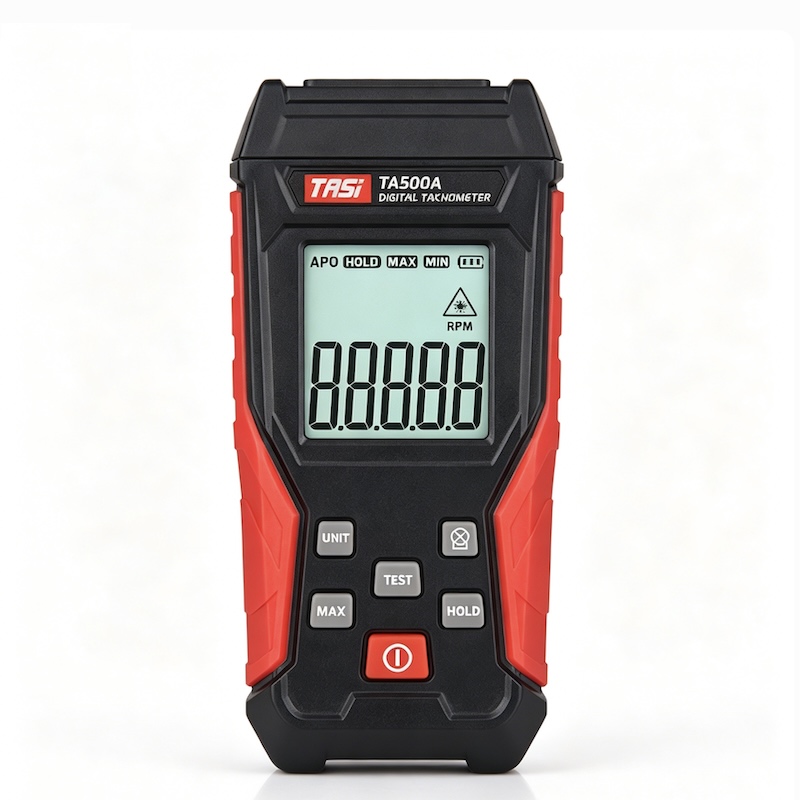
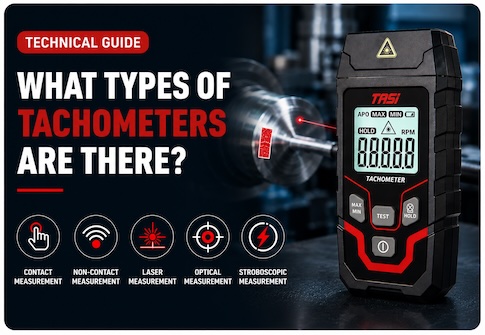
Rotational speed is an important parameter for evaluating the operating condition of motors, fans, pumps, drive shafts, rollers, and industrial machinery. For portable speed measurement, tachometers are generally divided into two main categories: non-contact tachometers and contact tachometers.
Both are designed to measure rotational speed, but they use different measurement methods and are suitable for different operating conditions. A non-contact tachometer typically measures speed using photoelectric or laser-reflection detection without physically touching the rotating component. A contact tachometer uses a contact tip or measuring wheel that is placed directly against the moving part.
The right choice therefore depends not on which technology is inherently better, but on factors such as equipment geometry, RPM range, safe working distance, whether physical contact is permitted, and whether linear speed also needs to be measured.
Key Takeaways
● For high-speed, hazardous, or difficult-to-access rotating equipment, a non-contact tachometer is usually the preferred option.
● For shafts, rollers, or other rotating components that can be accessed safely, a contact tachometer can provide a simple and direct measurement method.
● Non-contact measurement generally requires a stable optical reflection signal and often uses reflective tape.
● Contact measurement requires stable mechanical contact; excessive pressure, slipping, or poor alignment can affect the reading.
● If linear speed of belts, conveyors, rollers, or moving materials must be measured directly, a contact tachometer with a measuring wheel is usually more suitable.
● Where both measurement methods are regularly required, a combined contact/non-contact digital tachometer can offer greater flexibility.
How Do Non-Contact and Contact Tachometers Measure Speed?
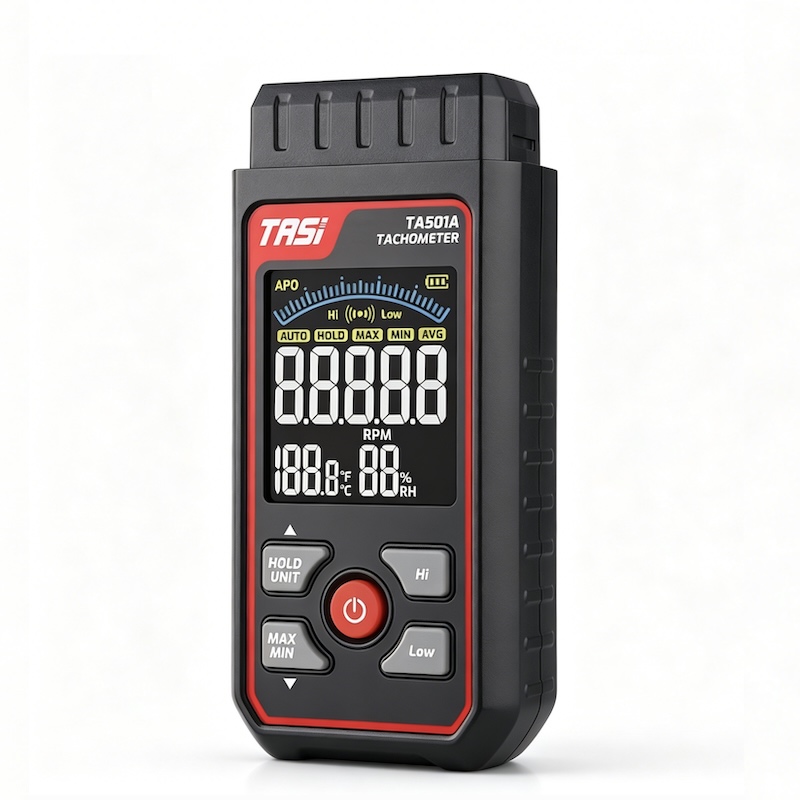
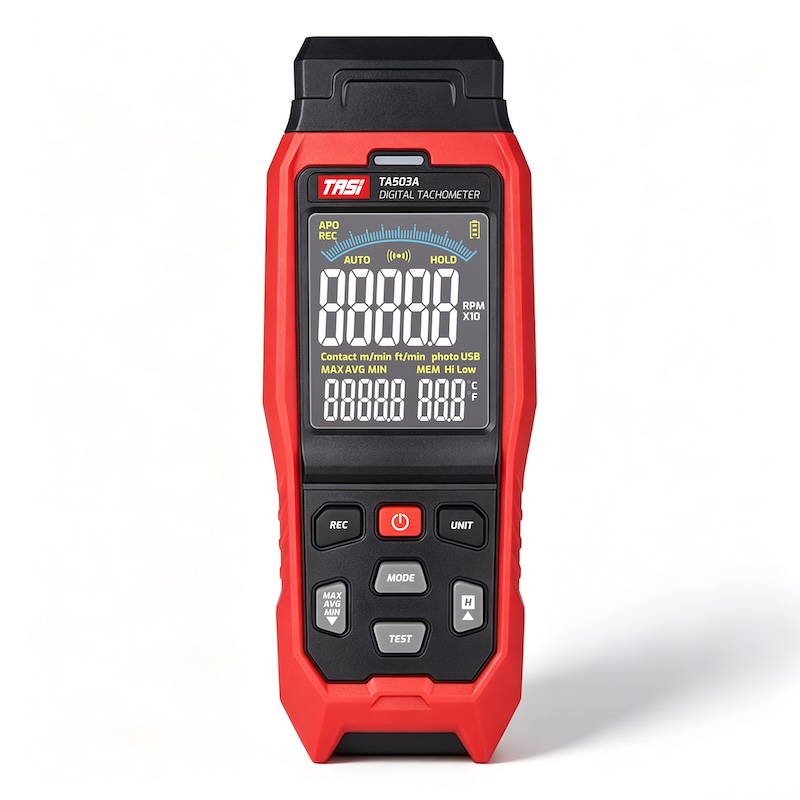
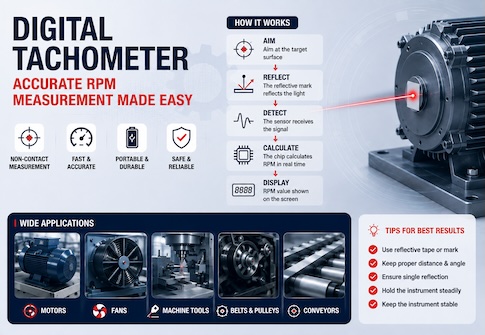
A non-contact tachometer normally works using photoelectric or laser-reflection detection. A clearly distinguishable reflective mark, such as reflective tape, is placed on the rotating component. Each time the reflective area passes through the sensing point, the instrument detects an optical pulse. By calculating the number of pulses over time, the tachometer determines rotational speed and displays the result in RPM.
Because no physical contact with the rotating component is required, this method is particularly suitable for motor shafts, fan impellers, machine spindles, and other high-speed rotating equipment.
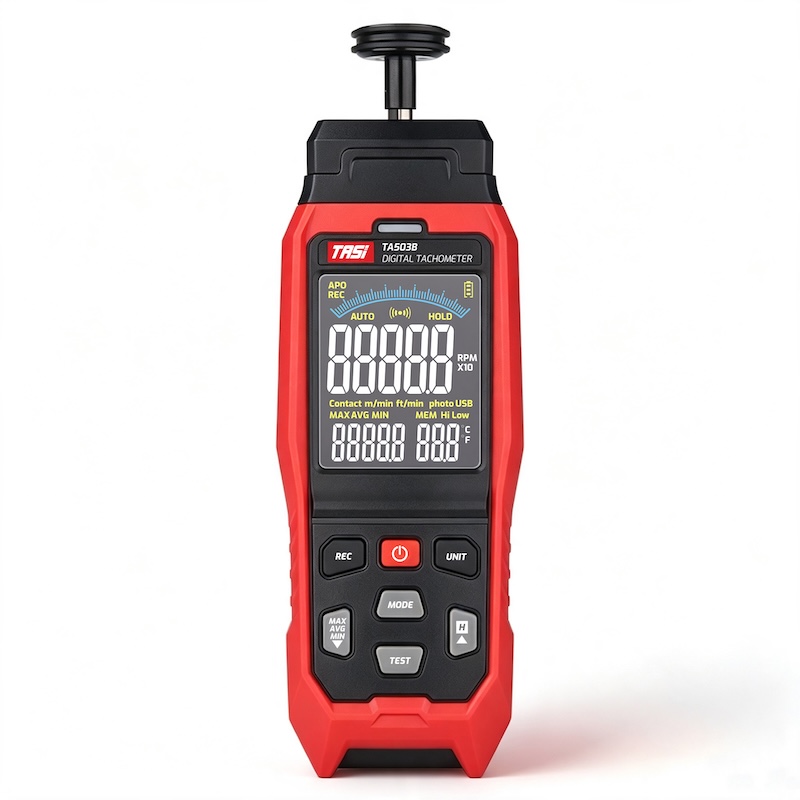
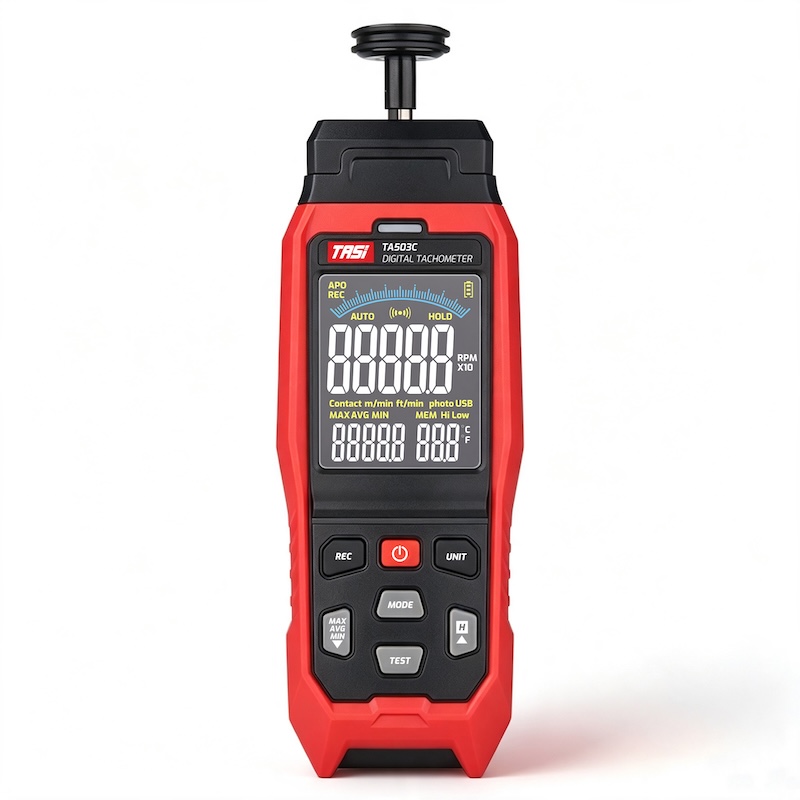
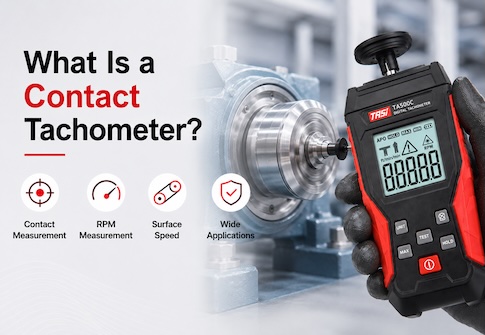
A contact tachometer works differently. A dedicated contact tip is pressed against a rotating shaft or surface so that the instrument's sensing mechanism rotates with the measured component. The instrument then calculates RPM from the speed of the contact shaft.
Some contact tachometers can also be fitted with a measuring wheel. When the wheel is placed against a moving belt, conveyor, sheet, cable, or similar surface, the instrument can calculate linear speed in units such as m/min or m/s.
Key Differences Between Non-Contact and Contact Tachometers
| Comparison | Non-Contact Tachometer | Contact Tachometer |
|---|---|---|
| Measurement method | Photoelectric or laser-reflection detection | Direct contact using a tip or measuring wheel |
| Physical contact required | No | Yes |
| High-speed measurement | Generally more suitable | Contact safety must be considered |
| Confined or hazardous locations | Often advantageous | May be unsuitable |
| Reflective tape | Often required | Not required |
| Main influencing factors | Reflectivity, ambient light, optical signal | Contact stability, slipping, alignment |
| Linear speed measurement | Usually not measured directly | Available on models with measuring wheel |
| Preparation | Reflective marker may be needed | Suitable contact accessory required |
| Mechanical influence on equipment | Minimal | Some mechanical contact is applied |
| Typical applications | Motors, fans, spindles, impellers | Shafts, rollers, belts, conveyors |
The most important distinction is therefore not the display technology, but whether mechanical contact with the moving component is required. This should normally be one of the first considerations when selecting a tachometer.
When Should You Choose a Non-Contact Tachometer?
A non-contact tachometer is generally more suitable when the rotating equipment operates at high speed, is difficult to access, or presents a safety risk if approached closely.
● High-speed rotating equipment: Motors, machine-tool spindles, and high-speed fans may not be suitable for direct contact measurement. Non-contact measurement reduces mechanical interaction with both the machine and the operator.
● Applications where physical contact is not permitted: Non-contact measurement is appropriate for delicate surfaces, precision components, or equipment where additional mechanical load should be avoided.
● Rotating components inside machinery: If a rotating part is visible through an inspection opening or transparent guard but cannot be reached physically, optical measurement can be practical.
● Applications requiring greater working distance: Where exposed belts, couplings, or rotating parts create entanglement or impact hazards, maintaining distance can improve measurement safety.
● Routine inspection of multiple machines: Once suitable reflective marks are installed, RPM checks can often be carried out quickly across multiple assets.
Non-contact measurement still depends on a reliable optical signal. Highly reflective surfaces, multiple reflective areas, contamination, or strong ambient light can cause unstable or repeated signals if measurement conditions are not properly controlled.
When Should You Choose a Contact Tachometer?
A contact tachometer is often the more direct option when the rotating component is easy to access and the measuring attachment can be applied safely and steadily.
● Low- to medium-speed shaft measurement: Contact measurement is convenient for accessible shafts and rollers and does not require reflective tape.
● Surfaces unsuitable for optical sensing: If the surface produces inconsistent reflections or cannot provide a stable optical target, contact measurement may be more reliable.
● Direct linear speed measurement: A measuring wheel can be used on belts, conveyors, rollers, paper, film, cable, and other continuously moving materials.
● Applications where reflective tape is impractical: Oil, dust, temperature, or surface restrictions may make reflective markers difficult to use.
● Checking individual points in mechanical transmissions: Maintenance personnel can directly measure different shafts or rollers to compare actual speeds within a drive system.
However, contact measurement requires the operator to approach the moving component. It should not be selected merely for convenience where exposed high-speed parts, blades, or entanglement hazards make direct contact unsafe.
How Should RPM Range Influence the Choice?
Measurement range is one of the key specifications to consider.
Because a non-contact tachometer does not depend on a contact tip rubbing against the rotating surface, it is generally better suited to higher rotational speeds. For high-speed motors, spindles, or fans, verify that the maximum RPM of the non-contact mode comfortably exceeds the equipment's actual operating speed.
A contact tachometer is limited not only by the instrument itself but also by the mechanical contact accessory. The rated speed of the contact tip or measuring wheel should therefore be checked in addition to the tachometer's nominal measuring range.
As a practical rule, select an instrument with sufficient margin above the normal maximum operating speed rather than operating continuously near the upper end of its range.
For example, if a machine normally operates between 1,000 and 8,000 RPM, a tachometer with a maximum range comfortably above 8,000 RPM is generally the better choice.
What If Linear Speed Must Also Be Measured?
This is one of the most important differences between the two types.
If only rotational speed in RPM is required, either non-contact or contact measurement may be suitable depending on the application.
However, if you need to measure:
● Conveyor speed;
● Belt linear speed;
● Roller surface speed;
● Paper or film feed speed;
● Cable, wire, yarn, or other moving material speed;
a contact tachometer with a measuring wheel is generally the preferred solution.
The measuring wheel rotates against the moving surface, and the instrument calculates linear speed from the wheel circumference and rotational speed. For industrial maintenance applications requiring both RPM and m/min measurements, a contact or dual-mode tachometer is often more practical.
How Important Is Measurement Safety?
For rotational speed measurement, safety should take priority over convenience.
When a component rotates at high speed or is located close to fan blades, pulleys, couplings, gears, or similar moving mechanisms, contact measurement requires the operator to work near these hazards. This can increase the risk of entanglement, impact, or loss of control of the measuring attachment.
Where suitable optical conditions are available, non-contact measurement should therefore be preferred when it reduces the need for mechanical contact.
Non-contact instruments must still be used correctly, including maintaining the specified working distance and aiming direction. Where a laser is used for alignment, the beam is intended to assist targeting and should never be directed toward a person's eyes.
A useful selection principle is: if a reliable measurement can be made without touching the rotating component, consider whether the non-contact method provides the safer measurement arrangement.
What Specifications Matter for a Non-Contact Tachometer?
In addition to RPM range, consider the following factors.
● Measurement distance: Make sure the specified sensing distance is suitable for the physical layout of the equipment.
● Reflective target requirements: Confirm whether reflective tape can be applied and whether the target will pass consistently through the sensing area.
● Resolution: Higher resolution can be useful when measuring low speeds or monitoring relatively small changes in RPM.
● Accuracy: For equipment adjustment, quality control, or trend monitoring, compare the specified rotational speed accuracy.
● Data hold: HOLD functionality is useful where the display cannot be read easily during measurement.
● Maximum, minimum, and average functions: These can help evaluate equipment with variable or fluctuating speed.
A laser pointer alone does not determine the measurement capability of a non-contact tachometer. RPM range, accuracy, sensing distance, and optical conditions remain the more important selection criteria.
What Specifications Matter for a Contact Tachometer?
A contact tachometer requires consideration of both measurement specifications and mechanical accessories.
● Contact tip type: Different shaft geometries may require conical, concave, or other contact attachments.
● Measuring wheel specification: For linear speed measurement, verify the supplied wheel and supported units.
● Contact stability: The attachment should remain aligned with the rotating component without slipping.
● Permissible speed: Check both the instrument range and the speed rating of the contact accessory.
● Available working space: There must be enough room to position and hold the tachometer correctly.
● Safety conditions: Contact measurement should not be attempted where the operating environment does not provide adequate safe access.
Higher contact pressure does not necessarily improve measurement quality. Excessive pressure can introduce additional mechanical load, while insufficient pressure may cause slipping. Stable and appropriate contact is the objective.
When Is a Combined Contact/Non-Contact Tachometer the Better Choice?
Industrial maintenance and commissioning work often involves more than one type of rotating equipment. A technician may need to measure motor RPM in one application and conveyor linear speed in another.
A digital tachometer supporting both contact and non-contact modes can therefore be a practical solution.
Non-contact mode can be used for motors, fans, and high-speed rotating components, while contact mode can be used for shafts, rollers, and linear speed measurements. This allows one instrument to cover a broader range of maintenance tasks.
A dual-mode instrument does not mean that either mode is suitable for every application. The measurement method should still be selected according to equipment design, operating conditions, and safety requirements.
Common Selection Mistakes
● Assuming non-contact measurement is always more accurate. Both methods can provide reliable results. Non-contact measurement depends on optical signal quality, while contact measurement can be affected by slipping or poor alignment.
● Assuming a laser tachometer can measure any rotating surface directly. The optical sensor still requires a clear, repeatable reflection signal.
● Looking only at maximum RPM. An adequate RPM range does not compensate for unsafe access or unsuitable optical conditions.
● Ignoring linear speed requirements. If belt, conveyor, or material speed must be measured directly, verify that the instrument supports contact linear-speed measurement.
● Using contact measurement simply because it appears easier. High-speed or exposed rotating parts may make physical contact inappropriate.
FAQ
Which is more accurate: a non-contact or contact tachometer?
Accuracy cannot be determined from the measurement method alone. Both types can provide accurate results when used correctly. Non-contact instruments require a stable reflection signal, while contact tachometers require secure contact without slipping.
Which tachometer is better for high-speed motors?
A non-contact tachometer is generally preferred because RPM can be measured without placing a mechanical attachment against a high-speed shaft.
Does a non-contact tachometer always require reflective tape?
Not necessarily. However, reflective tape often provides a clear and repeatable optical target and can improve measurement stability. Whether it is required depends on the instrument design and surface characteristics.
Can a contact tachometer measure motor speed?
Yes. If the shaft provides a suitable contact point and can be accessed safely, a contact tachometer can measure its RPM. Non-contact measurement is generally preferable for high-speed or difficult-to-access shafts.
Can a non-contact tachometer measure conveyor speed?
A conventional non-contact tachometer normally measures rotational speed in RPM rather than direct linear speed. Conveyor speed can be measured more directly using a contact tachometer with a measuring wheel, or calculated from roller RPM and diameter.
Which type is more suitable for maintenance technicians?
Where daily work includes both non-contact RPM checks on motors and fans and contact measurements on shafts, rollers, or conveyors, a dual-mode contact/non-contact tachometer offers greater versatility.
Conclusion
Neither non-contact nor contact tachometers are universally superior. The correct choice depends on the application.
A non-contact tachometer is generally better suited to high-speed equipment, components that cannot be touched safely, applications requiring measurement from a distance, and situations where mechanical loading should be avoided. A contact tachometer is particularly useful for accessible shafts and rollers and for direct measurement of belt or conveyor linear speed.
When selecting an instrument, consider RPM range, measurement distance, equipment geometry, reflective conditions, mechanical access, linear speed requirements, safety, and accuracy rather than comparing maximum RPM alone.
For maintenance teams working with a wide range of rotating equipment, a digital tachometer supporting both contact and non-contact measurement can provide greater application flexibility.