Introduction
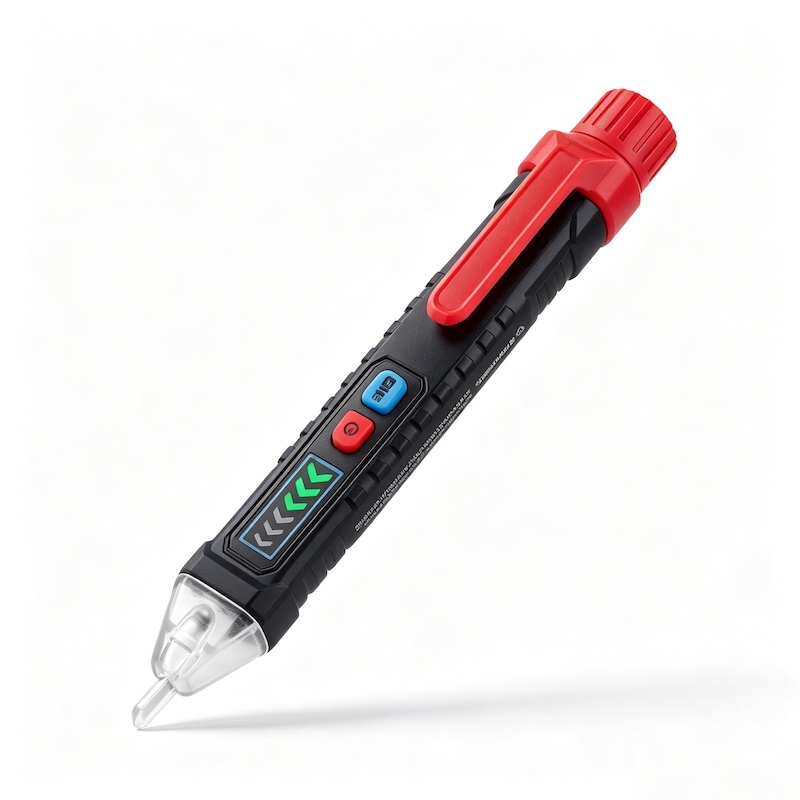
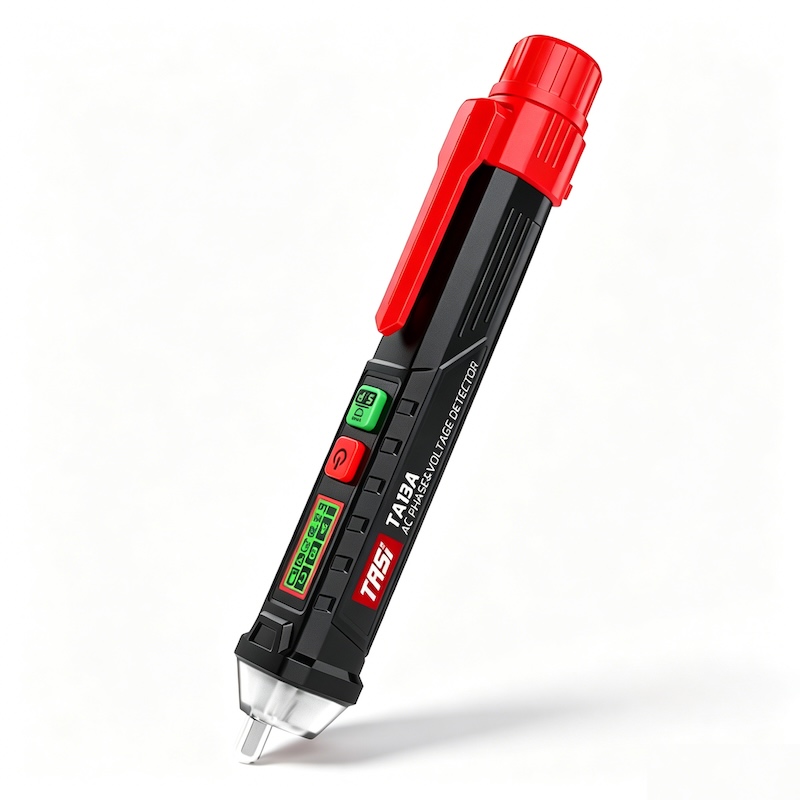
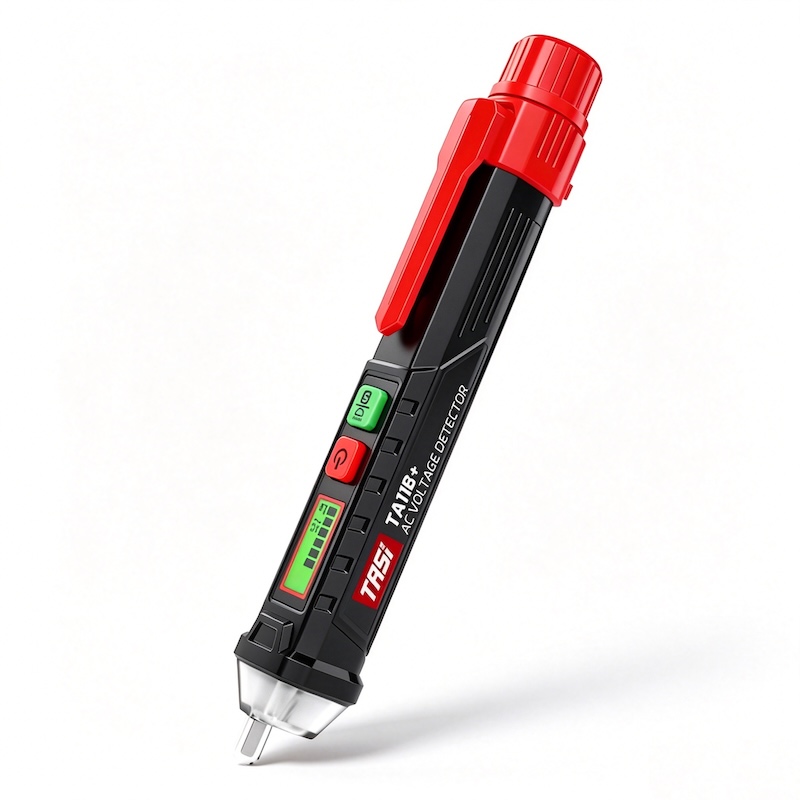
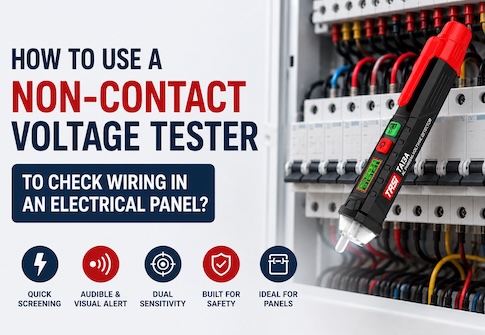
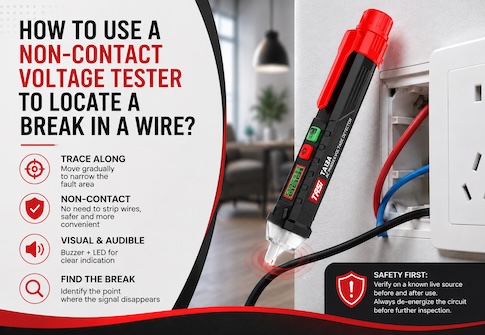
A non-contact voltage tester (NCV tester) detects the electric field surrounding an energized AC conductor without requiring direct contact with exposed metal. Its speed and portability make it widely used for electrical installation, equipment maintenance, troubleshooting, and routine electrical checks.
However, non-contact voltage testers differ considerably in voltage detection range, sensitivity, safety category, and available functions. Some models are designed mainly for standard mains circuits, while others provide dual-sensitivity modes for more demanding troubleshooting applications.
The right choice should therefore be based on the circuits and environments in which the tester will actually be used, rather than simply selecting the model with the widest range or the most functions.
Key Takeaways
● Start by identifying the required voltage range and primary application.
● For lower-voltage circuits or weak electric fields, detection sensitivity is particularly important.
● Dual-sensitivity operation can cover a wider range of applications and help narrow down the location of an energized conductor.
● The CAT measurement category should match the electrical environment in which the tester will be used.
● Audible and visual alarms, self-test functions, a flashlight, and low-battery indication can improve practical usability.
● An NCV tester is intended primarily to indicate the possible presence of AC voltage; it does not replace a multimeter for accurate voltage measurement.
● For de-energized work and other safety-critical procedures, never rely solely on a single NCV test to confirm the absence of voltage.
Start with the Application
Before selecting a non-contact voltage tester, determine what you will normally be testing. Different applications place different demands on voltage range, sensitivity, and safety rating.
● Residential electrical checks: Typical applications include checking wall outlets, power cords, switches, and household appliances. Simple operation, clear alarms, and portability are usually the main priorities.
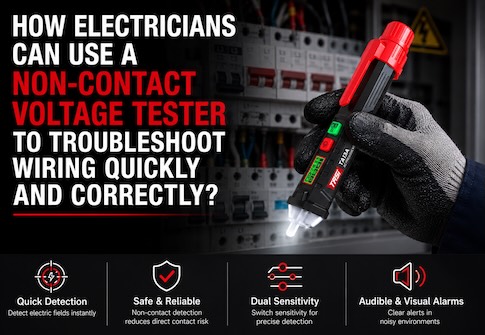
● Professional electrical work: Electricians may regularly inspect distribution panels, outlets, cables, and electrical equipment, making detection stability, CAT rating, and selectable sensitivity more important.
● Equipment maintenance: Industrial machinery often contains multiple closely routed conductors and a more complex electrical environment. Resistance to interference and more precise localization can therefore be valuable.
● HVAC and building maintenance: Typical tasks include checking control wiring, supply circuits, motors, air-conditioning equipment, and wiring around building structures. A tester with broader application capability is generally preferable.
The more complex the electrical environment, the more important the tester's overall performance becomes.
Choose the Appropriate Voltage Detection Range
The voltage detection range is one of the basic specifications of an NCV tester. It indicates the approximate AC voltage range within which the instrument is designed to sense an electric field.
Common products may specify ranges such as 50–1000 V AC or 12–1000 V AC, depending on the model. Always refer to the manufacturer's specification.
For routine checks of outlets, power cords, and standard mains circuits, a conventional detection range is generally sufficient.
If lower-voltage AC circuits also need to be checked, a tester with a lower starting detection voltage may be more suitable.
A specified detection range does not mean that the tester can measure the actual voltage value like a multimeter. An NCV tester primarily indicates whether an AC electric field strong enough to trigger the detector is present.
Pay Attention to Detection Sensitivity
Sensitivity determines how readily the tester responds to an AC electric field and is an important selection factor.
At higher sensitivity, the tester may detect an electric field from farther away or through thicker insulation. However, it may also respond more easily to adjacent energized conductors, induced voltages, or complex electromagnetic environments.
At lower sensitivity, the probe generally needs to be brought closer to the target conductor, but this can make it easier to narrow down the source in densely wired installations.
Higher sensitivity is therefore not automatically better. The appropriate level depends on the application.
Single or Dual Sensitivity?
Some non-contact voltage testers operate at one fixed sensitivity, while others offer high- and low-sensitivity modes or different detection ranges.
For straightforward routine checks, a single-sensitivity tester is often sufficient and simple to operate.
For broader troubleshooting requirements, dual sensitivity offers greater flexibility.
● High sensitivity can help detect weaker AC electric fields or perform an initial search for potentially energized conductors.
● Low sensitivity can reduce the influence of nearby energized wiring and help narrow down the target conductor.
For professional electrical work, industrial maintenance, and installations with multiple adjacent conductors, dual-sensitivity operation is often particularly useful.
Choose the Right CAT Safety Rating
Detection capability is only one part of selecting an electrical tester. The safety category is equally important.
Electrical test equipment commonly uses CAT II, CAT III, and CAT IV measurement categories. These categories relate to different locations within an electrical installation and the level of transient overvoltage that the equipment is designed to withstand.
In simplified terms:
● CAT II: Typically associated with loads and equipment connected to low-voltage installations.
● CAT III: Commonly associated with fixed building installations, distribution panels, and related circuits.
● CAT IV: Associated with the origin of a low-voltage installation and other environments with higher transient exposure.
A higher CAT number is not automatically the correct choice. What matters is that both the measurement category and its rated voltage are appropriate for the intended electrical environment.
For professional electrical maintenance, the enclosure, insulation design, and stated safety rating should all be considered carefully.
Check the Alarm Indication
When an NCV tester detects an AC electric field, it normally alerts the user with a buzzer, an LED indicator, or both.
For general use, a tester with both audible and visual indication is preferable. Visual indication remains useful in noisy environments, while audible alarms can help when lighting is poor or continuous observation of the tester is inconvenient.
Some testers vary the buzzer rate or LED flashing frequency according to the detected field strength. This can help the user approximately locate the energized conductor.
However, these changes should not be interpreted as a precise indication of voltage magnitude.
Consider a Self-Test Function
For any voltage detection tool, confirming that the instrument itself is operating correctly is important.
Some NCV testers perform an LED, buzzer, or internal circuit check when powered on, allowing the user to verify basic operation quickly.
This is particularly useful for testers used frequently in professional electrical work.
Even when a tester includes a self-test feature, it is good practice to verify operation on a known live source before testing. For safety-critical work, checking the tester again afterward can provide additional confirmation that it remained operational during the procedure.
Consider a Built-In Flashlight
Distribution panels, equipment cabinets, ceiling spaces, and machinery interiors are often poorly lit. An NCV tester with an integrated LED flashlight can therefore be useful during maintenance.
A flashlight does not improve voltage detection accuracy, but it makes it easier to see conductors, terminals, and test locations.
For users who frequently work in confined or poorly illuminated areas, integrated lighting can be a worthwhile feature.
Look for Low-Battery Indication and Auto Power-Off
Non-contact voltage testers are battery-powered. If battery voltage becomes too low, normal operation, alarm output, or detection performance may be affected.
A low-battery indicator helps the user replace batteries before this becomes a problem.
Automatic power-off is also useful, especially for frequently used tools, because it reduces unnecessary battery drain if the tester is left switched on.
Regardless of available battery indicators, the condition of both the tester and its battery should be confirmed before safety-critical testing.
Consider Ergonomics and Portability
An NCV tester is often carried throughout the workday and operated with one hand, so physical design also affects usability.
Consider:
● Whether the body is comfortable to hold and operate one-handed.
● Whether buttons are easy to identify and switch.
● Whether the sensing tip can reach outlets, cables, and confined spaces.
● Whether a pocket clip is provided.
● Whether LED indicators remain visible from practical viewing angles.
● Whether the housing provides suitable mechanical strength and insulation.
For frequent use, a robust, lightweight, straightforward design may be more valuable than a long list of rarely used functions.
Do Not Choose a Tester Based Only on Detection Distance
A tester that alarms from farther away is not necessarily more accurate.
NCV detection distance can be affected by:
● Actual circuit voltage;
● Insulation thickness;
● Conductor position and arrangement;
● Tester sensitivity;
● Coupling between the user, tester, and surrounding environment;
● Nearby energized conductors;
● Shielding and metallic structures.
Longer detection distance therefore should not be treated as a direct measure of tester quality.
In densely wired installations, excessive sensitivity can cause the tester to respond to several adjacent conductors, making localization more difficult.
Recommendations for Different Applications
For residential and general-purpose checks, prioritize simple operation, clear audible and visual indication, a suitable range for common mains circuits, and basic self-test capability.
For professional electrical maintenance, dual sensitivity, an appropriate safety category, stable detection, low-battery indication, and durable construction are more important.
For industrial equipment maintenance, consider the safety rating together with immunity to complex electrical environments, sensitivity selection, and the ability to localize individual conductors.
For lower-voltage AC circuits, pay particular attention to the minimum specified detection voltage rather than only the maximum voltage.
For work inside distribution panels, machinery, or poorly lit locations, an integrated flashlight, clear alarms, and one-handed operation can be especially useful.
What an NCV Tester Cannot Replace
The main advantage of a non-contact voltage tester is rapid screening. It is not a complete electrical measurement instrument.
An NCV tester generally cannot:
● Measure an exact voltage value;
● Measure current, resistance, frequency, or other electrical parameters;
● Independently prove that a circuit is safe and de-energized;
● Reliably distinguish line, neutral, and protective earth in every situation;
● Reliably detect all DC circuits.
When an actual voltage value is required, use a suitable multimeter or voltage tester.
For lockout, maintenance, wiring, or other safety-critical work, follow the applicable electrical safety procedure for verifying the absence of voltage. The absence of an NCV alarm alone is not sufficient.
FAQ
Is a wider NCV detection range always better?
No. A wider range may increase versatility, but suitability also depends on sensitivity, safety category, detection stability, and the electrical environment. Users who only work on ordinary mains circuits do not necessarily need the lowest possible starting detection voltage.
Should I choose a 12–1000 V or 50–1000 V tester?
For ordinary mains circuits, both ranges can cover many common applications. If lower-voltage AC circuits also need to be detected, a model with a lower starting voltage may be preferable. Actual performance still depends on the circuit construction and operating environment.
Is dual sensitivity worth having?
For professional maintenance, troubleshooting, and installations containing multiple adjacent conductors, dual sensitivity is often useful. It allows higher sensitivity for initial searching and lower sensitivity for more precise localization.
Does a higher CAT rating mean a better tester?
Not necessarily. The CAT rating identifies the type of electrical environment for which the instrument is designed. The correct choice is a tester whose CAT category and rated voltage match the intended application.
Can a non-contact voltage tester detect DC voltage?
Conventional NCV testers operate by sensing alternating electric fields and are primarily intended for AC voltage detection. Unless the manufacturer specifically states that DC detection is supported, an ordinary NCV function should not be used to determine whether a DC circuit is energized.
If the tester does not alarm, is the circuit definitely de-energized?
No. Battery condition, probe distance, shielding, insulation, sensitivity, and operating technique can all affect detection. A single negative NCV indication must not be treated as proof of absence of voltage for safety-critical work.
Conclusion
Choosing a non-contact voltage tester requires more than comparing voltage ranges. The most suitable model should be selected according to the detection range, sensitivity modes, CAT safety rating, audible and visual alarms, self-test capability, battery indication, lighting, and physical design required by the application.
For residential checks, simple operation and clear indication may be the main priorities. Professional electricians and industrial maintenance personnel should place greater emphasis on dual sensitivity, safety category, and stable performance in complex electrical environments.
Most importantly, an NCV tester should be understood as a rapid screening tool for the possible presence of AC voltage—not as a precision voltage measurement instrument. Correct tool selection and proper testing procedures are both essential for safe and effective electrical work.