Introduction
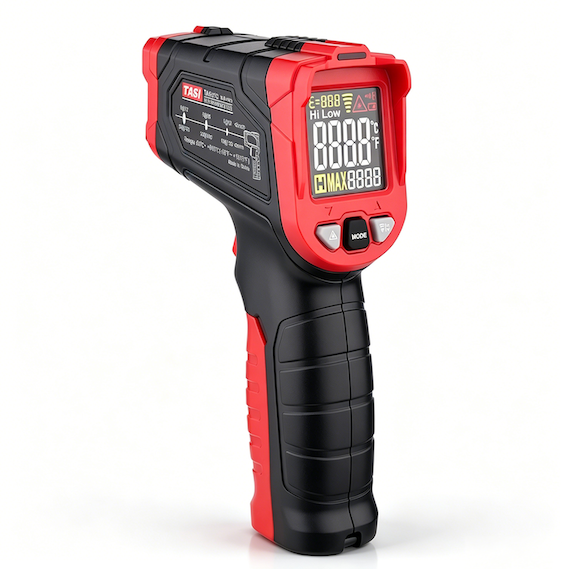
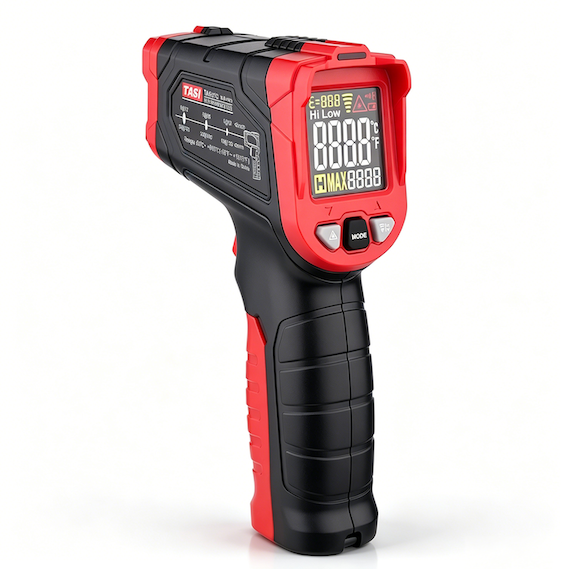
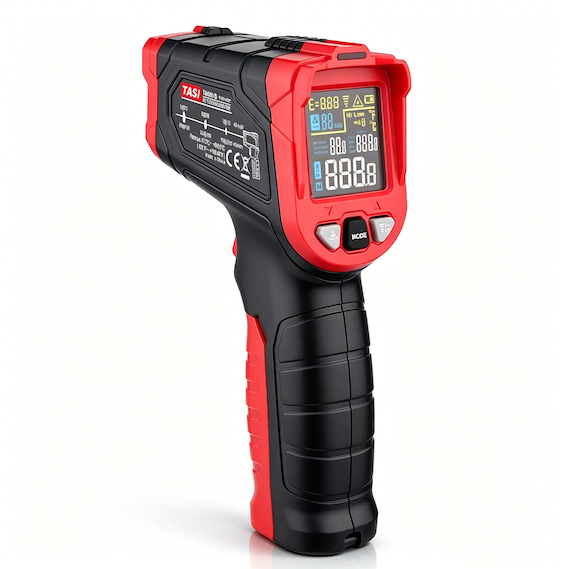
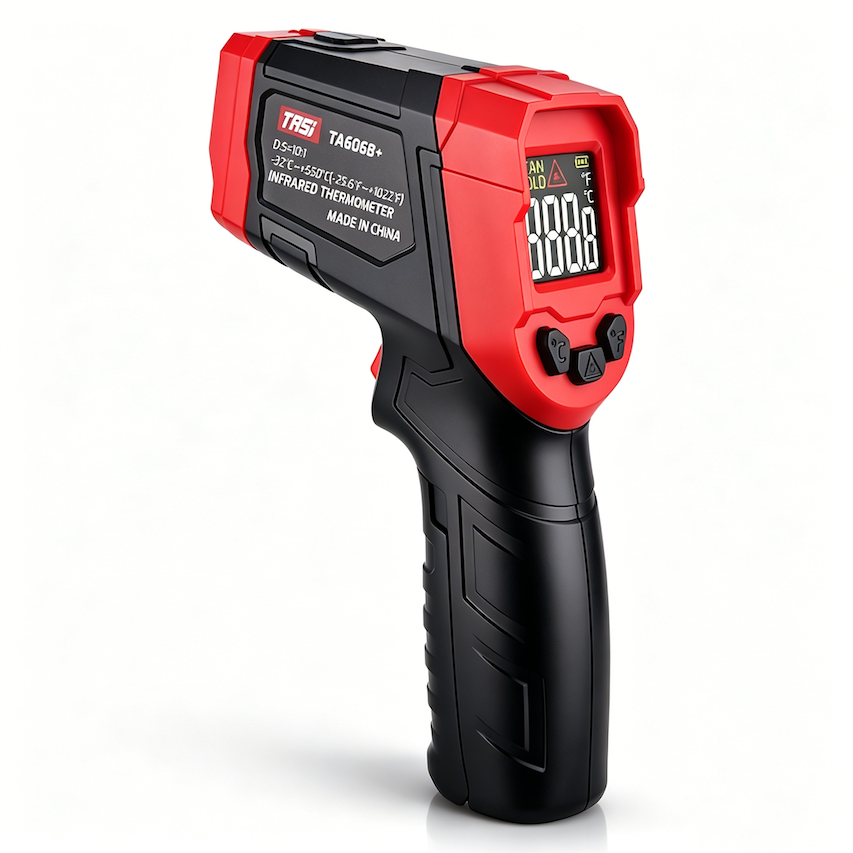
Infrared thermometers provide fast, non-contact surface temperature measurements and are widely used in electrical maintenance, mechanical inspection, HVAC applications, industrial processes, and high-temperature equipment monitoring. To make target identification easier, many infrared thermometers incorporate a laser targeting system.
It is important to understand that the laser itself is not used to measure temperature. The instrument measures infrared radiation emitted from the target surface, while the laser serves primarily as a visual aiming aid.
The main advantage of a laser-equipped infrared thermometer is therefore not higher inherent measurement accuracy. Instead, laser targeting improves aiming efficiency, helps reduce the risk of measuring the wrong area, and makes operation easier at longer distances or in complex environments.
Key Points
● The laser is primarily an aiming and positioning aid and does not directly participate in temperature measurement.
● Laser targeting helps users identify the intended measurement location more quickly, especially for distant, small, or closely spaced targets.
● A laser can reduce measurement errors caused by incorrect aiming, but it does not change the specified accuracy of the instrument itself.
● The laser spot does not represent the entire measurement area; the actual spot size must be determined from the instrument's D:S distance-to-spot ratio.
● Laser targeting is particularly useful when measuring hot, moving, energized, or difficult-to-access equipment.
● Instrument selection should also consider temperature range, accuracy, D:S ratio, emissivity, response time, and operating conditions.
How Does a Laser Infrared Thermometer Work?
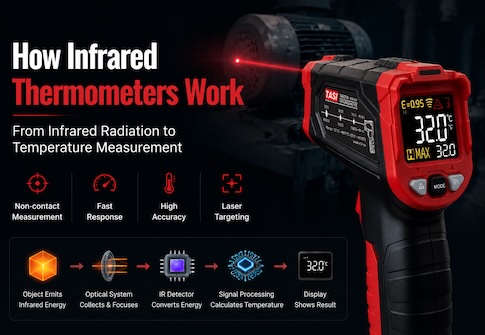
An infrared thermometer uses an optical system to collect infrared radiation emitted from the target surface and direct it to an infrared sensor. The instrument then calculates the surface temperature according to the detected radiation, emissivity setting, internal compensation, and calibration characteristics.
The laser system operates as a separate aiming aid. When activated, the laser projects onto or near the target to help the user identify where the instrument is pointing.
The two functions can therefore be understood simply as follows:
● The infrared sensing system performs the temperature measurement.
● The laser system assists with aiming.
On most models, temperature measurement can still be performed when the laser is switched off. The laser improves target identification rather than changing the principle of infrared temperature measurement.
Laser Targeting Makes It Easier to Identify the Measurement Location
When measuring a large object at close range, it is generally easy to determine where the infrared thermometer is pointing. At longer distances or when measuring smaller targets, however, judging the exact aiming direction from the instrument body alone can become more difficult.
A laser provides a clear visual reference.
For example, when inspecting multiple electrical terminals inside a distribution panel, adjacent components may be positioned very close together. Without an aiming reference, the operator may not immediately know which terminal is being measured. Laser targeting makes target identification faster and can improve inspection efficiency.
This is particularly useful for applications such as:
● Electrical terminal temperature inspection
● Motor and bearing condition checks
● Pipe surface temperature measurement
● HVAC outlet and equipment inspection
● Industrial equipment temperature monitoring
Laser Targeting Is Especially Helpful for Measurements at a Distance
One of the key advantages of infrared thermometers is their ability to measure temperature without contacting the target. This allows users to inspect hot, moving, or difficult-to-access objects from a safer or more convenient distance.
As the measurement distance increases, however, visual alignment becomes more difficult.
When measuring hot pipes, furnaces, machinery, or other equipment from several metres away, a laser provides a clear aiming reference and helps the operator identify the intended area more efficiently.
For applications involving frequent long-distance measurements, the D:S ratio should be considered together with the laser function. A higher D:S ratio generally allows a smaller area to be measured at the same distance, making the instrument more suitable for distant or relatively small targets.
Laser Targeting Helps Reduce Errors Caused by Measuring the Wrong Area
An infrared thermometer measures infrared radiation from a defined area rather than from an infinitely small point.
If the instrument is aimed incorrectly, or if the measurement area includes both the intended target and surrounding surfaces, the displayed temperature may be influenced by those surrounding areas.
For example, if the intention is to measure a hot bearing but the instrument is actually aimed at the cooler metal housing beside it, the reading will not accurately represent the bearing surface temperature.
The laser does not improve the instrument's stated accuracy specification, but it can help reduce practical measurement errors caused by incorrect aiming.
Why Is the Laser Spot Not the Same as the Actual Measurement Area?
This is one of the most important points when using a laser infrared thermometer.
The laser spot is primarily a targeting reference. It does not necessarily represent the complete area from which the infrared sensor receives radiation. The actual measurement area is determined mainly by the optical system and the D:S distance-to-spot ratio.
For example, with a D:S ratio of 12:1, a simplified interpretation is that at a measurement distance of approximately 1200 mm, the measurement spot diameter is about 100 mm. Actual performance should always be confirmed using the manufacturer's optical diagram and product specifications.
Therefore, even if the laser is positioned precisely on a small target, the infrared measurement area may extend beyond that target and include surrounding surfaces.
For correct use:
● Use the laser to confirm the aiming direction.
● Use the D:S ratio to estimate the measurement spot size.
● Ensure that the target is clearly larger than the actual infrared measurement area.
Laser Targeting Improves Convenience When Measuring Hot or Hazardous Targets
Infrared thermometers are frequently used on targets that are unsuitable for direct contact, such as hot furnaces, heated pipes, rotating machinery, electrical equipment, or elevated installations.
In these applications, operators often need to maintain an appropriate working distance.
Laser targeting makes it easier to identify the required measurement location without approaching the target unnecessarily, improving operational convenience and efficiency.
For example, when inspecting the surface temperature of hot equipment, an operator can remain at a suitable distance, use the laser to identify the required location, and then obtain the temperature reading.
Laser targeting does not replace normal safety procedures. Appropriate safety practices and working distances must still be maintained around energized equipment, high-temperature surfaces, and rotating machinery.
Laser Targeting Is Useful for Small Targets and Closely Spaced Measurement Points
Industrial inspections often involve small or closely spaced components, including:
● Electrical terminals
● Fuses
● Circuit breakers
● Small bearings
● Pipe joints
● PCBs and electronic components
● Heating elements
In these situations, laser targeting makes it easier to distinguish between adjacent measurement points.
However, a laser alone is not sufficient for very small targets. The operator must also confirm that the infrared measurement spot at the selected distance is smaller than the target.
For small-target measurements, both laser targeting capability and an appropriate D:S ratio should therefore be considered.
What Is the Difference Between Single-Laser and Dual-Laser Targeting?
Infrared thermometers may use either single-laser or dual-laser targeting systems.
A single laser normally provides one visible reference point to indicate the approximate aiming location or measurement centre. This is sufficient for many general maintenance, HVAC, and industrial temperature measurement applications.
Dual-laser systems use two laser points to provide additional guidance for locating the measurement area or target boundaries, depending on the optical design of the instrument.
Different manufacturers may implement dual-laser systems differently. The area between two laser points should therefore not automatically be assumed to be the exact infrared measurement area.
Always refer to the optical diagram and operating instructions for the specific model.
Does a Laser Make an Infrared Thermometer More Accurate?
Not necessarily.
Infrared thermometer accuracy is primarily determined by factors such as the infrared sensor, optical system, calibration, internal compensation, emissivity setting, and overall instrument design.
For example, if an instrument has a specified accuracy of ±1.5% or ±1.5°C, adding a laser does not directly improve that base specification.
The laser primarily improves the user's ability to aim at the intended target.
A useful distinction is:
● Instrument accuracy determines how accurately the temperature is measured.
● Laser targeting helps ensure that the correct location is being measured.
These are two different aspects of instrument performance.
When Is a Laser Infrared Thermometer Recommended?
A laser-equipped model is particularly useful when:
● Measurements are frequently performed at a distance.
● The target area is relatively small.
● Multiple targets are closely spaced.
● Large numbers of measurement points must be inspected quickly.
● Hot or difficult-to-access locations need to be measured.
● Electrical panels, machinery, pipes, or other defined points are inspected regularly.
● Operators require a clear visual aiming reference.
For close-range measurements of large surfaces such as walls, floors, or large equipment housings, laser targeting is less critical, although it can still improve operating convenience.
What Other Specifications Should Be Considered When Selecting a Laser Infrared Thermometer?
Laser targeting is only one feature of an infrared thermometer. Selection should also consider the following specifications:
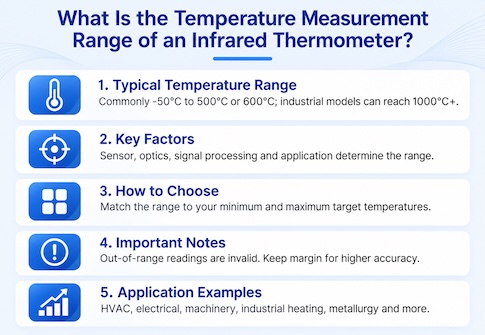
● Temperature range: Ensure that the measurement range covers the lowest and highest temperatures expected in the application.
● Accuracy: Select an appropriate accuracy level for maintenance, inspection, development, or quality-control requirements.
● D:S ratio: Particularly important for distant or small-target measurements.
● Emissivity: Adjustable emissivity provides greater flexibility when measuring different surface materials.
● Response time: Important for rapid inspection and changing temperature conditions.
● Display resolution: Determines the smallest temperature increment shown on the display.
● High/low temperature alarm: Useful for quickly identifying temperatures outside preset limits.
● Data hold or maximum-value functions: Helpful when recording and comparing inspection results.
● Operating environment: Consider ambient temperature, dust, humidity, and site conditions.
Whether a thermometer has laser targeting should therefore be treated as one selection factor rather than a substitute for evaluating its core measurement performance.
Important Considerations When Using the Laser Function
Laser-equipped infrared thermometers are convenient to use, but several basic precautions should be observed.
● Never direct the laser beam toward the eyes.
● Avoid prolonged viewing of the beam or strong reflected laser light.
● When measuring polished, mirror-like, or highly reflective surfaces, consider the direction of possible laser reflections.
● Do not use the laser point as a substitute for determining spot size from the D:S ratio.
● A laser positioned on the target does not necessarily mean that the entire infrared measurement area is within that target.
● Keep the infrared lens clean to prevent dust, oil, or contamination from affecting infrared signal reception.
FAQ
Is a laser infrared thermometer more accurate than a model without a laser?
Not necessarily. The laser is primarily an aiming aid and does not directly participate in temperature calculation. It may reduce aiming errors, but measurement accuracy still depends on the infrared sensor, optical system, calibration, emissivity, and operating conditions.
Can an infrared thermometer still measure temperature when the laser is switched off?
In most laser-equipped infrared thermometers, yes. The infrared measurement system and laser targeting system perform different functions. Refer to the product manual for model-specific operation.
Does the laser point indicate the exact infrared measurement area?
No. The laser primarily indicates the aiming location. The actual infrared measurement area depends on the D:S ratio and measurement distance.
Is dual-laser targeting always better than single-laser targeting?
Not necessarily. Dual-laser systems can provide additional aiming information, but overall suitability still depends on D:S ratio, temperature range, accuracy, emissivity, and other instrument specifications.
Is laser targeting sufficient when measuring a very small target?
No. The target must also be larger than the infrared measurement spot at the selected distance. For small targets, the D:S ratio is particularly important.
Does the laser heat the measured object?
Under normal operating conditions, the low-power aiming laser used in an infrared thermometer does not cause a meaningful temperature change on typical industrial targets. Its primary purpose is visual positioning.
Conclusion
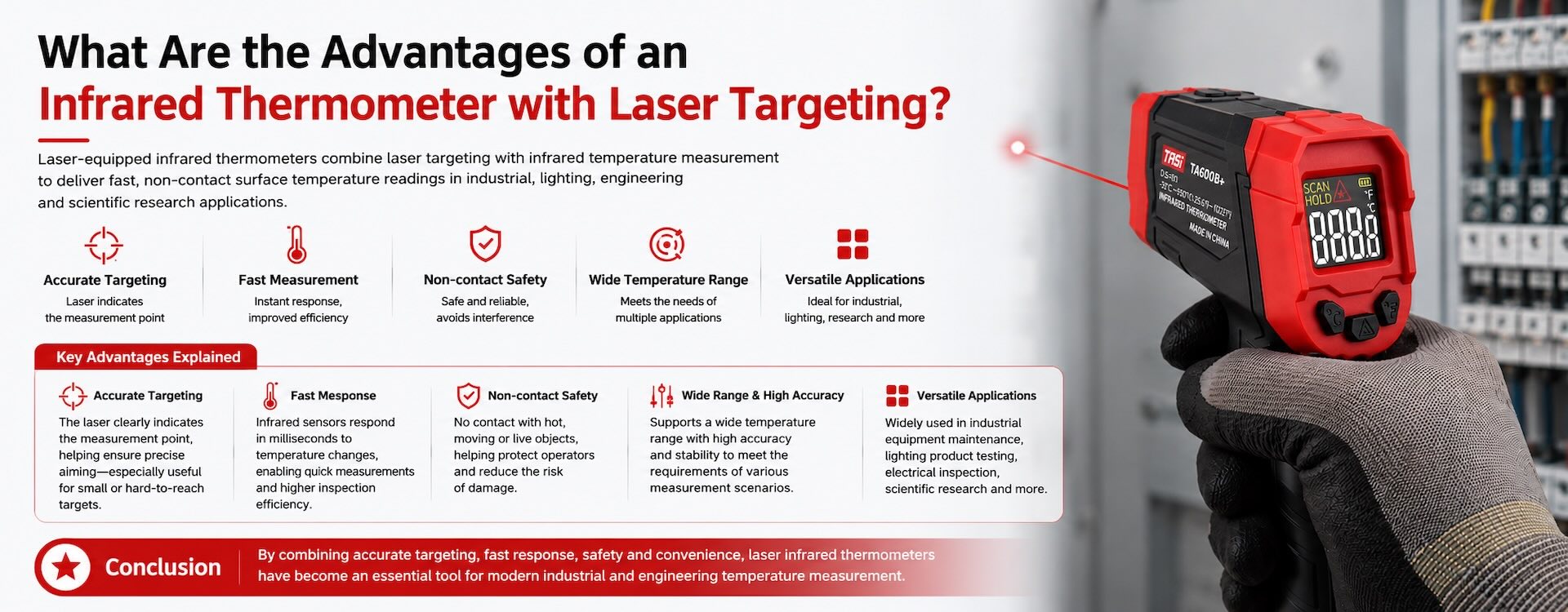
The main advantage of a laser infrared thermometer is that it makes non-contact temperature measurement more intuitive and efficient. Laser targeting is particularly useful for distant targets, small components, multiple inspection points, and hot or difficult-to-access equipment because it helps users identify the intended measurement location and reduces practical errors caused by incorrect aiming.
However, it is important to distinguish between three factors: the laser determines where the instrument is aimed, the infrared optical system determines the area actually measured, and the instrument's accuracy specification determines how accurately temperature is measured.
When selecting an infrared thermometer, laser targeting should therefore be evaluated together with temperature range, accuracy, D:S ratio, emissivity, response time, and actual working distance. For routine inspection, long-distance measurement, and applications requiring precise target identification, a laser-equipped infrared thermometer can provide a significant improvement in operating efficiency.