Introduction
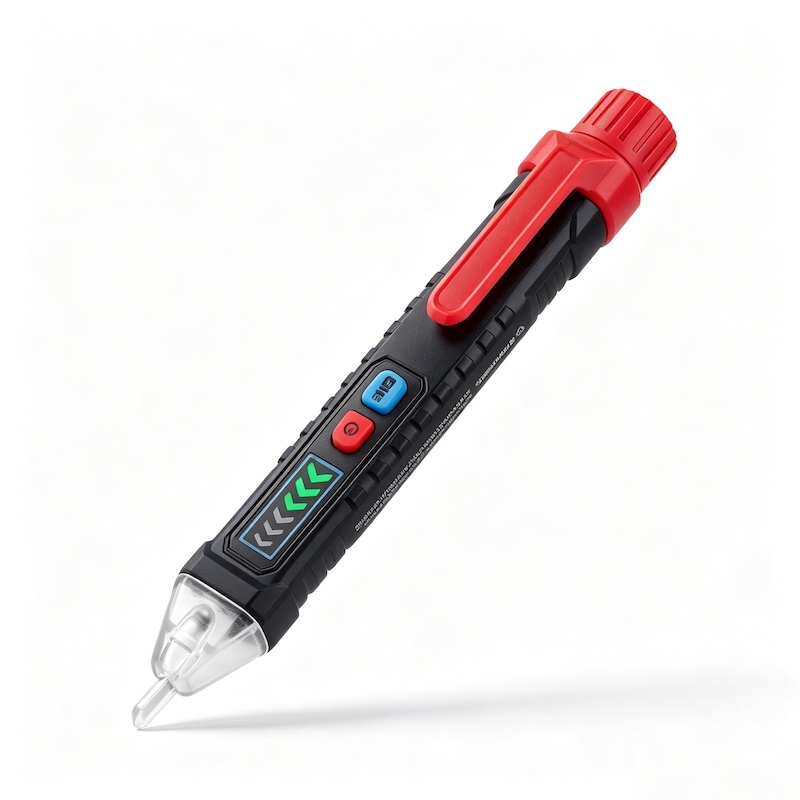
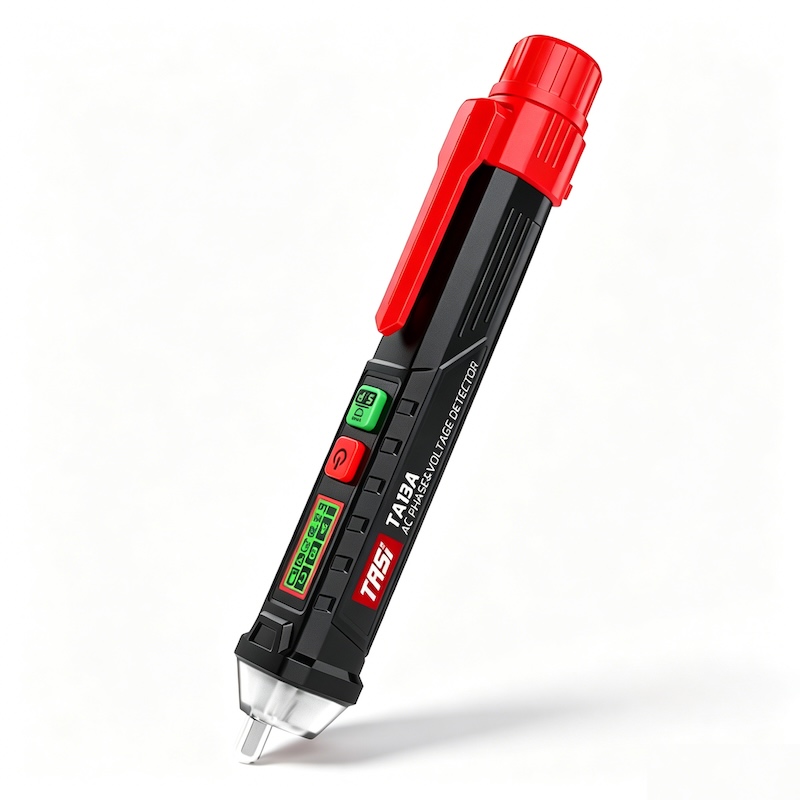
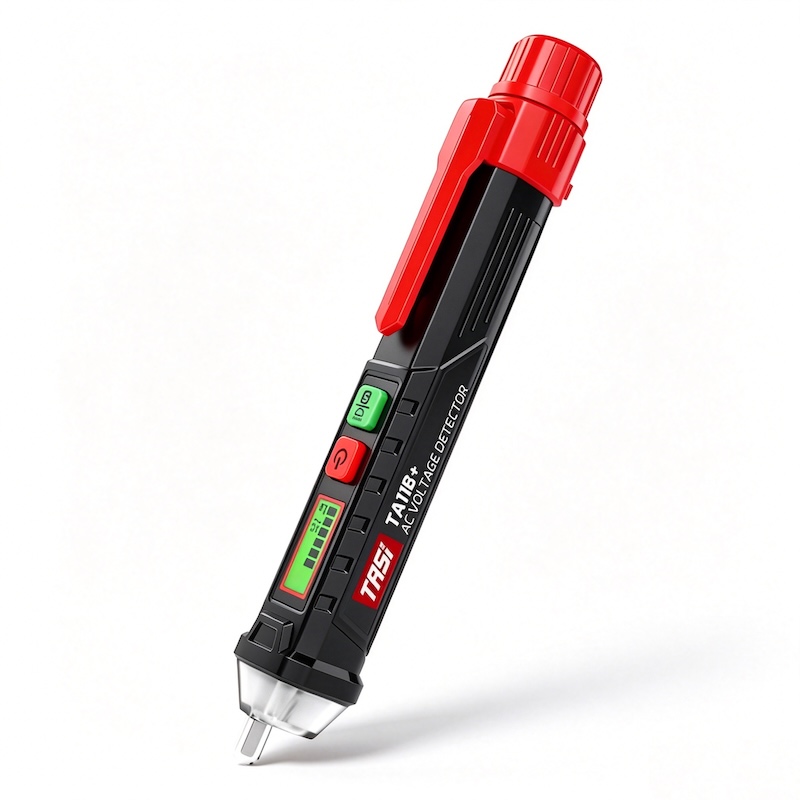
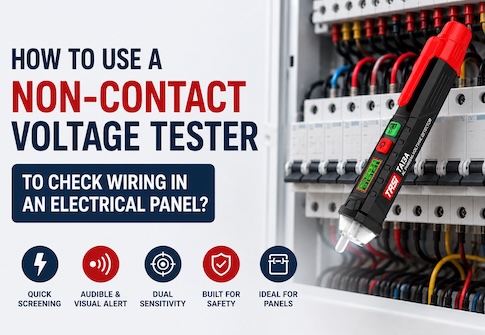
Non-contact voltage testers are designed to sense AC electric fields and are commonly used for quick checks on live conductors, outlets, cables, and electrical equipment.
This often raises a question: Can a non-contact voltage tester detect a ground wire?
It can detect an AC electric field around a ground or protective earth conductor, but one important limitation must be understood: a non-contact voltage tester cannot confirm whether a ground conductor is properly connected to earth or whether the grounding system is effective.
Under normal conditions, a protective earth conductor should not remain at a significant hazardous voltage. If an NCV tester indicates voltage near a ground wire, the result should be investigated using appropriate test equipment.
Key Points
● A non-contact voltage tester can sense an AC electric field around a ground or protective earth conductor.
● A correctly functioning protective earth conductor normally should not produce the same strong, stable indication as a live conductor.
● An alert near a ground wire does not necessarily mean that the conductor is carrying a hazardous voltage. It may result from induced voltage or coupling from a nearby live conductor.
● An NCV tester cannot determine whether a protective earth conductor is correctly connected or measure earth resistance.
● Proper grounding should be verified using suitable contact measurement instruments or dedicated grounding test equipment.
How Does a Non-Contact Voltage Tester Detect a Ground Wire?
A non-contact voltage tester does not directly measure the voltage between a conductor and earth. Instead, its internal sensing circuit detects the alternating electric field produced around an energized AC conductor.
When the probe tip approaches a conductor carrying AC voltage, the electric field can be detected by the tester. If the signal exceeds the instrument's detection threshold, the tester provides an audible, visual, or combined alarm.
When the tester is placed near a ground wire, it is therefore detecting:
● Whether a sufficiently strong AC electric field is present around the conductor;
● Not whether the conductor has a correct and effective connection to earth.
This is why NCV testers are useful for rapid voltage screening but are not substitutes for grounding test instruments.
Should a Ground Wire Normally Trigger an NCV Tester?
In a correctly installed electrical system with an effective protective earth connection, the protective earth conductor should normally remain close to earth potential. It therefore generally should not produce the same strong and consistent NCV indication as a live conductor.
When checking a wall outlet, for example, a typical result may be:
● A clear indication near the live conductor;
● Little or no indication near the neutral conductor under normal conditions;
● Little or no indication near the protective earth conductor under normal conditions.
These results are not absolute.
NCV indications can be influenced by tester sensitivity, conductor arrangement, insulation thickness, distance from the conductor, and surrounding electric fields. A single positive or negative indication should therefore not be used to determine whether wiring is correct.
Why Might a Ground Wire Trigger the Tester?
If an NCV tester produces an alert near a ground wire, it does not automatically indicate a serious fault. Several conditions may cause this response.
● Electric field from a nearby live conductor: Live, neutral, and protective earth conductors are often installed together in the same cable, conduit, or junction box. A sensitive NCV tester may detect the field from an adjacent live conductor rather than from the ground wire itself.
● Induced voltage: Conductors running parallel over a distance can be capacitively coupled. This may create a small induced voltage on a conductor that is not directly energized.
● Abnormal protective earth connection: A disconnected, incorrectly wired, or otherwise compromised protective conductor may develop an abnormal potential and should be investigated.
● Electrical fault: Damaged insulation, incorrect wiring, or equipment leakage can place voltage on a protective conductor.
● High tester sensitivity: High-sensitivity NCV modes are designed to detect weaker electric fields and are consequently more susceptible to nearby conductors and induced signals.
An NCV indication should therefore be treated as a reason for further investigation rather than immediate proof that the ground conductor is energized.
Does No NCV Indication Mean the Ground Wire Is Good?
No.
This is one of the most important limitations when using an NCV tester around protective earth conductors.
If the tester does not respond near a ground wire, it only means that no AC electric field above the tester's detection threshold was detected under the current test conditions. It does not confirm that the protective earth connection is intact or effective.
No indication may occur when:
● The ground conductor is correctly connected;
● The ground conductor is not connected at all;
● The conductor is broken or open;
● The probe is too far from the conductor;
● The tester sensitivity is insufficient;
● No electric field strong enough to trigger the tester is present.
For this reason, the absence of an NCV alarm must not be treated as proof of a valid protective earth connection.
Can an NCV Tester Confirm That a Ground Wire Is Properly Connected?
No.
The primary function of an NCV tester is to detect AC electric fields. It is not designed to assess protective conductor continuity or earth resistance.
It cannot reliably determine:
● Whether the protective earth conductor is actually connected to the grounding system;
● Whether the conductor is broken somewhere along the circuit;
● Whether grounding terminals are mechanically secure;
● The earth resistance value;
● Whether the grounding system meets applicable electrical safety requirements.
Depending on the test objective, a multimeter, two-pole voltage tester, receptacle tester, earth resistance tester, or other appropriate professional instrument should be used.
What Should You Consider When Checking an Outlet Ground?
An NCV tester can be used as a preliminary screening tool around an outlet, but its indication should never be the sole basis for confirming correct wiring.
● Verify the tester on a known live source before use.
● Check different points around the outlet and compare the indication instead of relying on a single test.
● Do not assume that the protective earth connection is correct simply because the ground contact does not trigger an alert.
● If a strong and persistent indication appears around the ground contact, verify the condition with an appropriate contact-type instrument.
● If incorrect wiring, leakage, an energized protective conductor, or grounding failure is suspected, discontinue work and have the circuit inspected by a qualified person.
Because the conductors inside an outlet are installed close together, an NCV indication at the ground contact may sometimes originate from the nearby live conductor.
FAQ
Is it normal for an NCV tester not to respond to a ground wire?
Yes, this can be normal. However, no indication does not prove that the protective earth conductor is properly connected. A disconnected or broken ground wire may also produce no indication.
If the ground wire triggers the tester, does that mean it is live?
Not necessarily. The tester may be responding to induced voltage, a nearby live conductor, or high sensitivity. Contact measurement may be required to determine the actual condition.
Can an NCV tester determine whether an outlet has a working ground connection?
Not reliably. The absence of an indication at the ground contact does not confirm that a functional protective earth conductor is present.
Can an NCV tester detect a broken ground wire?
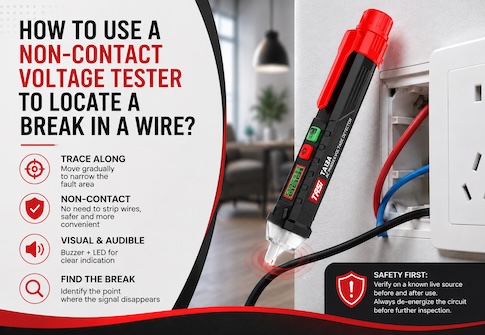
Generally, no. Because a protective earth conductor should not normally produce a strong AC electric field, alarm continuity cannot be used to locate or confirm a break reliably.
How can I verify that a ground connection is working correctly?
The required test depends on whether you need to verify protective conductor continuity, voltage conditions, or earth resistance. Appropriate contact-type or dedicated grounding test equipment should be used. Fixed electrical installations should be tested in accordance with applicable local safety requirements by qualified personnel.
Conclusion
A non-contact voltage tester can sense an AC electric field around a ground or protective earth conductor, so it may occasionally produce an alert near the ground wire. However, the tester detects AC electric fields, not grounding quality itself.
A properly functioning protective earth conductor normally should not produce the same strong and stable indication as a live conductor. If it does, the cause may be an adjacent live conductor, induced voltage, incorrect wiring, or an electrical fault that requires further investigation.
Likewise, no NCV indication does not prove that the ground connection is intact.
An NCV tester is best used as a rapid voltage-screening tool. To verify protective conductor continuity, grounding integrity, or earth resistance, use appropriate professional test equipment.