Introduction
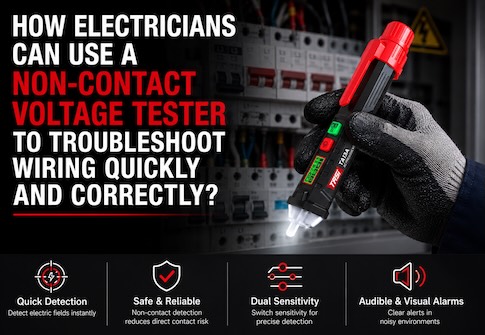
Insulating gloves are commonly used as part of electrical safety practices. However, some users notice that a non-contact voltage tester, or NCV tester, behaves differently when gloves are worn. The tester may need to be moved closer to a live conductor, the alarm may become less stable, or a conductor that triggers an alarm without gloves may not trigger one when gloves are worn.
This does not necessarily indicate a fault with the tester. Insulating gloves can change the capacitive coupling between the tester, the user, and the surrounding environment, which may affect the sensitivity of some non-contact voltage testers.
An NCV tester can therefore generally still be used while wearing insulating gloves, but the result must be interpreted correctly. A lack of an alarm should never be treated as proof that a circuit is de-energized.
Key Takeaways
● Wearing insulating gloves does not normally make an NCV tester unusable, but it may affect detection sensitivity.
● Glove material and thickness, as well as the tester's circuit design, can influence the actual effect.
● When gloves are worn, the sensing distance may decrease and the tester may need to be positioned closer to the conductor.
● Before and after testing, verify the NCV tester on a known live source whenever practical.
● No alarm from an NCV tester must not be used as the sole evidence that a circuit is de-energized.
● Electrical work requires suitable protective equipment for the voltage and risk involved; ordinary gloves must not be treated as certified electrical insulating protection.
Why Can Insulating Gloves Affect an NCV Tester?
A non-contact voltage tester does not need direct metallic contact with a conductor. Instead, its sensing circuit detects the alternating electric field surrounding an energized AC conductor.
During this process, the tester, the user's body, and the surrounding environment can form part of a capacitive coupling path. If the electrical coupling between these elements changes, the strength of the signal reaching the tester's sensing circuit can also change.
When thick insulating gloves are worn, the coupling conditions between the user's hand, the tester, the body, and the environment may be altered. With some NCV testers, this can reduce the detected signal and lead to effects such as:
● The tester must be moved closer to the conductor before it alarms.
● An alarm that was previously stable may become intermittent.
● Low-voltage conductors or cables with thick insulation may become more difficult to detect.
● Results may vary slightly between users or installation environments.
Different NCV testers use different sensing structures, amplification circuits, and alarm thresholds, so the effect of gloves is not identical for every model.
Do Insulating Gloves Always Reduce Sensitivity?
Not necessarily.
Gloves are only one of several factors that influence NCV detection sensitivity. The result also depends on conductor voltage, insulation thickness, tester detection range, sensitivity setting, and the surrounding electrical environment.
● Higher conductor voltage: A stronger electric field is generally easier to detect, so the effect of gloves may be less noticeable.
● Lower conductor voltage: When the available sensing signal is already weak, changes in coupling may have a greater effect on alarm distance.
● Thicker gloves: Thicker insulating material may produce a more noticeable change in coupling conditions.
● High-sensitivity mode: On testers with selectable sensitivity, the high-sensitivity setting may detect weaker electric fields more easily.
● Thick conductor insulation: The field reaching the sensing tip may already be reduced, making detection more sensitive to other influencing factors.
● Tester design: Sensor geometry, signal amplification, filtering, and alarm thresholds differ between models.
It is therefore more accurate to say that insulating gloves may change the detection conditions and can affect the sensitivity of some NCV testers, rather than saying that gloves always cause an NCV tester to malfunction.
Why Might the Tester Stop Alarming When Gloves Are Worn?
If a conductor is known to be energized but the NCV tester does not alarm while gloves are worn, other possible causes should also be checked.
● The tester's battery may be low.
● The tester may not be switched on correctly or may be in the wrong detection mode.
● The conductor voltage may be below the specified detection range.
● The sensing tip may be too far from the energized conductor.
● The cable insulation may be unusually thick or include shielding.
● Closely spaced conductors may influence the surrounding electric field.
● The conductor may be inside metallic conduit, an enclosure, or another shielded structure.
● Grounding conditions or body-to-environment coupling may have changed.
● The NCV tester itself may be faulty.
If the tester alarms after the gloves are removed but does not alarm when they are worn, the gloves may be contributing to the change in sensing conditions. Even so, the tester should be checked against a known live source.
How Should an NCV Tester Be Used While Wearing Insulating Gloves?
Correct operating practices can reduce the likelihood of misinterpreting the result.
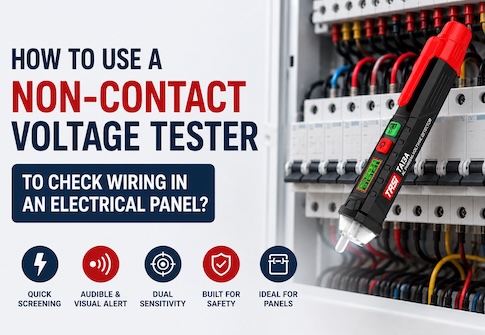
● Verify the tester first. Before testing, check the NCV tester on a known live outlet or conductor to confirm that its visual and audible alarms operate correctly.
● Hold the tester correctly. Grip the instrument only in the intended holding area and do not cover the sensing tip.
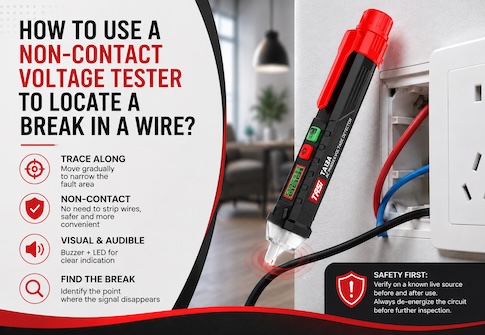
● Approach the conductor slowly. Move the sensing end gradually toward the target rather than sweeping quickly across it.
● Position the sensing tip appropriately. If sensitivity is reduced while gloves are worn, move the sensing tip closer to the target without contacting exposed live parts.
● Select the appropriate sensitivity. If the tester provides multiple sensitivity ranges, choose the mode suitable for the application.
● Verify the tester again after testing. Rechecking it on a known live source helps confirm that the instrument remained functional during the test.
A practical sequence is therefore: known live source → target circuit → known live source. This helps reduce the risk of false conclusions caused by changes in the tester or test environment.
Does Wearing Insulating Gloves Make Electrical Work Safer?
Suitable insulating gloves can form part of an electrical personal protective equipment system when correctly selected and used. However, wearing gloves does not eliminate the need for other electrical safety measures.
It is also important to distinguish between professional electrical insulating gloves and ordinary rubber, household, or general-purpose work gloves. Ordinary gloves should not automatically be considered suitable electrical insulating protection.
Protective equipment should be selected according to the working voltage, task, environmental conditions, and applicable safety requirements. Gloves should also be inspected before use for damage, deterioration, or other defects.
Wearing insulating gloves does not change the basic purpose of an NCV tester. An NCV tester is primarily a screening tool for detecting the presence of an AC electric field; it should not be relied upon alone to establish that equipment is safe to touch or work on.
Does No Alarm Mean the Circuit Is De-Energized?
No.
This is one of the most important limitations of non-contact voltage testing. An NCV tester senses the alternating electric field around an energized conductor rather than directly measuring the voltage between two electrical points.
If the electric field reaching the tester is too weak because of gloves, distance, shielding, low voltage, grounding conditions, or other factors, the signal may remain below the alarm threshold even though the conductor is still energized.
Therefore:
● An alarm normally indicates that an AC electric field has been detected nearby.
● No alarm does not, by itself, prove that a conductor is de-energized.
Where confirmation of de-energization is required before wiring, maintenance, disassembly, or contact with conductors, follow the applicable electrical safety procedure and use an appropriate contact-type voltage test instrument.
FAQ
Can I still use a non-contact voltage tester while wearing insulating gloves?
Generally, yes. Gloves do not necessarily prevent an NCV tester from operating, but they may affect sensitivity. Verify the tester on a known live source while wearing the gloves you intend to use.
Why does the alarm distance become shorter when I wear gloves?
The insulating material may change capacitive coupling between the tester, the user, and the environment. As a result, the sensing circuit may receive a weaker signal and require closer proximity to the energized conductor.
Do thicker gloves always have a greater effect?
They may, but glove thickness is not the only factor. Voltage level, conductor insulation, tester sensitivity, and environmental conditions also affect the result.
Can ordinary rubber gloves replace electrical insulating gloves?
No. General-purpose rubber or work gloves should not automatically be regarded as suitable electrical insulating PPE. Appropriate protective equipment must be selected for the electrical hazard involved.
If the tester does not alarm while I am wearing gloves, is the circuit safe?
No. A lack of alarm cannot be used as the sole proof that a circuit is de-energized.
Should I recheck the tester while wearing the gloves?
Yes. Testing the NCV tester on a known live source under the same conditions in which it will actually be used provides a more meaningful functional check.
Conclusion
Wearing insulating gloves normally does not prevent a non-contact voltage tester from operating, but it can change capacitive coupling between the tester, the user, and the surrounding environment, which may affect sensitivity, alarm distance, and alarm stability.
The actual effect depends on glove thickness, tester design, conductor voltage, cable construction, and site conditions. When gloves are worn, verify the NCV tester on a known live source before testing the target circuit and check it again afterwards.
Most importantly, an NCV tester is suitable for preliminary detection of AC electric fields, but a lack of alarm must never be treated as proof of de-energization. Where electrical work requires confirmation that a circuit is safe, use an appropriate contact-type voltage test instrument and follow the applicable electrical safety procedure.