Introduction
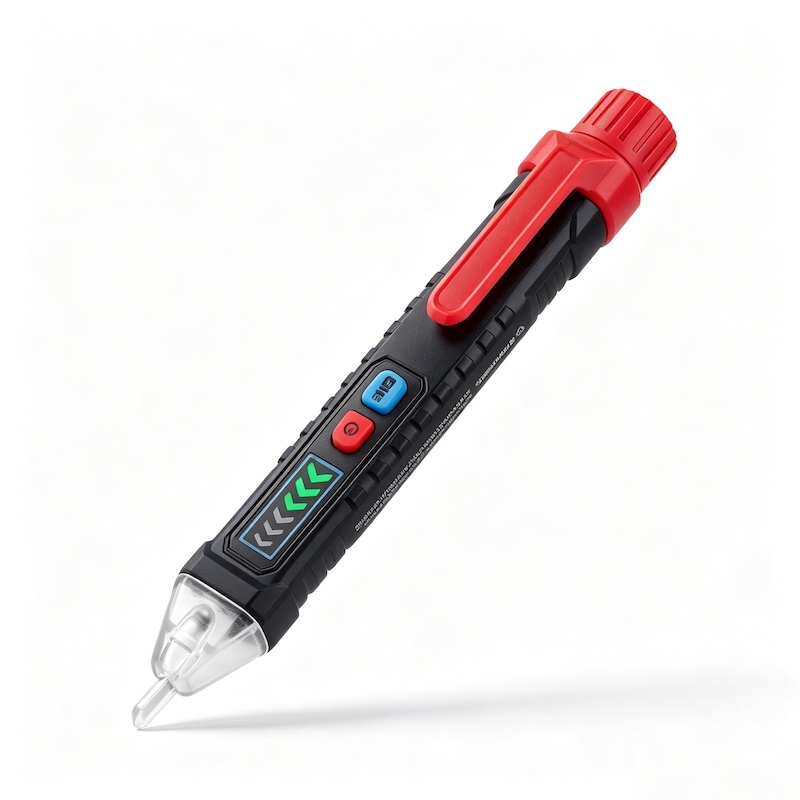
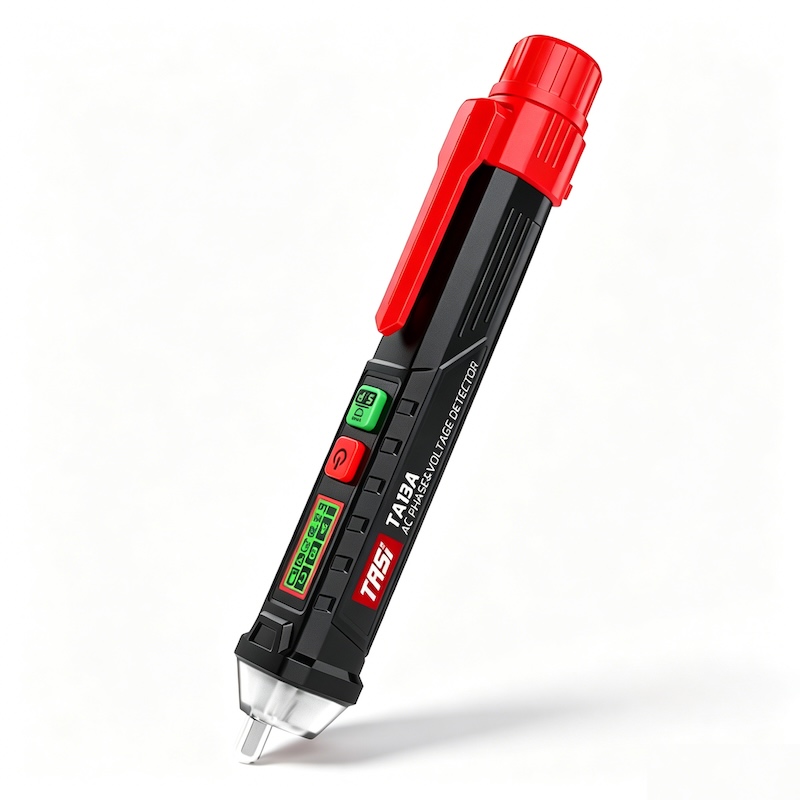
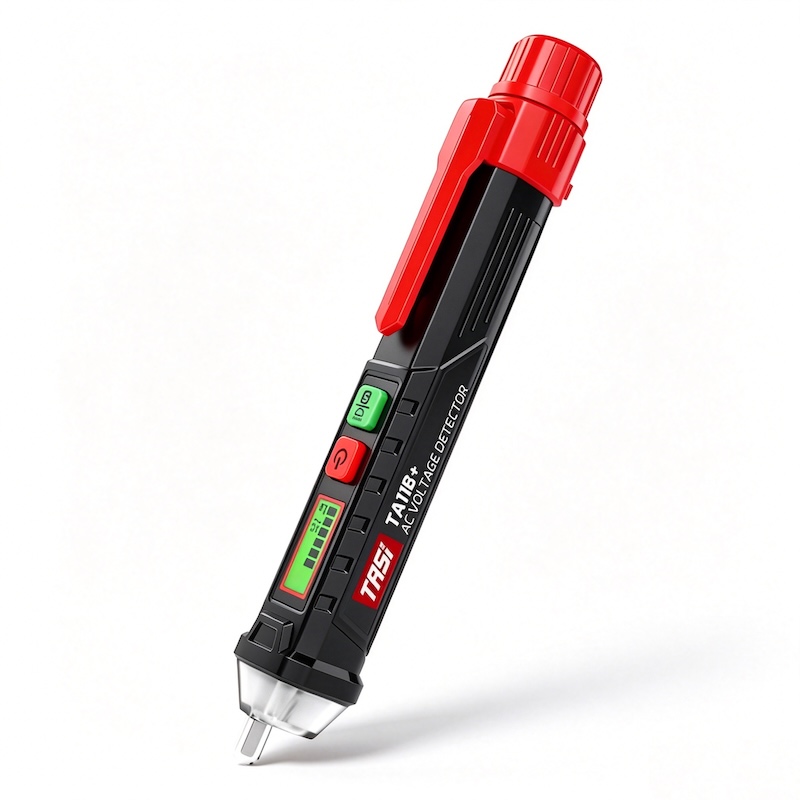
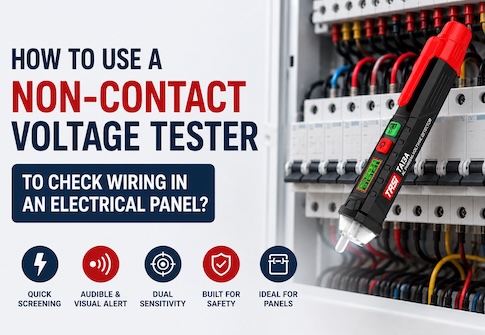
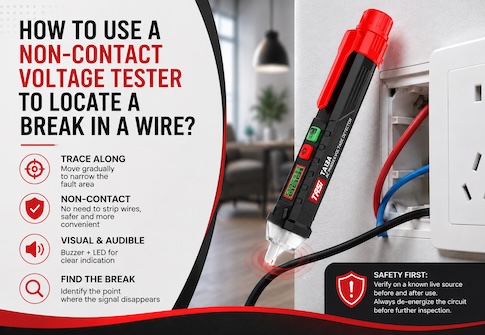
A non-contact voltage tester (NCV tester) detects the electric field generated around an energized AC conductor without normally requiring direct contact with exposed metal.
It is widely used for checking wall outlets, power cords, fixed wiring, distribution systems, and electrical equipment during preliminary troubleshooting and maintenance.
Although many NCV testers look similar, their performance can differ considerably in voltage range, sensitivity, CAT safety rating, alarm indication, operating frequency, and auxiliary functions.
For this reason, selecting an NCV tester should not simply be based on the widest voltage range. The tester should match the actual operating voltage, electrical environment, and intended application.
Key Points
When selecting a non-contact voltage tester, pay particular attention to:
● Detection voltage range: Determines the AC voltage range for which the tester is designed.
● Sensitivity and detection modes: Affect the tester's response to lower voltages and weaker electric fields.
● CAT safety rating: Should correspond to the electrical environment in which the tester will be used.
● Operating frequency range: Determines the AC frequencies the tester can reliably detect.
● Alarm indication: Common options include audible alarms, LEDs, or combined visual and audible indication.
● Self-test and status indication: Help confirm that the tester is powered and operating correctly.
● Additional functions: Such as a flashlight, auto power-off, and low-battery indication.
● Mechanical design and operating environment: Including probe shape, grip, durability, and environmental specifications.
For professional electrical applications, correct safety classification and suitability for the working environment are more important than simply choosing the highest sensitivity or widest voltage range.
Detection Voltage Range Is a Fundamental Specification
Different NCV testers are designed for different AC voltage ranges. Common specifications include:
● Approximately 12–1000 V AC
● Approximately 50–1000 V AC
● Other ranges designed for specific applications
For general checks on wall outlets, power cords, and common mains wiring, a standard AC detection range is sufficient in many situations.
If the tester will be used around lower-voltage AC circuits, control wiring, or weaker electric fields, a model with a lower detection threshold or a high-sensitivity mode may be more suitable.
A specification such as 12–1000 V or 50–1000 V describes the intended detection range. It does not mean the NCV tester can measure or display the actual voltage.
An alarm only indicates that an AC electric field meeting the tester's response conditions has been detected. It cannot determine whether the conductor is carrying 120 V, 230 V, or another specific voltage.
Single or Dual Sensitivity Should Match the Application
NCV testers may use fixed sensitivity or provide two or more sensitivity levels.
A fixed-sensitivity tester is generally simple to operate and suitable for routine checks on outlets, power cords, and common AC wiring.
Dual- or multi-sensitivity models allow the user to adapt the detector to different environments.
● High-sensitivity mode can improve detection of lower voltages or weaker AC electric fields.
● Low-sensitivity mode can help reduce interference from adjacent energized conductors and make it easier to locate the target wire.
Higher sensitivity is not always better.
Inside distribution panels, cable bundles, or confined spaces, excessive sensitivity may cause the tester to respond to several nearby energized conductors, making accurate localization more difficult.
For electrical troubleshooting, cable identification, and equipment maintenance, selectable sensitivity often provides greater flexibility.
Do Not Overlook the CAT Safety Rating
The measurement category is an important safety specification for electrical test equipment.
Common classifications include CAT II, CAT III, and CAT IV. These categories correspond to different installation environments and levels of transient overvoltage exposure.
In general:
● CAT II applies to loads and equipment connected to low-voltage installations.
● CAT III applies to fixed installations and building distribution systems, including distribution equipment and permanently installed wiring.
● CAT IV applies to locations at or near the origin of the low-voltage installation, such as service entrances and other upstream distribution points.
The CAT category must be considered together with the rated voltage, for example CAT III 1000 V or CAT IV 600 V.
A higher category number does not automatically mean that a tester is suitable for every application. The complete rating, product design, and actual working environment must be considered together.
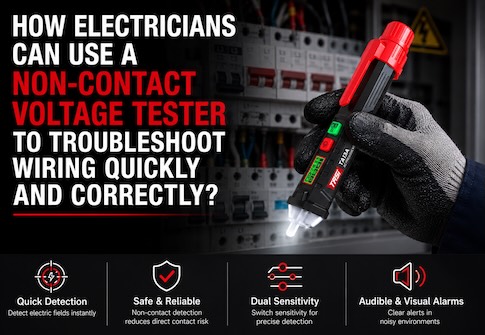
For electricians and maintenance professionals working around distribution panels and fixed installations, this specification is particularly important.
Confirm Whether the Tester Is Intended Primarily for AC Detection
Most non-contact voltage testers are designed mainly for AC voltage detection because they sense the changing electric field surrounding an energized AC conductor.
A conventional NCV tester therefore does not normally work like a multimeter for direct DC voltage measurement.
Before purchasing, identify the intended applications, such as:
● Household outlets
● AC power cords
● Distribution wiring
● Electrical control cabinets
● Industrial AC equipment
● Other specific electrical systems
If the job also requires actual voltage measurement, DC voltage testing, resistance measurement, or continuity testing, an appropriate digital multimeter or other electrical test instrument should be used in addition to the NCV tester.
Operating Frequency Range Also Matters
Because an NCV tester responds to an alternating electric field, its performance depends partly on signal frequency.
Most conventional mains systems operate at 50 Hz or 60 Hz, and general-purpose NCV testers are usually designed to cover these frequencies.
However, industrial equipment, variable-frequency drive systems, and specialized electrical installations may produce voltages with frequencies or waveforms that differ from standard mains power.
In such applications, check the manufacturer's specified operating frequency range and application limitations.
If the signal falls outside the tester's intended operating range, the conductor may be energized without producing the expected indication.
Audible and Visual Alarms Improve Field Usability
Typical indication methods include:
● LED indication
● Audible buzzer
● Combined audible and visual alarms
● Progressive indications that change with detected field strength
For general use, combined audible and visual indication is often easier to recognize.
In noisy industrial areas, an audible alarm may be difficult to hear, making a clear LED indication especially useful.
In bright environments or areas where the display is difficult to see, an audible alarm provides useful additional feedback.
Some testers vary the beep rate or LED indication according to the relative strength of the detected electric field. This can help locate an energized conductor, but alarm intensity should not be interpreted as a direct measurement of voltage magnitude.
Self-Test and Operating Status Indication Are Useful Features
An NCV tester depends on batteries and electronic sensing circuitry. Low battery voltage, internal faults, or failure to power on correctly can affect its response.
Useful functions may include:
● Power-on indication
● Self-test function
● Low-battery indication
● Automatic power-off
These features do not increase the basic detection range, but they improve usability and help the operator confirm the tester's operating status.
For electrical safety checks, it is still good practice to verify the tester on a known energized source before and after testing, in accordance with the applicable work procedure.
Probe Design Affects Practical Use
Most NCV testers use a narrow probe tip so that the sensing area can be positioned close to outlet slots, insulated wires, and confined electrical components.
Useful design considerations include:
● Whether the probe can easily approach the target conductor
● Clear separation between the sensing end and the hand-grip area
● Convenient one-handed button operation
● Size suitable for a tool pouch or pocket
● Adequate housing durability
● Secure battery compartment design
For electricians and maintenance technicians who carry the tester frequently, size, weight, and grip comfort also affect long-term usability.
A Flashlight and Auto Power-Off Can Be Practical
NCV testers are often used inside electrical cabinets, behind equipment, in corners, and in poorly illuminated areas. An integrated LED flashlight can therefore be useful.
Automatic power-off can reduce unnecessary battery consumption if the tester is accidentally left switched on.
Other possible functions include:
● Buzzer on/off control
● Operating-status LED
● Battery-level indication
● Sensitivity mode memory
● Pocket clip
These should be selected according to actual work requirements rather than simply choosing the model with the greatest number of features.
Do Not Choose a Tester Only by Its Maximum Voltage
A common purchasing mistake is to compare NCV testers only by the highest voltage printed on the specification sheet.
For most low-voltage electrical work, maximum detection voltage is only one factor.
Two testers may both be rated to detect up to 1000 V but differ significantly in:
● Minimum detection voltage
● Sensitivity
● CAT rating
● Alarm method
● Frequency range
● Permitted operating environment
A better approach is to define the application first and then compare the specifications that matter for that environment.
How to Choose for Different Applications
For household outlets, power cords, and basic appliance checks, a simple NCV tester with clear audible/visual indication and a range covering common mains voltages is generally appropriate.
For electrical installation and building maintenance, greater attention should be given to CAT rating, selectable sensitivity, flashlight functionality, and durability.
For industrial maintenance, control cabinets, or densely packed wiring, selectable sensitivity, resistance to interference, operating frequency range, and probe localization performance are particularly useful.
For lower AC voltages or weaker electric fields, consider a model with a lower detection threshold and high-sensitivity mode.
Other Product Information Worth Checking
In addition to the main specifications, review the manufacturer's technical documentation.
● Is the AC detection range clearly stated?
● Is the operating frequency specified?
● Are the CAT rating and corresponding rated voltage clearly marked?
● Are operating temperature and humidity limits provided?
● Is a complete user manual with safety instructions available?
● Are the model, manufacturer, and product markings clearly identified?
● Is relevant conformity information available for the intended market?
For test and measurement instruments, clear specifications and complete technical documentation are important indicators of a professionally designed product.
An NCV Tester Does Not Replace a Multimeter or Proper Verification Procedure
Even a high-quality non-contact voltage tester cannot replace every type of electrical test instrument.
NCV detection may be influenced by probe distance, insulation thickness, shielding, adjacent energized conductors, grounding conditions, and capacitive coupling between the operator and the surrounding environment.
Therefore:
● An alarm does not provide an actual voltage measurement.
● No alarm does not prove under all conditions that a conductor is de-energized.
● An NCV tester does not replace a multimeter or other instrument when an actual voltage value must be measured.
● Before electrical maintenance or work on isolated circuits, follow the applicable safety procedure and use appropriate test equipment to verify the condition of the circuit.
Understanding these limitations is more important than simply choosing the most sensitive detector.
FAQ
Is a wider NCV detection range always better?
No. The range should first cover the actual voltages being tested. Minimum detection voltage, sensitivity, CAT rating, and application environment are often equally important.
What is the difference between a 12–1000 V and a 50–1000 V NCV tester?
One major difference is the specified lower detection threshold. A 12–1000 V model is generally designed to respond to lower AC voltages, although actual response still depends on distance, insulation, electric-field strength, and environmental conditions.
Is a dual-sensitivity NCV tester worth choosing?
Yes, especially for users who work with different types of wiring. Selectable sensitivity is useful in distribution panels, cable bundles, and situations where weak fields need to be detected.
Should I choose CAT III or CAT IV?
Choose according to the actual electrical environment and the rated voltage of the instrument. CAT III generally applies to fixed building installations, while CAT IV applies to locations closer to the origin of the low-voltage installation.
Can an NCV tester tell whether a circuit is 220 V or 230 V?
A conventional NCV tester normally indicates only the presence of a detectable AC electric field. It does not accurately measure the actual voltage value.
Is higher sensitivity always better?
No. Excessive sensitivity may cause unwanted responses from nearby energized conductors, making it more difficult to identify the target wire.
Is combined audible and visual indication better than sound only?
In many applications it is more practical because the two indications complement each other. However, alarm type does not replace suitable safety ratings and core detection performance.
What are the three most important specifications when buying an NCV tester?
As a practical starting point, check the detection voltage range, CAT safety rating, and sensitivity mode. Then compare alarm methods, flashlight functions, auto power-off, and other convenience features.
Conclusion
When buying a non-contact voltage tester, selection should begin with the intended application rather than the highest voltage rating or the number of features.
For general AC wiring checks, focus on the detection range and clear indication. For professional electrical work, also consider CAT safety rating, sensitivity modes, operating frequency, mechanical design, and the completeness of technical documentation.
A suitable NCV tester should provide a good balance between safety classification, detection capability, and field usability.
It is equally important to remember that an NCV tester is primarily a rapid screening tool for the presence of AC electric fields. It does not replace a multimeter for quantitative voltage measurement and should not be the sole means of verifying that a circuit is safe to work on.