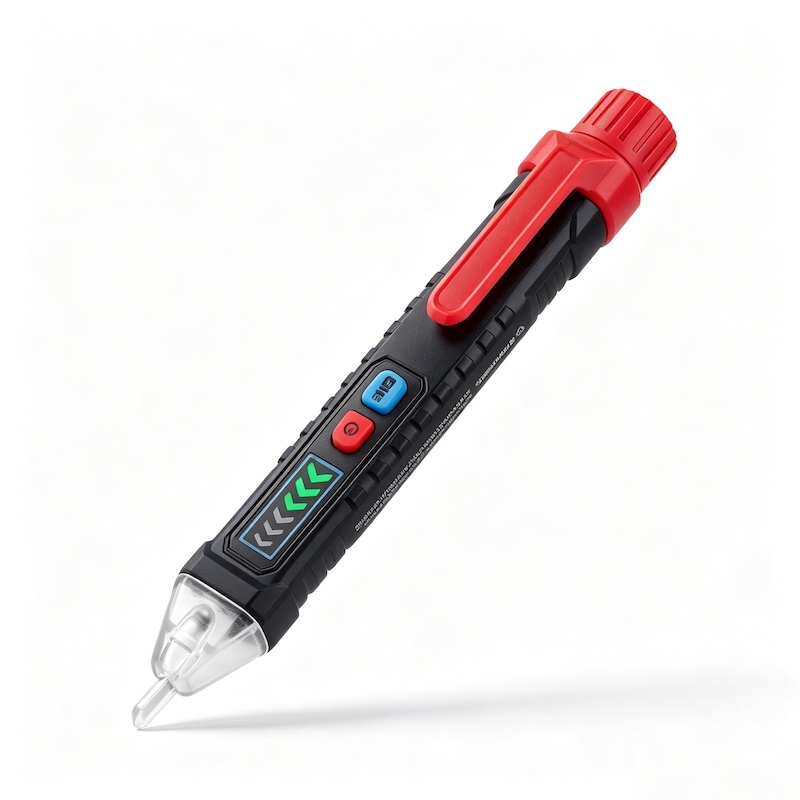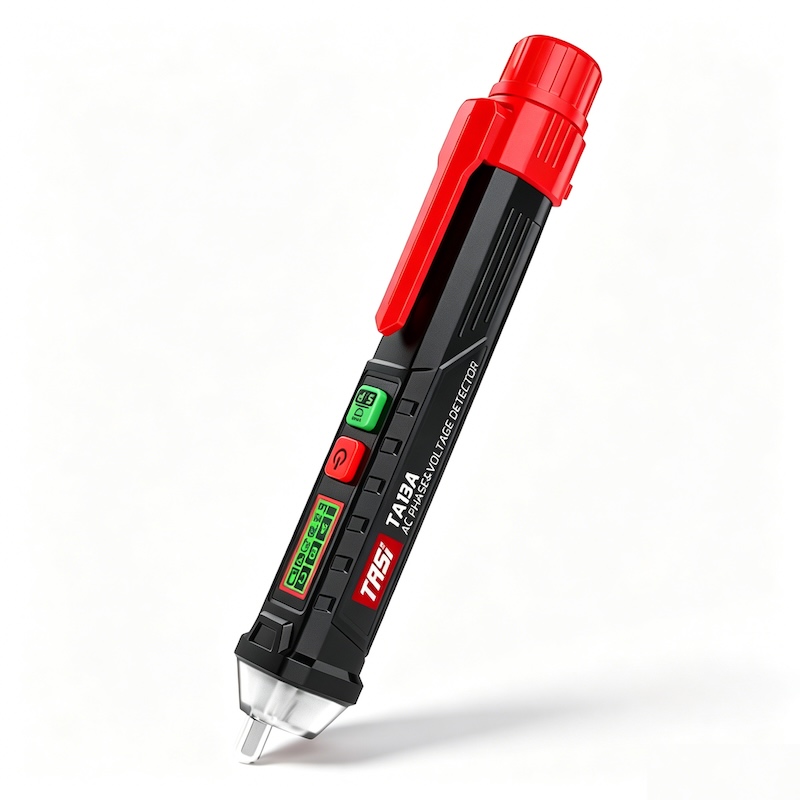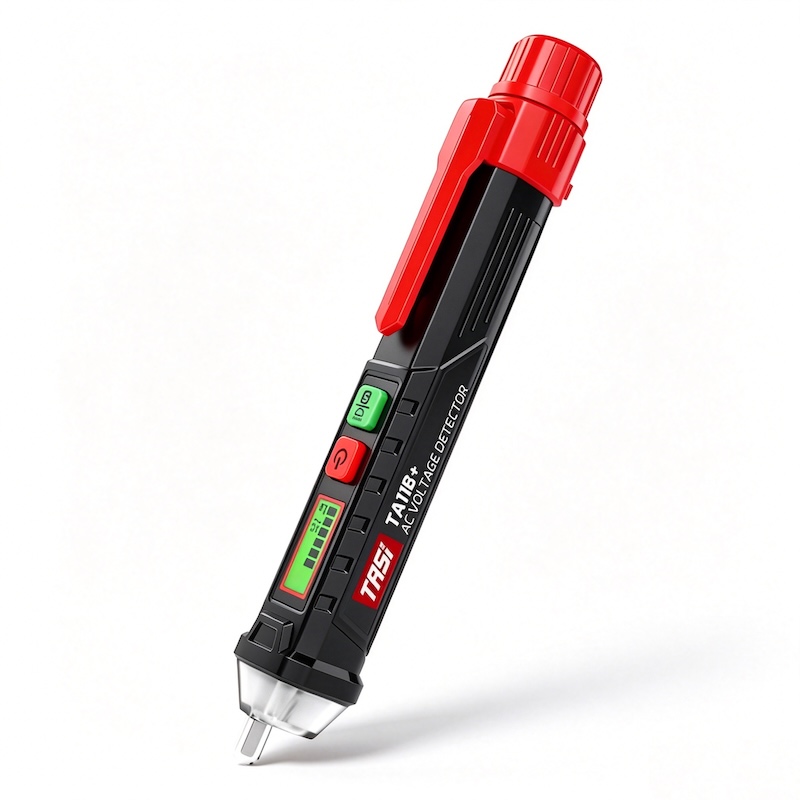
Introduction
When choosing a non-contact voltage tester, detection range, safety category, and alarm method are important specifications, but detection sensitivity also deserves careful consideration.
Common NCV testers may use a fixed sensitivity or provide two selectable sensitivity levels, typically referred to as high and low sensitivity. Both designs detect the alternating electric field around energized AC conductors, but they can differ in detection distance, response to lower voltages, resistance to interference, and usability around closely spaced wiring.
A single-sensitivity tester is not necessarily less capable, and a dual-sensitivity model is not automatically the better choice. The right option depends on the actual electrical environment and the type of work being performed.
Key Takeaways
● Single-sensitivity NCV testers use a preset detection sensitivity and are well suited to routine AC live-voltage checks.
● Dual-sensitivity testers allow users to switch between higher and lower sensitivity for greater flexibility in different electrical environments.
● High sensitivity makes weaker electric fields easier to detect, but may also increase responses caused by adjacent energized conductors or induced voltages.
● Low sensitivity can help reduce responses to nearby conductors and may be useful around outlets, closely spaced wiring, and when narrowing down the likely location of an energized conductor.
● Sensitivity should not be considered in isolation. Detection voltage range, CAT rating, alarm method, probe design, and operating instructions are equally important.
What Does Detection Sensitivity Mean in an NCV Tester?
A non-contact voltage tester typically detects the alternating electric field surrounding an energized AC conductor. When the sensing tip approaches a live wire, outlet, or other energized electrical component, the tester responds once the detected field reaches its internal trigger threshold.
Sensitivity therefore describes how readily the tester responds to an AC electric field.
A higher sensitivity generally allows the tester to respond to weaker fields, such as those produced by lower voltages, greater sensing distances, or conductors behind insulation. However, a wider response range can also make the tester more susceptible to electric fields from nearby live conductors, induced voltages, and the surrounding electrical environment.
For this reason, higher sensitivity is not always better. The appropriate sensitivity depends on the application.
What Is a Single-Sensitivity Non-Contact Voltage Tester?
A single-sensitivity NCV tester operates with a preset detection sensitivity. Once switched on, the sensing tip can be brought near the test point without selecting between different sensitivity levels.
Its main advantage is simplicity.
● Ready for routine testing after power-up;
● No need to decide between high and low sensitivity;
● Suitable for quick checks of outlets, power cords, switches, and common low-voltage AC circuits;
● Convenient for household inspection, basic electrical maintenance, and preliminary troubleshooting.
“Single sensitivity” does not mean that all such testers perform identically. Detection thresholds, voltage ranges, sensing-tip design, and signal processing vary between models, so the manufacturer's specifications should always be checked.
What Is a Dual-Sensitivity Non-Contact Voltage Tester?
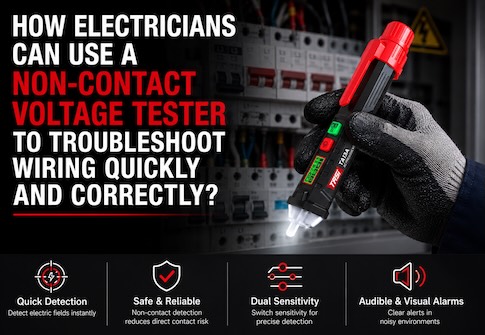
A dual-sensitivity NCV tester generally provides two selectable detection modes, such as high and low sensitivity.
Some models may associate these modes with different voltage ranges, with high sensitivity providing a lower starting detection voltage and low sensitivity covering higher-voltage conditions. However, there is no universal voltage range for these modes, and specifications vary by product.
The purpose of dual sensitivity is not simply to add another setting. It allows the user to adjust how readily the tester responds to surrounding electric fields.
For example:
● High sensitivity can be used when looking for weaker electric-field signals;
● Low sensitivity can help narrow the response area where several conductors are close together;
● Comparing the tester's response in both modes can provide additional information when checking outlets or wiring.
This flexibility can be useful for electrical maintenance and troubleshooting across changing work environments.
What Are the Main Differences Between Single and Dual Sensitivity?
The key difference is whether the user can actively change the tester's detection sensitivity.
● Operation: A single-sensitivity tester is generally ready to use after switching on, while a dual-sensitivity tester requires the user to select the appropriate mode.
● Adaptability: Single sensitivity is suitable for relatively consistent routine applications. Dual sensitivity provides greater flexibility across different field strengths and wiring conditions.
● Lower-voltage or weak-field detection: If the high-sensitivity mode has a lower starting detection voltage, it can be more useful for identifying weaker AC electric fields.
● Closely spaced wiring: Low sensitivity may reduce responses from more distant energized conductors and help narrow the sensing area.
● Ease of use: Single-sensitivity models are generally more straightforward. Dual-sensitivity models offer more control but require the operator to understand what each mode does.
Neither design is inherently superior in every application.
When Is High Sensitivity Useful?
High-sensitivity mode is primarily useful when stronger response to weak AC electric fields is needed.
Typical applications include:
● Detecting lower AC voltages within the tester's specified range;
● Detecting energized conductors through insulation;
● Tracing energized areas along a power cable;
● Locating areas where an AC electric field may be present;
● Improving response when the normal or lower-sensitivity mode produces a weak signal.
Higher sensitivity, however, also increases the area from which the tester may respond.
Where several energized conductors run close together, the tester may respond to more than one conductor. High sensitivity is therefore useful for finding a signal, but it may be less suitable for precisely narrowing down which conductor is responsible.
When Is Low Sensitivity Useful?
Low-sensitivity mode is often more practical where the electric field is relatively strong or wiring is densely arranged.
Typical applications include:
● Checking standard mains outlets;
● Inspecting switches and connection points;
● Narrowing the sensing area around parallel conductors;
● Rechecking an area where high sensitivity causes frequent alarms;
● Comparing electric-field strength around adjacent conductors.
Reducing sensitivity may help limit responses caused by nearby wiring, making the indication easier to interpret.
However, weaker electric fields may no longer trigger the tester in low-sensitivity mode. A lack of indication must therefore not be interpreted automatically as proof that the circuit is de-energized.
Which Type Is Better for Household Use?
For users who mainly check wall outlets, power cords, extension leads, or household appliances for the possible presence of AC voltage, a single-sensitivity NCV tester will often be sufficient.
For these applications, priorities typically include:
● Simple operation;
● Clear alarm indication;
● Fast response;
● A safety category appropriate for the intended environment.
A dual-sensitivity tester may be more useful when the user also needs to locate electric fields behind insulation, compare closely spaced wiring, or deal with frequent interference from nearby energized conductors.
Which Type Is Better for Electricians and Maintenance Technicians?
For electrical installation, equipment maintenance, HVAC service, and industrial troubleshooting, dual sensitivity often provides greater flexibility.
Typical work may involve:
● Outlet and distribution-circuit checks;
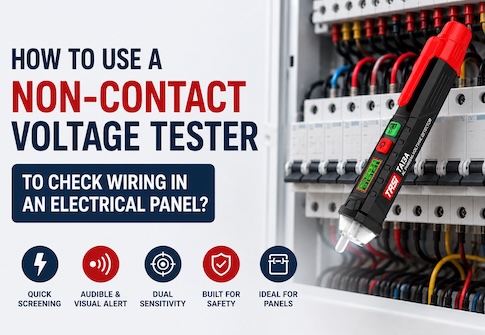
● Wiring inside control panels;
● Closely spaced conductors;
● AC circuits with different voltage levels;
● Preliminary fault investigation.
Switching between high and low sensitivity allows the tester's response to be adapted to the field strength and wiring arrangement. For users working in varied electrical environments, this additional control can be valuable.
Can Dual Sensitivity Reliably Distinguish Live and Neutral Conductors?
Dual sensitivity can provide additional flexibility when making a preliminary distinction between live and neutral conductors, but it does not guarantee reliable identification under all conditions.
The electric field around a live conductor is normally stronger, so an NCV tester will often respond more readily near the live conductor. In practice, however, the result can also be influenced by conductor spacing, insulation thickness, load conditions, capacitive coupling, induced voltage, and surrounding electric fields.
Where live and neutral conductors are positioned very close together, high sensitivity may cause the tester to indicate near both. Switching to lower sensitivity can sometimes help narrow the response area, but the result should still be regarded as an indication rather than definitive conductor identification.
Where conductor status must be confirmed before electrical work, an appropriate test method and instrument should be used for verification.
What Other Specifications Should Be Considered?
Sensitivity is only one part of NCV tester selection.
Other important considerations include:
● Detection voltage range: Ensure the specified AC voltage range covers the intended applications.
● Safety category: Select an appropriate CAT rating and rated voltage for the working environment, such as outlets, distribution systems, or equipment circuits.
● Alarm method: Audible and visual alarms can improve recognition in field work, while some models may also provide vibration.
● Auto power-off: Helps reduce unnecessary battery consumption.
● Low-battery indication: Makes it easier to identify when battery condition may affect operation.
● Probe design: Tip geometry and sensing area affect accessibility around outlets, terminals, and confined locations.
● Self-test or status indication: A method of confirming basic tester operation before use can help reduce the risk of misinterpreting a failed instrument.
These factors are generally more meaningful than selecting a tester solely on the basis of maximum sensitivity.
How Should You Choose Between Single and Dual Sensitivity?
Choose a single-sensitivity NCV tester when the application is relatively consistent and the main requirement is to perform quick checks of common outlets, power cords, or AC equipment with minimal setup.
Choose a dual-sensitivity tester when working with different voltages, changing wiring configurations, or electrically complex environments where switching between broader detection and narrower response can be useful.
As a practical guide:
● Routine live-voltage checks: Single sensitivity is often sufficient.
● Multi-purpose electrical maintenance: Dual sensitivity provides greater flexibility.
● Weak-field detection: Pay particular attention to the actual starting voltage of the high-sensitivity mode.
● Closely spaced wiring: A low-sensitivity mode can be useful for reducing the effective sensing area.
The best choice should be based on the intended application rather than the number of available modes.
What Should You Know When Using a Dual-Sensitivity Tester?
Dual sensitivity provides more flexibility, but the indications must still be interpreted correctly.
● Before testing, verify that the tester responds correctly on a known energized source.
● Do not assume that a wider response in high-sensitivity mode means the result is more reliable.
● If high sensitivity produces broad or frequent alarms, switch to low sensitivity and test again.
● Keep the sensing distance and movement reasonably consistent when comparing responses at different points.
● No alarm does not, by itself, prove that a circuit is de-energized.
● Before touching conductors, dismantling equipment, or beginning electrical work, verify the de-energized condition using procedures and test equipment appropriate to the task.
An NCV tester is primarily a rapid screening and supplementary indication tool, not a replacement for all contact-based electrical testing.
FAQ
Is a single-sensitivity NCV tester sufficient?
For routine checking of outlets, power cords, switches, and common AC circuits, a suitable single-sensitivity tester is often sufficient. Its suitability depends mainly on the required detection range and working environment.
Is a dual-sensitivity tester always more accurate?
No. Dual sensitivity provides greater flexibility in how the tester responds to electric fields, but it does not automatically mean greater measurement accuracy. NCV testers are designed primarily to detect the presence of an AC electric field rather than measure an exact voltage value.
Is higher sensitivity always better?
No. Higher sensitivity can detect weaker electric fields, but it can also increase responses caused by adjacent energized wiring, induced voltage, and surrounding electric fields.
Why does the tester stop indicating after switching to low sensitivity?
Low sensitivity generally requires a stronger electric field before the alarm threshold is reached. Lower voltage, greater sensing distance, or thicker insulation may therefore prevent an indication. This does not prove that the circuit is de-energized.
Can a dual-sensitivity NCV tester locate a broken wire?
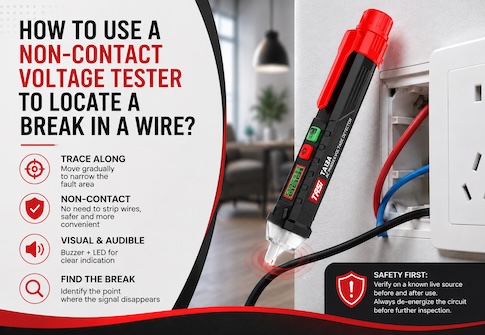
It can assist with preliminary fault tracing on some AC circuits by showing changes in detected electric-field strength along a cable. However, conductor arrangement, shielding, adjacent wiring, and induced voltage can affect the result, so the alarm point should not be treated as an exact break location.
What should I check when buying a dual-sensitivity tester?
In addition to the number of sensitivity modes, compare the voltage range of each mode, CAT rating, alarm methods, probe design, and manufacturer instructions. “High” and “low” sensitivity are not defined identically across all models.
Conclusion
Both single- and dual-sensitivity non-contact voltage testers can be used for quick detection of AC electric fields. Their main difference is how much control the user has over detection sensitivity.
Single-sensitivity models are simple and suitable for routine checks of outlets, power cords, and common AC circuits. Dual-sensitivity models provide more flexibility when working with lower voltages, closely spaced wiring, and more complex electrical environments.
Selection should not be based on the assumption that “dual sensitivity is always better” or that “higher sensitivity is always preferable.” A better approach is to consider the detection voltage range, application, safety category, interference conditions, and operating requirements together.
Regardless of the sensitivity design, an NCV tester should be treated as a rapid screening and supplementary indication tool. Where electrical work requires confirmation of a de-energized condition, use an appropriate verification procedure and test instrument.