Introduction
When selecting a non-contact voltage tester, specifications such as “CAT III 1000 V” or “CAT IV 600 V” are commonly found on the product housing or datasheet. These ratings are sometimes mistaken for the voltage detection range, while others assume that a CAT IV tester is automatically more accurate than a CAT III model.
In fact, the CAT rating primarily defines the electrical installation environments in which a test instrument is designed to be used and the level of transient overvoltage it is intended to withstand. It is different from detection sensitivity, voltage detection range, and measurement accuracy.
Choosing between CAT III and CAT IV should therefore begin with the electrical environment in which the tester will be used—whether for equipment and building wiring, distribution systems, or locations closer to the service entrance and utility supply.
Key Takeaways
● CAT III and CAT IV describe electrical installation environments, not simply the voltage detection range.
● CAT III is commonly associated with fixed installations inside buildings, including distribution boards, circuit breakers, fixed wiring, and permanently installed equipment.
● CAT IV applies to locations closer to the origin of the low-voltage installation, such as service entrances, electricity meters, incoming supply conductors, and outdoor low-voltage lines.
● A higher CAT category generally corresponds to environments with greater potential transient overvoltage energy, but the CAT designation alone is not sufficient to assess suitability.
● Always evaluate the measurement category together with its rated voltage, such as CAT III 1000 V or CAT IV 600 V.
● For professionals working across different parts of electrical distribution systems, a tester rated for both CAT III and CAT IV environments can provide greater application flexibility.
What Do CAT III and CAT IV Mean?
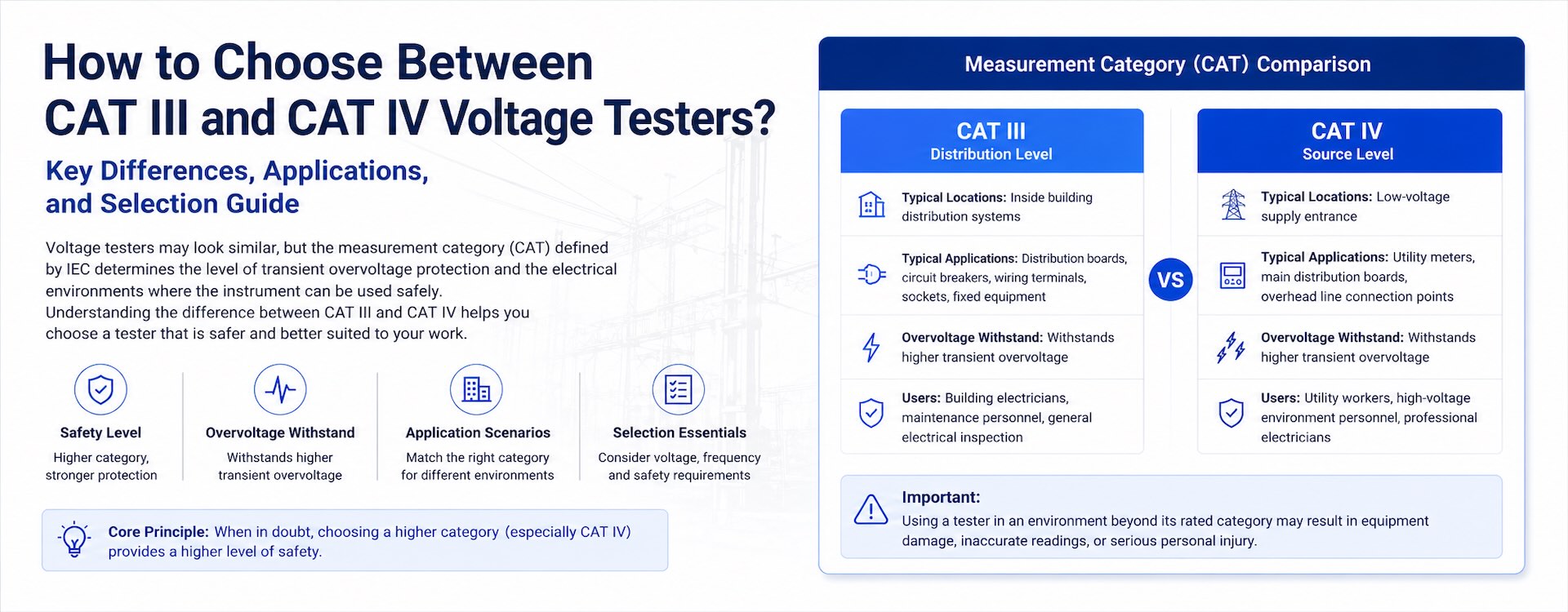
CAT refers to the Measurement Category assigned to test equipment for use in different parts of a low-voltage electrical installation.
Different locations within an electrical system are exposed to different transient overvoltage conditions. In general, locations closer to the source of the installation may be exposed to higher-energy transients and therefore require test equipment with an appropriate safety design.
CAT III typically covers fixed installations within a building, including distribution panels, circuit breakers, busbars, fixed cabling, and permanently installed equipment connected directly to the distribution system.
CAT IV applies closer to the origin of the low-voltage installation, including incoming supply conductors, electricity meters, service entrances, and certain outdoor low-voltage distribution circuits.
In practical terms, CAT IV environments are generally closer to the supply source and may involve higher transient energy than CAT III locations.
Where Is a CAT III Voltage Tester Suitable?
For routine electrical testing inside buildings or industrial equipment, CAT III covers a wide range of common applications.
Typical examples include:
● Checking whether internal building wiring is energized;
● Testing circuits around distribution boards and circuit breakers;
● Checking fixed electrical cables;
● Inspecting industrial equipment power wiring;
● Electrical maintenance of HVAC equipment;
● Checking motors, control cabinets, and permanently installed equipment;
● Rapid screening of receptacles, power cords, and general low-voltage AC wiring.
CAT III is therefore common among electricians, maintenance technicians, industrial service personnel, and building electrical professionals.
However, suitability must always be assessed together with the tester’s CAT-rated voltage. The category designation alone is not sufficient.
Where Is a CAT IV Voltage Tester Suitable?
CAT IV should receive greater consideration when testing is performed close to the origin of a building’s low-voltage installation or the utility supply interface.
Typical applications include:
● Checking incoming building supply conductors;
● Testing around electricity meters and meter cabinets;
● Inspecting outdoor low-voltage distribution wiring;
● Testing near the main service entrance;
● Work associated with low-voltage overhead lines;
● Rapid energized-circuit checks in environments with higher transient overvoltage exposure.
These locations generally have lower impedance between the test point and the supply source, meaning transient events can potentially carry greater energy. Test equipment used in these areas therefore requires an appropriate level of insulation, protection, and overall safety design.
For professional electricians and utility or electrical maintenance personnel working across multiple parts of a distribution system, CAT IV-rated equipment can provide broader application coverage.
How Should You Choose Between CAT III and CAT IV?
Start by identifying where the tester will normally be used.
If the main applications involve receptacles, equipment wiring, fixed cables, industrial machinery, and internal building distribution circuits, a CAT III tester with a suitable rated voltage will generally cover many typical tasks.
If testing includes service entrances, meter locations, incoming supply wiring, outdoor low-voltage circuits, or work that spans both CAT III and CAT IV environments, a tester with an appropriate CAT IV rating is the better choice.
For professional users, products marked with ratings such as:
CAT III 1000 V / CAT IV 600 V
can be particularly practical.
This marking means the product is rated for use up to the stated voltage within each corresponding measurement category. It does not mean that the tester is rated to 1000 V in a CAT IV environment.
Why Must the CAT Rating Be Considered Together With Voltage?
A measurement category should never be evaluated independently of its rated voltage.
Examples include:
● CAT III 600 V;
● CAT III 1000 V;
● CAT IV 600 V.
These are all CAT safety ratings, but they apply to different combinations of installation environment and rated voltage.
It is therefore inaccurate to assume that “CAT IV is always higher than CAT III 1000 V” without considering the voltage rating.
For example, a tester marked “CAT III 1000 V / CAT IV 600 V” is rated for use up to 1000 V in CAT III environments and up to 600 V in CAT IV environments.
The actual application must remain within both the specified measurement category and the corresponding rated voltage.
Is the CAT Rating the Same as the Voltage Detection Range?
No.
A non-contact voltage tester may, for example, have a detection range of 12–1000 V AC while also being marked CAT III 1000 V / CAT IV 600 V.
In this case:
● 12–1000 V AC describes the approximate AC voltage range over which the non-contact detection function can respond;
● CAT III 1000 V / CAT IV 600 V describes the rated application conditions for specific electrical installation environments.
These specifications serve different purposes.
A tester capable of detecting 1000 V AC should therefore not automatically be considered suitable for every 1000 V electrical environment.
What Else Should You Consider When Selecting a Voltage Tester?
The CAT rating is important, but it is only one part of selecting an appropriate non-contact voltage tester.
Other key factors include:
● Voltage detection range: Ensure it covers the circuits being tested, such as 12–1000 V AC or 50–1000 V AC.
● Sensitivity modes: Dual-sensitivity models can be useful when both conventional energized-circuit checks and lower-voltage or weaker-field detection are required.
● Audible and visual indication: A buzzer and LED indication can improve recognition in demanding environments.
● Vibration alert: Useful where ambient noise is high or visual indicators are difficult to see.
● Auto power-off: Helps reduce unnecessary battery consumption.
● Low-battery indication: Helps reduce the risk of unreliable operation caused by insufficient battery power.
● Built-in flashlight: Useful inside electrical panels, machinery, and poorly illuminated areas.
● Housing and insulation design: Particularly important for professional electrical maintenance work.
For users working in multiple environments, a well-balanced combination of detection range, CAT rating, sensitivity, and practical functions is generally more valuable than focusing on a single specification.
Is a CAT IV Tester Always Better Than a CAT III Tester?
Not necessarily.
CAT IV indicates suitability for electrical environments with greater transient overvoltage exposure, but it does not mean the tester has greater detection sensitivity or provides more accurate detection.
If routine work is limited to building wiring and equipment maintenance, a properly rated CAT III tester may be entirely appropriate.
CAT IV becomes more important when work extends to main distribution, meter locations, incoming supply conductors, or outdoor low-voltage distribution circuits.
The most appropriate choice is therefore not simply the highest CAT number, but a tester whose CAT rating matches the actual electrical environment.
What Precautions Apply When Using CAT III or CAT IV Voltage Testers?
Regardless of CAT rating, correct electrical safety procedures remain essential.
A non-contact voltage tester is primarily used to quickly detect the presence of an AC electric field. Its response can be influenced by shielding, conductor distance, insulation thickness, grounding conditions, surrounding electric fields, and the operating condition of the tester.
Before use, verify correct operation on a known live source. After testing, verify the tester again to confirm that it remains operational.
For lockout, maintenance, or any procedure where absence of voltage is critical to personal safety, a non-contact tester should not be used as the sole means of proving that a circuit is de-energized. Follow the applicable safe working procedure and use an appropriate contact-type test instrument with a suitable CAT rating for final verification.
FAQ
Which is higher, CAT III or CAT IV?
CAT IV applies to locations closer to the source of a low-voltage installation and generally requires protection against higher-energy transient conditions than CAT III. However, the rated voltage must always be considered together with the category.
Do I need a CAT IV tester for household use?
If the main applications are indoor receptacles, power cords, and general branch wiring, choosing CAT IV solely for the higher category is usually unnecessary. A model rated for both CAT III and CAT IV may still be useful when broader application coverage is desired.
Should professional electricians choose CAT III or CAT IV?
It depends on the work environment. For main distribution, meter locations, service entrances, and outdoor low-voltage systems, CAT IV should be considered. For internal building distribution and equipment maintenance, CAT III often covers many applications.
Is a CAT IV voltage tester more sensitive?
No. CAT rating relates primarily to the electrical environment and transient overvoltage capability. It is not a specification for non-contact detection sensitivity.
What does CAT III 1000 V / CAT IV 600 V mean?
It means the product is rated up to 1000 V in CAT III environments and up to 600 V in CAT IV environments. Both the category and voltage limit must be respected.
Is a tester automatically safe just because it is marked CAT IV?
No. The CAT-rated voltage, overall product compliance, construction, condition, and correct operating procedure must all be considered.
Conclusion
The key difference between CAT III and CAT IV voltage testers is not which one is “more accurate,” but the type of electrical installation environment and transient overvoltage exposure for which each is designed.
For fixed installations, internal building distribution, and industrial equipment maintenance, a CAT III tester with an appropriate rated voltage can cover a wide range of applications. For service entrances, meter locations, incoming supply conductors, and outdoor low-voltage distribution systems, CAT IV becomes more relevant.
When selecting a tester, consider the measurement category, CAT-rated voltage, voltage detection range, sensitivity, and actual working environment together.
For professionals who regularly work across different electrical environments, a non-contact voltage tester rated for both CAT III and CAT IV can provide greater flexibility. However, non-contact voltage testers remain primarily screening tools for detecting the possible presence of AC voltage. Where personal safety depends on proving a circuit de-energized, an appropriate contact-type verification method should also be used.