Introduction
When reviewing infrared thermometer specifications, you may see values such as “Response Time ≤500 ms” or “Response Time <1 s.” Response time is sometimes mistaken for instrument start-up time, but these are two different parameters.
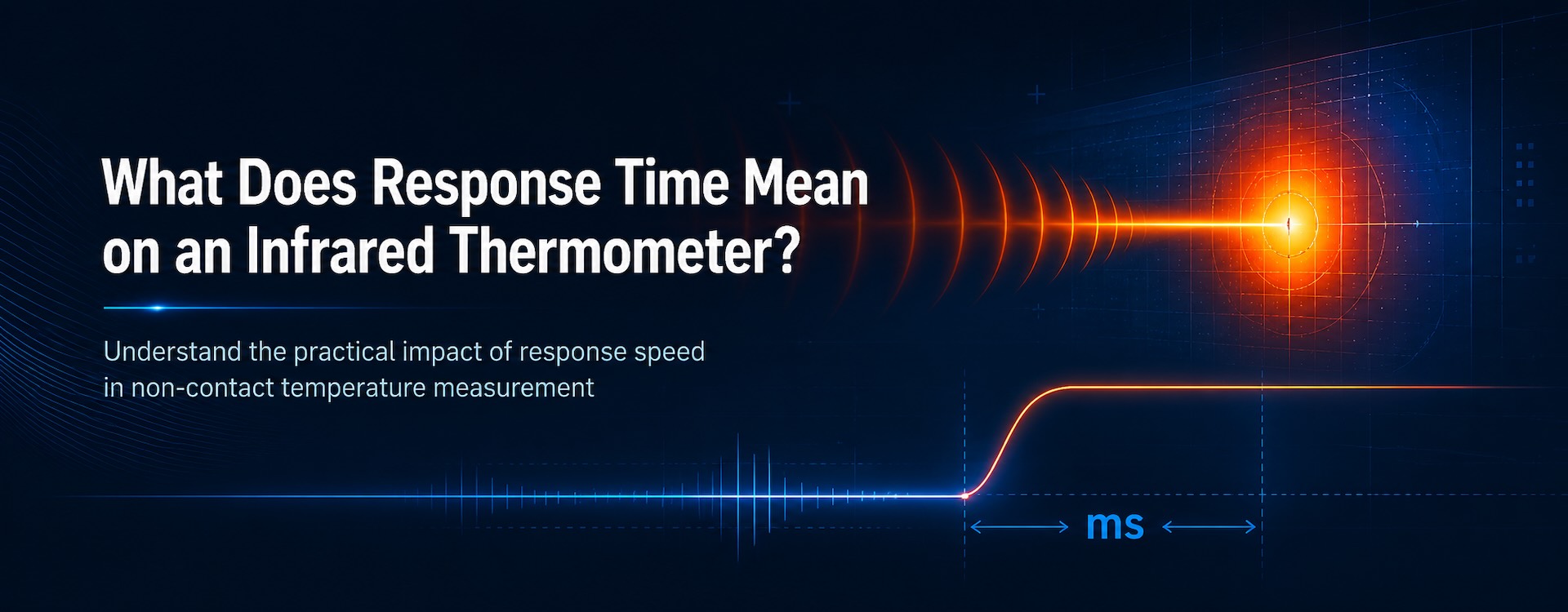
The response time of an infrared thermometer describes how quickly the instrument reacts after the target temperature changes. A shorter response time generally allows the thermometer to follow rapid temperature variations more effectively.
For slowly changing targets such as walls, pipes, HVAC components, or stationary machine surfaces, the difference between several hundred milliseconds and around one second may not be significant. For moving parts, production lines, rapidly heating components, or dynamic thermal processes, however, response time becomes much more important.
Key Points
● Infrared thermometer response time indicates how long the instrument takes to respond to a change in target temperature.
● Typical handheld infrared thermometers often have response times ranging from several hundred milliseconds to around one second, depending on the model.
● A shorter response time is advantageous when measuring rapidly moving targets or fast temperature changes.
● Response time is not the same as measurement accuracy. A faster instrument is not necessarily a more accurate one.
● Actual measurement performance also depends on target size, D:S ratio, emissivity, measuring distance, and environmental conditions.
● Response time should be selected according to the speed of temperature change and the actual application.
What Is Infrared Thermometer Response Time?
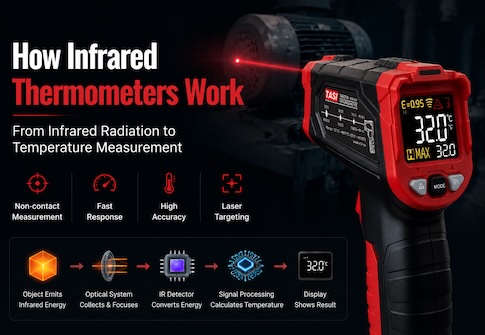
An infrared thermometer uses an optical system to collect infrared radiation emitted by a target surface. The detector converts this radiation into an electrical signal, which is then processed and converted into a temperature reading.
When the target temperature changes, the instrument cannot respond in absolutely zero time. A certain period is required for the detector and signal-processing system to react and for the displayed reading to reach the specified response level. This period is referred to as the response time.
For example, if an infrared thermometer has a specified response time of 500 ms, it can generally be understood as requiring approximately 0.5 seconds to achieve the specified degree of response after a significant change in target temperature.
Response-time definitions and test conditions can vary between manufacturers. When comparing instruments, the conditions stated in the product specifications should therefore also be considered.
What Do 500 ms and 1 s Mean?
ms stands for millisecond.
● 1000 ms = 1 second;
● 500 ms = 0.5 second;
● 250 ms = 0.25 second.
For example:
● Response Time ≤500 ms means the specified response occurs within approximately 0.5 second;
● Response Time <1 s means the response time is less than one second.
From a purely numerical perspective, 250 ms represents a faster response than 500 ms, and 500 ms is faster than 1 second.
However, response time alone should not be used to evaluate the overall performance of an infrared thermometer. Measurement range, accuracy, D:S ratio, emissivity adjustment, repeatability, and spectral response are also important specifications.
What Does Response Time Affect?
Response time mainly affects how effectively the infrared thermometer can track rapid temperature changes.
For a thermally stable target such as a building wall, air-conditioning outlet, pipe, or stationary machine housing, the operator can usually wait for the displayed reading to stabilize before recording the result.
The situation is different when the target changes quickly.
Examples include:
● Workpieces moving along a conveyor;
● Rotating shafts, rollers, or other moving components;
● Equipment heating rapidly over a short period;
● Components cooling quickly;
● Continuous inspection of multiple products on a production line;
● Searching for short-duration hot spots on equipment surfaces.
If the response time is too slow, the displayed value may lag behind the actual temperature change, making short-duration temperature events more difficult to detect.
Is a Shorter Response Time Always Better?
From the perspective of tracking rapidly changing temperatures, a shorter response time is generally beneficial. However, not every application requires the fastest possible response.
For routine inspection and industrial maintenance, where target temperatures change relatively slowly, a response time of around 500 ms or even somewhat longer may be entirely adequate.
In these applications, measurement accuracy, temperature range, and D:S ratio may be more important than achieving the shortest possible response time.
Short response times become particularly important when measuring fast-moving objects, dynamic production processes, or rapidly changing temperatures.
The appropriate principle is therefore not simply “the faster, the better,” but rather to select a response speed suited to the measurement task.
What Is the Difference Between Response Time and Accuracy?
Response time and measurement accuracy are separate performance parameters.
Response time describes how quickly the instrument reacts, while accuracy indicates how close the measured value is expected to be to the actual target temperature.
For example:
● Thermometer A: response time 250 ms;
● Thermometer B: response time 500 ms.
This information indicates only that Thermometer A responds faster. It does not demonstrate that Thermometer A is more accurate.
Even a very fast infrared thermometer can produce inaccurate readings if the emissivity is set incorrectly, the target does not fully fill the measurement spot, or the measuring distance is unsuitable.
Response time should therefore never be used as a substitute for an accuracy specification.
Why Can an Infrared Thermometer Not Display the True Temperature Instantly?
Although infrared temperature measurement is non-contact, several stages are involved in producing a reading.
Infrared radiation from the target first enters the optical system and is focused onto the detector. The detector converts the received radiation into an electrical signal. The instrument then performs signal amplification, compensation, analog-to-digital conversion, and temperature calculation before updating the display.
The detector itself also has inherent physical response characteristics.
As a result, a measurable time interval exists between a change in target temperature and the corresponding change in the displayed value. This is why response time is specified as a separate performance parameter.
What Factors Affect the Practical Response?
The specified response time is normally determined under defined test conditions. In actual use, the perceived response performance may also be influenced by other factors.
● Rate of temperature change: Faster-changing targets place greater demands on response speed.
● Target size: The target should sufficiently fill the measurement area. Otherwise, radiation from the surrounding background may influence the reading.
● D:S ratio: As measuring distance increases, the measurement spot becomes larger. If the spot exceeds the target size, surrounding surfaces may affect the result.
● Emissivity setting: Incorrect emissivity can cause measurement error, although this affects accuracy rather than response time itself.
● Surface condition: Highly reflective or low-emissivity surfaces can increase uncertainty in infrared measurements.
● Ambient temperature changes: If the instrument is moved rapidly between environments with substantially different temperatures, it should be allowed time to reach thermal equilibrium.
● Display update rate: Detector response time and display refresh rate are not necessarily identical, so the visible change on the screen may also depend on display design.
How Should Response Time Be Selected for Different Applications?
For routine industrial maintenance, HVAC inspection, building diagnostics, and equipment surface-temperature checks, target temperatures usually do not change dramatically within a few hundred milliseconds. Standard handheld infrared thermometer response times are therefore generally sufficient.
For production lines, moving workpieces, or rapidly changing thermal processes, response time deserves closer attention.
● General equipment maintenance: Extremely short response times are usually unnecessary. Measurement range, accuracy, and D:S ratio should receive greater priority.
● HVAC and building inspection: Temperature changes are generally gradual, so standard response times are typically sufficient.
● Rotating or moving components: Because the target may remain within the measurement area only briefly, a faster response is preferable.
● Continuous production-line inspection: Faster response helps the instrument track temperature differences between consecutive workpieces.
● Rapid heating or cooling processes: Response time should match the rate of temperature change. For demanding applications, continuous data logging or dedicated fixed infrared temperature sensors may be more appropriate.
How Can More Reliable Temperature Readings Be Obtained?
Even when an infrared thermometer has a fast response time, correct measurement technique remains essential.
First, ensure that the target is larger than the measurement spot at the selected distance. The D:S ratio defines the relationship between measuring distance and spot diameter. Excessive distance can cause the measurement area to include surrounding surfaces.
For thermally stable targets, aim the thermometer at the required area and allow the reading to stabilize before recording the value rather than relying only on the first number shown.
For rapidly changing targets, reduce the measuring distance where practical and keep the measurement spot completely within the target area to make full use of the instrument's response performance.
When searching for the hottest point on an equipment surface, scan the area gradually and, where available, use functions such as maximum-value hold.
FAQ
Is a 500 ms response time fast for an infrared thermometer?
For most handheld infrared thermometer applications, 500 ms is a common and practical response time. It is generally suitable for equipment maintenance, HVAC inspection, building diagnostics, and routine industrial temperature measurement. Faster-moving targets may require further evaluation.
Does a 500 ms response time mean the thermometer cannot display a temperature until 0.5 second has passed?
No. The display may update continuously. The 500 ms specification mainly describes the time required for the measurement system to reach a defined level of response after the target temperature changes.
Does a shorter response time mean higher accuracy?
No. Response time describes measurement speed, while accuracy describes measurement error. They are separate specifications.
Is response time important when measuring stationary objects?
If the target temperature is stable, response time is usually not the most critical specification. Accuracy, emissivity, D:S ratio, and measurement range are often more important.
Why is a faster response time useful for moving objects?
A moving target may remain within the effective measurement area for only a short time. If the response is too slow, the instrument may not fully capture the target temperature before it moves away.
Is response time the same as display refresh rate?
Not necessarily. Response time describes how quickly the measurement system reacts to temperature change, while display refresh rate describes how frequently the displayed value is updated.
Conclusion
Infrared thermometer response time indicates how long the measurement system requires to reach a specified level of response after detecting a change in infrared radiation from the target. It is commonly expressed in milliseconds or seconds; for example, 500 ms equals approximately 0.5 second.
For stationary targets with stable temperatures, response time is usually not the primary factor affecting measurement quality. For moving workpieces, rapidly changing temperatures, and continuous production processes, however, a shorter response time can improve the instrument's ability to follow temperature changes.
When selecting an infrared thermometer, response time should be evaluated together with measurement range, accuracy, D:S ratio, emissivity, and the characteristics of the target to ensure that the instrument is suitable for the intended application.