Introduction
An infrared thermometer measures temperature without physical contact by detecting infrared radiation emitted from the surface of an object. It is therefore easy to assume that as long as the instrument has a clear line of sight to the target, the measurement will be reliable.
In practice, the infrared radiation emitted by the target must travel through the atmosphere before reaching the detector. If the optical path contains significant amounts of steam, smoke, dust, mist, or other suspended materials, part of the infrared energy may be absorbed or scattered. These materials can also emit infrared radiation of their own.
As a result, clean air generally has little influence on short-range infrared measurements, whereas dense steam, smoke, dust, and long atmospheric paths can significantly affect measurement accuracy.
Key Points
● Clean, normal air usually has only a minor effect on short-range infrared thermometer measurements.
● Dense steam can absorb and scatter infrared radiation emitted by the target, resulting in measurement errors.
● Smoke, soot, and dust can reduce infrared transmission and may cause the detector to receive radiation from both the target and the suspended particles.
● The longer the measurement distance, the more relevant atmospheric humidity, gas absorption, and suspended particles can become.
● An infrared thermometer measures infrared radiation within its field of view; the laser pointer itself does not measure temperature.
● In environments containing steam, smoke, or dust, keep the measurement path as short and unobstructed as practical.
Why Can Air Affect Infrared Temperature Measurement?
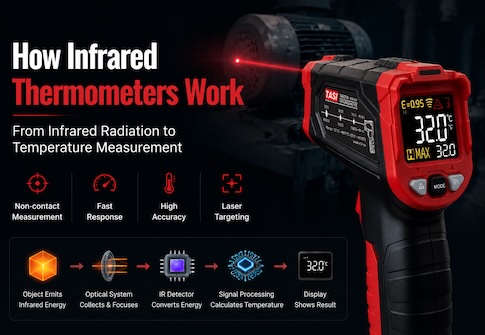
The basic measurement process of an infrared thermometer can be described as:
Target emits infrared radiation → radiation travels through the atmosphere → optical system collects the radiation → detector receives the energy → instrument calculates temperature.
The medium between the target and the instrument therefore forms part of the measurement path.
Under ideal conditions, most of the infrared radiation emitted by the target reaches the detector. In real environments, however, the atmosphere contains water vapor, carbon dioxide, and suspended particles. These substances absorb infrared radiation to different degrees depending on wavelength.
Many industrial infrared thermometers operate within atmospheric transmission windows, commonly in the long-wave infrared region, where normal air has relatively high transmission.
For typical indoor or short-distance measurements, atmospheric effects are therefore usually small. As the measurement path becomes longer, or as concentrations of water vapor, smoke, dust, or other materials increase, atmospheric influence becomes more important.
How Much Does Normal Air Affect Infrared Measurements?
For most handheld infrared thermometer applications, clean air over distances ranging from a few centimeters to several meters normally causes little measurable error.
Typical applications include measuring:
● Motor housings;
● Electrical cabinet components;
● HVAC pipes and ducts;
● Machine surfaces;
● Food packaging surfaces;
● Walls and floors.
In these situations, emissivity settings, target size, distance-to-spot ratio, reflected background radiation, and instrument accuracy are generally more important than the effect of clean air itself.
For measurements over tens of meters or more, however, absorption and scattering caused by atmospheric water vapor, carbon dioxide, aerosols, and particles may accumulate. This is why long-range infrared measurement systems require greater attention to atmospheric transmission.
Why Does Steam Affect Infrared Temperature Measurement?
Steam is a common source of interference in boiler rooms, food processing plants, piping systems, heat-treatment facilities, and chemical processes.
Water molecules absorb infrared radiation in specific wavelength bands. When a significant amount of water vapor exists between the target and the infrared thermometer, part of the radiation emitted from the target may be absorbed before reaching the detector.
Steam also has its own temperature and emits thermal radiation.
The detector may therefore receive a combination of:
● Attenuated radiation from the target;
● Thermal radiation emitted by the steam itself.
The resulting temperature can be either higher or lower than the actual target surface temperature. Steam does not always produce an artificially low reading.
For example:
● A hot target viewed through cooler steam may produce a lower indicated temperature.
● Hot steam or hot gases within the field of view may increase the infrared energy received by the detector.
● Rapid changes in steam density can cause unstable or fluctuating readings.
If a target is completely obscured by dense steam, a standard handheld infrared thermometer should generally not be relied upon for high-accuracy surface temperature measurement.
What Is the Difference Between Water Vapor, Steam, and Mist?
What appears visually as “white steam” is often not purely gaseous water vapor. It usually contains very small condensed water droplets.
Water vapor itself is normally invisible. The visible white cloud commonly observed around steam systems is largely made up of condensed droplets.
These droplets can cause additional scattering and obstruction of infrared radiation.
For practical infrared thermometry, dense visible steam, mist, and condensation clouds are therefore usually more problematic than ordinary humid air.
If the target is difficult to see clearly through the mist, the infrared measurement should also be treated with greater caution.
How Does Smoke Affect Infrared Measurements?
Smoke is typically a mixture of gases and suspended solid or liquid particles, including soot, combustion products, oil droplets, and dust.
When infrared radiation passes through smoke:
● Part of the radiation may be absorbed by smoke particles;
● Part may be scattered away from the detector;
● Hot smoke and combustion gases may emit infrared radiation;
● Dense smoke may partially or completely obscure the target.
The effect generally becomes more significant as smoke density and optical path length increase.
When measuring furnaces, exhaust ducts, combustion equipment, or similar processes, the detector may receive a combined signal from the target, smoke, gases, and suspended particles rather than radiation from the target surface alone.
For this reason, temperature readings obtained through dense smoke should not automatically be interpreted as the true surface temperature of the object behind it.
Can Dust Affect Infrared Temperature Measurement?
Yes.
In cement plants, mining operations, woodworking, metal processing, and other dusty environments, suspended particles can absorb or scatter infrared radiation.
Low concentrations of dust may have little practical effect. However, a dense dust cloud between the instrument and the target can increase measurement uncertainty.
Dust also creates another important problem: contamination of the infrared optical window or lens.
Dust, oil, moisture, or condensation deposited on the optical surface reduces the amount of infrared energy entering the instrument. This can continue to affect measurements even after the instrument is moved into clean air.
Infrared optics should therefore be inspected and cleaned in accordance with the manufacturer's instructions when instruments are used in dusty or contaminated environments.
Does Air Temperature Affect Infrared Readings?
Two different effects should be considered.
The first is the temperature of the air between the target and the instrument. For normal short-range measurements, air does not normally behave like a solid target surface. However, hot gases, long atmospheric paths, or gases with significant infrared absorption can influence the detected signal.
The second effect is the ambient temperature of the infrared thermometer itself.
If an instrument is moved rapidly from a cold environment into a warm area, or from a hot environment into a cooler one, its optics and electronics may need time to reach thermal equilibrium. Measurements taken before stabilization may show temporary errors.
For example, an infrared thermometer brought directly from a cold outdoor environment into a warm production area may not immediately provide its best measurement accuracy.
Always operate the instrument within its specified environmental conditions and allow sufficient stabilization time after significant temperature changes.
Why Does Measurement Distance Increase Atmospheric Effects?
The influence of air, steam, and smoke depends strongly on optical path length.
If the target is only 20 cm from the instrument, infrared radiation passes through a very short atmospheric path. Even with moderate humidity, attenuation is normally limited.
At distances of 5 m, 20 m, or more, the radiation passes through substantially more atmosphere, increasing the opportunity for absorption, scattering, and additional radiation from the intervening medium.
In general:
Shorter path → lower atmospheric influence;
Longer path → greater importance of atmospheric transmission.
Increasing distance also creates another common measurement issue: a larger measurement spot.
An infrared thermometer has a specified distance-to-spot ratio, or D:S ratio. As the measurement distance increases, the measured area becomes larger. If the target does not fully fill the measurement spot, radiation from the surrounding background will also contribute to the reading.
Consequently, errors in long-distance infrared measurement are not always caused by the atmosphere alone. Target size and spot size must also be considered.
Can the Laser Pointer Indicate Whether Smoke Is Affecting the Measurement?
No.
The laser on an infrared thermometer is primarily an aiming aid. It does not detect or measure temperature.
Even if the visible laser beam passes through smoke and reaches the target, this does not mean that the infrared radiation emitted by the target reaches the detector without attenuation.
Visible laser light and the infrared wavelength range used for temperature measurement have different transmission characteristics.
Therefore, seeing the laser spot on the target is not proof that the infrared temperature reading is accurate.
How Can Errors Caused by Steam and Smoke Be Reduced?
Several practical measures can improve measurement reliability:
● Keep the measurement distance as short as practical while respecting the instrument's D:S ratio.
● Select a measurement position with the lowest possible concentration of steam, smoke, or dust.
● If steam or smoke is intermittent, measure during a period when the optical path is temporarily clear.
● Ensure the target completely fills the instrument's measurement spot.
● Set the correct emissivity for the target surface.
● Inspect the infrared optics for dust, oil, moisture, or condensation.
● Allow the instrument to stabilize after major changes in ambient temperature.
● For critical process temperatures, cross-check infrared measurements with a thermocouple, contact thermometer, or another appropriate method.
If the target remains continuously obscured by dense steam or smoke, a standard handheld infrared thermometer may not provide a sufficiently reliable indication of the true surface temperature.
Which Applications Require Special Attention?
Atmospheric effects are particularly important in:
● Boilers and steam piping: Dense steam may be present between the instrument and target.
● Food processing: Cooking, sterilization, and heating processes can produce high humidity, steam, and mist.
● Industrial furnaces and combustion systems: Smoke, combustion gases, and hot particles may affect infrared transmission.
● Welding and metal processing: Fumes and suspended particles may enter the measurement path.
● Cement, mining, and woodworking: High dust concentrations can affect transmission and contaminate the optics.
● Long-range outdoor measurements: Humidity, fog, aerosols, and long atmospheric paths can increase measurement uncertainty.
In such applications, the rated accuracy of the infrared thermometer is only one part of the overall measurement uncertainty. Environmental conditions must also be evaluated.
FAQ
Can normal air make an infrared thermometer inaccurate?
For normal short-range measurements in clean air, the effect is generally very small. Atmospheric effects become more important over long distances or in high humidity and contaminated air.
Can an infrared thermometer measure through steam?
Small amounts of steam may have limited influence, but dense steam or mist can cause substantial errors. A reading obtained through heavy steam should not automatically be treated as the true surface temperature.
Does smoke make infrared readings higher or lower?
Either is possible. The result depends on target temperature, smoke temperature, particle concentration, wavelength, and measurement distance.
Why can I still see the laser spot through smoke when the temperature reading is inaccurate?
Because the laser is only an aiming aid. The instrument measures infrared radiation, which may be absorbed or scattered differently from visible laser light.
Does high humidity affect infrared temperature measurement?
The effect is usually small over short distances, but it may become more significant at very high humidity, over long paths, or when visible mist is present.
Can a standard infrared thermometer directly measure air or steam temperature?
Generally no. Standard infrared thermometers are designed primarily for surface temperature measurement. Gas temperature measurement usually requires specialized instruments designed for specific gas absorption bands.
Can condensation on the lens affect measurement accuracy?
Yes. Moisture, dust, oil, or other contamination on the infrared optical window can reduce infrared transmission and introduce measurement errors.
Conclusion
Air, steam, and smoke can affect infrared temperature measurement, although the magnitude of the effect varies considerably with the measurement conditions.
Clean air normally has little influence over short distances. Dense steam, mist, smoke, soot, and dust can absorb, scatter, or add infrared radiation to the measurement path, resulting in readings that differ from the true target surface temperature.
The longer the measurement path and the higher the concentration of interfering materials, the more important these effects become.
For reliable infrared thermometry in industrial environments, maintain the clearest possible optical path, minimize measurement distance, use the correct emissivity setting, keep the optics clean, and verify critical measurements using an appropriate contact method when necessary.
Understanding how infrared radiation travels through the atmosphere is an important part of evaluating measurement reliability and improving infrared temperature measurement accuracy.