Introduction
Infrared thermometers determine surface temperature by detecting infrared radiation emitted by an object, allowing measurements to be taken without physical contact. However, this does not mean that the surrounding environment has no influence on the measurement.
If an infrared thermometer is moved directly from a cold location into a warm workshop, or if the measurement area is exposed to strong airflow, intense heat sources, or rapidly changing ambient temperatures, the infrared detector, optics, and internal temperature-compensation system may not yet be in thermal equilibrium.
During this transition period, repeated measurements of the same target may drift or vary until the instrument stabilizes.
For applications requiring good repeatability and measurement accuracy, reasonably stable environmental conditions are therefore important.
Key Points
● The temperature of the infrared thermometer itself can influence measurement stability.
● Rapid ambient temperature changes can temporarily affect internal temperature compensation.
● Strong airflow, nearby high-temperature equipment, and direct sunlight can increase measurement uncertainty.
● After moving the instrument between environments with a significant temperature difference, allow sufficient acclimation time.
● A stable environment does not require perfectly constant temperature; the objective is to avoid sudden and substantial environmental changes during measurement.
Why Can Environmental Changes Affect Infrared Measurement?
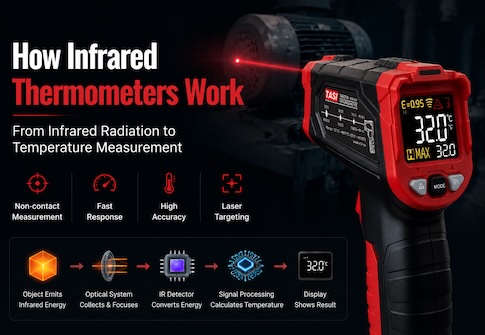
An infrared thermometer does more than simply detect infrared radiation and display a temperature value. Its internal system typically includes an infrared detector, optical components, an ambient temperature sensor, and compensation electronics.
The instrument calculates the target temperature using both the detected infrared energy and information about its own internal thermal condition.
When ambient temperature changes rapidly, the housing, optical system, internal electronics, and infrared detector may not all change temperature at the same rate. The instrument can therefore remain temporarily out of thermal equilibrium.
For example, an infrared thermometer stored for an extended period in a cold vehicle may still be cold when it is brought into a warm production area. Although the surrounding air has changed immediately, the internal components require time to reach a new equilibrium.
During this period, some measurement drift may occur.
How Do Rapid Ambient Temperature Changes Affect Measurement?
Most infrared thermometers include ambient temperature compensation and are designed to operate correctly within a specified operating temperature range. Normal variations in ambient temperature therefore do not automatically prevent accurate measurement.
The main concern is a substantial temperature change occurring over a short period.
Typical situations include:
● Moving directly from an air-conditioned room into a hot outdoor environment;
● Bringing the instrument from a cold outdoor area into a heated workshop;
● Moving from a refrigerated storage area into a high-temperature production zone;
● Taking the instrument from a vehicle and measuring immediately;
● Frequently moving between high-temperature equipment and normal ambient conditions.
In these situations, the instrument should be allowed to acclimate before measurements requiring high accuracy are taken.
Can Strong Airflow Affect the Measurement?
Airflow does not normally alter the fundamental principle of infrared measurement. However, strong airflow can indirectly influence the result by changing the temperature of the target surface or the instrument itself.
For example, near HVAC outlets, industrial fans, or high-velocity air streams, continuous airflow may cool or heat the surface being measured.
The infrared thermometer may still be correctly measuring the actual surface temperature, but that temperature represents the surface under current airflow conditions. It may not represent the internal temperature of the equipment or the temperature that would exist without the airflow.
If hot or cold air is continuously directed at the thermometer itself, the instrument body may also change temperature more rapidly, increasing the time required for the readings to stabilize.
Why Should Nearby High-Temperature Heat Sources Be Considered?
Industrial environments often contain furnaces, heaters, hot pipes, engines, and other equipment that produces significant thermal radiation.
If an infrared thermometer remains close to these heat sources for an extended period, its housing, optics, and internal components may gradually warm.
In addition, shiny or low-emissivity surfaces can reflect infrared radiation from surrounding hot objects, causing the displayed temperature to be higher than the target's actual surface temperature.
When measuring in high-temperature environments:
● Avoid prolonged direct exposure of the instrument to intense thermal radiation;
● Prevent strong heat sources or direct sunlight from shining directly onto the optics;
● Consider reflected infrared radiation when measuring metallic or other low-emissivity surfaces;
● Measure from a reasonably stable position whenever possible;
● Repeat important measurements to confirm consistency.
Can Direct Sunlight Affect Infrared Temperature Measurement?
Sunlight is an important environmental factor in outdoor infrared temperature measurement.
Solar radiation can directly heat the target surface. As a result, the measured surface temperature may be substantially higher than the temperature of the same object under shaded conditions.
In this situation, the infrared thermometer is not necessarily producing an incorrect result. The actual surface temperature has changed because of solar heating.
Direct sunlight on the thermometer body or optical system can also gradually raise the instrument's temperature.
When comparing temperatures between different objects or at different times, measurements should therefore be made under similar lighting and environmental conditions whenever possible.
How Long Should an Infrared Thermometer Acclimate?
There is no single acclimation time that applies to every infrared thermometer or every measurement situation.
The required time depends primarily on:
● The temperature difference between the previous and current environments;
● The instrument's construction and thermal mass;
● The presence of strong airflow or thermal radiation;
● The manufacturer's specified acclimation or operating requirements.
If the thermometer is already being used under normal operating conditions and ambient temperature changes are small, a dedicated waiting period is usually unnecessary.
However, after a significant temperature transition, the instrument should be left in the new environment until its temperature stabilizes.
For measurements requiring higher accuracy, always follow the acclimation and environmental requirements specified by the manufacturer.
How Can You Tell Whether the Instrument Has Stabilized?
Repeated measurements can provide a simple practical indication.
Select a target with a relatively stable temperature and consistent surface condition. Keep the measurement distance, target area, aiming position, and emissivity setting unchanged while taking several consecutive readings.
If the readings initially drift and then gradually become consistent, the instrument may have been adapting to the new ambient conditions.
If substantial variation continues, check whether:
● The target temperature itself is changing;
● The measurement distance is consistent;
● The target fully covers the instrument's measurement spot;
● The emissivity setting is appropriate;
● The surface is highly reflective;
● The optics are contaminated by dust, oil, or condensation;
● Strong heat sources or airflow are present.
Which Applications Require More Stable Environmental Conditions?
Not every infrared measurement requires tightly controlled environmental conditions. For routine equipment inspections, consistent measurement technique within the specified operating conditions is usually sufficient.
Environmental stability becomes more important when:
● Monitoring temperature trends on the same equipment over time;
● Comparing small temperature differences between similar components;
● Performing laboratory or quality-control measurements;
● Measuring industrial processes where repeatability is important;
● Working across cold, hot, indoor, or outdoor environments with significant temperature differences;
● Evaluating temperature differences of only a few degrees or less.
In these applications, consistency of environment, distance, angle, emissivity, and instrument condition is often more important than obtaining a single rapid temperature reading.
FAQ
Does an infrared thermometer have to be used in a temperature-controlled room?
No. Most infrared thermometers are designed to operate within a specified ambient temperature range. A stable environment mainly means avoiding sudden and significant temperature changes rather than maintaining perfectly constant room temperature.
Can I measure immediately after bringing the thermometer indoors from outside?
If the temperature difference is small, the effect may be negligible. If the difference is substantial, particularly in winter or high-temperature environments, allow the instrument to acclimate before taking measurements that require higher accuracy.
Does an unstable environment always cause incorrect readings?
No. The effect depends on the magnitude and rate of the environmental change, the instrument design, and the required measurement accuracy. Routine inspections may show little noticeable effect, while precision or repeatability measurements are more sensitive.
Why does the temperature reading gradually change when measuring the same object repeatedly?
The target temperature may actually be changing, or the infrared thermometer may still be adapting to the ambient environment. Measurement distance, emissivity, spot size, and reflected radiation should also be checked before assuming an instrument fault.
Can an infrared thermometer be used in a high-temperature workshop?
Yes, provided the ambient conditions remain within the instrument's specified operating range. Avoid prolonged exposure to intense thermal radiation, and pay particular attention to reflected radiation when measuring low-emissivity surfaces.
Conclusion
Infrared thermometers benefit from reasonably stable environmental conditions because rapid environmental changes can affect the instrument's thermal equilibrium, internal compensation system, and the actual surface temperature of the target.
Normal industrial measurement does not require strict room-temperature control. However, when the instrument moves between environments with substantial temperature differences, when strong airflow or thermal radiation is present, or when high repeatability is required, sufficient acclimation time and consistent measurement conditions become important.
Reliable infrared temperature measurement depends on a combination of stable conditions, correct emissivity, appropriate measurement distance, and consistent measurement technique.