Introduction
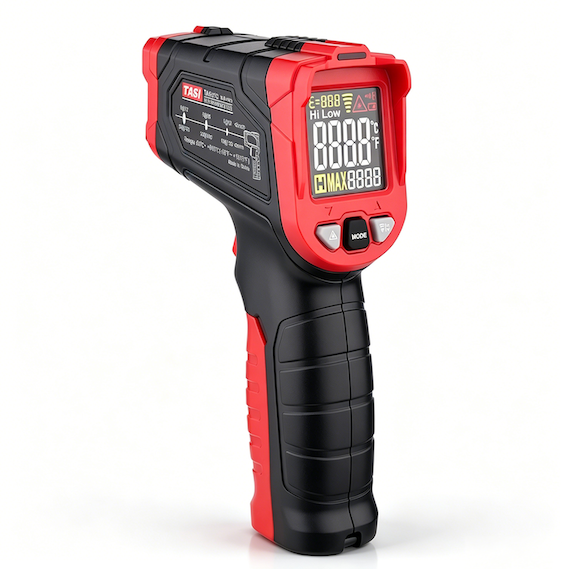
A common question when using an infrared thermometer is whether it can measure the temperature of an object through glass or transparent plastic.
The answer is generally: visible transparency does not necessarily mean infrared transparency.
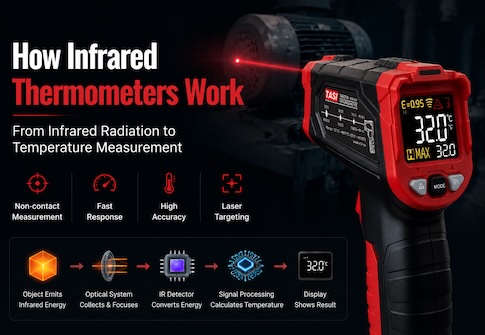
An infrared thermometer does not measure temperature by visually “seeing” an object. Instead, it detects infrared radiation emitted from the target surface. A material that appears transparent to the human eye may be partially or completely opaque within the wavelength range used by the thermometer.
For this reason, measurements involving glass, transparent plastics, films, or transparent containers require careful consideration of infrared transmission, emissivity, and reflection.
Key Takeaways
● Infrared thermometers detect infrared radiation emitted from a surface rather than visible light.
● A material that is transparent in the visible spectrum may not be transparent in the infrared spectrum.
● Standard handheld infrared thermometers generally cannot measure the temperature of an object through ordinary glass.
● Measurements through transparent plastics depend on material type, thickness, and infrared transmittance.
● If the actual target is located behind a transparent barrier, another measurement method may be required.
Why Does Visible Transparency Not Mean Infrared Transparency?
The human eye detects only the visible portion of the electromagnetic spectrum, while infrared thermometers operate at much longer wavelengths.
Many industrial handheld infrared thermometers, for example, operate approximately within the 8–14 μm long-wave infrared range. Ordinary glass is generally not transparent within this spectral band in the same way that it is transparent to visible light.
As a result, even though an operator can clearly see equipment through a glass window, the infrared thermometer may primarily detect infrared radiation emitted by the glass itself.
In practical terms:
● The human eye sees the object behind the glass.
● The infrared thermometer may measure the glass surface.
This distinction is one of the most important factors when measuring through transparent materials.
Can an Infrared Thermometer Measure Glass?
Yes. An infrared thermometer can measure the surface temperature of glass, but it generally cannot measure the temperature of an object behind ordinary glass.
For example, when an infrared thermometer is pointed through a window toward an outdoor object, the displayed temperature will usually represent the window surface rather than the building or object outside.
The same principle applies to machinery with glass inspection windows. A temperature reading taken through ordinary glass should not automatically be interpreted as the temperature of an internal component.
If the target behind the glass must be measured, use an unobstructed measurement position whenever possible or select another temperature measurement method suitable for the application.
Can Transparent Plastic Be Measured?
Transparent plastics are more complex because their infrared properties vary considerably.
Infrared transmittance depends on factors such as:
● Material composition.
● Thickness.
● Surface treatment.
● Colour or additives.
● Measurement wavelength.
A relatively thick transparent plastic panel will often behave as an infrared surface and the thermometer will mainly measure the panel itself.
Some thin plastic films, however, may transmit part of the infrared radiation from an object behind them. In such cases, the thermometer may receive a combination of radiation emitted by the film and radiation transmitted from the background target, which can produce inaccurate or unstable readings.
Unless the infrared spectral properties of the material are known, a standard infrared thermometer should not be relied on for measurements through transparent plastic.
Can Liquid Temperature Be Measured Through a Transparent Container?
Usually, the displayed value should not be treated as the actual internal liquid temperature.
When hot liquid is contained in a glass vessel, transparent bottle, or plastic container, an infrared thermometer normally measures the external surface temperature of the container.
If the container wall and the liquid have reached a stable thermal equilibrium, the surface temperature may be reasonably close to the liquid temperature and can sometimes provide a useful reference.
However, significant differences may occur when:
● The liquid temperature is changing rapidly.
● The container wall is thick.
● The container material has low thermal conductivity.
● The external surface is exposed to a different ambient temperature.
For accurate measurement of internal liquid temperature, a thermocouple, temperature probe, or other suitable contact sensor is generally more appropriate.
Why Can Transparent Materials Cause Measurement Errors?
Three main infrared effects must be considered.
● Transmission: Some infrared radiation from an object behind the material may pass through it.
● Reflection: The surface may reflect infrared radiation from surrounding machinery, walls, lighting systems, or other heat sources.
● Emission: The transparent material itself emits infrared radiation according to its temperature and emissivity.
The infrared thermometer may receive a combination of these components. As a result, the displayed value may not represent the true surface temperature of a single target.
Professional infrared temperature measurement therefore requires consideration not only of distance and measurement range, but also of emissivity, infrared transmittance, and reflective properties.
How Should Transparent Materials Be Measured Correctly?
If the objective is to measure the surface temperature of the transparent material itself, normal infrared measurement principles can be applied.
● Ensure the target area is larger than the thermometer's measurement spot.
● Set an appropriate emissivity value when the instrument allows adjustment.
● Avoid strong reflections from sunlight, hot machinery, heaters, or other surrounding heat sources.
● When measuring glass, understand that the reading normally represents the glass surface rather than the object behind it.
● Where practical, a high-emissivity tape or coating with known emissivity can be applied to the surface. Allow it to reach thermal equilibrium before taking the measurement.
If the actual target is located behind the transparent material, it is preferable to remove the obstruction, use a direct line of sight, or select a contact sensor or infrared measurement system specifically designed for the material and wavelength involved.
Common Measurement Mistakes
● Measuring outdoor objects through a window: The reading is usually dominated by the window surface temperature.
● Measuring internal equipment through a glass inspection window: Ordinary glass does not normally provide a valid direct measurement of the internal component.
● Measuring products through a transparent plastic bag: The film may transmit, absorb, and reflect infrared radiation, affecting the result.
● Measuring liquid through a transparent bottle: The thermometer generally measures the bottle surface rather than the liquid itself.
● Judging infrared transparency by appearance: Visible transparency does not indicate infrared transmittance.
FAQ
Can an infrared thermometer measure through glass?
Usually not. Standard handheld infrared thermometers mainly detect infrared radiation emitted by the glass itself, so the reading normally represents the glass surface temperature rather than the object behind it.
Why can I see an object through glass but cannot measure its temperature accurately?
The human eye detects visible light, while an infrared thermometer detects infrared radiation within a specific wavelength range. Glass can be transparent to visible light while being opaque to the infrared wavelengths used by the thermometer.
Can an infrared thermometer measure transparent plastic?
It can measure the surface temperature of transparent plastic. Whether radiation from an object behind the plastic can pass through depends on the material type, thickness, and infrared transmission characteristics. Measurements through unknown plastic materials should not be assumed to be accurate.
Can I measure hot water through a glass container?
The reading will mainly represent the temperature of the glass surface. If the container and liquid are in thermal equilibrium, the value may be close to the liquid temperature, but it should not be treated as an accurate internal liquid measurement.
How can measurement accuracy be improved when measuring transparent materials?
First determine whether the intended target is the transparent material itself or an object behind it. Consider emissivity, infrared transmission, and reflections. For higher accuracy, verify the measurement using a suitable contact temperature sensor.
Conclusion
Whether an infrared thermometer can measure a transparent object cannot be determined simply by how transparent the material appears to the human eye.
For most standard handheld infrared thermometers, ordinary glass behaves as a measurable infrared surface. The thermometer therefore measures the glass rather than the object behind it. Transparent plastics require further evaluation because their infrared transmission properties vary with material composition and thickness.
Before taking a measurement, clearly identify whether the target is the transparent surface itself or an object located behind it. When a transparent barrier prevents a reliable infrared measurement, use an unobstructed measurement position or a more suitable contact or specialized infrared measurement method.